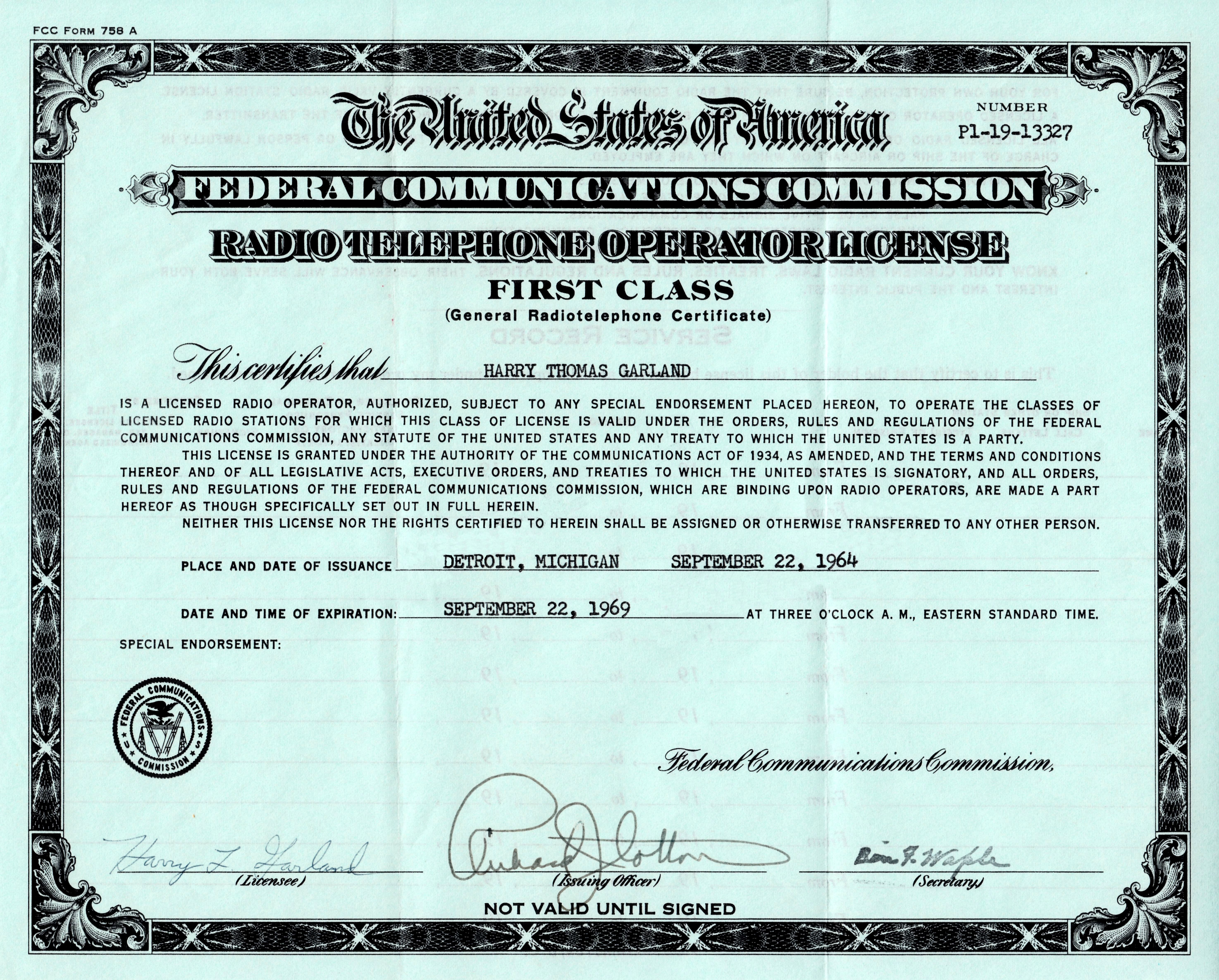
It wasn't enough to have someone watching the transmitter: for most of broadcasting's history, that someone had to hold the Radio Telephone Operator License, First Class, universally known as the "First Phone." It was the top of a three-tier ladder, and for decades it was the single most valuable piece of paper a broadcast engineer could own.
The ladder. The commercial radiotelephone licenses came in three grades, each a prerequisite for the next:
Class
What it allowed
Third Class
Operate a transmitter by simple on/off: the classic holder was a police dispatcher keying a base station. Could not install or service transmitting equipment.
Second Class
Install and service communications-grade transmitters and certain safety equipment.
First Class ("First Phone")
Operate and maintain broadcast transmitters, the highest and most complex tier. Required to sit for it: you first had to pass the Third and Second exams.
Table 15.12-1
The exam everyone remembers. The First Phone was earned by written examination covering electronics theory, radio law, and transmitter practice, and it had a reputation as a genuine gauntlet, the ticket that separated the professionals from the hobbyists. For a generation of engineers (and a great many radio amateurs looking to turn the hobby into a paycheck), passing the First was a rite of passage and the key that opened the door to a full-time job in broadcasting. A station's transmitter site often displayed a "license wall": the operators' soft-blue First Phone tickets framed and arranged by seniority beneath the station's own license.
Required, then not. Before 1963, every broadcast station had to be operated and maintained only by First Phone holders, no exceptions, regardless of power or mode. The requirement then eroded in stages. In 1963 the FCC let FM stations and non-directional AM stations of 10 kW or less be run by a lesser grade, including a hybrid "broadcast-endorsed Third Class" permit that allowed an operator to turn the transmitter on and off, keep the log, and adjust power, but not to maintain the transmitter. The high-power and directional stations held out longest, but in 1973 that last requirement fell too: from then on, all classes of broadcast station could be operated by a broadcast-endorsed Third, with a designated Chief Operator holding overall technical responsibility. 1973 was the last year a First Phone was required to run any U.S. broadcast station.
The end of the ticket. Deregulation finished the job. On January 5, 1979, the FCC dropped the Third Class requirement entirely and let holders of a mail-in Restricted Radiotelephone Permit operate transmitters of nearly all classes and powers. Then, on August 7, 1981, the Commission abolished the numbered license grades altogether and stopped issuing First and Second Class licenses, folding their authority into a single new credential, the General Radiotelephone Operator License (GROL), which survives today, required mainly for non-broadcast work like aviation and maritime gear. The First Phone was never required for broadcasting again, and after 1981 it could no longer even be earned. The license walls came down, and the proud blue tickets became collector's items.
Sources: Radio World ("The Demise of the First Phone," Charles "Buc" Fitch) · oldradio.com Broadcast Archive (U.S. broadcast regulation history) · FCC (Commercial Radio Operator License Program; General Radiotelephone Operator License) · Wikipedia (General radiotelephone operator license).
The ticket itself. A genuine First Class Radiotelephone Operator License from 1964, the "First Phone" of the story title. A wallet-sized government certificate, earned through the three-exam ladder (Third, then Second, then First), and for decades the legally required credential to be the chief engineer of a broadcast station or to lay hands on a television transmitter. Many an engineer's career began the day this piece of paper arrived in the mail, and ended its run of usefulness in 1983, when the FCC stopped testing for it and folded the survivors into the lifetime GROL. Photo: Wikimedia Commons, user GarlandFamily, CC BY-SA 4.0.