

This is a collection of notable, unusual, and record-setting trivia associated with the AM Broadcast Band for the USA and North America. I'm in no way claiming authorship of any of it — I built this compilation as a way to learn more about the things that interest me most about AM radio. I've been keeping notes for years and finally got the chance to pull them together. It's a noncommercial hobby project of mine, gathered from public sources and shared freely for anyone who loves AM radio.
Put this whole page to the test — 264 multiple-choice questions, every one drawn from the facts below.
Take the AM Trivia Challenge →Thirty-one quick facts about the AM band — most jump to the section with the full story.
| Trivia Category | Call | Dir | City, State | kHz | Day Power | Day Towers | Night Power | Night Towers |
|---|---|---|---|---|---|---|---|---|
| Oldest station, still on the air since October 7, 1921 | KDKA | ND1 | Pittsburgh, PA | 1020 | 50 KW | 1 | 50 KW | 1 |
| Most powerful daytime signal, 3545.89 mV/m @ 50KW Ground Conductivity = 15, only FCC-certified Franklin Antenna in the USA. ERP 100–400 KW from 50 KW transmitter. | KFBK | DA2 | Sacramento, CA | 1530 | 50 KW | 2 | 50 KW | 2 |
| Highest directional RMS field strength 3,934.90 mV/m @ 1 km — exceeds KFBK's 3,545.89 non-directional record. (WWJ's single-lobe nighttime peak of 7,980 mV/m is higher still.) | WWL | DA2 | New Orleans, LA | 870 | 50 KW | 50 KW | ||
| Smallest nighttime power drop | KEIB | DA2 | Los Angeles, CA | 1150 | 50 KW | 5 | 44 KW | 5 |
| Lowest nighttime power drop (8%) | WFLF | DA2 | Pine Hills, FL | 540 | 50 KW | 6 | 46 KW (92% of daytime) | 6 |
| Daytime only, Tallest electrical length tower | KUAZ | NDD | Tucson, AZ | 1550 | 50 KW | 1 @ 215.6° | CP | |
| Daytime only, shortest electrical length tower Array | WCEO | DAD | Columbia, SC | 840 | 50 KW | 3 @ 87.30° | ||
| Daytime only, Top Loaded Tower Array — 4 towers | WDRU | DAD | Creedmoor, NC | 1030 | 50 KW | 4 @ Top Loaded | ||
| Daytime only, Top Loaded Tower Array — 2 towers | WYMM | DAD | Jacksonville, FL | 1530 | 50 KW | 2 @ Top Loaded | ||
| Daytime Non-Directional with lowest nighttime power | WMQM | NDD | Lakeland, TN | 1200 | 50 KW | 1 | 0.035 KW (0.0007 of daytime) | 1 |
| Daytime & Lowest Critical Hours power | WPBS | NDD | Atlanta, GA | 850 | 50 KW / 5.5 KW | 1 | ||
| Daytime & Highest Critical Hours Power | WXKG | NDD | Atlanta, GA | 1010 | 50 KW / 45 KW | 1 | 0.078 KW | 1 |
| Most nighttime towers — 12 Separate day/night transmitter sites. 12-tower array is ½ mile long, two rows 200 ft apart. Resembles a runway — a plane once tried to land there. Built 1968 to protect WOWO Fort Wayne. | KFXR | DA2 | Dallas, TX | 1190 | 50 KW | 4 (Irving) | 5 KW | 12 (Rockwall) |
| Most daytime towers — 11 More total feet of steel (4,551 ft) than any other AM site anywhere. | KNTH | DA2 | Houston, TX | 1070 | 10 KW | 11 | 5 KW | 9 |
| Largest nighttime power increase — 45 KW (900% over daytime, 10×) | KGB | DAN | San Diego, CA | 760 | 5 KW | 1 | 50 KW | 3 |
| Class A station running higher power at night 35 KW day / 42 KW night per FCC records. Often incorrectly listed as 50/50. | WBBM | DA | Chicago, IL | 780 | 35 KW | 42 KW | ||
| Most stations running higher night power | 73 US AM stations run higher power at night than during the day. WLAN-1390 Lancaster, PA has the largest ratio: 61.1× more power at night. | |||||||
| Tallest Blaw-Knox Tower in operation, 808 ft | WSM | ND1 | Nashville, TN | 650 | 50 KW | 1 | 50 KW | 1 |
| Tallest Sectionalized Tower — center-fed "shortened Franklin," lower section 120° of 300° total (see Antenna Oddities) 227.3 meters / 745.7 feet | WHO | ND1 | Des Moines, IA | 1040 | 50 KW | 1 | 50 KW | 1 |
| Tallest Tower in Electrical Height (without top loading) 193.50° | KNX | ND1 | Los Angeles, CA | 1070 | 50 KW | 1 | 50 KW | 1 |
| Tallest Tower Array in Electrical Height (without top loading) 4 @ 178.3° | KMJ | DA1 | Fresno, CA | 580 | 50 KW | 4 | 50 KW | 4 |
| Shortest Daytime Electrical Length Tower, 50 KW | KTRB | DAN | San Francisco, CA | 860 | 50 KW | 1 @ 63.4° | 6 KW | 4 @ 63.4° |
Radio in America wasn't founded by hobbyists in garages. It was founded by four of the largest industrial corporations on earth — and each put a flagship station on the air not to entertain, but to prove out its own equipment.
By the early 1920s, broadcasting was being invented in four corporate laboratories at once. General Electric, Westinghouse, and the American Telephone & Telegraph Company were electrical-manufacturing titans; the fourth, the Radio Corporation of America, was the creature they built together. Each ran a pioneer station that doubled as a testbed — GE's WGY in Schenectady, Westinghouse's KDKA in Pittsburgh, RCA's WJZ in New York, and AT&T's WEAF, also in New York. Four companies, four flagship "laboratory" stations, one industry taking shape.
The patent pool. They ended up in the same business because of patents. No single company owned enough of them to build a complete radio system without infringing someone else's, so the companies pooled them. In 1919 GE formed RCA to buy up the American assets of British-owned Marconi; over 1920 and 1921, GE, RCA, Westinghouse, AT&T — and, less famously, the United Fruit Company — signed a web of cross-licensing agreements that carved the young industry into spheres. RCA was, in effect, a jointly owned patent trust.
Two camps. The pool split into rivals. On one side, the "Radio Group" — RCA, GE, and Westinghouse — whose stations included WGY, WJZ, KDKA, KOA, and KGO. On the other, AT&T's "Telephone Group," built around WEAF. AT&T held two decisive advantages: it claimed the sole right to sell airtime — it called paid advertising "toll broadcasting" and invented it at WEAF in 1922 — and it owned the long-distance telephone lines. When the Radio Group tried to link its own stations into a network, AT&T refused it those lines, forcing it onto inferior telegraph wires. It was a lopsided fight.
The truce that made NBC. It ended in 1926. After years of disputes and a federal arbitration, AT&T settled with the Radio Group, sold WEAF to RCA for a reported $1 million, and walked away from broadcasting to concentrate on the telephone business — keeping, crucially, its monopoly on the network lines everyone else would now have to lease. RCA took WEAF, combined it with WJZ, and launched a new company to run them both: the National Broadcasting Company, on the air in November 1926. NBC ran two networks — the Red, built on WEAF, and the Blue, built on WJZ — and dominated American radio for a generation.
So the medium that would define the twentieth century was assembled by four corporations that each thought of a radio station as an experiment: a way to sell equipment, to test transmitters, or to extend a telephone network. The sections that follow tell each company's story — General Electric, RCA, Westinghouse, and AT&T — starting with the one that treated its stations most literally as laboratories.
Sources: Wikipedia (RCA Corporation; NBC Radio Network; Broadcasting Company of America; Westinghouse Broadcasting; Patents and licensing in early radio) · PBS NewsHour media history · Media & Culture (Macmillan) — the RCA patent pool, the Radio/Telephone groups, and the 1926 NBC convergence.
Most early stations were built by people who wanted to broadcast. General Electric's were built by people who wanted to test transmitters — and that difference shaped everything about them. GE, already a titan of electrical manufacturing, put three high-power pioneer stations on the air in the early 1920s: WGY in Schenectady, New York; KOA in Denver; and KGO in Oakland, California — each strong enough to be heard clear across the continent. The flagship, and the laboratory where it all began, was WGY.
WGY signed on at 7:47 p.m. on February 20, 1922, one of the first stations in the country and, to this day, the oldest to operate continuously in New York State. Its home was GE's sprawling Schenectady campus, one of the world's great cradles of radio technology, and it was staffed in effect by the company's engineering talent — the same complex that employed Ernst Alexanderson, Charles Steinmetz, Irving Langmuir, and a young Andrew D. Ring, who would later become assistant chief engineer of the FCC. When announcer Kolin Hager signed on that first night, he told listeners the call letters stood for W for wireless, G for General Electric, and Y for the last letter in Schenectady. It was a nice story; the letters were actually assigned at random.
That first transmitter put out about 1,500 watts — three times what passed for a "high-powered" station at the time — from an open wooden framework of coils, wires, and vacuum tubes squeezed into the elevator room of GE Building 40, with the studio a half-mile away on the fourth floor of Building 36. But 1,500 watts was only the beginning. Because GE built the transmitters themselves, WGY became the company's field laboratory, the place where each new generation of higher-power equipment was tried out on the air. Power climbed fast: 5 kW within months, 10 kW by 1924 using the first practical water-cooled tube, and then the milestone that put WGY in the record books. On July 18, 1925, WGY became the first station in the United States to run 50,000 watts — more than a year before WLW in Cincinnati fired up the first commercial 50 kW transmitter. That first 50 kW ran only in restricted hours; that October the regulators allowed 50 kW on weekends, and after months passed with no interference complaints, WGY won full-time, day-and-night 50 kW authorization on May 8, 1926. Even that wasn't the ceiling GE reached for: the company ran experimental superpower tests at 100 kW in 1927 and a remarkable 200 kW in 1930, pulling reception reports from as far away as New Zealand.
There’s a reason GE, of all the founders, was the one chasing ever-higher power — and it runs back well before broadcasting. General Electric was the company that had made high-power radio possible in the first place. Its Schenectady engineers, led by Ernst Alexanderson, built the room-sized alternators that gave the United States its only reliable transatlantic link in the First World War; the technology was so strategically valuable that owning it is what led GE to buy up American Marconi and found the Radio Corporation of America in 1919. That was long-wave telegraphy, a different craft from voice broadcasting — but it meant that when GE set out to make WGY the most powerful station on the AM band, the work was being done by the very people who had already built the most powerful radio transmitters on Earth. The reach for 50, then 100, then 200 kilowatts wasn’t ambition outrunning ability; it was a high-power company doing on the broadcast band what it had already done on the long waves.
GE shaped high-power broadcasting a second, quieter way: for years it manufactured almost everyone’s transmitters — including its rivals’. Under the patent-pool arrangement that carved up the early industry, GE and Westinghouse were the designated factories while RCA was, in the words of the FCC’s own 1941 history, the “sales agent.” The most celebrated 50,000-watt transmitter of radio’s golden age, the RCA-50B — the rig behind NBC’s flagship clear-channel stations in New York, Chicago, Denver, and San Francisco through the 1930s — wore an RCA nameplate, but the machine itself was built by General Electric and Westinghouse. RCA didn’t manufacture its own transmitters at all until the 1932 antitrust consent decree severed GE and Westinghouse’s ownership of the company and, in the same stroke, freed RCA to become a maker in its own right; only afterward did GE begin selling 50 kW transmitters under its own badge. Which means the 50,000-watt “RCA” transmitter running at KOA in Denver in the mid-1930s was, in all likelihood, a General Electric machine — a fitting twist, since GE had put KOA on the air in the first place.
WGY was just as much a pioneer in programming as in raw power. In August 1922 it aired "The Wolf," the first full-length drama produced for radio, its sound effects improvised on the spot — two boards slapped together to slam a door. The response was overwhelming, and the station formed the WGY Players, radio's first dramatic stock company, who performed 43 plays in that first season alone. WGY carried early remote broadcasts and live sports, and — most remarkably — on September 11, 1928, using Alexanderson's experimental mechanical television system, it transmitted "The Queen's Messenger," the first drama ever televised.
The three stations weren't isolated — GE ran them as a coordinated chain and a testbed for long-distance relay. In October 1924, the company relayed New York campaign speeches all the way to the Pacific, hopping WGY's signal through Pittsburgh and Nebraska to reach KGO in Oakland. GE was the nation's pioneer shortwave broadcaster too, using experimental Schenectady shortwave stations to feed WGY's programs westward to the Denver and Oakland outlets. Of the three, WGY was always the favored showpiece — when GE needed a clean clear channel for it, the company deliberately throttled KGO's power to hand WGY the better frequency.
That West Coast sibling has a coda close to home. GE's Oakland "Sunset Station," KGO, went on to become one of San Francisco's legendary voices, sharing the 810 kHz clear channel with WGY from the opposite coast — to this day the Bay Area signal is beamed north and south specifically to protect WGY back in Schenectady. KGO carried its call letters for 101 years, until they were retired on January 1, 2025, and the old GE station now broadcasts as KSFO on 810.
A century after that first hour of live music, WGY is still on the air — still on its clear channel at the U.S. legal maximum of 50,000 watts, now at 810 kHz, a talk station under different ownership. But the real monument of GE's radio laboratories isn't a call sign or a format. It's that much of what became standard practice in American broadcasting — high power done right, the crystal-controlled transmitter, radio drama, even televised drama — was first worked out in a GE elevator room by people who thought of a radio station as an experiment.
Sources: Wikipedia (WGY; KGO (AM); KOA (AM)) · schenectadyhistory.org · theradiohistorian.org · Broadcasters' Desktop Reference · ethw.org (Alexanderson) · Bay Area Radio Museum. First U.S. 50 kW dates: July 18, 1925 (restricted hours) and full-time May 8, 1926 — superseding the "01/30/1926" figure carried in the old records table. On the high-power lineage and transmitter manufacture: IEEE/ETHW Alexanderson milestone · the 1920 Alexanderson paper in General Electric Review · Naval Submarine League RCA-origin history · FCC Report on Chain Broadcasting (1941) · oldradio.com Broadcast Archive · fmamradios.com (RCA-50B) · the 1932 RCA antitrust consent decree (EBSCO; MIT Technology Review). — N6JET
If GE's stations were laboratories for transmitters, RCA's were laboratories for programming. A patent restriction forbade RCA from selling advertising at all — so it competed on shows, talent, and the brand-new art of the network instead.
RCA was the odd founder: not a manufacturer with decades of machinery behind it, but a company invented in 1919 to hold patents. General Electric created it to absorb the American assets of British-owned Marconi, and Westinghouse and AT&T soon bought in. That left RCA in a strange spot — it owned a share of nearly everyone's patents but, at first, almost no stations of its own. When it finally built them, it built them in a tight cluster and ran them nothing like GE did.
A false start, and a borrowed flagship. RCA's first try flopped. In the fall of 1921 it put WDY on the air at a company plant in Roselle Park, New Jersey — and the station lasted barely two months. Rather than prop it up, RCA did something more consequential: it began sharing the cost of a Westinghouse station across the river in Newark called WJZ. That folded the two companies' broadcasting ambitions together and handed RCA the station that would become its flagship.
The trio by 1923. Within two years RCA was running three stations. WJZ — the former Westinghouse Newark outlet, whose license RCA took over fully in May 1923 and moved into New York City — was the flagship, and survives today as WABC. Beside it in New York sat WJY, a weaker companion sharing studios with WJZ in a facility grandly named "Radio Broadcast Central"; this "weak sister" was shut down in 1927, no longer needed once RCA acquired WEAF. The third was WRC in Washington, D.C. (today's WTEM). Two stations in New York and one in the capital — a compact urban cluster, the opposite of GE's transcontinental spread.
Commercial-free by decree. Here is what truly set RCA apart. Under the patent pool, AT&T claimed the exclusive right to sell airtime, and its reading of the agreements barred the RCA stations from carrying advertising at all. So while WEAF was busy inventing the commercial, the RCA stations stayed ad-free — bankrolled instead out of the profits from RCA's booming radio-set sales. Freed from selling, RCA competed on the programming itself: bigger talent, better shows, and above all the idea of stitching stations together into a network. It was RCA, under David Sarnoff, that would fold WJZ and its later prize WEAF into the two halves of NBC.
WJZ becomes NBC Blue. When NBC launched in November 1926, the former AT&T station WEAF anchored the Red network, and WJZ became the flagship of the Blue — the more cultural, experimental chain. The Blue Network was later forced off on its own under government antitrust pressure and became the American Broadcasting Company, ABC. RCA's flagship had come a long way from a shared Westinghouse transmitter in Newark — and it is still on the air in New York today.
Sources: Wikipedia (RCA Corporation; WDY; WJY (New York City); WABC (AM); WRC; Blue Network; NBC Radio Network) · PBS NewsHour media history. RCA's ad-free stations and equipment-sales financing, and the WJZ Westinghouse-to-RCA handover (May 1923), cross-checked across independent origins. — N6JET
Westinghouse didn't just build the first commercially licensed station — it built the first group of stations, four pioneers in four cities, and supplied the flagship for the network that became NBC.
Of the four founders, Westinghouse got there first. It was a Westinghouse engineer, Frank Conrad, whose Pittsburgh garage experiments drew enough of a following that the company spotted a business — not in the broadcasts, but in selling the receivers to hear them. That insight produced KDKA in 1920, and once KDKA proved the idea, Westinghouse did what no one else had yet dared: it built more stations, in more cities, as a coordinated group. Within a year there were four — KDKA in Pittsburgh, WJZ in Newark, WBZ in Springfield, and KYW in Chicago — the first multi-station broadcasting group under a single owner. KDKA is the one history remembers, and it earned it.
If broadcasting has a Mount Rushmore, KDKA Pittsburgh is the rock it's carved into. The Department of Commerce issued its license on October 27, 1920, and on the night of November 2, 1920 the station put the world's first broadcast by a commercially licensed station on the air — the returns of the Harding–Cox presidential election, read from a 100-watt transmitter in a shack on the roof of the Westinghouse plant in East Pittsburgh. The voice was Leo Rosenberg, a Westinghouse publicity man, who closed by asking anyone listening to write in so the station could learn how far the signal had carried. (KDKA is the conventional answer to "first station," though the title is disputed — see KQW / KCBS 740 and The First-Station Wars.)
The firsts kept coming. Early in 1921 KDKA hired Harold Arlin, a 25-year-old Westinghouse electrical engineer, as the world's first full-time radio announcer — and over a single summer and fall, almost by accident, Arlin invented sports play-by-play. On August 5, 1921 he sat in a box seat at Forbes Field with a converted telephone he called his "mushiphone" and described a Pirates–Phillies game to listeners while mystified fans in the surrounding seats wondered what he was doing. He had never heard a ballgame on the radio — no one had. The Pirates won 8–5. The very next day, August 6, he called a tennis match; that October 8 he called a Pitt–West Virginia football game. Arlin was characteristically modest about all of it, figuring radio baseball would never catch on.
| Date | First | Detail |
|---|---|---|
| Nov 2, 1920 | First broadcast by a commercially licensed station | Harding–Cox election returns; announcer Leo Rosenberg (license issued Oct 27) |
| Jan 2, 1921 | First broadcast of a regular church service | Calvary Episcopal Church, Pittsburgh |
| Mar 4, 1921 | First broadcast of a presidential inaugural address | Warren G. Harding |
| Apr 11, 1921 | First broadcast of a sporting event | Johnny Ray–Johnny Dundee boxing bout, Motor Square Garden |
| Aug 5, 1921 | First broadcast of a major-league baseball game | Pirates 8, Phillies 5, Forbes Field — Harold Arlin |
| Aug 6, 1921 | First broadcast of a tennis match | Harold Arlin — the day after his baseball first |
| Oct 8, 1921 | First broadcast of a college football game | Pitt vs. West Virginia — Harold Arlin |
Note that the April 1921 boxing match — KDKA's first sporting event of any kind — was not Arlin's; he was still months from the microphone. His own boxing debut came later, in 1923. And one famous "first" KDKA is sometimes handed but didn't earn: the first World Series broadcast, in 1921, was Tommy Cowan re-creating the game from telegraph reports in a New Jersey studio, not a KDKA original. Everything else on the list, though, started on a factory rooftop in Pittsburgh.
KDKA's firsts weren't confined to the 1920s. Six decades later, in 1982, it became the first U.S. AM station to broadcast in stereo — see AM Stereo.
Sources: CBS News Pittsburgh ("KDKA Firsts") · Pennsylvania Center for the Book · Society for American Baseball Research · National Baseball Hall of Fame · HISTORY.
The rest of the quartet. KDKA's three siblings each seeded a major market. WJZ, licensed in Newark in 1921, is the pivotal one: Westinghouse built it, then in 1923 handed its license — and its move to New York City — to RCA, where it became the flagship of NBC's Blue Network (which is why the same call sign anchors the RCA story above). It survives today as WABC. WBZ, launched in Springfield, Massachusetts in 1921, soon shifted its center of gravity to Boston, the two cities formally swapping the WBZ and WBZA calls in 1931; it remains a Boston institution. And KYW, Chicago's first station, signed on in November 1921 carrying the Chicago opera's entire season, then was picked up and moved wholesale to Philadelphia in 1934 when the government wouldn't grant it a good Chicago frequency.
Westinghouse was also one of RCA's founding owners, and when NBC was organized in 1926 it took a stake and steered its stations into the new network's Blue chain. The company that made the first broadcast had, within six years, helped build the first network — and KDKA, WBZ, and KYW are all still on the air today, three of the most historic call signs in the country.
Sources: Wikipedia (Westinghouse Broadcasting; KDKA (AM); WBZ (AM); KYW (AM); WABC (AM)) · the four-station quartet, the WBZ/WBZA swap (1931) and KYW's 1934 move to Philadelphia cross-checked across independent origins. — N6JET
AT&T built the station that taught radio to pay for itself — then, at the height of its success, sold it and left the business entirely. What it left to build turned out to be bigger than broadcasting.
Of the four founders, AT&T had the least obvious reason to be in radio and the clearest idea of what to do once it was. It was the telephone monopoly: it knew how to sell the use of a wire, and it owned the long-distance lines that would one day tie every network together. When it entered broadcasting in 1922 with WEAF in New York, it brought a telephone company's logic to a medium everyone else treated as a novelty — if you can charge for a phone call, you can charge for airtime.
In the summer of 1922 broadcasting had a problem that sounds familiar to anyone who watched the early internet: a miracle of technology with no business model. Hundreds of stations had signed on, programming cost money, and the airtime itself earned nothing. The going theory was that radio would pay for itself through receiver sales — which is why so many early stations belonged to set makers and department stores, and why it worked tolerably for RCA and Westinghouse and nobody else. Into this walked the one company in America that already knew how to sell the use of a wire: AT&T.
Toll broadcasting. AT&T's station WEAF in New York, licensed through its Western Electric subsidiary in 1922, was built on a telephone company's logic. Where every other station spoke for its owner, WEAF would speak for no one: it had no cause to promote and no products to move. It was, in effect, a phone booth to the airwaves — anyone could bring a message and pay the toll, exactly as you'd pay for a long-distance call. The Bell System even called it toll broadcasting, and ran it from the same instincts that produced the phone bill.
August 28, 1922, around 5:00 PM. The first customer was the Queensboro Corporation, developer of the Hawthorne Court garden apartments in Jackson Heights, Queens. For a fee usually given as $50 (the first installment of a multi-day package, plus connection charges), a company officer named H. M. Blackwell delivered a ten-minute talk — the first paid broadcast advertisement in history. No recording survives; what we have is a recreation WEAF made in 1952, when the moment was still in living memory. The copy is nothing like a modern spot. Blackwell never stated a price, never said "call now." He preached: flee "the solid masses of brick" where children "grow up starved for a run over a patch of grass and the sight of a tree," and seek a home "right at the boundaries of God's great outdoors, and within a few minutes by subway from the business section of Manhattan." Ten minutes of high-minded sermon with a real-estate office at the end of it — the soft sell was born fully formed, before the hard sell existed.
It worked. Sponsors followed within weeks, and the sponsored program — an advertiser paying for a whole show and putting its name on it — became the standard shape of American radio for the next thirty years. Every soap opera (sponsored by soap), every variety hour, every sponsored newscast of the golden age descends from the Queensboro experiment: the question of who pays for broadcasting had been answered, and the answer was the advertiser. AT&T, true to form, initially claimed that its telephone patents gave it the exclusive right to sell radio advertising — toll traffic was Bell traffic — and fought to license or freeze out everyone else. It lost that fight, and the commercial became everybody's business model.
The exit that built NBC. WEAF's other great invention was the network: AT&T owned the long-distance lines, and it used them to feed WEAF programming to other cities — the first true chain broadcasting. But by 1926 the company concluded that show business sat uneasily beside its regulated telephone monopoly, and it sold WEAF to RCA for a famous $1 million, taking a contract to carry the new network's programs over Bell lines instead. That network, organized around WEAF as its flagship, debuted in November 1926 as the National Broadcasting Company — NBC's Red Network. The call letters marched on as the flagship evolved: WEAF became WNBC, then WRCA, then WNBC again — and the facility on 660 kHz is today's WFAN, still a 50 kW Class A (see the 50 kW lists). The frequency where the commercial was born has been selling things without interruption for over a century.
KDKA proved broadcasting could draw a crowd (The Station of Firsts); WEAF proved the crowd could be sold. Of the two inventions, it's no contest which one built — and paid for — the golden age that followed.
The business-model fork of 1922. Receiver sales financed the pioneers; the toll — selling the airtime itself — financed everything after.
Sources: NPR, "First Radio Commercial Hit Airwaves 90 Years Ago" (incl. WEAF's 1952 recreation); The Saturday Evening Post, "Making Radio Pay"; oldradio.com ("The WEAF Experiment" / toll broadcasting); Frequent Business Traveler (WEAF→WNBC→WRCA→WFAN lineage); contemporary transcript of the Queensboro talk (Early Radio History).
By 1926 AT&T had decided that show business sat uneasily beside a regulated telephone monopoly — the account above tells how it sold WEAF to RCA and helped birth NBC. But the deeper story is what AT&T kept, and what it went off to build instead.
It kept the pipes. AT&T gave up owning stations, but it held onto the one thing every broadcaster would need: the long-distance network. So it leased RCA the very lines that connected NBC's stations into a chain — and every national radio network for the next half-century, NBC and CBS alike, ran on AT&T's long lines. The company that quit broadcasting became the indispensable plumbing beneath all of it.
And it built Bell Labs. In 1925, as it disentangled from broadcasting, AT&T and Western Electric folded their research arms into a single institution: Bell Telephone Laboratories. Freed to pursue basic research, Bell Labs became one of the most productive laboratories in human history — the birthplace of the transistor, the solar cell, the laser, radio astronomy, information theory, and Unix, and a long shelf of Nobel Prizes. AT&T gave up the glamour of broadcasting and, in the same stroke, set up the lab that would help invent the rest of the century.
So the fourth founder's arc runs opposite to the other three. GE, Westinghouse, and RCA leaned into broadcasting; AT&T looked at the business it had just proven could work, decided it wasn't theirs to run, and left to build the network beneath the networks. It's the rare case of a company inventing an industry's business model and then choosing, deliberately, to become its landlord instead.
Sources: Wikipedia (History of AT&T; Bell Labs; NBC Radio Network; Broadcasting Company of America) · existing WEAF sources above. The long-lines leaseback and the 1925 organization of Bell Telephone Laboratories cross-checked across independent origins. — N6JET
The legal ceiling for an American AM station is 50,000 watts. Exactly one station has ever been allowed past it — and the broadcasters who tried to follow it were all turned away. (For the stations that ran that kind of power anyway — just over the Mexican border — see Border Blasters.)
WLW, Cincinnati, 700 kHz — "The Nation's Station." Powel Crosley Jr. had spent the 1920s climbing the power ladder — 50 watts, then 500, 1,000, 5,000, and by 1928 the legal maximum of 50,000. He wanted more. Under a special experimental license he built a 500,000-watt amplifier at the Mason, Ohio transmitter site — a half-million-Depression-dollar machine that filled its own building, drew power from a dedicated 33,000-volt substation, and dumped its waste heat into an outdoor cooling pond. It fed an 800-foot vertical radiator. Testing began after midnight in January 1934 under the experimental call W8XO; in April the station was cleared to run the full 500 kW under its own WLW calls, and on May 2, 1934 President Franklin Roosevelt ceremonially keyed it on. WLW was heard across a dozen states, into Canada, and as far as Europe.
The complaints, and the cap. That much power on a clear channel caused trouble almost immediately. Toronto's CFRB complained of interference; New Jersey's WOR later sued. WLW added a directional antenna to steer energy away from Canada, but its license never advanced past "experimental" — Crosley's lawyers re-argued for a fresh six-month extension every half year for five years. In 1939 the U.S. Senate and the FCC ended the experiment, fixing 50,000 watts as the maximum for any broadcaster. WLW dropped back to 50 kW on March 1, 1939, where it remains today. (The big transmitter was briefly fired up again for government broadcasting during World War II, then left idle — it still sits in the building.)
The applications that died. WLW's five-year run convinced the other clear-channel giants that superpower was within reach. The independently-owned clears formed the Clear Channel Group in 1934 and lobbied hard, and the FCC held marathon allocation hearings from 1936 to 1938. By the early 1940s a stack of superpower applications was pending — and the FCC granted none of them. The campaign was revived in the 1950s and '60s, with proposals for both 500 kW and 750 kW clears, and the Commission declined again. The documented bids:
| Station | City | kHz | Power Sought | Outcome |
|---|---|---|---|---|
| WLW | Cincinnati, OH | 700 | 650 kW | Denied (had run 500 kW 1934–39) |
| WOAI | San Antonio, TX | 1200 | 750 kW | Denied |
| WSM | Nashville, TN | 650 | 500 kW (later 750 kW) | Denied |
| WHO | Des Moines, IA | 1040 | 500 kW | Denied |
| KSL | Salt Lake City, UT | 1160 | 500 kW | Denied |
| WSB | Atlanta, GA | 750 | 500 kW | Denied |
| WHAS | Louisville, KY | 840 | 500 kW | Denied |
These are the named applicants from the trade press; after the first round of hearings, roughly fifteen more clear-channel stations filed for 500 kW, some going so far as to start building the transmitters and antenna systems they would never be allowed to switch on. Regional treaties technically permit AM operation up to 100,000 watts, but the FCC has never let a U.S. station exceed 50 kW since WLW went dark at superpower — making Crosley's "Nation's Station" the first and last of its kind. (For the stations that ran that kind of power anyway — just across the Mexican border, beyond the FCC's reach — see Border Blasters.)
Sources: Time (1934) · Broadcasting (1941) · National Endowment for the Humanities · The Radio Historian · Wikipedia (WLW).
WLW still broadcasts from Mason, Ohio, at a normal 50,000 watts — but the half-million-watt machine that briefly made it the most powerful station on Earth (see The Superpower Era) is still in the building. The 500 kW amplifier hasn't carried the signal since superpower ended in 1939 — apart from some government use during World War II — yet it was never fully torn out. Walk the Mason transmitter building today and you're walking through the relics of the biggest broadcast transmitter the United States ever ran.
What it took to make half a million watts. The plant drew about 750 kW from the wall to put 500 kW into the antenna. The output came from three 180 kW General Electric amplifiers combined together. The plate supply ran on RCA 870 mercury-vapor rectifier tubes rated for 1,200 kW at 12,000 volts, with the plate transformers and reactor mounted outside the building because of their size. The tubes were water-cooled, dumping their heat into an outdoor spray pond.
The motor-generators that lit the filaments. The giant final tubes needed an enormous filament current — thousands of amps — and it had to be direct current, because even a little AC ripple on the filaments would have hummed its way onto the carrier and modulated the signal. So in the basement sat a set of motor-generators: AC motors spinning DC generators to produce roughly 4,000–4,500 amps of filament DC (three machines, about 1,500 amps each). They're gone now — hauled out long ago, along with the plate supply.
What's gone, and what's simply too big to move.
| Component | Status today |
|---|---|
| Plate power supply (RCA 870 mercury-vapor rectifiers, 12,000 V) | Gone |
| Filament motor-generators (DC, ~4,000–4,500 A total) | Gone |
| Two Westinghouse modulation transformers, 37,000 lbs (18.5 tons) each | Still in the building — too massive to be worth removing |
| Blaw-Knox diamond tower | Still standing and still radiating, now at 50 kW (see Blaw-Knox Diamond Towers) |
The reason the modulation transformers are still there is the simplest one in engineering: each one weighs 37,000 pounds. Moving a pair of 18-ton transformers out of an old building costs more than anyone has ever thought the empty floor space was worth, so they stayed — silent monuments where they were bolted down in 1934.
Nulling Canada — directional control for the skywave. All that power created an international incident. Just 10 kHz down the dial at 690 kHz sat CFRB in Toronto — a 10 kW station about 400 miles to the northeast — and in the summer of 1934 the Canadian government complained that WLW's 500 kW non-directional signal had shrunk CFRB's usable coverage to little more than the city of Toronto itself. WLW was forced back down to 50 kW at night until it could fix the problem. After studying some twenty different options, Crosley's engineers erected two 326-foot "suppressor" towers across Tylersville Road from the main antenna — passive elements placed directly on the bearing toward Toronto and tuned to cancel WLW's skywave radiation to the northeast, toward Canada and the Niagara Falls region, at the roughly 20°-above-horizon takeoff angle that does the long-distance damage. It worked beautifully: the null protected CFRB, WLW got its 500 kW back in early 1935, and the fix is widely cited as the first use of directional control aimed specifically at the skywave.
The twin that went to war. WLW's transmitter had a sister. A second 500 kW unit, built by RCA for WJZ in Newark, New Jersey, never got permission to run superpower in the U.S. (the FCC capped everyone at 50 kW in 1939). Instead it was sold to the British government, shipped across the Atlantic, and installed in 1942 at Crowborough in southeast England as Aspidistra — a black-propaganda and broadcasting weapon aimed at Nazi-occupied Europe, running up to about 600 kW. The American superpower experiment died at home, but its twin spent the war as one of the loudest voices on the continent.
The trivia. Set the relics against a modern station and the scale is almost comic: one of WLW's two modulation transformers, by itself, outweighs an entire 50 kW solid-state transmitter of today many times over — the kind that now fits in a couple of cabinets along a wall (see The Shrinking Transmitter). The Nation's Station didn't leave behind a plaque. It left behind 18-ton transformers no one could lift, sitting quietly in a building that still goes on the air every day at one-tenth the power.
Sources: The Radio Historian (WLW 500 kW gallery) · Radio World / Radio Heritage Foundation ("The Development of the Directional AM Broadcast Antenna") · Hackaday (WLW transmitter tours) · The Broadcasters' Desktop Reference ("WLW — The Big One") · Internet Archive ("WLW's 500,000 Watt Transmitter" film) · Wikipedia (Aspidistra; Crosley Broadcasting).
WLW's 500,000 watts (see The Superpower Era) was the only time the FCC ever let a U.S. station run that hard — and it lasted only a few years. But just across the Rio Grande, a row of Mexican stations ran that kind of power for decades, aimed squarely at American ears, and there was nothing the FCC could do about it. Their call signs all began with the "X" that Mexico assigned its northern stations, so the trade called them the border blasters — the X-stations.
Dr. Brinkley and XERA. The man who started it was John R. Brinkley, a quack who made a fortune implanting goat glands into men as a cure for impotence. After Kansas revoked his medical license and the license of his station KFKB, Brinkley simply crossed into Villa Acuña (now Ciudad Acuña), Coahuila, and around 1931 put XER on the air — soon rebuilt as XERA. Its transmitter was a monster: a 500,000-watt unit built by James Weldon's firm, the future Continental Electronics (see Who Built the Transmitters) — ten times any legal U.S. signal, and legend often inflates it to a full million watts. XERA boomed across the United States and into Canada. Between the goat-gland pitches and prayer-cloth preachers, Brinkley put a then-unknown act called the Carter Family on the air and helped carry country music to the whole country. His empire collapsed in 1939 — a lost libel suit, bankruptcy, and a new U.S.–Mexico frequency treaty — and the Mexican government silenced XERA.
The Brinkley Act. The transmitters were beyond the FCC's reach — but their programs weren't. Because Brinkley's studios sat on the Texas side and fed the Mexican transmitter over a telephone line, Congress struck at the link instead: the 1934 provision still known as the Brinkley Act (Section 325 of the Communications Act) made it illegal to run a wire from a U.S. studio to a foreign transmitter beaming back at the United States without permission. That law is the reason every later border-blaster star — Wolfman Jack included — had to physically cross into Mexico to broadcast.
XERF and Wolfman Jack. In 1947 a new station, XERF on 1570 kHz, took over XERA's abandoned Acuña site — a fresh license, not a revival of Brinkley's. It climbed from 50,000 to 250,000 watts and sold its nights to American preachers and pitchmen, until a Brooklyn kid named Bob Smith arrived in 1963, became the station manager, and after midnight turned into Wolfman Jack, howling rhythm-and-blues and rock-and-roll across the continent. The station's wealth made it a target: gunmen attacked XERF in 1962 and again in 1964. Wolfman soon moved to XERB on 1090 near Tijuana, beaming into Los Angeles, and by the late 1960s he was on three X-stations at once. Here's the fun part: that's the station playing in the background of American Graffiti. The all-night Wolfman Jack the cruising teenagers tune to throughout George Lucas's film was lifted straight from the Wolfman's real XERB broadcasts (see KEAR 610 & KVTO 1400 for the full story).
The Mighty 690. The West Coast had its own blaster trained on a U.S. metro. From Tijuana, XETRA on 690 kHz — "The Mighty 690" — aimed its 50,000-watt signal (later 77 kW by day) straight up the coast at San Diego and Los Angeles, and across stretches of the 1960s through the 1980s it was a Top 40 powerhouse that rival L.A. and San Diego stations genuinely feared. Gordon McLendon — the same broadcaster behind KABL (see The Simulcast Pendulum) — took programming control in 1961 and briefly reinvented it as "XTRA," among the first all-news stations in the country. And in a small-world twist, this is the same Tijuana station — then signing as XEAK — where AM stereo was first demonstrated in 1960 (see AM Stereo).
| Call | Border city | Freq / power | Claim to fame |
|---|---|---|---|
| XER → XERA | Villa Acuña (Ciudad Acuña) | up to 500 kW | Brinkley's flagship; on air ~1931, XERA from 1935, silenced 1939 |
| XERF | Ciudad Acuña | 1570 kHz / 250 kW | New 1947 station on XERA's old site; Wolfman Jack, 1963; now "La Poderosa" |
| XERB | near Tijuana | 1090 kHz | Wolfman Jack's later home; the American Graffiti station; later XEPRS, "The Mighty 1090" |
| XETRA | Tijuana / Rosarito | 690 kHz / 50–77 kW | "The Mighty 690," aimed at San Diego & L.A.; Top 40 power; McLendon's 1961 "XTRA" was an early all-news format; site of the first AM-stereo demo, 1960 (as XEAK) |
| XEG | Monterrey | 1050 kHz | Postwar blaster; carried Wolfman Jack too |
| XEAW | Reynosa | — | Brinkley's second station; sold in 1939 to Carr Collins (with future Texas governor "Pappy" O'Daniel a part-owner) |
The border blasters were finally tamed by international frequency agreements and Mexico's own change of heart, but their DNA is everywhere: the format they perfected — nonstop music, hard-sell hype, and a larger-than-life voice — became the template for American AM radio. And the basic trick never died. Putting a powerful transmitter where the target country's rules can't reach is exactly what the United States later did in the opposite direction with Radio Martí, aimed into Cuba. XERF still broadcasts from Acuña today as "La Poderosa"; the old XERB lives on as XEPRS. The megawatts are gone, but the X-stations are still on the dial.
Sources: Texas State Historical Association (Border Radio; XERF) · Wikipedia (Border blaster; Brinkley Act; XERA; XHRF-FM; XEPRS) · Continental Electronics history (oldradio.com / Barry Mishkind) · Mexico News Daily · Modesto Radio Museum.
The outlaw X-stations of the table above, plotted on the Mexican side of the border with their signals firing north into American ears. Hover or tap a city to read its stations and stories; search by call sign, frequency, or city. Ciudad Acuña and Tijuana each carry two.
In the United States and Canada, 50,000 watts has been the ceiling since the U.S. Senate froze it there in 1938 — but the treaty that drew the modern dial never imposed that cap on Mexico's own clear channels (see The Other Clear Channels). Mexico took full advantage. For most of a century, the loudest signals in North America have come from south of the border, and several still do. Power figures below are per current FCC records (fccinfo.com). Licensed power is a matter of record; actual radiated power on a given night is not published.
Running more than 50,000 watts (current FCC records):
| kHz | Call | City | Power | Notes |
|---|---|---|---|---|
| 540 | XEWA | San Luis Potosí | 150 kW D/N | Second only to XERF among Mexican AMs; built in 1948 as an XEW relay to reach the whole republic. |
| 900 | XEW | Mexico City | 100 kW D/N | "La Voz de la América Latina." Ran 250 kW from 1935 for more than 80 years — long the most powerful station on the continent — until the 2016 transmitter relocation cut it to 100 kW. |
| 730 | XEX | Mexico City | 100 kW D/N | |
| 1050 | XEG | Monterrey | 150 kW D/N | "La Ranchera de Monterrey." Its English-era jingle modestly undersold it: "One hundred thousand watts — that covers the nation!" |
| 1060 | XEEP / XECPAE | Mexico City | 50 kW (formerly 100 kW day) | Radio Educación, the government cultural station — recently reduced from 100 kW. |
| 1110 | XERED | Mexico City | 50 kW (formerly 100 kW day) | Recently reduced from 100 kW days. |
| 1220 | XEB | Mexico City | 100 kW D/N | "La B Grande," one of Mexico's oldest stations — first reached 100 kW in 1942, when wartime parts shortages made keeping the transmitter alive a struggle. |
| 1570 | XERF | Ciudad Acuña | 250 kW D/N | The border-blaster survivor — the most powerful licensed AM signal in North America. |
| 690 | XEWW | Tijuana | 77 kW day / 50 kW night | The old "Mighty 690," aimed squarely at Southern California. |
The departed superpowers. The historical numbers are wilder still. Dr. John R. Brinkley's XER at Villa Acuña signed on in 1932 claiming 75 kW and was briefly licensed for one million watts before Mexican authorities shut it down; its successor XERA ran a genuine 500,000 watts from 1935 to 1939 — matching WLW's famous superpower experiment, but with no FCC to ever turn it off. After the war the same site became XERF, the station where Wolfman Jack howled. XELO — later XEROK 800 in Ciudad Juárez — ran 150 kW in its glory years, but today is licensed for 50 kW and reportedly runs half that to save on the power bill: Ciudad Juárez grew up around the site and the grid can no longer feed the old fire. Norman Baker's XENT in Nuevo Laredo and XEPN in Piedras Negras rounded out the superpower borderline of the 1930s. For the full story of these outlaw stations, see Border Blasters.
From California, the survivors are easy catches after dark: XEWA fighting CBK on 540, XEW on 900, XEG rolling in on 1050, and XERF still owning 1570.
Sources: FCC AM records via fccinfo.com (power figures); Wikipedia (XEW-AM, XEB-AM, XHEWA-FM, XER, XERA); Radio World, "Who's Got the Biggest, Meanest AM Flamethrower?"; Modesto Radio Museum, "XERF — First Border Blaster."
Canada’s big AM signals tell a different story than America’s: north of the border, the biggest clear-channel sticks went largely to the public broadcaster — while a handful of private legends built the country’s pop-music history.
Under the North American treaties that carved up the AM dial (see The Other Clear Channels), Canada received its own set of Class I-A clear channels — frequencies on which one dominant station is protected across the continent at night. But Canada made a distinctly different choice about who got them. In 1946 the CBC’s Board of Governors declared that Class I-A frequencies would be reserved for the public broadcaster, and the CBC applied to reclaim clear channels then held by private stations. The result is that Canada’s biggest, most far-reaching AM signals belong mostly to the CBC — the opposite of the U.S., where the great clear channels were overwhelmingly commercial.
Trivia — why the CBC stations start with “CB.” Look at those call signs — CBK, CBU, CBR — and you’ve spotted an oddity. The “CB” prefix isn’t actually Canada’s to use: under the ITU international allocation, CB belongs to Chile (which holds the CAA–CEZ block). Canada’s own assignment is CF–CK, plus VA–VG, VO, VX–VY and XJ–XO. But since 1936, when the CBC was formed, Canada has used CB for CBC stations — the letters conveniently reading as “Canadian Broadcasting” — by a long-standing informal arrangement with Chilean authorities, workable because Chile had little broadcasting of its own at the time. So every CBC clear channel on this list quietly flies a Chilean prefix.
The frequency swap of 1948. The most striking consequence came in Toronto. On September 1, 1948, two stations traded dial positions in a single day: privately-owned CFRB moved from 860 to 1010 kHz, and the CBC’s CJBC took over 860 — both jumping to 50,000 watts at the same moment. CFRB got a strong regional channel; the CBC got the protected clear channel it wanted. CJBC runs 50 kW non-directional on 860 to this day, now as a French-language Radio-Canada station.
The public giants. The CBC clear channels are the true Canadian blowtorches. CBK 540, near Watrous, Saskatchewan, signed on in 1939 with a 50 kW RCA transmitter and a 460-foot radiator to blanket the Prairies — a single station covering an enormous, thinly-populated expanse, exactly the job a clear channel was invented for (the potash-rich soil around Watrous gives unusually good ground conductivity). CBU 690 Vancouver and CBR 1010 Calgary served the same role out west — nation-building infrastructure, carrying CBC programming to farms and small towns hundreds of miles from any local signal.
The private legends. The commercial powerhouses are where Canada’s pop-music history lives. CFRB 1010 Toronto holds a genuine world record: founded in 1927 by Edward S. Rogers Sr., it was the world’s first all-electric radio station (the “RB” stands for “Rogers Batteryless”), and it became Toronto’s perennial ratings champion — morning man Wally Crouter held the same shift for exactly fifty years, 1946 to 1996. CHUM 1050 Toronto was the teen answer to CFRB: on May 27, 1957 it became Canada’s first 24-hour Top 40 rock station (first song, Elvis’s “All Shook Up”), and its weekly CHUM Chart shaped Canadian record-buying for decades. And CKLW 800 “The Big 8,” licensed to Windsor but aimed squarely at Detroit, became one of the most influential Top 40 stations in all of North America (its story is told with the U.S. giants in AM Music Giants of the Past).
| Station | Freq | City | Power / signal | Status |
|---|---|---|---|---|
| CBK | 540 | Watrous, SK | 50 kW, non-directional | Current — CBC Radio One clear channel (1939) |
| CBU | 690 | Vancouver, BC | 25 kW (was 50 kW) | Current — CBC; cut to 25 kW after a 2018 transmitter fire |
| CBR | 1010 | Calgary, AB | 50 kW | Current — CBC Radio One; also on 99.1 FM |
| CJBC | 860 | Toronto, ON | 50 kW, non-directional | Current — now French Radio-Canada |
| CFRB | 1010 | Toronto, ON | 50 kW, directional | Current — Newstalk 1010; world’s first all-electric station (1927) |
| CHUM | 1050 | Toronto, ON | 50 kW, directional | Past (as music) — Canada’s first 24-hr Top 40 (1957); now TSN sports |
| CKLW | 800 | Windsor, ON | 50 kW, directional | Past (as Top 40) — “The Big 8”; CanCon rules muted it, now talk |
| CKAC | 730 | Montreal, QC | 5 kW (50 kW bid denied) | Past — N. America’s first French station (1922); now traffic “Radio Circulation 730” |
| CFCN | 1060 | Calgary, AB | 50 kW | Silenced — “Voice of the Prairie” (1922); became CKMX, shut down 2023 |
| CKNW | 730 | Vancouver, BC | 50 kW, directional | Current — BC’s dominant talk; moved 980→730 in 2025 |
ND = non-directional; DA = directional antenna. CKNW is a Class B regional station, not a clear channel — included here as a powerhouse. Frequencies and status verified to 2025–2026.
The pattern that runs through this whole page — music giving way to talk, sports, and news, and marginal signals going dark — played out in Canada too. CHUM dropped Top 40 in 1986 and is now TSN sports radio; CFRB is now all-news; and CFCN, on the air since 1922, was silenced as CKMX in 2023. But the great clear channels endure, and the split remains distinctly Canadian: the public broadcaster on the biggest sticks, the commercial legends on the strong regional ones, together covering a country far larger and emptier than the dial alone would suggest. (For the Mexican side of the continent’s big signals, see AM Powerhouses of Mexico.)
Sources: Wikipedia (CFRB, CHUM, CJBC, CBK, CBU, CBR, CKAC, CKMX, CKNW); History of Canadian Broadcasting (broadcasting-history.ca); The Globe and Mail CHUM history; station records.
The 1941 treaty that carved up the AM dial divided the continent’s clear channels among five parties — the U.S., Canada, Mexico, Cuba, and the Bahamas. Two of them are easy to forget: the island nation that walked away from the system, and the tiny one that’s still in it.
When NARBA set aside 60 clear-channel frequencies in 1941 (see The Other Clear Channels), it wasn’t only the big three land nations that got them. Cuba and the Bahamas were signatories too, each assigned protected frequencies of their own. Having covered Mexico and Canada, these two complete the continental set — and they’re the most interesting of all, because one of them quit.
Cuba — the country that walked away. Cuba was an original NARBA member with several assigned clear channels. But after the 1959 revolution, Cuba stopped participating in the treaty system — and it has operated outside it ever since. That single fact explains why Cuban signals are the most notorious source of nighttime interference along the Gulf Coast and up the Eastern Seaboard: unbound by the agreement, Cuban stations run high power on frequencies the U.S. considers protected, and their skywave rolls across the southeastern states after dark. Two Cuban stations in particular have become legends among long-distance listeners.
Radio Reloj — the clock that talks. “Clock Radio” is one of the most distinctive stations on the planet. Since 1947 it has run an unbroken “time and news” format: two announcers read the news in alternating one-minute segments over a constant metronome tick…tick…tick, and at the top of every single minute a tone sounds followed by the letters “RR” in Morse code. That Morse ID is the trick that makes it a DXer’s favorite: you can positively identify Radio Reloj by the code even when the voices are buried in noise. Its signals on 570, 790, and 950 kHz punch hardest into the U.S. The classic catch came on January 21, 1999, when New York’s WMCA 570 shut down for maintenance — the instant its carrier dropped, Radio Reloj boomed up the Eastern Seaboard and into New York City itself.
Radio Rebelde — Che’s station. “Rebel Radio” was founded in 1958 by Che Guevara in the Sierra Maestra mountains, built to broadcast the aims of Castro’s 26th of July Movement during the revolution — it carried the first reports that Guevara’s column had taken Santa Clara on New Year’s Eve 1958. Today it blankets the AM band from many transmitters (commonly 530, 550, 600, 620, 670, 710, and others), identifiable by a distinctive 9-note melody that cuts through even crowded frequencies. Some sites reportedly run very high power, part of a deliberate effort to overpower U.S. broadcasts aimed at the island.
The 1560 connection — a Cuban clear the U.S. seized. Here’s a thread that ties back to the Radio Disney story. Under NARBA, 1560 kHz was a Cuban Class I-A clear channel. When Cuba abandoned the treaty after 1959, the U.S. simply took 1560 for itself as a I-B clear — and that is the frequency of WQEW New York, the 50,000-watt signal Disney paid roughly $40 million for in 1998 to carry Radio Disney. So the marquee station of a kids’ network sat on a frequency the United States had claimed from Castro’s Cuba. The dial remembers things the listeners never knew.
The Bahamas — still in the club. Where Cuba left, the Bahamas stayed. The country holds a NARBA Class I-A clear channel on 1540 kHz, home to ZNS-1, “Radio Bahamas” — the national voice, broadcasting from Nassau with 54,000 watts (a hair above the usual 50 kW). Its origin is one of the best on the dial: the Broadcasting Corporation of the Bahamas was created in 1936 specifically to broadcast hurricane warnings to the scattered islands, and ZNS-1 signed on for the coronation of King George VI on May 12, 1937. The callsign stands for “Zephyr Nassau Sunshine.” At night its clear-channel signal reaches most of Cuba, southeastern Florida, and the Yucatán.
The signal war. The U.S. answer to Cuba’s wall of transmitters is Radio Martí, which broadcasts pro-U.S. programming at Cuba with about 100,000 watts from a site in Marathon, in the Florida Keys (its story is told in the Radio Martí section). Cuba responds by piling high-power Rebelde transmitters onto the same and adjacent frequencies to jam it. The result is a decades-long, still-running radio duel across the Straits of Florida — a small piece of the Cold War that never quite ended, playing out every night in the 90 miles between Key West and Havana.
| Station | Freq(s) | Country | What it is |
|---|---|---|---|
| Radio Reloj | 570, 790, 950 + | Cuba | “Time and news” with metronome tick and Morse “RR” ID (since 1947) |
| Radio Rebelde | 530, 550, 600, 620, 670, 710 + | Cuba | Founded 1958 by Che Guevara; 9-note melody ID |
| ZNS-1 (Radio Bahamas) | 1540 | Bahamas | NARBA Class A clear, 54 kW; national station since 1937 |
| Radio Martí | 1180 | U.S. → Cuba | ~100 kW from Marathon, FL Keys, aimed at Cuba |
Cuban AM assignments shift and multiply; the frequencies above are those most commonly heard in the U.S., not a fixed allocation. Cuba has operated outside the NARBA framework since 1959.
So the continent’s clear channels tell four different national stories. The U.S. and Canada built vast public and commercial networks on theirs; Mexico pushed some past 150,000 watts; the Bahamas turned one into a hurricane lifeline and national voice; and Cuba tore up the rulebook and turned the dial into a battleground. Same treaty, same slices of spectrum — five very different countries, five very different sounds after dark.
Sources: Wikipedia (Clear-channel station, Radio Reloj, Radio Rebelde, ZNS-1, Radio Havana Cuba); DX Central; oldradio.com clear-channel archive; station records.
Every AM station does the same basic thing: it turns the sound from the studio into a radio wave that rides out across the countryside. But how it does that is unlike anything else on the dial — AM works in a way FM, TV, and your cell phone do not.
It starts in the studio. Sometimes the studio sits right at the transmitter and connects by a direct wired line. More often the studio is downtown, miles from the tower, and the audio rides out to the transmitter site over an STL — a Studio-to-Transmitter Link, usually a microwave hop or an internet connection.
The transmitter builds the carrier. It generates a single steady radio wave at the station's dial position — say 740 kHz. On its own it's silent. To send sound, the transmitter makes that wave a little stronger and weaker in step with the audio: louder sound, bigger wave. That's amplitude modulation — the A and M in AM. (FM leaves the strength alone and nudges the frequency instead — see How AM Is Actually Modulated.)
The doghouse matches it to the tower. The signal travels a feedline to a small hut at the tower's base — the doghouse — where a tuning unit matches it so power flows efficiently into the steel instead of bouncing back. (See Inside the Tuning House.)
The whole tower radiates. Here's what makes AM different: there's no small antenna bolted to the top. The entire steel tower is the antenna, energized at its base and radiating from bottom to top. And it needs a hidden partner — a fan of buried copper wires turns the earth itself into the other half of the antenna. Dig up those radials and the station nearly goes silent. (See How the Tower IS the Antenna and Ground Radial Systems.)
The signal leaves as a groundwave. It travels out along the surface of the earth, reaching well past the horizon by day. At night it can also bounce off the upper atmosphere and carry hundreds of miles — which is why far-off stations appear after dark. (See Groundwave, Skywave & the M3 Map.)
How AM broadcasting went from wires on rooftops to the complex phased arrays that shape every signal on the dial today.
When AM broadcasting began around 1920, stations borrowed antenna technology from maritime radiotelegraphy — horizontal long-wire antennas. These took two forms: the "flattop" (parallel wires on cross-arms) and the "cage" (wires in a cylindrical arrangement). Both were typically suspended between two masts or between a mast and a tall building, fed at the center (T-antenna) or at one end (L-antenna). Most early stations operated from rooftops in downtown buildings, with their studios, transmitters, and antennas all in the same location. The FCC logo still incorporates the old flattop antenna and its feeder system. What engineers didn't realize at first was that in most of these installations, the vertical feed wire did most of the actual radiating — the horizontal wires on top were essentially just capacitive loading.
In 1924, Stuart Ballantine published two landmark papers that changed everything. He showed mathematically that a vertical monopole antenna over a ground plane had a radiation resistance that increased with height up to a half wavelength, and that maximum horizontal (groundwave) radiation occurred at about 0.625 wavelength (225 electrical degrees). This meant a single vertical tower — properly insulated at its base and fed against a ground system — could outperform a two-mast flattop while being cheaper to build and requiring far less land. In 1931, New York's WABC (now WHSQ/WCBS's predecessor) erected what is believed to be the world's first medium-wave insulated-base vertical radiator in Paterson, New Jersey, and it made the cover of Radio-Craft magazine. By 1930–31, the Blaw-Knox company had patented its distinctive diamond cantilever tower design — one of the first purpose-built mast radiators. A 1942 Blaw-Knox ad claimed 70% of all US radio towers were their product. The era of the wire antenna was over.
As the number of AM stations exploded through the 1930s (from about 500 to over 2,000 by 1950), co-channel interference became severe, especially at night when skywave propagation could carry signals thousands of miles. The solution was the directional antenna — multiple towers fed with carefully controlled current amplitudes and phases to create radiation patterns that could be shaped to protect other stations. The first known directional antenna was built in 1927 for WFLA/WSUN in Clearwater, Florida, designed by Raymond Wilmotte using lumped-constant phasing networks. By 1937, 39 of the 646 AM stations on the air were using directional antennas. In 1935, WOR in New York built a landmark array designed by Bell Labs — two self-supporting towers with a taut cable and drop-wire as a third element. The 1941 North American Regional Broadcasting Agreement (NARBA) reshuffled the entire AM band, moved hundreds of stations to new frequencies, and established the Class system (I through IV) that required many stations to directionalize to protect clear-channel stations. This drove the massive adoption of directional arrays — and the tower farms we see today.
After NARBA and through the postwar boom, the number of AM stations tripled from about 2,000 to 4,000 by 1970, virtually all made possible by directional antenna technology. Today, the United States has more directional AM antenna systems than all other countries combined. Arrays range from simple two-tower patterns to the 12-tower monster at KFXR in Dallas. Tower heights are measured in electrical degrees — 90° is a quarter wavelength (the most common), while some stations use towers over 200° for maximum groundwave performance. Sectionalized towers (like KFBK's Franklin array), top-loaded towers (like WHO in Des Moines), folded unipoles, and shunt-fed arrangements each solve different engineering problems. Modern Method of Moments (MoM) computer modeling has replaced the laborious field measurement proofs that once required engineers to drive to every tower and record readings by hand, but the fundamental physics — phased vertical radiators over a ground plane — hasn't changed since Ballantine's 1924 papers.
Most AM directional arrays are built from towers of a single height. This is not an accident of construction — it is the easy path, because when every tower is the same electrical height, the current the phasor pushes into each one equals the field it radiates, and the licensing math stays simple. Depart from uniform height and that convenience breaks: a short tower and a tall tower fed the same current radiate different fields, so the current ratios and the field ratios diverge. The FCC's directional formula is written in field ratios precisely so it survives that divergence.
So the interesting question is not why arrays use equal heights. It is why some deliberately don't.
The FCC's licensed antenna database holds 3,872 current multi-tower AM directional systems. Of those, 87% use towers of a single electrical height. Only 497 mix heights at all. Set the bar at a 20-electrical-degree difference and 361 systems qualify — roughly 244 individual stations — and the population thins smoothly from there, with no natural break, down to two dozen arrays whose towers differ by more than 120 electrical degrees. Unequal height is the deliberate exception, chosen by about one array in eight.
| Height difference | Systems | Share of all multi-tower arrays | Stations | |
|---|---|---|---|---|
| any (all multi-tower) | 3,872 | 100% | 2,267 | |
| ≥ 5° | 497 | 12.8% | 334 | |
| ≥ 10° | 456 | 11.8% | 309 | |
| ≥ 20° | 361 | 9.3% | 244 | |
| ≥ 30° | 264 | 6.8% | 186 | |
| ≥ 40° | 210 | 5.4% | 150 | |
| ≥ 60° | 167 | 4.3% | 119 | |
| ≥ 80° | 125 | 3.2% | 92 | |
| ≥ 100° | 68 | 1.8% | 50 | |
| ≥ 120° | 24 | 0.6% | 17 | |
A daytime pattern protects a bearing — hold the groundwave down toward the station you would otherwise interfere with. A nighttime pattern has a harder job: it must protect a bearing and an elevation angle, because after dark the signal that causes trouble is the skywave, leaving the towers at roughly 25–55° above the horizon and bouncing off the ionosphere into a distant co-channel station. Phasing — current ratio and timing — steers the null in azimuth. It cannot, on its own, control elevation. Tower height can. A tower's electrical height sets the shape of its vertical pattern, so building towers of different heights gives the designer a handle on the vertical plane that a uniform array simply does not have.
That handle comes in two strengths.
The gentle version is a trim: two unequal towers roll off at different rates as you look upward, so the amplitude balance the designer struck at the horizon drifts with elevation — and a careful designer exploits the drift to deepen the null exactly where the skywave leaves. The dramatic version needs a tower taller than a half-wave (180 electrical degrees): such a tower has a genuine null in its own vertical pattern, an angle at which it radiates nothing at all, in every compass direction at once. Pick the height and you place that null on the skywave. The classic case is the 5/8-wave tower (about 225°), which maximizes groundwave along the horizon and — by the same physics, seen twice — nulls the sky near 37°. It is why 5/8-wave is called an anti-fading height.
KVXR in Moorhead, Minnesota runs a three-tower night array on 1,280 kHz with towers of 95°, 206°, and 70°. The middle tower is the tall one, past half-wave, with a vertical-pattern null around 48°. Counterintuitively it carries the least current in the array — a near-⅝-wave tower is such an efficient horizon radiator that a small current makes a respectable field. The short 70° tower is the opposite: it must be driven hard to contribute at all. Two towers, same array, at opposite ends of the height-versus-current trade.
These are pulled from the licensed database and span the full range — from a modest 53° trim to a tower more than a half-wave taller than its shortest neighbor. Every figure below is straight off the FCC record; the last column simply flags whether any tower exceeds 180 electrical degrees, the threshold above which a tower carries a null in its own vertical pattern.
| Station | City | kHz | Twr | Heights (°) | Spread | >180° |
|---|---|---|---|---|---|---|
| WPMZ | East Providence, RI | 1110 | 2 | 73 – 222 | 149° | yes |
| WOC | Davenport, IA | 1420 | 3 | 187 – 325 | 138° | yes |
| KVXR | Moorhead, MN | 1280 | 3 | 70 – 206 | 136° | yes |
| WADO | New York, NY | 1280 | 4 | 70 – 199 | 129° | yes |
| WNIO | Youngstown, OH | 1390 | 6 | 106 – 220 | 114° | yes |
| KAHZ | Pomona, CA | 1600 | 2 | 94 – 146 | 53° | no |
A few are worth a second look. WOC's tallest tower runs 325 electrical degrees — far past the 5/8-wave optimum, into the region where the vertical pattern breaks into multiple lobes, and the point where the simple thin-wire model gets least trustworthy. WNIO stacks six towers, five of them over 180°, to shape a demanding night pattern. And KAHZ, the shortest-spread case, shows the gentle end of the idea: no tower has a null of its own, yet the two unequal heights still drift apart with elevation enough to be useful. The dramatic and the subtle are the same design, dialed to different intensities.
The first deliberate use of tower height to steer the skywave was WLW's 1935 fix. Running 500 kW on 700 kHz, the Cincinnati station was obliterating CFRB in Toronto. Crosley's engineers analyzed some twenty options and settled on two 326-foot "suppressor" towers, placed on the bearing toward Toronto and sized to knock the skywave down at about 20° above the horizon — a null aimed at a specific bearing and a specific elevation angle. Ninety years later, the same physics is licensed into 244 stations across the country.
A note on the word "suppressor": it was WLW's own 1935 label and does not survive as standard terminology — modern engineering says reference tower, field ratio, and phase. And two contemporary accounts disagree on whether the suppressor towers were driven or passive; both are on record, and the disagreement is itself a nice piece of history.
| Claim | Source |
|---|---|
| Current ratio ≠ field ratio for unequal heights; FCC formula written in field ratios | W.C. Alexander, Dir. of Engineering, Crawford Broadcasting — AM Antenna Systems |
| Night patterns protect a bearing and an elevation angle; height governs takeoff angle | Consulting engineer, RadioDiscussions multi-tower thread |
| Census: 3,872 multi-tower systems; 497 mixed-height; 361 at ≥20°; 244 stations; threshold curve | FCC CDBS licensed-antenna database (am_ant_sys, am_towers), January 2024 snapshot |
| Six-station parameters (heights, tower counts, field ratios, spreads) | FCC license records via fccinfo.com — WPMZ (fac. 4377), WOC (60360), KVXR (35863), WADO (70684), WNIO (13669), KAHZ (61814) |
| WLW suppressor towers — 326 ft, 1,850 ft out, nulling ~20° elevation toward Toronto (1935) | J. Schneider, The Development of the Directional AM Broadcast Antenna, Radio World |
| WLW suppressor towers reported as installed to reduce radiation toward Toronto (1935) | J. Brittain, Scanning the Past, Proceedings of the IEEE (1994) |
| WLW suppressor system eliminated CFRB interference without reducing signal strength | Edwin B. Dooley WLW Collection finding aid, University of Maryland Libraries |
| WLW towers fed via trolley wire, 85 kW at 96° out of phase (driven account — conflicts with passive account) | Wikipedia, WLW, citing period sources |
| Element-plane null formula (sin θ = 360/G − 1) and horizon field factor (1 − cos G) | Derived from standard thin-wire monopole theory; verified numerically |
| 36 electrical degrees = FCC threshold for directional-array protection | 47 CFR 1.30002 |
The most unusual, innovative, and one-of-a-kind antenna systems in American AM broadcasting — Franklin arrays, sectionalized towers, rooftop installations, synchronous boosters, and designs that break every rule in the book.
| Antenna Type | Call | kHz | City, State | Power | Notes |
|---|---|---|---|---|---|
| True Franklin Antenna Array Only FCC-certified Franklin in the US | KFBK | 1530 | Sacramento, CA | 50/50 KW | Two full-wavelength towers, each center-fed through a mid-tower insulator. The Franklin design concentrates RF at a low radiation angle, multiplying effective radiated power to an estimated 100–400 KW from 50 KW input. Produces the highest published omnidirectional field strength of any AM station: 3,545.89 mV/m @ 1 km (WWJ's directional nighttime beam reaches 7,980 mV/m but in a single direction). See detail writeup below. |
| Near-Perfect Franklin "The Secret Strongest Signal" | KSTP | 1500 | St. Paul, MN | 50/50 KW | Single sectionalized tower: two stacked 0.498λ sections = 0.996λ total height, missing a perfect full wavelength by a hair. Computed field strength of 3,618.76 mV/m @ 1 km actually exceeds KFBK's published 3,545.89 — but FCC publishes 1 km values based on a standard 1 KW reference, listing KSTP at only 511.77. At 50 KW, KSTP may be the true champion. See detail writeup below. |
| Center-Fed Shortened Franklin Top-loaded, grounded base | WHO | 1040 | Des Moines, IA | 50/50 KW | Grounded at the base, fed at the center with only the top section excited. Also top-loaded (tallest single top-loaded tower at 745.7 ft). Pushes a mammoth 15.8 dB gain lobe at 41° elevation — probably the highest gain lobe of any station in the US. |
| Franklinized Sectionalized Tower | KELO | 1320 | Sioux Falls, SD | 5/1 KW | Historically advertised as "Franklinized to 13,600 watts during daytime operation" in the SRDS directory. A sectionalized tower design that boosted effective radiated power well beyond its licensed 5 KW — an early example of antenna gain doing the heavy lifting. |
| Highest Single-Direction Field Strength 7,980 mV/m @ 1 km — the tightest beam in US AM | WWJ | 950 | Detroit, MI | 50/50 KW | Six-tower nighttime array with 3 augmentations produces a field strength of 7,980 mV/m at 1 km in its primary direction — more than double KFBK's omnidirectional record of 3,545.89. The array fires a narrow beam north from the Newport, MI transmitter site toward Detroit and beyond, reaching the Upper Peninsula and Mackinac at night. By day, 5 towers produce a different pattern. The "downriver six-tower monster" was built in the late 1990s when CBS upgraded WWJ to 50 KW full-time. One of America's oldest stations (August 20, 1920, as 8MK). See detail writeup below. |
| Highest Directional RMS Field Strength 3,934.90 mV/m @ 1 km | WWL | 870 | New Orleans, LA | 50/50 KW | Directional array generates 3,934.90 mV/m at 1 km — exceeding KFBK's published non-directional record of 3,545.89. Class A clear-channel station, one of the most powerful signals on the Gulf Coast. (WWJ's single-lobe nighttime peak of 7,980 is higher still, but WWL's RMS across its full pattern is the directional record.) |
| Warehouse-Enclosed Rooftop Array Two 50 KW stations diplexed | KEIB KTNQ | 1150 1020 | Los Angeles, CA | 50 KW 50 KW | Five half-wave towers with ground radials on the roof of a massive warehouse literally built around the tower bases. The warehouse is two buildings with a driveway between them — radials from one tower run across both rooftops and over the driveway. Standing at ground level, you can look up and see copper radials overhead. |
| 80-Year Rooftop L-Antenna Only Class C with DA-1 | KYPA | 1230 | Los Angeles, CA | 1/1 KW | Operated from an 80+ year-old rooftop L-antenna before recently moving to two towers of co-owned KBLA 1580's six-tower array. In doing so, became the only US Class C AM station to operate DA-1 (directional, same pattern day and night). |
| Synchronous AM Booster Experimental, filling a nighttime null | KKOB | 770 | Albuquerque, NM Booster: Santa Fe | 50/50 KW Booster: 230W | 230W experimental synchronous transmitter on same 770 kHz in Santa Fe to fill the nighttime null aimed at WABC New York. One of only a few FCC-authorized synchronous AM operations in the US. Daytime tower destroyed by hot-air balloon Oct 2024; station at 1 KW temporary from long-wire antenna. |
| Dual-City Synchronous Transmitters | WLLH | 1400 | Lowell AND Lawrence, MA | 1/1 KW | Two synchronous transmitters — one in Lowell, one in Lawrence — broadcasting the same signal on the same frequency simultaneously. Licensed to both cities (not "Lowell-Lawrence"). Both formerly used rooftop antennas. One of the rarest AM configurations in the US. |
| Early Hybrid Wire/Tower Array First directional antenna for a major station | WOR | 710 | New York, NY | 50/50 KW | Original 1935 directional array used two 385-foot self-supporting towers plus a 790-foot taut cable stretched between their tops, with a drop-wire conductor descending from the midpoint as the third antenna element. Designed by Bell Labs/Western Electric to aim signal at NYC and Philadelphia while nulling over the Atlantic and Pennsylvania mountains. 40 miles of buried copper wire for the ground system. |
| Kinstar Low-Profile Antenna | (various) | Non-traditional design by Kintronic Labs using five short support poles instead of a tower. Produces 300 mV/m/kW inverse distance field. Short enough to avoid FAA lighting requirements and local zoning battles — a solution for stations that can't build a conventional tower. Used by several smaller AM stations. |
The half-wave on a pedestal. Most AM towers radiate along their whole length and stand insulated from the earth. WHO's 745.7-foot giant near Mitchellville inverts both rules: the base is bolted straight to ground, the bottom 120 electrical degrees is just a steel pedestal, and the actual antenna is the insulated top section — a complete 180° half-wave radiator fed at the sectionalizing insulator hundreds of feet in the air, a "shortened Franklin" in FCC Type-2 language. Lifting a half-wave that high squeezes splendid groundwave out of 50 kW (3,334 mV/m RMS at 1 km — up with the Franklin-antenna record holders), but it also creates the tower's famous quirk: a monster secondary lobe at 41° elevation, roughly 15.8 dB of gain — about two million watts ERP fired at the sky. By day the D layer eats it; by night one hop brings it down in a doughnut of signal 150–350 miles out. The trivia paradox: one of the loudest stations in America locally and via its night ring, yet at extreme DX distances it can underperform an ordinary 50 kW quarter-wave, because so much power rides that one steep angle.
Sources: FCC AM Query / license BL-20021224ADP (sectionalized tower data, RMS) · Radio-TimeTraveller "Tower Talk" (lobe analysis).
Broadcasting itself began on a borrowed structure. The antenna that carried KDKA's famous election-night broadcast of November 2, 1920 was a six-wire flat-top strung 210 feet above the Westinghouse works in East Pittsburgh — supported at one end by a 100-foot pipe mast on a nine-story building, and at the other end by a powerhouse smokestack. The first commercially licensed broadcast station in America went on the air with a chimney for a tower. (For why these horizontal wire antennas were the standard of the day — and why the vertical feeder was secretly doing most of the radiating — see Wire Antennas.)
The "anything tall" era. Through the 1920s, stations hung their flat-tops and cage antennas from whatever the city offered: office buildings, hotel roofs, factory stacks — and at least one house of worship. In Los Angeles, KFSG radiated from a T-antenna suspended between two towers atop Angelus Temple in Echo Park, the church of evangelist Aimee Semple McPherson — said to be the first woman ever granted a broadcasting license, in February 1924. Sunday sermons went out from wires above the sanctuary; the congregation was sitting under the antenna. Across downtown, KRKD ran its flat-top from the roof of the Spring Arcade building on Broadway. The line between "building" and "antenna support" simply didn't exist yet.
The flagpoles of Aptos. The genre's masterpiece stood on a golf course in Santa Cruz County, California. In 1976, after eight years of fighting for approvals, Grant Wrathall Jr. won permission to build a daytime AM station on the Cabrillo Golf Course (the old Aptos Par 3) — on the condition, in effect, that nobody would have to look at radio towers. His answer: build the 160-foot towers as flagpoles, "in hopes of presenting a more pleasing appearance." KKAP 1540 signed on in November 1977 radiating from what were reported as the only antennas of their kind in the country — and the tallest flagpoles west of the Appalachians. A fourth pole joined the array when the station, renamed KMFO, went to 10,000 watts in September 1980, with a signal reaching King City and Point Sur. The station ended as KMBY, its license cancelled May 4, 1998 in a deal that let Westinghouse improve co-channel-adjacent KPIX 1550 San Francisco — and then came the strangest chapter: the flagpoles simply stayed, silent, for 22 more years, golfers playing through a dead directional array. Fire claimed one in 2020 and the rest were removed the same year. For four decades, the best-disguised AM antenna system in America flew over a par-3 course.
Flagpoles as a genre. Aptos was the showpiece, but the disguise caught on wherever zoning and aesthetics collided with physics. When 1540 in Los Angeles rebuilt its facility on 2,641-foot Verdugo Peak, it went up as six flagpole-style monopoles — short, slim, and (Burbank Airport being just below) still required to be painted and lit like any tower. And the modern descendant of the idea is the purpose-built low-profile antenna: designs like the Kinstar (see the Antenna Oddities table) that use a handful of short poles precisely because they don't look like, or legally count as, a tower. The flagpole trick of 1977 became an industry product category.
The ones that got away. Radio lore is full of stations said to have loaded up water tanks and even bridges as radiators — and in the anything-tall 1920s, wires certainly got strung from water towers along with everything else. But a licensed U.S. broadcast station with a water tower or a bridge as its actual antenna has proven stubbornly hard to document. If you have evidence of one — a license, a photo, an engineering writeup — the author would genuinely love to see it.
Sources: Radio World, "Constructing the First 'Real' Radio Station" (Donald Little's KDKA accounts); TV Technology, "A Most Unusual Transmitter Plant"; Scott Fybush / bostonradio.org tower site tours (KFSG, KRKD, Verdugo Peak); The Pajaronian, "Aptos flag poles come down" and "A giant falls: Fire destroys Aptos radio tower"; Santa Cruz Public Library local history archive.
Every directional array on this page is really a row of little buildings, one crouched at the foot of each tower. Broadcasters call them tuning houses, ATU huts, or — universally — "doghouses." They are where the elegant theory of a phased array meets a few hundred amps of RF current and a tower sitting at thousands of volts above ground.
The base insulator — why the tower floats. A series-fed AM tower doesn't touch the earth electrically. It stands on a single heavy porcelain or steatite base insulator, often no bigger than a stack of dinner plates, that carries the entire dead weight of the structure while keeping it isolated from ground. The whole tower is the "hot" conductor of the antenna, driven against the buried ground radial system. On a tall radiator the RF voltage at the base can run into the thousands of volts, which is why the base insulator sits inside a fenced, interlocked enclosure and why the guy wires are chopped into harmless lengths by strain insulators — the egg-shaped porcelain links old-timers call "Johnny balls" — so the guys can't re-radiate and wreck the pattern.
The ATU — matching and phasing. Inside the doghouse is the Antenna Tuning Unit (sometimes Antenna Coupling Unit). At minimum it transforms the tower's base impedance — which is rarely a tidy 50 ohms — to match the transmission line. In a directional array it does more: working with the phasor back in the transmitter building, it sets the phase and amplitude of the current in that particular tower relative to the others. The hardware is gloriously physical: tapped roller inductors the size of paint cans, vacuum or mica transmitting capacitors, copper strap instead of wire, and an RF ammeter on the wall reading the base current. Adjusting one is a slow conversation between the tuning house and the antenna monitor (see The Antenna Monitor).
The Austin transformer — lighting a tower that's electrically hot. Here's a problem most listeners never think about: the FAA wants red obstruction lights burning at the top of that tower, but the tower is floating at high RF potential. Run an ordinary mains wire up it and you'd short the antenna to ground through the power company. The classic solution is the Austin ring transformer — an air-gapped toroidal transformer whose primary winding sits on the grounded side and whose secondary rides on the tower, the two halves separated by a deliberate physical gap. Power crosses the gap by magnetic coupling; RF cannot. For decades that gapped ring at the base was how nearly every insulated tower in America kept its lights lit. Newer sites increasingly skip it in favor of fiber-fed or photovoltaic lighting controllers that need no copper path across the insulator at all — but walk an older site and you'll find the Austin ring still doing its quiet trick.
Sources: Kintronic Labs (ATU / phasing literature) · Austin Insulator Co. · NAB Engineering Handbook · ARRL Antenna Book (MF verticals).
The whole tower stands on a ceramic foot. In a series-fed AM tower the entire structure is the radiating element, so it can't touch ground — hundreds of tons of steel rest on a porcelain compression insulator the size of a milk can. Porcelain is enormously strong in compression (the one shown handles the tower's full weight with a wide safety margin) while blocking the RF from leaking to the pier. The ribbed sheds stretch the surface leakage path so rain and dirt can't creep a short across it, and the ball gap alongside gives lightning a deliberately easier route to ground than punching through the porcelain. Guy anchors get the same treatment with strain ("Johnny ball") insulators — see the section text.
Three parts, one job. The classic ATU is a T-network — coil in, capacitor down, coil out — that transforms whatever impedance the tower presents into the clean 50 Ω the transmission line wants, while shifting phase by a designed amount (here 90°, the standard choice — and in a directional array, that designable phase shift is exactly how each tower gets its assigned timing). The coils are big edge-wound copper ribbon with taps or rollers; the capacitor is a vacuum or mica unit rated for thousands of volts. The static drain choke looks like one more coil but carries no matching duty — it's a high-reactance path that quietly bleeds rain static and induced charge off the hot tower so it can't build up a wallop. Values shown are a real solution for a quarter-wave tower at 1000 kHz; a real installation lands near these numbers, then the engineer trims taps until the common-point meter reads exactly right.
Two chain links that never touch. A series-fed tower carries thousands of volts of RF, so you cannot simply run a lighting wire from the grounded world up the steel — it would short the antenna to ground. The Austin transformer solves it like a magic trick: two toroidal rings interlinked like links of a chain, each wound as one half of a transformer. The grounded primary ring sits on its pedestal and takes ordinary 240 V lighting power; the hot secondary ring hangs from a bracket on the tower, inches away across an air gap. The 60 Hz magnetic flux happily jumps the gap and powers the beacon and side lights, while the same gap presents almost no capacitance — so the tower's RF stays on the tower. Invented by Arthur O. Austin in the 1920s, the design is so right that towers built last year still use rings that look just like the originals. You can spot one at almost any series-fed AM site: look for the interlocked hoops beside the base insulator.
Interactive · Antennas
On a bare tower the current tapers to nothing at the top, so the last third of the steel barely radiates. A hat puts current up there. But watch what it actually buys you — the answer is not the one most people expect, and it depends entirely on what's buried under the tower.
| Bare tower | With the hat | Change | |
|---|---|---|---|
| Effective height | |||
| Radiation resistance | |||
| Efficiency | |||
| Field at 1 km per kW | |||
| Base reactance |
The surprise, and why it's real. Radiation resistance rises as the square of effective height — this calculator confirms it to four figures. So for a lossless tower, hatting it raises heff and Rrad together and the radiated field barely moves. The hat is not a gain antenna. What it actually does is raise Rrad until the ground system's loss resistance stops mattering — on 120 radials it's worth a fraction of a dB, on a compromised ground system it's worth several. It also walks the base toward resonance, which drops the base voltage and widens the bandwidth the sidebands have to live in. Exact: the current distribution I(z) = sin(G+T−z), the radiation integral over the monopole and its image, Rrad, heff and the field — the engine reproduces a bare quarter-wave at 36.56 Ω and 313.8 mV/m per kW at 1 km, matching the other explorers on this page, and its radiation integral agrees with the independent induced-EMF formulation to within 0.000% across 30–170°. Approximate: base reactance uses a transmission-line model X = −Z₀·cot(G+T) with Z₀ from tower slenderness, and the radial-count-to-ohms mapping is indicative only — real ground loss depends on soil, radial length and burial, and is measured, not calculated. Hat radiation is assumed to cancel in the horizontal plane, which holds for a symmetric hat. 73 de N6JET
Interactive · Tuning house
The worked example elsewhere on this page matches a 50 Ω line to a 36 + j21 Ω tower at 1000 kHz. Here it is as a bench: change the frequency, the tower, or the phase shift, and watch the coils and capacitor resize. The phase shift is the knob that matters — in a directional array, that's how each tower gets its assigned timing.
| Leg | Required reactance | Component | Value |
|---|---|---|---|
| Series — line side | |||
| Shunt — to ground | |||
| Series — tower side |
The arithmetic. An image-matched T‑network transforming R1 to R2 with phase shift θ needs shunt Xb = −√(R₁R₂) / sin θ, series Xa = (√(R₁R₂) − R₁·cos θ) / sin θ on the line side, and Xc = (√(R₁R₂) − R₂·cos θ) / sin θ on the tower side — from which the tower's own reactance is subtracted, because the tower supplies part of the output leg for free. At θ = 90° every leg collapses to |X| = √(R₁R₂), which is the shortcut used in the worked example. Set it to 1000 kHz, 90°, 36 + j21 and this bench returns 6.75 µH, 3,751 pF and 3.41 µH — the page says 6.75, 3,750 and 3.4. Base impedance in "compute from height" mode comes from the thin-wire monopole integrals and is an idealisation: a real tower's cross-section, guys, base region and ground system move it, which is why an engineer measures the base Z rather than trusting a formula. Positive phase = lag (low-pass, series coils); negative = lead (high-pass, series capacitors). Component ratings, common-point metering and the static drain choke are not part of the match. 73 de N6JET
An AM tower is valuable vertical real estate, and the same physics that makes it radiate also makes it a menace to any other antenna or structure nearby. Two pieces of specialized hardware manage both sides of that coin.
The isocoupler — riding the hot tower. Stations love to rent space on their towers to FM, two-way, or cellular tenants — but you can't just clamp a coax to a series-fed tower floating at AM potential. An isocoupler solves it: a coaxial coupling device, mounted across the base insulator, that passes the tenant's VHF/UHF signal straight through while presenting a very high impedance at the AM frequency. The FM tenant gets a clean path up the tower; the AM signal never sees the connection. It's the high-frequency cousin of the Austin transformer's trick (see Inside the Tuning House) — both move something useful across the base insulator without letting the AM RF escape.
Detuning — making a tower disappear. The opposite problem: a nearby structure that isn't yours — another broadcaster's tower, a power-line pylon, a cell monopole — happens to be near-resonant at your frequency. It will soak up your signal and re-radiate it with the wrong phase, bending your carefully licensed pattern out of spec. The cure is detuning: a skirt of wires run down the offending tower to a detuning network at its base, tuned to make the structure electrically "invisible" — non-resonant — at the AM frequency. The FCC's rules on construction near AM arrays put the burden on whoever builds the new structure to detune it and pay for a fresh proof if they distort the pattern. It's why a new cell tower going up across the road from a directional array can turn into a surprisingly expensive radio-engineering project.
Sources: Kintronic Labs · FCC 47 CFR Part 1 (AM proximity rules) · Radio World.
When cellular service launched in 1983, nobody in the new industry was thinking about amplitude modulation. They were thinking about coverage, which meant towers — tens of thousands of them, then hundreds of thousands, pushed out of downtown rooftops and into the suburban and rural landscapes where AM transmitter sites had been sitting quietly for fifty years. And here physics played a joke on everyone: the standard cellular monopole, typically 100 to 200 feet of grounded steel, is near-resonant across most of the AM broadcast band. A quarter wave at 1200 kHz is about 205 feet; at 680 kHz, about 362. The wireless industry had begun mass-producing, entirely by accident, parasitic AM antenna elements — and planting them next to the most precisely tuned antenna systems in broadcasting.
Why the pattern bends. An AM signal doesn't ask who owns the steel. Any conductive structure near resonance soaks up energy from the passing wave, and the induced current re-radiates it with its own amplitude and phase — making the structure an unintended element of the station's antenna system, exactly like the parasitic elements in a Yagi. For a non-directional station the result is a lumpy circle. For a directional array it can be a license violation: the deep nulls that protect distant co-channel stations are built from precise cancellation between towers, and a stray re-radiator a half mile away can partially fill a null that took engineers months to carve. A few decibels of bulge in the wrong direction puts interference on a protected station hundreds of miles away by skywave — and it's the AM station, watching its antenna monitor drift and its monitor points go out of tolerance, that's legally on the hook for a pattern someone else just bent.
The wild years. Through the 1980s and '90s the problem was handled the worst possible way: service by service and case by case. Different FCC rule parts imposed different (or no) obligations on different kinds of tower builders, stations often discovered a bent pattern only after the steel was up, and the question of who paid for the fix was a recurring fight. The Commission opened a docket to unify the rules — MM Docket No. 93-177 — in 1993. It then sat, through the entire cellular, PCS, and broadband buildout, for twenty years: one of the slowest-burning files in the agency's history (a worthy companion to the sagas in Dockets That Shaped the AM Band). The uniform rules finally arrived in a 2013 Report & Order, effective that December.
The 2013 rulebook (47 CFR 1.30002). The deal struck is clean, and every tower builder in America now lives by it. Near a non-directional AM station: any proposed tower within one wavelength that's taller than 60 electrical degrees at the AM frequency requires 30 days' notice to the station, and if it would distort the pattern by more than 2 dB, the builder installs and maintains the detuning. Near a directional station the zone is bigger and the trigger lower: within the lesser of 10 wavelengths or 3 kilometers, taller than 36 electrical degrees — and any radiation in excess of the licensed standard or augmented pattern makes the builder responsible. The referee is moment-method computer modeling, the same mathematics that now certifies the arrays themselves. The rules also close the back doors: a structure once detuned must stay detuned, and any later change to it — new antennas, even new feed lines — triggers fresh notice and a readjustment, because hanging hardware on a tower changes its electrical length. Outside the distance-and-height criteria a tower is presumed harmless, but a station that measures real distortion can still bring the complaint.
The fix. The hardware is the same trick described in Isocouplers & Detuning: a skirt of wires run down the offending structure, brought to a tuning network at the base, adjusted — guided by the model and confirmed by field measurement — until the structure is non-resonant, electrically invisible, at the AM frequency. A detuned monopole still holds up its cellular antennas perfectly well; it has simply been told to stop singing along with the radio. Drive past a cell site near any AM array and look for the telltale: a cage of vertical wires standing off the monopole on insulators, and a small weatherproof box at the bottom. That's the cellular industry paying its quiet, perpetual rent to physics.
The flip side. The same proximity that made cell towers a menace also made AM towers valuable: if the new neighbors must coexist with the hot stick anyway, why not put them on it? Isocouplers let cellular and two-way tenants ride a series-fed radiator directly (see Isocouplers & Detuning), turning the liability into rent — for some struggling AM stations, the tower lease now outearns the broadcasting. Forty years on, the relationship has settled into an old marriage: the cell industry detunes what it builds nearby, leases what it can't avoid, and the AM pattern — that invisible, litigated, treaty-protected shape in the air — goes on being the thing everyone else's steel has to respect.
Before and after detuning. A grounded monopole near resonance re-radiates the AM signal and partially fills the protective null; skirt wires and a tuned network at its base make it electrically invisible again.
Sources: 47 CFR § 1.30002 (Tower construction or modification near AM stations); FCC Report & Order, MM Docket No. 93-177 (2013); LBA Group, "New FCC AM Protection (Detuning) Rules"; NAB Engineering Handbook; Radio World.
Interactive · Detuning
A two-tower array with a deep null aimed north, protecting a co-channel station hundreds of miles away. Drag the cell monopole around. Watch what a piece of steel that belongs to somebody else does to a pattern that took months to carve.
| Toward the protected station | Licensed | Actual | Change |
|---|---|---|---|
| Field in the null | |||
| Null depth below max | |||
| Current induced on the monopole | — |
The model. Two 90° towers, quarter-wave spaced, phased for a cardioid with the null due north. The monopole is a genuine parasitic element, not a cartoon: its induced current is Ip = −Σ(Zpi·Ii) / (Zpp + jXdetune), with mutual impedances from the induced-EMF formulation and self-impedance from the standard monopole integrals. Spot-checks: mutual Z at 0.25λ comes out 40.8 − j28.4 Ω against the textbook 40.9 − j28.3; a quarter-wave monopole comes out 36.5 + j21.3 Ω, and the ATU section on this page has that same tower handing the network "+j21 of its own." Thin-wire, equal-height, perfect-ground idealization — no soil loss, no guy wires, no terrain. The FCC's real referee is method-of-moments modelling. What this is faithful about is why the rule exists: sweep the height slider and watch the coupling collapse below about 36°, which is exactly where 47 CFR 1.30002 draws its line. 73 de N6JET
Any tall conductive vertical — or long run of conductor — that is an appreciable fraction of the AM wavelength and has a resonant path can soak up the signal and re-radiate it with a shifted phase, distorting the station's licensed pattern (directional arrays are the most sensitive). The remedy is almost always the same: make the structure electrically invisible rather than move it — and the party who built the structure generally pays for the fix.
| Structure | Preferred mitigation | Notes |
|---|---|---|
| Broadcast, cellular, microwave & land-mobile towers | Detune it — a wire skirt plus a base tuning network forces the tower's RF current to a null. | The classic case. A grounded tower near resonance is the worst offender; the antennas on top don't matter, the steel does. |
| Power transmission lines & their support towers (incl. multi-circuit “6-wire” lines) | Detune or isolate the towers and break up the line's resonance; reroute the line in severe cases. | Two radiators in one — the lattice tower and the long conductors. Utilities have redesigned miles of high-voltage line to comply. |
| Water tanks & water towers | Detuning skirt + tuning unit installed on the tank and standpipe. | The tank plus its standpipe/legs forms a resonant metal vertical. |
| Guy wires & other long conductors (fences, pipelines, rail catenary) | Splice in insulators to break the run into short, non-resonant lengths. | The same reason AM tower guy wires carry strain insulators. |
| Wind turbines & wind farms | Siting / setback and method-of-moments re-modeling of the array; detune the fixed towers; relocate individual turbines if needed. | The hardest case — the rotating blades can't be detuned, so distance and modeling do most of the work. New wind projects near AM stations require an electromagnetic-impact study. |
| Steel-frame buildings, bridges, cranes, stacks, grain elevators, flagpoles, light standards | Detuning network or bonding; relocation of the facility as a last resort. | Any tall metal object near resonance qualifies; extreme cases have forced costly relocations. |
Who has to do it: For an FCC-registered tower or antenna structure built or modified near an AM station, 47 CFR §1.30002 requires the builder to notify the station, run a method-of-moments analysis, and install and maintain whatever detuning apparatus is needed to restore the licensed pattern — at the builder's expense. Power lines, water tanks and wind turbines usually fall outside that tower rule, so the same “detune it, and the builder pays” outcome is normally reached through the station's complaint, a re-radiation study, and negotiation (or litigation) instead.
Sources: FCC 47 CFR §1.30002 (tower construction near AM stations); LBA Group Technical Notes 100/102/113 and the AM Detuning of Power Lines & Water Tanks service (detuning hardware, case histories); wind-permitting electromagnetic-impact analyses (wind turbines); Wikipedia, Reradiation.
A tall radiator floating on a base insulator is, from a thunderstorm's point of view, an invitation. Two humble components keep a direct hit or a slow static buildup from blowing the base insulator apart.
The ball gap is exactly what it sounds like: two metal spheres bracketing the base insulator with a precisely set air gap between them. Normal operating voltage jumps nowhere, but a lightning surge — or accumulated static — arcs across the balls and dumps to ground instead of puncturing the porcelain. The static drain choke (or drain coil) is an inductor strapped from tower to ground that bleeds off the slow "precipitation static" charge that builds as snow and dust blow past the steel, while presenting a high enough impedance at the carrier frequency that it doesn't short out the signal it's protecting. Together with the site's copper grounding and the Jesus stick inside the building, they're the reason AM sites shrug off strikes that would level less-protected structures.
A spark plug for the whole tower. A hot tower is a lightning rod standing on a piece of porcelain, and a direct hit has to go somewhere. The ball gap gives it the path: one polished ball bolted to the hot tower base, one to a heavy strap running straight to the ground system, with a few inches of carefully set air between them. Air is a fine insulator right up until it isn't — the tens of thousands of volts in a strike ionize the gap instantly, the arc carries the surge to earth, and the wind blows the path clear a moment later. The whole trick is the spacing, shown on the scale at right: close enough that lightning fires the gap before the base insulator flashes over or the surge reaches the ATU, but wide enough that the station's own RF — even on the loudest modulation peaks — never jumps it. Set it too tight and the gap arcs along with the music, a sustained RF flame that can weld the balls; many stations pair the gap with a static drain choke so everyday charge never builds up at all (see the section text).
The fenced, locked compound around an AM tower base isn't only there to keep people away from the thousands of volts on the base insulator. It's also a regulatory boundary — the line between where the law assumes trained workers who understand the risk and where it assumes the general public who don't.
Why an energized AM tower bites. A series-fed tower is a live conductor from base to tip. Brush against an operating high-power radiator and you don't get a tidy 60 Hz jolt — you get an RF burn, a deep, slow-healing tissue burn from current flowing into the body at the carrier frequency. The hazard isn't only the tower itself: at AM frequencies, any ungrounded metal nearby — a fence, a ladder, a guy wire, a downspout — can pick up enough induced RF voltage to deliver a contact burn when touched. It's why the metalwork around a serious AM site is deliberately bonded to ground or detuned.
MPE — the numbers the FCC enforces. The FCC sets Maximum Permissible Exposure (MPE) limits for RF fields, spelled out in OET Bulletin 65. There are two tiers: a more permissive occupational/controlled limit for workers who are aware and trained, and a stricter general-population/uncontrolled limit for everyone else. At AM frequencies the limits are written as electric-field (volts per meter) and magnetic-field (amperes per meter) values rather than a simple power density, because close to the tower you're in the near field where the two aren't directly related — and induced and contact current limits, measured in milliamps, often turn out to be the binding constraint.
Fences, signs, and procedures. A high-power site evaluates its fields and then controls access to stay compliant: a locked perimeter fence, the familiar RF-hazard warning signs at the gate, and work rules that may require dropping power or taking the station off the air before crews climb or work at the base. The same directional array that protects distant stations also shapes the exposure field on the ground, so the compliance map around a multi-tower site can be a complicated thing. The short version, painted on the sign: don't touch the tower.
Sources: FCC OET Bulletin 65 (and Supplement) · FCC 47 CFR 1.1310 (MPE limits) · ANSI/IEEE C95.1 / C95.2 (exposure limits and hazard signage) · NAB Engineering Handbook.
A directional license isn't a suggestion. A DA-2 station is legally required to hold each tower's current at a specified ratio and phase relative to a reference tower, every minute it's on the air — that's what carves the nulls that protect distant stations. The instrument that keeps it honest is the antenna monitor.
At the base of each tower, a small sample of the RF current is tapped — historically by a sampling loop, today almost always by a toroidal current transformer ringing the feed. Equal-length sample lines (the equal length matters enormously — a few extra feet is a few degrees of phase error) carry those samples back to the antenna monitor in the transmitter building, which displays each tower's relative amplitude and phase against the reference. The operator trims the tuning-house networks until the readings match the license.
That stack of numbers — the field ratios and phases, plus the "common point" current and impedance where the phasor meets the antenna system — is the directional pattern, in the same way a chord is a set of notes. The augmentation counts you see scattered through this page (KEEL's 23 nighttime augmentations, for instance) are tweaks layered on top of that baseline to satisfy every protected station. The old way of proving it all worked was a "field proof" — engineers driving radials out from the site for miles, recording field strength by hand at hundreds of points. Modern Method of Moments modeling lets a computer certify the array instead, but the antenna monitor still watches it in real time.
Sources: FCC 47 CFR 73.151–73.158 · NAB Engineering Handbook · Radio World.
Elsewhere on this page is the story of when the pattern changed by hand, an operator out at the transmitter at local sunset moving heavy knife switches. The job still happens twice a day at every DA-2 site — but now it's automatic, and how it's done says a lot about why AM engineering is fussier than it looks.
At the appointed minute the control system reconfigures the phasor: it changes the amplitude and phase settings, and at many sites brings entirely different towers in or out of the array — recall the stations on this page that run one tower by day and six by night, or two by day and nine by night. The switching itself is done by motor-driven contactors and relays carrying serious RF current.
And here is the unglamorous secret of the whole operation: the carrier comes off first. The control logic mutes the transmitter, lets the contactors move into their night positions, settles them, and only then brings the carrier back. Switch those contacts while RF is flowing — "hot switching" — and the make-and-break arc erodes the silver contact faces in a startlingly small number of cycles, since the arc at AM power levels is sustained and destructive. It's why stations plagued by contact wear are almost always found to be switching live, and why the high-current legs of many phasors have moved to sealed vacuum contactors, which don't oxidize, don't tarnish, and don't care about the voltage across an open gap. The handle moved by hand at sunset has become a few milliseconds of muted carrier — but the physics it's respecting hasn't changed at all.
Almost every number on this page — the power drops at sunset, the towers that multiply after dark, the protected clear channels, KFBK's record field strength — descends from one set of facts about how medium-wave radio actually travels. It's worth stating them plainly in one place.
Groundwave — the daytime workhorse. By day, an AM signal clings to the curve of the earth and propagates as a groundwave. How far it reaches depends overwhelmingly on what it's traveling over, because the ground itself is part of the circuit. This is measured as ground conductivity, in millisiemens per meter (mS/m): poor, dry, rocky soil might be 1 mS/m; rich farmland or marsh 15–30; and seawater an astonishing ~5,000. That single variable is why a Gulf Coast or river-delta station throws a groundwave far out of proportion to its power, and why the KFBK note on this page reads "Ground Conductivity = 15" — fifteen millisiemens of cooperative California valley soil under a record-setting Franklin antenna.
The M3 map. The FCC publishes the conductivity of the entire country as a contour map — the famous M3 map — and engineers lay their proposed coverage right on top of it. It is, in a real sense, the soil-quality atlas of American radio: the same 50,000 watts covers wildly different amounts of ground depending on where the M3 map says you're standing.
Skywave — and why night is different. Sunlight charges a low layer of the ionosphere called the D-layer, which by day absorbs medium-wave signals that try to bounce skyward. At sunset the D-layer dissipates, and the higher E and F layers begin reflecting AM signals back to earth hundreds or thousands of miles away. That night-time skywave is a gift to listeners (see Chasing the Skip) and a curse to the band: suddenly every station on a frequency can hear every other one. The entire apparatus of nighttime power cuts, directional arrays, clear-channel protection, and the vanished daytime-only stations exists for one reason — to manage skywave interference after dark. It's why a station can be a local lion at noon and drop to a single watt at midnight.
Sources: FCC 47 CFR 73.183–73.190 (groundwave/skywave; M3 conductivity map) · NAB Engineering Handbook · "The Development of the Directional AM Broadcast Antenna" (Radio Heritage Foundation).
Same station, two different physics. By day, an AM signal travels as groundwave — it hugs the curve of the earth, reaching as far as the ground conductivity allows, while the sun-charged D layer of the ionosphere acts as a sponge and soaks up anything radiated skyward. After sunset the D layer evaporates within minutes, uncovering the higher E and F layers, which act as a mirror: the skywave that died at noon now bounces and comes down hundreds of miles away at nearly full strength. Between where the groundwave fades and where the skywave lands lies the skip zone — close enough to "know" the station, too far for groundwave, too near for the bounce. This nightly transformation is the engine behind almost everything else on this page: clear channels, directional night patterns, daytimers, power cuts at sunset, and the DXer's whole hobby.
Interactive · Groundwave
Two stations, same power. The one with the worse antenna can cover far more ground. Set the soil they're transmitting over and see why the bottom of the dial wins.
The ground beneath both stations
| Distance to contour | 5 mV/m city grade | 2 mV/m primary | 0.5 mV/m fringe |
|---|---|---|---|
| Station A | |||
| Station B |
The model. Launch: sinusoidal-current monopole over perfect ground; radiation resistance by numerical integration, field at the horizon = 60·√(P/Rm)·(1−cos G). A quarter-wave comes out at 36.6 Ω and 313.8 mV/m per kW at 1 km; peak field lands at 228°, which is Ballantine's 5/8-wave optimum. Travel: Norton flat-earth groundwave attenuation over the numerical distance p. Cross-checked against the FCC license figures elsewhere on this page — WHO's 471.54 mV/m per kW scales to 3,334.3 mV/m at 50 kW, matching the licensed 3,334.29. It is a smooth-earth approximation: no terrain, no mixed paths, no skywave. Real coverage is messier. 73 de N6JET
Interactive · Propagation
One station, one power, one tower. Scrub the clock. The D layer builds at dawn and swallows everything the tower throws upward; at sunset it evaporates and the same signal comes down two states away. Every power cut, every night pattern, every daytimer on this page exists because of what you're about to watch happen.
Sun elevation Sunrise Sunset D-layer absorption
| Where the signal lands | Groundwave | Skywave |
|---|---|---|
| Reaches the 0.5 mV/m contour at | ||
| Field at 300 miles | ||
| Takeoff angle for that one hop | — |
What's exact and what isn't — because it matters. Exact: the elevation pattern, which is the same sinusoidal-current monopole integral used by the other explorers on this page; and the one-hop geometry — takeoff angle and slant path from spherical trigonometry with a 6,371 km earth. Sweep the tower past about 190° and watch a second lobe climb into the sky: that is the mechanism behind the WHO 1040 story, though WHO's actual sectionalized "shortened Franklin" is not a plain monopole and is not modelled here. Calibrated, not derived: the absolute skywave level and the D-layer absorption, which uses a Chapman-style (cos χ)0.75/f² scaling tuned so that a 50 kW station lands near the FCC's 0.5 mV/m clear-channel contour at continental distances. It is not the FCC skywave curves of 47 CFR 73.190, and it should not be used to plan a station. Solar geometry is local solar time, not clock time, and ignores refraction. Real skywave also fades, splits, and arrives by multiple hops — none of that is here. 73 de N6JET
A clear channel is a station whose signal is guarded across a huge area — but that protection only kicks in after dark. Here is why, using 700 kHz and WLW Cincinnati, the “Nation's Station,” as the example.
Why only at night? By day, an AM signal travels only by groundwave — it hugs the earth and fades out within roughly a hundred miles, because sunlight charges the ionosphere's D-layer, which absorbs anything aimed skyward. So in daylight, WLW in Cincinnati and a station on 700 in Oregon simply cannot hear each other; their groundwaves never meet, and no protection is needed. Everyone on 700 is on the air at full power, scattered across the country, none of them interfering:
After sunset, everything changes. The D-layer dissolves and AM signals bounce off the high F-layer, skipping hundreds or thousands of miles as skywave. Now that Oregon signal lands right in WLW's nighttime audience. So the FCC requires every other U.S. station on 700 to get out of WLW's way after dark — and they do it three ways: sign off entirely, cut power to a nightlight, or aim a directional null away from Cincinnati.
The three methods, station by station:
| Station | Location | Day | Night | How it protects WLW |
|---|---|---|---|---|
| WLW | Cincinnati, OH | 50 kW ND | 50 kW ND | — the protected clear channel |
| WDMV | Walkersville, MD | 5 kW | off | signs off at sunset |
| WARB | Dothan, AL | 1.6 kW | off | signs off at sunset |
| KGRV | Winston, OR | 23 kW | 470 W | slashes power (23 kW → 470 W) |
| KDAZ | Albuquerque, NM | 450 W | 55 W | throttles to a nightlight |
| KALL | Salt Lake City, UT | 50 kW | 10 kW DA | cuts power + directional null |
| KSEV | Tomball, TX | 15 kW | 1 kW DA | cuts power + directional null |
Same frequency vs. next door. Those are all co-channel — same 700 kHz. The adjacent channels are a different thing: 710 is its own clear (WOR New York and KIRO Seattle, both 50 kW Class A) and 690 is a Mexican clear. Nobody there aims anything at Cincinnati; WLW and its neighbors each simply keep their audio inside their own 10 kHz slot so they don't splatter across the gap. WLW isn't in open space — it's boxed in by other blowtorches one channel away on each side.
Here is a puzzle that surprises even experienced operators. Take two AM stations running the identical 5,000 watts into similar towers, one at 600 kHz near the bottom of the dial and one at 1500 kHz near the top. In the daytime, the 600 kHz station reaches significantly farther. Now add the twist: the low-band station's tower is usually the less efficient radiator of the two. So the station with the worse antenna covers more ground. How?
The answer is to separate two things that frequency pulls in opposite directions: how well a station launches its wave, and how well that wave survives the trip across the ground. (This is the daytime groundwave story. A companion section, Groundwave, Skywave & the M3 Map, covers the band's two other great variables — the conductivity of the ground you're transmitting over, and why skywave makes night a different world. This one is about frequency.)
Launch — the high end's advantage. A vertical AM tower radiates most efficiently when it is a useful fraction of a wavelength tall, and wavelength balloons toward the bottom of the band. At 600 kHz a full wavelength is about 500 meters, so a quarter-wave tower — the classic efficient height — would need to stand roughly 410 feet. At 1500 kHz the wavelength is only 200 meters and a quarter-wave is a mere 164 feet. Put the same ordinary 300-foot tower on each:
| 600 kHz | 1500 kHz | |
|---|---|---|
| Wavelength | 500 m (~1,640 ft) | 200 m (~656 ft) |
| A full quarter-wave tower | ~410 ft | ~164 ft |
| A typical 300-ft tower is… | 0.18 λ (66°) — short of quarter-wave | 0.46 λ (165°) — a tall, efficient radiator |
| Groundwave reach at 5 kW | farther | shorter |
This is exactly the situation you see on real towers: a 600 kHz tower is often a tall structure that still falls short of a full quarter-wave, while the same height at 1500 kHz is a comfortably efficient radiator. On the launch side alone, the high-band station wins — it gets a few more decibels of signal off the tower. That's the part everyone expects.
Survival — the low end's much larger advantage. Then the wave has to travel. As it drags itself along the ground, the imperfect earth bleeds energy out of it — the wave tilts forward and pours power into the soil as heat — and that loss climbs steeply with frequency. The mechanism is the skin effect in the earth: a higher-frequency wave forces its return currents into a thinner surface layer of ground, raising the effective resistance and burning off the signal faster. So mile after mile, the 1500 kHz wave is absorbed harder than the 600 kHz wave. Crucially, this is not a one-time penalty — it compounds with every mile of the path.
And that is why the low end wins. The high-band station's antenna advantage is a single, modest, few-decibel head start, paid once at the tower. The low-band station's propagation advantage is a lower loss rate that keeps paying off across the entire journey. A small lead at the starting line is no match for running downhill the whole race. By fifty or eighty miles out it isn't close — the 600 kHz groundwave is still usable where the 1500 kHz signal has long since sunk into the noise.
Two practical consequences fall out of this. First, it's why stations at the bottom of the band build those enormous towers: they can't easily reach a full quarter-wave (410 feet is a lot of steel), so they go as tall as they practically can to claw back launch efficiency — fighting the one category where the low band is at a disadvantage. (You can watch that field-versus-height tradeoff in Tower Height & Signal Strength.) Even so, a low-band station with a modest, electrically short tower still outdistances an efficient high-band station, because the propagation physics does the heavy lifting, not the antenna. Second, frequency is only half of the survival story — the ground the wave crosses matters just as much, which is the conductivity tale told in the M3 map section. Put the two together — a low frequency over high-conductivity ground — and you get the booming daytime signals that punch far out of proportion to their power.
So the rule of thumb that low-dial stations "boom in" while high-dial stations stay local isn't folklore — it's the attenuation curve of the earth itself. Lower frequency means lower ground loss means farther daytime reach, and that single fact outweighs antenna efficiency, tower height, and nearly everything else about how far a daytime AM signal will go.
Sources: Wikipedia (Ground wave) · FCC M3 Ground Conductivity Map and AM Groundwave Field-Strength Graphs (47 CFR 73.183/73.184) · ITU-R groundwave propagation curves.
This page admires the 18-ton modulation transformers still bolted into the WLW building and lists the companies that built the transmitters. Worth a section of its own is how those transmitters put a voice onto a carrier — a story of chasing efficiency, because the electric bill (see Cutting the AM Power Bill) has always driven the engineering.
High-level plate modulation (the classic era). For decades the standard method was brute and beautiful: a big audio amplifier varied the plate (high-voltage) supply of the final RF stage in step with the program audio, through a massive iron modulation transformer. Those Westinghouse monsters at WLW are exactly that — audio transformers sized to swing a half-million watts. Effective, but heavy, hot, and only so efficient, which is why broadcasters chased cleverer schemes like Doherty and Ampliphase outphasing (covered under High-Efficiency Modulation).
Pulse modulation (the transistor bridge). Mid-century designs replaced the giant transformer with switching. In pulse-duration (or pulse-width) modulation — the Harris MW series being the household example — a high-power switch chops the supply into a pulse train whose width tracks the audio, then a filter recovers a smooth modulating voltage. Continental's pulse-step modulation stacked banks of switched DC supplies instead. Both threw out the heaviest iron and ran cooler.
Solid-state and direct-digital (the shrinking transmitter). Modern AM transmitters — the kind that now fit in a couple of cabinets along a wall — combine dozens or hundreds of small RF amplifier modules running as efficient switching (Class D/E) stages, turned on and off under digital control to synthesize the modulated signal directly. Nautel and others took this to its logical end: the carrier and its modulation are built from code and switching devices, with no high-level analog modulator at all. One of these can outperform a 1930s plant that filled a building and drank 750 kW from the wall — and weighs less than one of WLW's transformer bolts' worth of the old iron.
Sources: NAB Engineering Handbook · Continental Electronics / Harris (Gates) transmitter histories (oldradio.com) · Nautel technical literature · Radio World.
Loudest on the dial. On a crowded AM band, program directors held one article of faith: the listener spinning the dial stops on the station that jumps out of the speaker. Louder sounded closer, bigger, more powerful — a 5 kW station with aggressive processing could sound “larger” than a lazy 50 kW. So every competitive station in America chased the same title, loudest on the dial, and an entire industry of gain-riding hardware grew up to win it.
Before the war: the gain riders. The first processors existed for legality, not loudness — AM overmodulation splatters, so something had to catch the peaks. Through the 1950s that meant simple compressors from the transmitter makers — the Gates Sta-Level and Level Devil, the RCA BA6A — boxes that did the job but “breathed,” audibly pumping the background noise up during every pause.
The Maxx brothers. In 1959 CBS Laboratories — the network’s R&D arm under Dr. Peter Goldmark — changed the game with the Audimax, a “smart” gated automatic gain control designed around psychoacoustics by Emil Torick: it held levels rock-steady across a wide gain platform but froze when the audio paused, killing the noise-breathing that plagued everything before it. Its partner the Volumax was a peak limiter with a moderate attack feeding a final clipper — and the AM version clipped asymmetrically, exploiting the FCC’s asymmetric modulation rules that allow positive peaks well past 100%. The first tube units cost as much as a new car; the solid-state 400 series that followed put an Audimax/Volumax pair — engineers called them the Maxx brothers — in nearly every serious air chain in America for over a decade. Hot-rodders knew the tricks: swap one resistor in the Audimax for a zero-ohm jumper and the compression went from smooth to crushing.
Escalation. Single-band processing could only go so far — squeeze everything with one gain control and the bass pumps the highs. In 1971 Mike Dorrough’s Discriminate Audio Processor split the audio into bands, each compressed separately, and the multiband era began: denser, louder, more consistent. Top-40 engineers built custom chains, piled on high-frequency pre-emphasis to punch through dull car radios, and pushed occupied bandwidth to 30 kHz and beyond — the very splatter arms race that eventually forced the industry to negotiate NRSC-1.
The Optimod. In 1977 Bob Orban’s Optimod-AM arrived and reset the board: a receiver equalizer that pre-compensated for the rolled-off radios of the day, a distortion-canceling clipper that got loudness without the grunge, and tight bandwidth control ahead of the FCC’s occupied-bandwidth rules. It did to AM processing what its FM sibling had done two years earlier — so thoroughly that “Optimod” became the generic word for an audio processor, the way Kleenex means tissue.
The Trivia. The loudness war never really ended — it just declared its winner the sound of the medium: virtually every commercial AM signal you have ever heard passed through heavy processing, and “the AM sound” is largely the sound of the boxes. WTIC Hartford’s Volumax was said to have carried the station through ten consecutive ratings books at number one. FCC rules still permit AM positive modulation peaks of up to 125% — the legal asymmetry the Volumax’s clipper was built to exploit. And surplus Audimax/Volumax pairs remain prized by AM enthusiasts today, still getting rebuilt and racked up decades after CBS Labs closed the books.
| Trivia Category | Call | Dir | City, State | kHz | Day Power | Day Towers | Night Power | Night Towers |
|---|---|---|---|---|---|---|---|---|
| Rooftop Array, Diplexed | KMKY KSFN | DA2 DA2 | Oakland, CA Piedmont, CA | 1020 1510 | 8 KW 5 KW | 4 4 | 5 KW 2.4 KW | 4 4 |
| Rooftop Array, Diplexed | KEIB KTNQ | DA2 DA2 | Los Angeles, CA Los Angeles, CA | 1150 1020 | 50 KW 50 KW | 5 5 | 44 KW 50 KW | 5 4 |
| Historic diplexed site Former home of KRE (1922) & KFRC (1968). Wolfman Jack studio in "American Graffiti" (1972). | KEAR KVTO | San Francisco, CA Berkeley, CA | 610 1400 | 5 KW 1 KW | 1 1 | 5 KW 1 KW | 1 1 |
| Trivia Category | Call | Dir | City, State | kHz | Day Power | Day Towers | Night Power | Night Towers |
|---|---|---|---|---|---|---|---|---|
| Highest single-direction field strength in the US 7,980 mV/m @ 1 km nighttime — more than double KFBK's omnidirectional record. 6-tower night array fires a narrow beam north toward Detroit. | WWJ | DA2 | Detroit, MI | 950 | 50 KW | 5 | 50 KW | 6 |
| 9 identical short towers, two completely different patterns All 9 towers at 82° electrical height (53.77 m) — remarkably short for 50 KW. Day pattern field ratios swing from 0.454 to 1.608; night ratios compress to 0.47–1.0. Same array, reshaped by phasing alone. Former WXYZ — ABC's Detroit flagship. | WXYT | DA2 | Detroit, MI | 1270 | 50 KW | 9 | 50 KW | 9 |
| 2 Day towers, 9 Night towers Day: 2 towers, 50 KW directional. Night: 9 towers, 10 KW directional — drops power 80% while adding 7 towers to protect Class A stations WBBR New York, KWKH Shreveport, and CBE Windsor/Vancouver on clear-channel 1130. Transmitter in Gibraltar, MI (downriver). Former WCAR — signed on 1939. Now iHeartMedia's Black Information Network (BIN 1130). | WDFN | DA2 | Detroit, MI | 1130 | 50 KW | 2 | 10 KW | 9 |
| 4 Day towers, 10 Night towers — 10 total All towers 71.1° (49.34 m) — among the shortest for any 50 KW station. Day: 4 towers at 50 KW. Night: 10 towers at only 15 KW — drops power 70% while adding 6 more towers to protect WOAI San Antonio on 1200. Night array uses two parallel rows of 5, with field ratios as low as 0.125. 3 augmentations. Former WCHB — one of America's first Black-owned stations. | WMUZ | DA2 | Taylor, MI | 1200 | 50 KW | 4 | 15 KW | 10 |
| Single stick by day, 6-tower array by night Day: 1 tower at 90° (quarter-wave), 50 KW non-directional. Night: 6 towers at 90°, 50 KW directional with an irregular layout (spacings 88°–281.3°). Originally ran a simpler 2-tower night array with a stronger nighttime signal — was forced to the complex 6-tower arrangement to protect additional co-channel stations on 670 kHz. One of the biggest day-to-night tower count jumps (1 → 6) at full 50 KW power. | KBOI | DAN | Boise, ID | 670 | 50 KW | 1 | 50 KW | 6 |
| 8-tower "near parallelogram", Day and Night Same 8 towers used for both patterns — 50 KW day, 25 KW night. Array built by ABC Radio ~2003–2006 in Monroe County (Carleton, MI), aimed northward toward Detroit. Station dates to 1922 as WEAA in Flint — one of Michigan's oldest. Now "910 AM Superstation" conservative talk under Kevin Adell/Adell Radio Group. | WFDF | DA2 | Farmington Hills, MI | 910 | 50 KW | 8 | 25 KW | 8 |
| 6-tower array, 50 KW day / 37 KW night Same 6 towers day and night, DA-2. One of the iconic Los Angeles AM signals — formerly the home of the LA Angels, Dodgers, and Lakers. Site at 34-04-43 N, 118-11-08 W. | KMPC | DA2 | Los Angeles, CA | 1540 | 50 KW | 6 | 37 KW | 6 |
| Trivia Category | Call | Dir | City, State | kHz | Day Power | Day Towers | Night Power | Night Towers |
|---|---|---|---|---|---|---|---|---|
| Clear Channel Class A Status (Grandfathered) | KNZR | DAN | Bakersfield, CA | 1560 | 25 KW | 1 | 10 KW | 3 |
| Largest nighttime power reduction (to 0.0014% of daytime power) | WCKB | ND2 | Dunn, NC | 780 | 7 KW | 1 | 0.001 KW (1 watt) | 1 |
| Nighttime flea power — 1 watt | WSQR | Sycamore, IL | 1180 | 0.9 KW | 1 | 0.001 KW (1 watt) | 1 | |
| Most Augmentations Nighttime — 23 Day: 4 towers, 50 KW. Night: 6 towers, 5 KW with 23 augmentations — the most pattern corrections of any US AM station. Night array is a symmetrical in-line at 138° spacing with extreme field ratios up to 6.08 (towers carrying 6× the reference current). All towers 96°. Protects WOR New York and KIRO Seattle on clear-channel 710. | KEEL | DA2 | Shreveport, LA | 710 | 50 KW | 4 | 5 KW | 6 |
| Shortest Tower Array in Electrical Height 56.1 degrees | WTOR | DAD | Youngstown, NJ | 770 | 13 KW | 3 | ||
| Ground Array, 3 stations diplexed | KRXA KYAA KTGE | DA2 DAN DA2 | Carmel Valley, CA Soquel, CA Salinas, CA | 540 1200 1570 | 10 KW 25 KW 5 KW | 3 1 3 | 0.5 KW 10 KW 0.5 KW | 3 4 3 |
| Low power, many towers (10) 4 Day and 6 Night with the same array center | WCAR | DA2 | Livonia, MI | 1090 | 0.25 KW | 4 | 0.5 KW | 6 |
| Critical Hours, many towers | KTEK | DA2 | Alvin, TX | 1110 | 2.5 KW | 6 | ||
| Complex Tower Arrangement | WSGW | DA2 | Saginaw, MI | 790 | 5 KW | 6 | 1 KW | 6 |
| Complex Tower Arrangement | KUBR | DA2 | San Juan, TX | 1210 | 10 KW | 2 | 5 KW | 5 |
| Complex Tower Arrangement | KGOW | DA2 | Bellaire, TX | 1560 | 46 KW | 6 | 15 KW | 9 |
| Two separate Six Tower Arrays 12 total towers | WMKM | DA2 | Inkster, MI | 1440 | 1 KW | 6 | 1 KW | 6 |
| Different Day/Night Frequency Switches at sunset — 690 is a Canadian/Mexican clear channel. 8 total towers, some shared to steer maxima different directions. | WNZK | DA2 | Dearborn Heights, MI | 690 Day 680 Night | 2.5 KW | 6 @ 90° | 2.5 KW | 6 @ 91.3° |
| Butterfly Nighttime Pattern | KGST | DAN | Fresno, CA | 1600 | 5 KW | 1 (NDD) | 5 KW | 4 |
| Interesting Nighttime Pattern | WSAI | 1360 | ||||||
| Synchronous AM Booster 230W experimental synchronous transmitter on same 770 kHz in Santa Fe to fill nighttime null aimed at WABC New York. One of only a few FCC-authorized synchronous AM operations in the US. Daytime tower destroyed by hot-air balloon Oct 2024; station currently at 1 KW temporary from long-wire antenna. | KKOB | DAN | Albuquerque, NM Booster: Santa Fe | 770 | 50 KW | 1 (NDD) | 50 KW | 2 (DA) |
| Flea power on the tallest AM tower in use 13 watts nighttime from the 992-foot (302.47 m) Detroit Metro Media Center tower in Oak Park, MI — the tallest tower radiating an AM signal in the US. At 560 kHz the tower is 203.4° electrical (0.565λ, over a half-wave), producing 394.75 mV/m per kW — extraordinary gain for 13 watts. Separate day/night sites 40 miles apart: daytime runs 500W directional from 4 towers with 11 augmentations in Monroe, MI. Class D. Former WHND/WLLZ. Same owner as WMUZ 1200 (Crawford Broadcasting). | WRDT | DA-D ND-N | Monroe, MI Night: Oak Park, MI | 560 | 0.5 KW | 4 | 0.013 KW (13 watts) | 1 @ 992 ft |
| Tallest non-top-loaded AM tower 913.27 feet / 277.59 m / 190° electrical. RMS of 395.9 mV/m per kW. | WNAX | Yankton, SD | 1 @ 190° | |||||
| Four-station quadraplex on a single tower Rarest diplexing arrangement — four AM stations sharing one tower in Honolulu. | KKEA | Honolulu, HI | ||||||
| Highway between the towers | KTSA | San Antonio, TX | 4 towers — 2 on each side of the road | |||||
| Highway between the towers | KWAL | Wallace, ID | 2 towers with I-90 running between them | |||||
| Highway between the towers | KFMB | San Diego, CA | 3 towers — east tower on the other side of Highway 52/13 | |||||
Spin the AM dial in the South Bay and you'll hear Vietnamese, Punjabi, Hindi, Spanish, Chinese, and Korean before you've heard much English at all. By one local count, fifteen non-English signals serve the San Jose / Bay Area market — five Vietnamese stations, three South Asian, five Spanish, plus Chinese and multilingual brokered outlets — making this arguably the most linguistically diverse AM dial of any major American metro. It's no accident: as English-language listening migrated to FM and streaming, immigrant communities became the AM band's most loyal audience, and brokered ethnic broadcasting became the business model that keeps these transmitters lit. The city where broadcasting was born (see KQW / KCBS) now runs its senior band in half a dozen languages.
Little Saigon on the dial — five Vietnamese stations. San Jose is home to the largest Vietnamese population of any city outside Vietnam, a community built by refugees who arrived after 1975 — and that community supports five AM signals:
| kHz | Call | On-Air Identity | Power (D/N) | Notes |
|---|---|---|---|---|
| 1120 | KZSJ | Quê Hương ("Homeland") | 5 kW / 150 W | Vietnamese & Korean; tower shared with KAZA |
| 1290 | KAZA | Viên Thao | 1.5 kW / 19 W | See Tower Sites Lost; tower shared with KZSJ |
| 1430 | KVVN | KVVN 1430 | 1 kW / 2.5 kW | Runs more power at night; towers shared with KLIV |
| 1500 | KSJX | Little Saigon Radio | 10 kW / 5 kW | Largest & longest-running Vietnamese station in Northern California |
| 1590 | KLIV | (relays KVVN) | 6.2 kW / 5 kW | The resurrected legend — see below |
The history here is genuinely first-of-its-kind: Quê Hương, founded in 1994 on KSJX, was the first 24-hour Vietnamese-language radio station anywhere outside Vietnam; the network later moved to KZSJ, where it still broadcasts. KVVN, for its part, bills itself as the only Vietnamese station in the United States owned and operated by a Vietnamese-American — Phuong Pham's Pham Radio Communication, whose little empire also includes KLIV and Chinese-language KVTO 1400 in Berkeley (Sing Tao Chinese Radio), giving one family signals in two languages on two sides of the Bay.
The resurrection of KLIV. No frequency on this dial carries more history than 1590. KLIV was the South Bay's top-40 powerhouse of the 1960s — the station that broke the Count Five and the Syndicate of Sound — and from 1991 to 2016 it was San Jose's news station, earning a Bay Area Radio Hall of Fame "Legendary Station" award. Then its transmitter site was sold out from under it (a familiar story on this page — see Tower Sites Lost to Development), and owner Bob Kieve — a one-time Eisenhower speechwriter — shut the transmitter down on the night of January 28, 2019, after 73 years. He tried to donate the station; there were no serious takers. In 2020 it sold for a token $100,000 to Pham Radio Communication, which returned KLIV to the air in 2021 carrying Vietnamese programming. The final indignity for the old regime came later: the longtime KLIV/KRTY studio building at 750 Story Road — in the heart of the Little Saigon district itself — was approved for demolition to make way for a warehouse. The news station died in Little Saigon; the frequency came back speaking Vietnamese.
The Indian dial — three South Asian stations. The headline act is KLOK 1170: a full 50,000 watts daytime — the legal maximum for any American AM station — pushing Punjabi talk and music across the entire Bay Area as "Punjabi Radio USA" (9 kW directional at night). KLOK has run South Asian formats since 2009, and its ownership chain captures this dial in one sentence: Tron Dinh Do — the Vietnamese broadcaster behind KAZA's Viên Thao — owned KLOK and ran the South Asian "Mirchi" network on it before selling to Punjabi American Media for $2.85 million in 2023. KMKY 1310 in Oakland, "Radio Punjab," broadcasts Hindi and Punjabi from beside the Bay Bridge toll plaza on a license that dates to 1922 — a frequency that previous generations knew as KDIA, the legendary Bay Area R&B and gospel voice, and later as Radio Disney (the KMKY call letters literally stand for Mickey). KZDG 1550, "Radio Zindagi," carries South Asian programming on the old KKHI classical/KFRC signal from Belmont.
The Spanish five. KIQI 1010 in San Francisco runs brokered Spanish talk and Oakland Athletics baseball in Spanish — from a slot directly under CFRB Toronto's Canadian clear channel, the very station WLW's 500,000-watt skywave null was built to protect (see The Superpower Era) — and its programming reaches the East Bay and Delta full-time via repeater KATD 990 in Pittsburg. KZSF 1370, "La Kaliente," is San Jose's Regional Mexican outlet on the old KEEN signal. KSFN 1510, "Radio Lazer," serves the Bay Area from West Oakland with Regional Mexican plus Giants and Raiders games in Spanish — and earns its antenna trivia: its entire directional array stands on the roof of a warehouse (see Rooftop AM Towers). On the North Bay edge of the dial, KZNB 1490 in Petaluma, "La Musikera," carries Regional Mexican on a frequency with two delightful past lives: it signed on in 1950 as KAFP — "Krowing Always For Petaluma," in honor of the poultry-town economy — and as KTOB its original transmitter building and tower appeared in American Graffiti. (The film's Wolfman Jack studio scenes were shot at KRE in Berkeley — the station you'll find elsewhere on this very dial chart as Chinese-language KVTO 1400. The American Graffiti station now broadcasts in Chinese, and the movie's tower frequency plays banda.)
The engineering punchline: shared steel. Plot these stations' FCC coordinates and the multilingual dial collapses onto a handful of antenna farms. One four-tower site in San Jose radiates three languages at once — KLOK 1170 in Punjabi, KZSF 1370 in Spanish, and KSJX 1500 in Vietnamese. KVVN 1430 and KLIV 1590 share towers in San Jose; KZSJ 1120 and KAZA 1290 share a single stick near San Martin (see Diplexing). Nearly every signal on this list is a tenant, a diplex partner, or a survivor of a lost site — the most diverse dial in America is also a working map of how the modern AM band consolidates, economizes, and endures. The transmitters that once carried top-40, classical, all-news, and Radio Disney didn't go silent; they learned new languages.
Sources: Wikipedia / FCC LMS (KSJX; KZSJ; KVVN; KLIV; KAZA; KVTO; KLOK; KMKY; KZDG; KIQI; KATD; KZSF; KSFN; KZNB) · Bay Area Radio Museum (KLIV history; KZNB) · ksjx1500.com · RadioInsight (KLOK sale, 2023) · San José Spotlight (750 Story Road demolition) · MondoTimes · N6JET firsthand dial survey.
The 15 non-English signals of the Bay Area dial, plotted by community of license and colored by language — the same scheme as the dial chart above. Each marker is a pie of the languages broadcast from that town; hover or tap for the stations. The locator at right shows where this sits in California. San Jose alone carries five signals in three languages, several sharing the very same towers.
Spin the AM dial almost anywhere and a station is one stick of steel in a field. Spin it across metropolitan Detroit and you're listening to a forest. Few if any American metros pack as many AM towers into the night sky as Detroit — twenty-one stations raise 106 nighttime towers between them, an average of five apiece, with four separate arrays of nine or ten. The single-station record for night towers belongs to KFXR's twelve-tower runway in Dallas; the market record arguably belongs to Detroit.
| Call | kHz | Night Towers | Night Power |
|---|---|---|---|
| WRDT | 560 | 1 | 13 W |
| WMIC | 660 | 2 | 1 kW |
| WJR | 760 | 1 | 50 kW |
| WNZK | 680 | 6 | 2.5 kW |
| WKNR | 850 | 4 | 4.7 kW |
| WFDF | 910 | 8 | 25 kW |
| WWJ | 950 | 6 | 50 kW |
| WDEO | 990 | 3 | 250 W |
| WKEG | 1030 | 3 | 5 kW |
| WTKA | 1050 | 4 | 500 W |
| WCAR | 1090 | 6 | 500 W |
| WDFN | 1130 | 9 | 10 kW |
| WCXI | 1160 | 2 | 400 W |
| WMUZ | 1200 | 10 | 15 kW |
| WXYT | 1270 | 9 | 50 kW |
| WDTW | 1310 | 6 | 5 kW |
| WMKM | 1440 | 6 | 1 kW |
| WPON | 1460 | 3 | 580 W |
| WSDS | 1480 | 4 | 3.8 kW |
| WLQV | 1500 | 9 | 10 kW |
| WAAM | 1600 | 4 | 5 kW |
Why the Motor City grows towers. Two forces pile steel onto Detroit's transmitter sites, and they compound. The first is the border. Windsor, Ontario sits directly across the river, and beyond it a whole country of stations that U.S. signals are bound by treaty to protect (see The Other Clear Channels). A Detroit station sharing a channel with a Canadian occupant can't simply blanket the area — it has to carve a precise null toward Canada after dark, and deep nulls take many towers to build. WNZK is the vivid case: it changes frequency at sunset, broadcasting on 690 by day and sliding to 680 at night, because 690 is a protected Canadian/Mexican clear channel. The second force is simple density. Detroit is a major market crowded onto regional channels — 1090, 1130, 1200, 1270, 1440 — each shared with co-channel stations in Chicago, Cleveland, Toronto, Fort Wayne and beyond, every one of which must be protected from Detroit's nighttime skywave. More stations to protect means more nulls, and more nulls mean more towers (see Directional Arrays).
The standouts. The aggregate is built from some genuinely extraordinary arrays, most already scattered through this page. WMUZ 1200 runs ten towers at night to drop 50 kW to 15 and protect WOAI San Antonio. WDFN 1130 and WXYT 1270 each run nine, and WLQV 1500 adds a fourth nine-tower array to the metro. WWJ 950 fires the tightest beam in American AM — 7,980 mV/m in a single direction — from a six-tower downriver array. At the opposite extreme, WRDT 560 abandons its four-tower daytime array at sunset and lights one tower — the tallest AM radiator in the country — with a 13-watt nightlight. Ten of the twenty-one stations here run six or more towers after dark; only in Detroit do they stand this thick.
Sources: radio-locator.com (per-station tower and power data, verified June 2026) · FCC AM Query · FCC, "Why AM Stations Must Reduce Power at Night" · N6JET dial survey.
The distinctive diamond-shaped Blaw-Knox towers were the first type of mast radiator used for AM broadcasting in the 1930s. Blaw-Knox went out of the tower business in 1958. A 1942 ad claimed 70% of all US radio towers were built by Blaw-Knox. Few diamond towers remain — all transmit AM radio signals.
| Status | Call | kHz | City, State | Dir | Power D/N | Height | Notes |
|---|---|---|---|---|---|---|---|
| ✦ Original | WSM | 650 | Nashville, TN | ND | 50/50 KW | 808 ft | Tallest Blaw-Knox in the US. Erected 1932, originally 878 ft, reduced 1939. National Register of Historic Places. Replica at Country Music Hall of Fame. |
| ✦ Original | WLW | 700 | Cincinnati, OH | ND | 50/50 KW | 747 ft | In use since 1934. On the official seal of the City of Mason. Site of legendary 500 KW experimental broadcasts (1934–1939). |
| ✦ Original | WBNS | 1460 | Columbus, OH | DAN | 5/1 KW | ||
| ✦ Original | WFEA | 1370 | Manchester, NH | 350 ft | |||
| ★ Rebuilt | WBT | 1110 | Charlotte, NC | 50/50 KW | 3 × 428 ft | Three towers. Originals destroyed in hurricane, rebuilt as exact reproductions. | |
| ✗ Gone | WADO | 1280 | New York, NY | DAN | 5/5 KW | 424 ft | Demolished 1999 when station upgraded to 50 KW with new 4-tower directional array. |
| ✗ Gone | WPHT | 1210 | Philadelphia, PA | Former WCAU site in Newtown Square, PA. | |||
| ✗ Gone | WABC | Wayne, NJ | 600+ ft | ||||
| ✗ Gone | WHO | 1040 | Des Moines, IA | Replaced late 1940s. Bottom ⅔ moved to Iowa State Police station. |
The elite club — Class A clear-channel stations running 50 KW non-directional. The true flamethrowers.
| Frequency | Call Sign | Location | Mode | Backup Tower |
|---|---|---|---|---|
| 640 | KFI | Los Angeles, CA | ND2 | Aux tower on site |
| 650 | WSM | Nashville, TN | ND | Aux tower on site |
| 650 | KENI | Anchorage, AK | ND | None |
| 660 | WFAN | New York, NY | ND1 | Aux tower on site |
| 670 | WSCR | Chicago, IL | ND | Aux tower on site |
| 680 | KNBR | San Francisco, CA | ND1 | Aux tower on site |
| 700 | WLW | Cincinnati, OH | ND | Aux tower on site |
| 720 | WGN | Chicago, IL | ND | Aux tower on site |
| 750 | WSB | Atlanta, GA | ND | None |
| 750 | KFQD | Anchorage, AK | ND | ???? |
| 760 | WJR | Detroit, MI | ND | None |
| 770 | WABC | New York, NY | ND | Aux tower on site |
| 810 | WGY | Schenectady, NY | ND | None |
| 820 | WBAP | Fort Worth, TX | ND | Aux tower on site |
| 840 | WHAS | Louisville, KY | ND1 | Aux tower on site |
| 850 | KOA | Denver, CO | ND1 | Separate aux site — at KDFD (760) site, N. of Denver |
| 880 | WHSQ | New York, NY | ND1 | Aux tower on site |
| 890 | WLS | Chicago, IL | ND | Aux tower on site |
| 1020 | KDKA | Pittsburgh, PA | ND | Aux tower on site |
| 1040 | WHO | Des Moines, IA | ND | Aux tower on site |
| 1070 | KNX | Los Angeles, CA | ND | Aux tower on site |
| 1100 | WTAM | Cleveland, OH | ND | Aux tower on site |
| 1120 | KMOX | St. Louis, MO | ND | Aux tower on site |
| 1160 | KSL | Salt Lake City, UT | ND | Aux tower on site |
| 1180 | WHAM | Rochester, NY | ND | Separate aux site — at WHTK (1280) site, across town |
| 1200 | WOAI | San Antonio, TX | ND | ???? |
| 1210 | WPHT | Philadelphia, PA | ND1 | ???? |
Every station in the 50 kW non-directional club is a Class A clear-channel giant, and losing the main antenna — a lightning hit, an ice-loaded guy wire, a base-insulator failure — means going dark on a signal that covers a third of the country at night. A backup (auxiliary) tower is the insurance: a second antenna that keeps the station on the air while the main one is down for repair. The Backup Tower column tells you, for each station, what that insurance looks like.
| Aux tower on site | A second, usually shorter tower stands at the same transmitter site as the main. Fastest to switch to, and the most common arrangement. |
| Separate aux site | The backup lives at a different location — often a co-owned sister station's site. KOA (850) backs up from the KDFD (760) site north of Denver; WHAM (1180) from the WHTK (1280) site across town. |
| None | No backup antenna — if the main tower is lost, the station is off the air until it's repaired. A surprising number of legendary clears fall here. |
| ???? | Not yet confirmed. Pending a check of the FCC record. |
A tall metal tower standing near the main antenna doesn't just sit there — it soaks up the main tower's RF and re-radiates it, and that stray signal distorts the station's carefully licensed coverage pattern. The effect is worst when the second tower is close to resonant — roughly a quarter- or half-wavelength tall at the station's frequency. So an on-site aux tower is deliberately built electrically short, well below resonance, so it couples to the main antenna as little as possible. When a tower can't be made short enough, engineers detune it instead — adding a skirt or stub that shifts its resonance out of the AM band. Either way, the goal is the same: keep the backup structure from re-radiating and warping the main pattern.
When an aux tower is idle, the instinct to simply ground it is the wrong one. A grounded tower that sits near resonance is exactly what re-radiates and distorts the main pattern — grounding alone does not make it electrically invisible. Instead the idle tower is kept under control by detuning: a skirt or base tuning network antiresonates it so the RF current on it stays near zero and it “floats” at the station's frequency. Leaving a tower genuinely ungrounded can accomplish the same thing — an ungrounded parasite develops little voltage and will not re-radiate. For lightning and static, a base-insulated tower still carries a drain to ground — a static-drain choke or a spark gap across the base insulator — which bleeds static safely while presenting high impedance to the AM signal. So the idle backup is detuned or floated, not solidly grounded: the one condition to avoid is a tower left grounded and near resonance.
| Detuned | A skirt or base tuning network is added to force the RF current on the tower to a null (antiresonance), so it will not re-radiate even when its height is near resonance. The engineered fix — used when a tower can't simply be floated. |
| Floated | The tower is left electrically isolated from ground at the AM frequency (its base sits on an insulator), so induced RF current has no path to flow; it develops little voltage and does not re-radiate. The passive fix — usually still fitted with a static drain (choke or spark gap) so it's grounded for lightning while floating at the broadcast frequency. |
| Grounded | The tower base is bonded to earth. Harmless when the tower is well away from resonance, but a grounded tower near a quarter- or half-wavelength becomes a resonant vertical that soaks up and re-radiates the signal — the one condition to avoid for an idle tower. |
An auxiliary antenna is a get-out-of-trouble facility, not a second full-power station, and the FCC treats
it that way. Under 47 CFR §73.1675, an aux antenna's service contour may not extend beyond
the main facility's 0.5 mV/m contour, and a former main antenna converted to auxiliary use is
held to an effective radiated power less than or equal to the old main license. It legally cannot
out-cover or out-power the main. On top of the rule, a short tower is simply a less efficient radiator
(lower radiation resistance), so it puts out less field strength for the same transmitter power — and since
the aux only has to keep the station alive during an emergency, operators typically run it at reduced power
anyway.
An on-site aux is the quickest to switch to — same building, same feed line room — but it shares the main site's fate in a site-wide disaster (flood, fire, tower collapse taking the whole field). A separate aux site trades switch-over speed for true geographic redundancy, which is why group owners like iHeart park a backup at a co-owned station's site: one emergency rig, two stations protected. And a few of these old I-A clears still carry no backup antenna at all — WHAM famously sought zoning permission to build one at its own site and then never did, relying instead on the off-site facility noted above.
Sources: FCC 47 CFR §73.1675 (auxiliary antennas — power/contour); LBA Group Technical Note 102 and Radio World, Detuning Unwanted Reradiators (re-radiation, and why an idle tower is detuned or floated rather than grounded); Fybush.com transmitter-site tours (KOA/KDFD and WHAM/WHTK aux locations); Wikipedia (current call signs and iHeartMedia co-ownership of the 760 and 1280 sites).
The 27 stations in the table above, plotted at their city of license. Hover or tap a city to read its station(s); search by call sign, frequency, or city. New York and Chicago each carry three; Los Angeles and Anchorage two apiece.
These Class A stations run 50 KW but use directional antennas (DA) day and/or night. Not in the non-directional table above.
| Freq | Call Sign | Location | Day KW | Night KW | DA Mode |
|---|---|---|---|---|---|
| 710 | KIRO | Seattle, WA | 50 | 50 | DA night |
| 710 | WOR | New York, NY | 50 | 50 | DA both |
| 810 | KSFO | San Francisco, CA | 50 | 50 | DA |
| 870 | WWL | New Orleans, LA | 50 | 50 | DA both |
| 1000 | KNWN | Seattle, WA | 50 | 50 | DA night |
| 1030 | WBZ | Boston, MA | 50 | 50 | DA |
| 1060 | KYW | Philadelphia, PA | 50 | 50 | DA |
| 1080 | KRLD | Dallas, TX | 50 | 50 | DA night |
| 1080 | WTIC | Hartford, CT | 50 | 50 | DA night |
| 1090 | WBAL | Baltimore, MD | 50 | 50 | DA night |
| 1110 | KFAB | Omaha, NE | 50 | 50 | DA night |
| 1130 | WBBR | New York, NY | 50 | 50 | DA night (Bloomberg) |
| 1130 | KWKH | Shreveport, LA | 50 | 50 | DA night |
| 1140 | WRVA | Richmond, VA | 50 | 50 | DA |
| 1170 | KOTV | Tulsa, OK | 50 | 50 | DA night |
| 1170 | WWVA | Wheeling, WV | 50 | 50 | DA night |
| 1190 | KEX | Portland, OR | 50 | 50 | DA night |
| 1500 | WFED | Washington, DC | 50 | 50 | DA both |
| 1500 | KSTP | St. Paul, MN | 50 | 50 | DA night |
| 1510 | WLAC | Nashville, TN | 50 | 50 | DA night |
| 1520 | WWKB | Buffalo, NY | 50 | 50 | DA |
| 1520 | KOKC | Oklahoma City, OK | 50 | 50 | DA night |
| 1530 | KFBK | Sacramento, CA | 50 | 50 | DA both (Franklin) |
| 1530 | WCKY | Cincinnati, OH | 50 | 50 | DA night |
| 1540 | KXEL | Waterloo, IA | 50 | 50 | DA night |
| 1560 | WFME | New York, NY | 50 | 50 | DA both (NCE) |
The 26 directional Class A stations from the table above, plotted at their city of license. Hover or tap a city to read its station(s) and DA mode; search by call sign, frequency, or city. New York carries three; Seattle two.
Fifty thousand watts is the ceiling — the most the FCC lets any U.S. AM station run (see the non-directional and directional 50 kW lists). So which metro crowds the most flamethrowers onto one dial? The honest answer is that it depends entirely on how you count — and the two ways crown two different cities.
Round-the-clock: New York. Count only the stations that hold the full 50 kW day and night — the true clear-channel and high-class Class B blowtorches — and New York wins, with eight.
| Metro | Full 50 kW, day & night | Reaches 50 kW by day |
|---|---|---|
| New York | 8 | 9 |
| Seattle* | 6 | 9 |
| Chicago | 5 | 5 |
| San Francisco Bay | 5 | 7 |
| Los Angeles | 4 | 10 |
New York's eight: WFAN 660, WOR 710, WABC 770, WHSQ 880, WINS 1010, WEPN 1050, WBBR 1130, and WFME 1560 — a wall of round-the-clock 50 kW signals matched by no other metro. (*Seattle's six leans on a pair licensed to the Everett/Snohomish edge of the metro.)
By day: Los Angeles. Ask the looser question — which metro has the most stations hitting 50 kW in the daytime, whatever they do after dark — and Los Angeles takes it with ten: KFI 640, KBRT 740, KLAA 830, KRLA 870, KTNQ 1020, KWVE 1110, KEIB 1150, KMPC 1540, KNX 1070, and KBLA 1580. The catch is the second column: only four hold 50 kW after sunset. The rest slam the power down at night.
It tracks the market map — mostly. No coincidence: New York and Los Angeles are also the #1 and #2 radio markets in the country, with Chicago #3 and the San Francisco Bay Area #4 — the very four metros that top the 50 kW count. A bigger market meant more advertising money, which justified the expense of a 50 kW plant and the acreage beneath it. But population only explains so much. Seattle, nowhere near the top of the market rankings, still lands six full-time 50 kW signals, and LA's daytime crown owes as much to its crowded, RF-hostile basin as to its size. Market size sets the table; history and geography deal the cards.
Why the split. It comes down to what each city collected. New York's 50 kW giants are mostly grandfathered clear-channel and high-class Class B stations entitled to full power around the clock. Los Angeles filled in later and lower on the protection ladder — its 50 kW stations are largely Class B outlets that get the full blast by day but must cut power and bend their patterns at night to protect stations elsewhere on the channel. New York holds the line after dark; Los Angeles is a daytime giant that shrinks at sunset. (Detroit wins a different superlative entirely — the most towers after dark.)
Sources: Wikipedia / FCC, "List of 50 kW AM Radio Stations in the United States" (community-of-license and power data) · Nielsen Audio radio-market rankings · radio-locator.com · FCC AM Query · metro grouping by N6JET.
These stations hold Class A status but don't run 50 KW. FCC data corrections and oddities.
| Call | kHz | City, State | Day KW | Night KW | Notes |
|---|---|---|---|---|---|
| WBBM | 780 | Chicago, IL | 35 | 42 | NOT 50/50 per FCC records. Runs higher power at night. Often listed as 50 KW in error. |
| WMVP | 1000 | Chicago, IL | 50 | 37 | DA both |
| KJNP | 1170 | North Pole, AK | 50 | 21 | Broadcasting from North Pole, Alaska |
| KNOM | 780 | Nome, AK | 25 | 14 | Class A at 25 KW |
| KICY | 850 | Nome, AK | 50 | 50 | 3-mode operation: ND day, ND night, DA-3 during Critical Hours only. Fires 3-tower array west into Russia during 11 PM–4 AM critical hours for Russian-language programming across Bering Strait. See detail writeup below. |
| KNZR | 1560 | Bakersfield, CA | 25 | 10 | Grandfathered Class A |
| WCCO | 830 | Minneapolis, MN | 50 | 45 | Class A clear channel. Historic Coon Rapids site ran 50/50 ND; granted CP to relocate to shorter Ramsey aux tower (419 ft), dropping authorized night power to 45 KW. |
Alaska gets Class A status for many low-power stations due to geographic isolation — no co-channel interference concerns. 12 stations at 10 KW or less hold Class A.
| Call | kHz | City | Power | Notes |
|---|---|---|---|---|
| KYUK | 640 | Bethel | 10/10 KW | NCE |
| KENI | 650 | Anchorage | 50/50 KW | ND |
| KFAR | 660 | Fairbanks | 10/10 KW | |
| KDLG | 670 | Dillingham | 10/10 KW | |
| KBRW | 680 | Barrow | 10/10 KW | |
| KBYR | 700 | Anchorage | 10/10 KW | |
| KOTZ | 720 | Kotzebue | 10/10 KW | |
| KFQD | 750 | Anchorage | 50/50 KW | ND |
| KCHU | 770 | Valdez | 9.7/9.7 KW | |
| KNOM | 780 | Nome | 25/14 KW | |
| KCBF | 820 | Fairbanks | 10/10 KW | |
| KICY | 850 | Nome | 50/50 KW | DA critical hours only |
| KBBI | 890 | Homer | 10/10 KW | |
| KVNT | 1020 | Eagle River | 10/10 KW | |
| KOAN | 1080 | Anchorage | 10/10 KW | |
| KJNP | 1170 | North Pole | 50/21 KW |
All 16 Alaska Class A stations from the table above, plotted at their community of license — from Barrow on the North Slope to Homer on Kachemak Bay. Hover or tap a place to read its station(s), power, and mode; search by call sign, frequency, or town. Anchorage carries four; Fairbanks and Nome two each.
When the FCC built the clear-channel system it created a special class for the two territories too remote to interfere with the mainland: Class I-N — 10 kW or more, non-directional, on frequencies that were jealously guarded clears everywhere else. Alaska and Hawaii both qualified, then diverged: Alaska's remote clears survive as Class A, while Hawaii's are now mainly Class B. Hawaii has no Class A station — and not one directional array in the entire state.
Two things make the directional antenna unnecessary here: distance and saltwater. The nearest mainland co-channel station is more than 2,000 miles away, so there is no pattern to protect; and the islands sit on seawater, the finest RF ground there is, so a single tower throws a clean groundwave in every direction. The FCC lists 25 AM licenses for Hawaii; with KPRP, KKNE, KHLO and KNDI recently gone dark, about twenty are on the air, and they cluster hard on Oʻahu.
All 21 AM stations on the air in Hawaii, plotted at their community of license — from ʻEleʻele on Kauaʻi to Hilo on the Big Island. Hover or tap a place to read its station(s), format, and mode; search by call sign, frequency, town, or language. Oʻahu carries eleven; Maui six. Every signal here is non-directional.
Six stations are licensed at 10 kW or more — the high-power tier of the dial, and every one is on Oʻahu. Four are on the air today; the other two, KPRP 650 and KKNE 940, are currently silent.
| Call | kHz | City | Power | Notes |
|---|---|---|---|---|
| KHNR | 690 | Honolulu | 10 KW | ND |
| KGU | 760 | Honolulu | 10 KW | ND · oldest in Hawaii (1922); on WJR's clear channel |
| KHVH | 830 | Honolulu | 11 KW | ND · highest power in the state; on WCCO's channel |
| KLHT | 1040 | Honolulu | 10 KW | ND |
| KHXM | 1370 | Pearl City | 250 W | ND · lowest power in the state |
KGU 760 is the dean of the dial — Hawaii's oldest station, on the air since June 2, 1922, thirty-seven years before statehood. It sits on a mainland clear channel that WJR Detroit dominates, one of only eighteen stations on 760 nationwide, and it runs full-time at 10 kW non-directionally for one reason: it is an ocean away from the station it would otherwise have to protect. At the other end of the scale, KHXM 1370 in Pearl City runs just 250 watts — the lowest-power AM station in the state — while KHVH 830 tops the field at 11 kW.
For a dial of only twenty-odd stations, Hawaii's AM band is remarkably multilingual — a Pacific echo of the polyglot dial of the Bay Area. KZOO 1210 broadcasts in Japanese, KREA 1540 and KHCM 880 in Korean, and KHXM 1370 in Chinese, alongside Hawaiian-language and Hawaiian-music formats across the dial. The crown jewel was KNDI 1270, which carried programming in some fourteen languages — Filipino, Chinese, Vietnamese, Spanish, Samoan and more — to the islands' immigrant communities for sixty-six years.
Diplexing — running two or more stations from a single tower — isn't a curiosity in Honolulu; it's how the dial survives. Land on urban Oʻahu is scarce and expensive, so instead of each station raising its own tower and burying its own ground system, owners stack their signals onto one stick. The upshot is that most of Honolulu's AM dial collapses onto just a handful of transmitter sites. For how the filtering that makes this possible actually works, see Diplexing — Two (or Three) Stations, One Tower.
The two clearest clusters fall along ownership lines — iHeartMedia's AMs near the Kapalama Canal in Iwilei, and the Malama Media group (the old Salem cluster) at Kewalo Basin in Kakaako:
| Shared site | Stations | Owner |
|---|---|---|
| Kapalama Canal / Dillingham Blvd, Iwilei | KSSK 590, KHVH 830 | iHeartMedia |
| Kewalo Basin / Ahui St, Kakaako | KGU 760, KHNR 690, KHCM 880 | Malama Media |
That's five of Honolulu's eleven AM stations sharing just two sites — and iHeart's third AM, KIKI 990, very likely joins its siblings at Kapalama, with the two Blow Up sports stations, KKEA 1420 and KHKA 1500, almost certainly paired as well. KZOO 1210, the last full-time Japanese-language station in the islands, holds down a third site on Kamani Street in Kakaako — a tower that over the decades carried KIKI, KORL, KPOI, KGMB and KHVH at one time or another.
The practice is older than the current clusters, and its history doubles as a land-use story. The tower on Ala Wai Boulevard in Waikiki once diplexed KGMB 590 and KPOI 1380, with KORL later joining them — until it was dismantled and the ground became home to the Hawaii Convention Center and Unity House. Across town, the KAIM 850 and KOHO 1170 transmitters once shared a single antenna above a Kaimuki bowling alley. The towers come and go; the land beneath them only grows more valuable — which is exactly what would later cost KNDI its home.
KNDI's story is also a warning about what is quietly killing AM today. In early 2026 the station was forced off the air — not by ratings or a failed transmitter, but by the ground under its tower. Broadcasting from a site in Kalihi on land owned by the state Department of Hawaiian Home Lands, KNDI was ordered to vacate by the end of 2025 over unspecified safety concerns, with three years still left on its lease. Rather than sue, the station is raising money to build a new transmitter in Mapunapuna and return to the air. It is the same force that erased so many mainland tower sites: when the dirt under the towers is worth more than the station, the station loses.
Hawaii's band has its ghosts, too. KORL 1180 carried a call sign that roamed the Honolulu dial — it had lived at 650 and 690 before settling at 1180. Its lineage traces back to KOHO, a Japanese- and Filipino-language station tied to the Hawaii Times newspaper that fell silent in 1993; the signal later became Hawaii's first Spanish-language station in 2010 before going dark for good in 2013. The FCC cancelled the license in 2015 after it had sat silent for more than a year.
Hawaii's AM stations hold one more place in the band's history. On the morning of December 7, 1941, Honolulu's stations were ordered off the air so their carriers could not guide incoming aircraft to the islands — the subject of Radio Silence, December 1941.
Under NARBA (1941), Alaska and Hawaii both had Class I-N status for stations at 10 KW or more. When the FCC reclassified in 1983, only Alaska kept Class A. The Pacific territories of Guam and Northern Mariana Islands are in ITU Region 3 and use 9 kHz channel spacing (like Asia) instead of the standard North American 10 kHz — making them the only FCC-licensed AM stations not on the US channel plan.
| Territory | AM Class | Channel Spacing | Notes |
|---|---|---|---|
| Alaska | Class A | 10 kHz | Only non-contiguous state with Class A. 16 Class A stations, 12 at 10 KW or less. FCC may still license additional Class A stations here. |
| Hawaii | Class B | 10 kHz | Formerly Class I-N under NARBA. Pacific Ocean provides natural interference protection. |
| Puerto Rico | Class B | 10 kHz | |
| US Virgin Islands | Class B | 10 kHz | |
| Guam | Class B or lower | 9 kHz | ITU Region 3 — uses Asian channel spacing. Only US territory with non-standard AM spacing. |
| Northern Mariana Islands | Class B or lower | 9 kHz | ITU Region 3 — uses Asian channel spacing. |
| Contiguous US (48 states + DC) | A, B, C, or D | 10 kHz | No new Class A stations licensed. Class D (daytime-only) discontinued for new applicants in 1987. |
Puerto Rico has the largest AM radio market of any US territory — over 100 licensed stations on the standard 10 kHz North American channel plan. Radio transmission on the island began on December 3, 1922, when WKAQ signed on in San Juan — the fifth radio station in the world. Here are the most powerful AM stations on the island.
| Call | kHz | City | Power | Format | Notes |
|---|---|---|---|---|---|
| WKAQ | 580 | San Juan | 10 KW | Talk | Puerto Rico’s first radio station (December 3, 1922 — fifth in the world). Has been on four frequencies: 830→1240→620→580. WAPA Media Group. |
| WAPA | 680 | San Juan | 10/9.5 KW | News/talk | Flagship of WAPA Radio News Network with 7+ AM affiliates across the island. |
| WIPR | 940 | San Juan | 10 KW | Talk | Public broadcaster — “Wonderful Island of Puerto Rico.” On the air since 1949. |
| WQII | 1140 | San Juan | 10 KW | Talk/personality | “11Q Radio.” On air since 1948. Call sign reads backwards: QII = 11Q. |
| WNIK | 1230 | Arecibo | 10 KW | News/talk | “Unica Radio.” |
AM physics loves islands. Saltwater is the best ground conductivity on Earth — the M3 map's scale tops out over the ocean — so a modest island transmitter launches groundwave that travels absurdly far over the sea, and skywave that takes off from a near-perfect ground plane. But island economics hates AM: the same salt air that carries the signal eats towers and ATU contacts, hurricanes flatten antenna systems, and on islands where the power comes from imported diesel, a kilowatt costs real money. The whole story of Caribbean AM is the tension between those two facts.
The off-channel oddities. The best trivia in the region: many island stations never sat on the North American 10 kHz grid at all. The British colonial allocations were never coordinated under NARBA, so the Eastern Caribbean filled up with split frequencies that existed nowhere else on the continent — making them unmistakable, and prized, DX catches. The roster over the years has included:
| kHz | Station | Location |
|---|---|---|
| 535 | Windward Islands Broadcasting | St. George's, Grenada |
| 555 | ZIZ | Basseterre, St. Kitts |
| 695 | WIBS outlet | Roseau, Dominica |
| 705 | WIBS outlet | Kingstown, St. Vincent |
| 885 | Radio Montserrat | Montserrat |
| 1035 | 4VEH | Cap-Haïtien, Haiti |
| 1235 | ZBM | Bermuda |
| 1505 | Radio Anguilla | Anguilla |
| 1555 | Radio Cayman | Grand Cayman |
| 1565 | Radio Caribbean | Castries, St. Lucia |
The survivor among them is the famous one: ZIZ St. Kitts on 555, the national station of St. Kitts and Nevis since 1961, sitting in the clear between 550 and 560 where nothing else in the hemisphere can hide it — it has been logged as far away as Nova Scotia and Europe on nothing more than its odd channel and a saltwater path.
Around the islands. The Bahamas put ZNS Nassau on the air in 1936, and ZNS-1 on 1540 earned a treaty-protected Class A clear channel of its own (see The Other Clear Channels). Cuba remains the AM giant of the basin, with government networks blanketing the dial at high power and no treaty obligations since 1959 (same section). Haiti's 4VEH at Cap-Haïtien, an evangelical station on the air since 1950, spent decades on off-channel 1035 before moving to FM-era operation. In the British Virgin Islands, ZBVI 780 Tortola runs 10 kW days and 20 kW nights — one of the rare stations anywhere that goes up at sunset — reaching Anguilla, the U.S. Virgin Islands, and the Puerto Rican islands of Culebra and Vieques over open water. (For Puerto Rico's own big signals, see AM Powerhouses of Puerto Rico.)
The hemisphere's biggest signal is an island signal. On the Dutch island of Bonaire, 50 miles off Venezuela, Trans World Radio's PJB — today branded "Shine 800 AM" — signed on in 1964 with a 500,000-watt Continental tube transmitter built on the island's south-coast salt flats, the ideal launch pad for medium wave. Operating costs forced a cut to 100 kW in 1998, but in January 2018 TWR completed its "Power Up" project: a solid-state Nautel NX400 running 440,000 watts, making Shine 800 once again the most powerful AM station in the Western Hemisphere. The stated mission was reaching Cuba and Venezuela; the station is the Bonaire electric utility's single largest customer. And for two decades the tiny island of Anguilla hosted another religious heavyweight: the Caribbean Beacon on 1610, carrying Dr. Gene Scott around the clock at high power on a then-empty channel — logged routinely by DXers in the United Kingdom.
The retreat. Island by island, AM is going dark. The Cayman Islands shut down medium wave entirely in 1999. Jamaica's RJR, Trinidad's stations, Radio St. Lucia, and most of the Eastern Caribbean have gone all-FM — the towers were expensive, the salt was relentless, and a 5 kW FM rig on a hilltop covers a small island just fine. The Bahamas is down to a handful of AMs; even ZIZ now lists four FM frequencies first. Each hurricane season tends to retire another transmitter that nobody rebuilds. The saltwater paths are still there; the signals that used them are fading out.
From California, honesty requires saying: these are mostly East Coast and gray-line catches. The realistic West Coast targets are Cuba's strongest signals and, on a good night with a quiet channel, Shine 800's half-megawatt — the rest belong to DXers from Florida to the Maritimes, who consider a ZIZ or ZBVI logging a badge of honor.
Sources: Radio World, "TWR's Bonaire Facility Gets 440,000 Watt Makeover" and "A Visit to Shine 800 AM"; Kintronic Laboratories project notes; worldradiomap.com Caribbean summaries; Wikipedia (ZIZ, ZBVI, ZNS); RadioDiscussions, "Caribbean stations which have been on uncoordinated frequencies."
The FCC licenses AM radio stations not just in the 50 states but across every US territory — and the further you get from the mainland, the stranger it gets. Different channel spacing, frequencies your radio can’t tune, call sign rules that contradict each other, and stations that went dark after typhoons and never came back.
The 9 kHz Problem. Guam, the Northern Mariana Islands, and American Samoa are in ITU Region 3 — the Asia-Pacific radio zone. Unlike the mainland US, which uses 10 kHz channel spacing (540, 550, 560...), Region 3 uses 9 kHz spacing (531, 540, 549, 558, 567...). This creates a bizarre situation: the FCC licenses AM stations on frequencies that most American radios literally cannot tune. KGUM in Hagåtña, Guam broadcasts on 567 kHz — try finding that on a US car radio that steps in 10 kHz increments. The station markets itself as “570 AM” because that’s the closest frequency American-made radios can display, but the actual signal is 3 kHz away. In the days of analog tuning dials you could split the difference, but a modern digital radio that snaps to 570 will be slightly off-frequency, producing audio distortion or weak reception.
Guam — Three AM Stations, Two Frequency Plans. Guam currently has three FCC-licensed AM stations:
KGUM on 567 kHz — 10,000 watts, Class B. Guam’s oldest surviving AM signal, originally KATB when it signed on in 1975. The 567 kHz frequency is pure 9 kHz spacing — it doesn’t exist on the North American channel plan. The station went dark after Super Typhoon Mawar devastated Guam in May 2023, was sold by Sorensen Media Group to PK Entertainment, and returned to the air in 2025 as “Mix 96” — now primarily heard through its FM translator at 96.5.
KICH on 630 kHz — 10,000 watts, Class B. Guam’s first commercial radio station, originally KUAM, signed on March 14, 1954 — replacing an Armed Forces Radio Service station that had operated at 1380 kHz since 1949. KICH has lived on three different frequencies: 610 kHz from 1954 to 1978, 612 kHz from 1978 to 2007, and 630 kHz today. That middle frequency — 612 — is a 9 kHz channel that doesn’t exist in North America. The move to 630 finally put the station on a frequency compatible with both the Asian 9 kHz plan and the North American 10 kHz plan. Pacific Telestations discontinued over-the-air operations in 2020 for economic reasons and sold the license; the station now operates as “Isla 63” online and through new ownership.
KUSG on 1350 kHz — 250 watts, Class B, Hagåtña. News/talk format branded “The Point.” The station has had a rough history — taken silent in 2017 due to transmitter site problems, returned with only 90 watts after its ground system was vandalized, went silent again in 2019 awaiting government approvals.
Northern Mariana Islands — One AM Station. KKMP on 1440 kHz — 1,100 watts, Class B, Garapan, Saipan. Island music format. Like Guam, the CNMI is in ITU Region 3, though 1440 kHz happens to fall on both the 9 kHz and 10 kHz channel plans.
American Samoa — The “W” Calls in the Pacific. American Samoa is the most distant US territory — 2,600 miles south of Hawaii, below the equator, closer to New Zealand than to California. It’s also in ITU Region 3. Two AM stations were licensed here; both are now dark:
WVUV on 648 kHz — 10,000 watts, Class B, Leone. Established in 1942 during World War II, making it one of the oldest radio stations in the Pacific. The “W” call sign — normally reserved for stations east of the Mississippi — was grandfathered from its wartime origins. WVUV was the furthest west “W” call AM station in the United States, broadcasting from 14° south latitude in the middle of the Pacific Ocean. The 648 kHz frequency is pure 9 kHz spacing. The station’s license was cancelled in 2011.
KJAL on 585 kHz — 5,000 watts, Class B, Tafuna. Religious format, signed on in 2002 — originally as WDJD. The FCC forced the station to change to a “K” call sign to conform with Pacific conventions, and it became KJAL. The 585 kHz frequency is another 9 kHz channel. The station filed to move to 630 kHz but never completed the change. License cancelled in 2014.
Puerto Rico — The AM Powerhouse. Puerto Rico has by far the most AM stations of any US territory — over 100 licensed stations on the standard 10 kHz North American channel plan, the largest AM radio market outside the 50 states. Stations range from 250 watts to 50,000 watts, with formats in both Spanish and English. WIPR 940, the public broadcaster (“Wonderful Island of Puerto Rico”), has been on the air since 1949. Puerto Rico was hit catastrophically by Hurricane Maria in September 2017 — an FCC tally showed 24 AM stations confirmed or suspected off the air. The FCC’s Disaster Information Reporting System remained activated for an unprecedented 183 days.
US Virgin Islands — The Smallest AM Market. The USVI has just a handful of AM stations, including WSTA and WUVI, which were confirmed operational after Hurricane Maria when most of the territory’s broadcast infrastructure was destroyed. All USVI stations use “W” calls and standard 10 kHz spacing.
The Trivia. KGUM 567 is the only FCC-licensed AM station in America on a frequency that most American radios cannot tune. WVUV 648 was the only “W” call AM station in the Pacific Ocean. KICH has operated on three different frequencies across two different channel spacing systems. And American Samoa — the only US territory south of the equator — has zero AM stations on the air today.
By FCC convention, stations east of the Mississippi use "W" and west use "K" — but historical exceptions exist from before the rule was standardized.
| Category | Call Sign | Location |
|---|---|---|
| "K" East of Mississippi | KDKA | Pittsburgh, PA |
| "K" East of Mississippi | KYW | Philadelphia, PA |
| "K" East of Mississippi | KQV | Pittsburgh, PA |
| "K" East of Mississippi | KFIZ | Fond du Lac, WI |
| "W" West of Mississippi | WBAP | Fort Worth, TX |
| "W" West of Mississippi | WOAI | San Antonio, TX |
| "W" West of Mississippi | WOW | Omaha, NE |
| "W" West of Mississippi | WHO | Des Moines, IA |
| "W" West of Mississippi | WCCO | Minneapolis, MN |
| "W" West of Mississippi | WHB | Kansas City, MO |
| "W" West of Mississippi | WDAY | Fargo, ND |
| "W" West of Mississippi | WNAX | Yankton, SD |
| "W" West of Mississippi | WKY | Oklahoma City, OK |
| "W" West of Mississippi | WIBW | Topeka, KS |
| "W" West of Mississippi | WOI | Ames, IA |
| "W" West of Mississippi | WMT | Cedar Rapids, IA |
| "W" West of Mississippi | WMBH | Joplin, MO |
| "W" West of Mississippi | WJAG | Norfolk, NE |
| "W" West of Mississippi | WBBZ | Ponca City, OK |
| "W" West of Mississippi | WTAW | College Station, TX |
On 1180 kHz, from a four-tower array off "Blimp Road" in Marathon in the Florida Keys, sits one of the strangest broadcast operations in the hemisphere. Radio Martí is a U.S. federal government station, so it carries no FCC license and no call letters — and it runs power no commercial AM station in the country is allowed: reportedly about 100,000 watts by day (the government has never officially confirmed the figure), beamed due south at Cuba through a tightly directional pattern. That's roughly double the 50,000 watts of WHAM Rochester, the Class A clear-channel "owner" of 1180. The signal is produced by two 50 kW transmitters combined, with the studios up in Miami. In a sense it's the border blaster turned inside out: where Mexican megawatt stations once aimed their signals north into the United States (see Border Blasters), Radio Martí points the same trick south, into Cuba.
| Frequency | 1180 kHz |
|---|---|
| Transmitter | Marathon, FL (Florida Keys) — 4-tower array, highly directional toward Cuba |
| Power | ~100 kW day / 50 kW night (reported; two 50 kW transmitters combined) |
| License / call sign | None — federal government operation, exempt from FCC licensing |
| Operator | Office of Cuba Broadcasting, U.S. Agency for Global Media (formerly the Broadcasting Board of Governors) |
| First broadcast | May 20, 1985 (authorized by Congress in 1983) |
| Studios | Miami, FL |
The U.S. had been broadcasting into Cuba on 1180 since the 1962 Cuban Missile Crisis, when the Voice of America used the frequency; Radio Martí inherited the mission in 1985. Cuba has jammed it from the very first day, parking its own transmitters (Radio Rebelde and Radio Taíno) directly on 1180. The jamming doesn't only smother Martí — it spills clear across North America after dark, so DXers hundreds of miles away hear a wash of Cuban interference on what is supposed to be a protected clear channel. It is, in effect, a frequency at war: an unlicensed 100 kW American signal and a wall of deliberate Cuban noise, fighting over the same 10 kHz every night.
The operation nearly ended in 2025. A March 2025 executive order directed the U.S. Agency for Global Media to shrink to its statutory minimum and close the Office of Cuba Broadcasting as a federal operation; staff were placed on administrative leave and the broadcasts went dark — the first silence in four decades. After backlash from the Cuban-American community and Florida lawmakers, and a court order, the broadcasts came back within days; the shortwave service from the Edward R. Murrow transmitting station in Greenville, North Carolina, silenced in the cuts, was restored that June, and USAGM's new leadership arranged for One America News to supply a free newsfeed. As of early 2026 Radio Martí is on the air again — but amid continuing litigation, layoffs, and funding battles across all of U.S. international broadcasting, its long-term future is genuinely uncertain. For now, the oddest signal on the AM dial — no license, no call sign, twice the legal power, and a hostile government jamming it in real time — is still transmitting.
Sources: Wikipedia (1180 AM; Radio y Televisión Martí) · The SWLing Post · Radio World · Havana Times · RFE/RL · Asia Times · NBC6 Miami.
| Category | Call Sign | kHz | Notes |
|---|---|---|---|
| Contender for oldest radio station in the world | KCBS (formerly KQW) | 740 | Charles "Doc" Herrold opened the Herrold College of Wireless and Engineering on January 1, 1909, at 50 West San Fernando Street in downtown San Jose, California — in the heart of what would become Silicon Valley. Using a 15-watt arc transmitter, Herrold and his students began regular voice and music broadcasts to crystal set listeners across the Santa Clara Valley, announcing "This is San Jose calling." His wife Sybil became one of the first female DJs, playing records on the air. Station FN (later 6XF, 6XE) received commercial license as KQW on December 9, 1921. Herrold was forced to sell in 1925 and died nearly unknown. CBS purchased KQW in 1949, changed the call to KCBS, and moved operations to San Francisco. KCBS 740 is now a 50 kW all-news station — the direct descendant of Doc Herrold's 15-watt spark transmitter in a San Jose bank building, broadcasting 17 years before KDKA. |
| Separate daytime and nighttime transmitters | KFXR | 1190 | Day site: Irving, TX (4 towers, 50 KW). Night site: Rockwall, TX (12 towers, 5 KW). Sites are 30 miles apart. |
| Loud 1K station, single tower | KMBY | 1240 | |
| Loud 1K station, single tower | KOY | 1230 | |
| Loud 1K station, single tower | KVVN | 1400 | |
| Short mountaintop tower, 4 radials | KVML | 1450 |
These 15 stations transmit at just 1 watt at night — the lowest authorized nighttime power in the United States. Indiana leads with 3 of the 15.
| Call Sign | kHz | City, State |
|---|---|---|
| WNBL | 1540 | Booneville, IN |
| WRFM | 990 | Muncie, IN |
| WGAB | 1180 | Newburgh, IN |
| KBOA | 1540 | Kennett, MO |
| WZRK | 1550 | Lake Geneva, WI |
| WJJT | 1540 | Jellico, TN |
| KLKC | 1540 | Parsons, KS |
| WSRY | 1550 | Elkton, MD |
| WSQR | 1180 | Sycamore, IL |
| KDYN | 1540 | Ozark, AR |
| KLEY | 1130 | Wellington, KS |
| WCKB | 780 | Dunn, NC |
| WPGR | 1510 | Monroeville, PA |
| WHFB | 1060 | Benton Harbor, MI |
| KYET | 1170 | Golden Valley, AZ |
These stations are licensed for the full 50 KW by day and keep most of that power after dark — a modest trim rather than a steep nighttime cut. They retain more of their daytime punch at night than most 50 KW stations. Ranked by how much they keep.
| Call | kHz | City, State | Class | Day KW | Night KW | Night % | Towers |
|---|---|---|---|---|---|---|---|
| WFLF | 540 | Pine Hills, FL | B | 50 | 46 | 92% | 6 (DA2) |
| WCCO | 830 | Minneapolis, MN | A | 50 | 45 | 90% | 1 (ND) |
| KEIB | 1150 | Los Angeles, CA | B | 50 | 44 | 88% | 5 (DA2) |
| KMPC | 1540 | Los Angeles, CA | B | 50 | 37 | 74% | 6 (DA2) |
| WMVP | 1000 | Chicago, IL | A | 50 | 37 | 74% | 6 (DA2) |
The mirror image of the stations that stay near full power after dark: every dot here is a regional station licensed for 50,000 watts by day that drops to a lower — but still-operating — power at night. Color and dot size show how much night power survives; the pale, small dots are the deep cutters, down to a few hundred watts, while the dark, large dots barely dip. Hover or tap a dot for the figures, filter by pattern, or search by call, city, or frequency — the table below follows along.
They cut back because of skywave: a 50 kW signal that stays regional by day would blanket a third of the continent after dark, so the FCC holds these stations to reduced night power, a tighter directional pattern, or both. And they are all Class B by definition — the protected Class A clears keep their power around the clock, Class C locals never reach 50 kW, and the 50 kW Class D stations are daytimers (see AM Station Classes).
| Call | kHz | City, State | Pattern | Day | Night | Retained |
|---|
Licensed Class B stations at 50 kW day with reduced night power, plotted at city-of-license (approximate, not transmitter sites). Color and dot size encode night power retained against the 50 kW day ceiling. 111 of 112 plotted; WCSZ (Sans Souci, SC) appears in the table pending coordinates.
Sources: N6JET U.S. AM directional-station dataset, 2026 (roster, power, pattern). Station coordinates: public U.S. ZIP-code gazetteer (city-of-license centroids, approximate). State boundaries: US-states GeoJSON (PublicaMundi), Albers USA projection. Station classes per 47 CFR § 73.21.
The high-power regionals that fall just short of the ceiling. These 38 Class B directional stations run 25 kW or more by day — from a solid 25 kW up to WNMA's 47 kW, a whisker under the legal maximum — without quite reaching the 50 kW that defines a true blowtorch. On the map, warmer and larger dots are the ones closest to the ceiling; hover or tap for the figures, filter by pattern, or search by call, city, or frequency.
This is the daytime companion to the throttle-down section: those stations reach the full 50 kW by day and cut back at night, while these never reach 50 kW at all, but hold serious power. All of them are Class B by definition (see AM Station Classes) — regional-channel stations authorised up to, but not beyond, the 50 kW maximum.
| Call | kHz | City, State | Pattern | Day | Night | Toward 50 kW |
|---|
High-power Class B directional stations at 25–47 kW daytime, plotted at city-of-license (approximate, not transmitter sites). Color and dot size encode daytime power; 50 kW is the legal ceiling none of them reach. All 38 plotted.
Sources: N6JET U.S. AM directional-station dataset, 2026 (roster, power, pattern). Station coordinates: public U.S. ZIP-code gazetteer (city-of-license centroids, approximate). State boundaries: US-states GeoJSON (PublicaMundi), Albers USA projection. Station classes and the 50 kW ceiling per 47 CFR § 73.21.
A regional blowtorch at noon, a back-porch light after sunset. These 20 stations are licensed for 50,000 watts by day and still broadcast at night — but at less than 1 kW, a cut of at least 53-to-1. At the top, WMQM Lakeland collapses from 50 kW to 35 watts, a 1,429-to-1 drop: a listener a mile away hears a full-market signal at 5 PM and a whisper at 8. Click any column to re-sort; the bar plots each station's night power on a logarithmic scale, so the farther left the dot, the deeper the fall from the 50 kW mark at the right.
This is deliberately the set that stays on the air. Stations that all but sign off — the daytimers dropping to a token 16–44 watts — belong to Daytime-Only Directional instead, and aren't counted here. It's the far end of the throttle-down story: those stations ease back at night, these fall off a cliff. Two of the twenty (ND) are non-directional and don't appear in the directional dataset at all — they're pulled from the complete FCC 50 kW roster so the ranking isn't quietly missing them.
| # | Call ▲ | kHz ▲ | City, State ▲ | Class | Day | Night ▲ | Cut ▲ | Collapse — 10 W to 50 kW (log) |
|---|
Licensed 50 kW-daytime AM stations that operate at night below 1 kW, ranked by day-to-night ratio. Day power is 50 kW for all; the bar shows night power on a log scale from 10 W to 50 kW. Daytime-only stations (which fall even further, effectively off the air) are excluded and covered under Daytime-Only Directional.
Sources: Day/night power cross-checked across the N6JET directional dataset (2026), the FCC 50 kW AM station roster, and the primary FCC license records for WCRV, WCKA, KZNS and WLOR. Every figure rests on at least two independent origins. Station class and the 50 kW ceiling per 47 CFR § 73.21; non-directional entries drawn from the FCC 50 kW roster.
Noncommercial educational (NCE) radio is mostly an FM story — the FCC reserves the bottom of the FM dial, 88.1–91.9 MHz, exclusively for it. The AM band has no reserved noncommercial sub-band, so an NCE station has to win the same allocations as any commercial broadcaster. Even so, 307 NCE stations hold AM licenses — and 17 are licensed at the maximum 50,000 watts. Those 17 are listed here, ranked by nighttime power.
The standout is WFME 1560 New York — the only NCE station in the country licensed for a full 50 kW day and night. Its plant is no ordinary educational facility: this is the former WQXR, The New York Times' classical-music powerhouse, which rose to 50 kW in 1956, later became standards station WQEW, then Radio Disney's New York flagship, before Family Radio bought it in 2015. The 50,000-watt Class A license survives — but the station lost its Maspeth, Queens transmitter site (sold for $51 million for redevelopment), and since October 2024 it has run at reduced power (10 kW) on temporary authority while Family seeks a permanent home for the full facility. A top-tier signal in the nation's largest radio market — ultimately worth more as land than as a station.
| Call | kHz | City, State | Day | Night | Notes |
|---|---|---|---|---|---|
| WFME | 1560 | New York, NY | 50 kW | 50 kW | Former WQXR / WQEW. Only NCE licensed 50 kW day and night; see above. |
| KFNW | 1200 | West Fargo, ND | 50 kW | 13 kW | — |
| WQOS | 1080 | Coral Gables, FL | 50 kW | 10 kW | — |
| KYES | 1180 | Rockville, MN | 50 kW | 5 kW | Also a DA-3 — see Three Phasor Club. |
| WCTS | 1030 | Maplewood, MN | 50 kW | 4 kW | — |
| WMET | 1160 | Gaithersburg, MD | 50 kW | 1.5 kW | — |
| WWJZ | 640 | Mount Holly, NJ | 50 kW | 950 W | — |
| KTIS | 900 | Minneapolis, MN | 50 kW | 500 W | — |
| KEXB | 1440 | University Park, TX | 50 kW | 350 W | — |
| KIHU | 1010 | Tooele, UT | 50 kW | 194 W | — |
| WCFO | 1160 | East Point, GA | 50 kW | 160 W | — |
| KRCN | 1060 | Longmont, CO | 50 kW | 111 W | — |
| WGCR | 720 | Pisgah Forest, NC | 50 kW | Daytime only | — |
| WQRM | 850 | Duluth, MN | 50 kW | Daytime only | — |
| WWGB | 1030 | Indian Head, MD | 50 kW | Daytime only | — |
| KCRN | 1120 | Limon, CO | 50 kW | Daytime only | — |
| KUAZ | 1550 | Tucson, AZ | 50 kW | Daytime only | Tallest electrical-length tower — see 50 KW Records. |
Class D is the AM band's "no protected nighttime service" class — a daytimer, or a station allowed only a tiny unprotected nighttime signal that other stations need not protect. It is the bottom rung of the class ladder. Yet 28 Class D stations are licensed to run the full 50,000 watts by day. The result is the band's most extreme day/night split: maximum legal power under the sun, then a flashlight after dark — or nothing at all. KIHU drops from 50 kW to 194 watts; WAZX to 16 watts; most simply sign off at sunset. Ranked by nighttime power.
| Call | kHz | City, State | Day | Night |
|---|---|---|---|---|
| KIHU | 1010 | Tooele, UT | 50 kW | 194 W |
| KBRT | 740 | Costa Mesa, CA | 50 kW | 190 W |
| WCFO | 1160 | East Point, GA | 50 kW | 160 W |
| KYWN | 890 | Meridian, ID | 50 kW | 125 W |
| KRCN | 1060 | Longmont, CO | 50 kW | 111 W |
| WXKG | 1010 | Atlanta, GA | 50 kW | 78 W |
| WLOR | 1550 | Huntsville, AL | 50 kW | 44 W |
| WMQM | 1600 | Lakeland, TN | 50 kW | 35 W |
| KOUU | 1290 | Pocatello, ID | 50 kW | 24 W |
| WAZX | 1550 | Smyrna, GA | 50 kW | 16 W |
| WGCR | 720 | Pisgah Forest, NC | 50 kW | Daytime only |
| KTBI | 810 | Ephrata, WA | 50 kW | Daytime only |
| WCEO | 840 | Columbia, SC | 50 kW | Daytime only |
| WQRM | 850 | Duluth, MN | 50 kW | Daytime only |
| WBAJ | 890 | Blythewood, SC | 50 kW | Daytime only |
| WWGB | 1030 | Indian Head, MD | 50 kW | Daytime only |
| WDRU | 1030 | Creedmoor, NC | 50 kW | Daytime only |
| KCTA | 1030 | Corpus Christi, TX | 50 kW | Daytime only |
| WPBS | 1040 | Conyers, GA | 50 kW | Daytime only |
| WFTD | 1080 | Marietta, GA | 50 kW | Daytime only |
| WWNL | 1080 | Pittsburgh, PA | 50 kW | Daytime only |
| KVTT | 1110 | Mineral Wells, TX | 50 kW | Daytime only |
| WTJZ | 1110 | Norfolk, VA | 50 kW | Daytime only |
| KCRN | 1120 | Limon, CO | 50 kW | Daytime only |
| WUST | 1120 | Washington, DC | 50 kW | Daytime only |
| WWBC | 1510 | Cocoa, FL | 50 kW | Daytime only |
| WYMM | 1530 | Jacksonville, FL | 50 kW | Daytime only |
| KUAZ | 1550 | Tucson, AZ | 50 kW | Daytime only |
US Class C "graveyard" AM stations with towers over 400 feet tall. These stations operate on the six most crowded AM frequencies (1230, 1240, 1340, 1400, 1450, 1490 kHz) with a maximum power of 1 kW — yet their tower investments rival stations running 50 times their power. Only 10 of approximately 900 graveyard stations (1.1%) have towers over 400 feet.
| Rank | Call | kHz | City | Tower (ft) | Elec° | Power | RMS mV/m | Notes |
|---|---|---|---|---|---|---|---|---|
| 1 | KWIX | 1230 | Moberly, MO | 507 | 228.1 | 0.49 kW | 441 | Taller than 50 kW KNX Los Angeles (500 ft)! |
| 2 | KTAM | 1240 | Bryan, TX | 498 | 226.0 | 0.38 kW | 441 | Only 380 watts into a 498 ft tower. |
| 3 | KOY | 1230 | Phoenix, AZ | 470 | 211.6 | 1.0 kW | 431.3 | Tallest at full 1 kW power. |
| 4 | WJOI | 1340 | Milwaukee, WI | 451 | 221.2 | 1.0 kW | 441 | — |
| 5 | KMNV | 1400 | St. Paul, MN | 445 | 228.0 | 1.0 kW | 440.96 | — |
| 6 | WSTC | 1400 | Stamford, CT | 444 | 227.5 | 0.78 kW | 440.96 | — |
| 7 | KVTO | 1400 | Berkeley, CA | 437 | 223.9 | 1.0 kW | 440.96 | Diplexed with KEAR 610. Historic American Graffiti site. |
| 8 | WOMI | 1490 | Owensboro, KY | 424 | 231.2 | 0.83 kW | 440.6 | Sectionalized self-supporting tower. Insulated at 75 ft, 5/8 wave radiator above. |
| 9 | WSIP | 1490 | Paintsville, KY | 413 | 225.2 | 1.0 kW | 440.96 | — |
| 10 | WOLF | 1490 | Syracuse, NY | 412 | 224.7 | 1.0 kW | 441 | Famous 5/8 wavelength Lingo pole. Co-owned with WVOA 1540 (33-ft tower, shortest in US). |
The Sweet Spot. All 10 stations fall between 220–230 electrical degrees, which corresponds to roughly 5/8 wavelength. This is the optimal electrical height for maximum groundwave field strength from an AM antenna. RMS theoretical field strength clusters tightly around 440–441 mV/m per kW — near the theoretical maximum for a vertical radiator. These towers are operating at peak antenna efficiency.
| Station | Class | Power | Tower (ft) | Watts/Foot |
|---|---|---|---|---|
| KDKA 1020 Pittsburgh | A | 50,000 W | 718 | 69.6 |
| WSM 650 Nashville | A | 50,000 W | 808 | 61.9 |
| KNX 1070 Los Angeles | A | 50,000 W | 500 | 100.0 |
| KOY 1230 Phoenix | C | 1,000 W | 470 | 2.13 |
| KWIX 1230 Moberly | C | 490 W | 507 | 0.97 |
| KTAM 1240 Bryan | C | 380 W | 498 | 0.76 |
KTAM is running 0.76 watts per foot of tower — less than one watt for every foot of steel in the air. KDKA runs 70 watts per foot. That's a ratio of almost 100 to 1. These towers were built for a full kilowatt — someone spent serious money on the antenna system and the station ended up running it at barely a third of capacity.
The term "graveyard" comes from what happens on these six frequencies at night. There are roughly 150 stations crammed onto each frequency across the country, all running just 1 kW or less. During the daytime, AM signals travel by groundwave so you only hear your local station. But at night, the ionosphere reflects AM signals hundreds or thousands of miles, and suddenly all 150+ stations on the same frequency pile on top of each other. The result is an eerie mess of fading signals, heterodyne whistles, and garbled audio — dozens of stations rising and falling like ghosts. Just like a graveyard has a huge number of graves packed into a small space, these channels have a huge number of stations packed onto one frequency.
Not all six are equally crowded. That "roughly 150" is an average — the busiest of the six is 1490 kHz, with 162 US stations, which makes it the single most crowded frequency in the entire AM band. All six together carry about 899 graveyard stations in the US — roughly 21 percent of every AM station in the country, squeezed onto just these six slices of the dial.
The name dates back to at least 1942 when DXer Norm Maguire in Albuquerque wrote about the West Coast "graveyard channels" in the National Radio Club's DX News. The frequencies were set aside as "local channels" under the 1937 North American Regional Broadcasting Agreement (NARBA), adopted in Havana, Cuba. These stations were designed to serve just a city and its immediate area — the opposite of the clear channel Class A stations, which were designed to cover entire regions. That's what makes the 400 Club so remarkable — these stations were never meant to reach far, but the owners invested in tall towers anyway to squeeze every last bit of coverage out of their 1 kW (or less).
Before there were stations, before there were call letters, before anyone had thought to regulate any of it, there was one stubborn Canadian with a violin. Reginald Aubrey Fessenden had been chasing a single idea since boyhood — that the human voice could ride radio waves — while nearly everyone else in wireless, Marconi included, was satisfied with dots and dashes. The orthodoxy said radio was telegraphy: a spark, a burst, a code. Fessenden understood something deeper — that what voice needed was a continuous wave, a clean unbroken carrier that audio could be impressed upon. That insight is amplitude modulation, conceived before the hardware to do it properly existed.
"Is it snowing where you are, Mr. Thiessen?" The proof of concept came on December 23, 1900, on Cobb Island near Washington, D.C., where Fessenden, working for the U.S. Weather Bureau, sent intelligible speech about a mile using a crude high-frequency spark: history's first radio transmission of the human voice — a question about the weather, naturally, and Thiessen telegraphed back that yes, it was snowing. The audio was dreadful. Spark transmitters chop the carrier to pieces; voice over spark was a voice shouted through a buzz saw. Fessenden's answer was to commission a machine almost nobody believed possible: a high-frequency alternator — a generator spun so fast it produced radio frequency directly, a pure sine-wave carrier with no spark at all. General Electric's engineers (a young Ernst Alexanderson among them) delivered a working version to Fessenden's station at Brant Rock, Massachusetts, in 1906. For the first time on Earth, there existed a transmitter that made the kind of wave AM actually needs.
The broadcast. Days before Christmas, Fessenden's operators telegraphed ships of the U.S. Navy and the United Fruit Company equipped with his receivers: listen on Christmas Eve. At 9:00 PM on December 24, 1906, after a CQ in code, the program began — and it was recognizably a program: a short speech by Fessenden explaining what was about to happen; Handel's "Largo" played on an Edison phonograph held to the microphone (making him radio's first disc jockey); then Fessenden himself on violin with "O Holy Night," singing a verse as he played; and a reading from Luke 2 — "Glory to God in the highest, and on earth peace, good will toward men." The planned cast was larger, but his wife Helen and his secretary froze in history's first recorded case of mic fright, so the inventor carried the whole show. He closed by wishing his listeners a merry Christmas and asking anyone who heard it to write. Ships' operators — men who had never heard anything come out of a wireless set but Morse — suddenly had music in their headphones. Reports put reception as far down the coast as Norfolk, Virginia. He did it again New Year's Eve.
The honest footnote. Historians still argue about that night, and the page won't pretend otherwise: the only first-hand account is a letter Fessenden wrote in 1932, a quarter century later, and no contemporary log or newspaper notice has ever surfaced. Some scholars accept it whole, some suspect the details grew in the telling. What nobody disputes is the technology and the timeline around it: the 1900 Cobb Island voice transmission is documented, the Brant Rock alternator was real and working in 1906, and demonstrations of voice and music transmission to invited witnesses that December are a matter of record. Whether or not the violin played at exactly 9:00 on the 24th, Fessenden owned the moment voice first rode a continuous wave — which is to say, the moment AM began.
Everything on this page descends from that machine. The continuous carrier became the master oscillator (see Armstrong, who replaced the alternator with a vacuum tube); the audio impressed on it became a century of modulation engineering; the audience of ships' operators became the audience of everyone. KQW's Charles Herrold would make broadcasting a scheduled habit a few years later, and KDKA would make it an industry — but the first time the air carried a program, it carried a violin, over salt water, on Christmas Eve.
Why nobody could broadcast before Fessenden. Spark transmitters chop the carrier into damped bursts; AM requires a continuous wave to modulate. The high-frequency alternator was the first machine that could make one.
Sources: IEEE Canada / ETHW (Brant Rock); earlyradiohistory.us (Fessenden's 1932 letter to Kinter — the sole first-hand account — and "Builder of Tomorrows" extract); Ottawa Citizen Fessenden profile; History of Information.
On January 1, 1909 — twelve years before KDKA's famous 1920 broadcast, and thirteen years before the first commercial radio licenses were issued — Charles David "Doc" Herrold opened the Herrold College of Wireless and Engineering in the Garden City Bank Building at the corner of First and West San Fernando Streets in downtown San Jose, California. What happened inside that building would change the world.
The First Broadcasts. Herrold and his first student, sixteen-year-old Ray Newby, connected a one-inch spark coil to a microphone and a storage battery, fed it into a massive "carpet aerial" antenna made from over 11,500 feet of bronze wire stretched like an umbrella across the bank building and three neighboring rooftops, and transmitted the human voice. The fifteen-watt signal carried more than twenty miles across the Santa Clara Valley — a valley of orchards and farms that would, decades later, become Silicon Valley. Amateur radio operators accustomed to hearing only Morse code dots and dashes were stunned to hear a human voice coming through their headphones.
Within months, Herrold had a regular audience. People called the school asking when the next test would be. It became, as Newby later recalled, "almost a religion with Professor Herrold to have his equipment ready and even only for a half hour on every Wednesday night at 9:00." By 1910, Herrold was broadcasting scheduled programming — news clippings from the newspaper, phonograph records, discussions of local events. His wife Sybil began hosting her own programs, playing records and taking requests — arguably the first female disc jockey in radio history. The station identified itself with a simple greeting: "This is San Jose calling."
The Claim. KCBS — the direct descendant of Herrold's station — claims 1909 as its founding year, which would make it the oldest radio station in the world. The claim is contested. KDKA in Pittsburgh (1920) and WHA in Wisconsin (1917) also claim early dates — a dispute explored in full in The First-Station Wars. What is not contested is that Herrold was making regular, scheduled voice and music broadcasts to a known audience years before anyone else. He wasn't experimenting with point-to-point communication — he was broadcasting to the public, on a schedule, with entertainment programming. That's radio.
The Fall. Herrold's pioneering station went silent during World War I when the federal government banned all non-military radio transmission. After the war, the station relaunched under the call sign KQW, but new technology had passed Herrold's arc transmitter by. Vacuum tube transmitters were more powerful and more reliable. Unable to keep up financially, Herrold was forced to sell KQW in 1925. He spent his remaining years in obscurity, working as an engineer and inspector. He died on July 1, 1948, largely forgotten — just one year before CBS would purchase his station and transform it into one of the most listened-to radio stations in America.
The Rebirth. CBS purchased KQW in 1949 and changed the call letters to KCBS. An elaborate multi-tower transmitter site was built in Novato, Marin County, and KCBS went on the air as a 50 kW CBS network affiliate in 1951. In 1968, KCBS dropped all music programming and became the San Francisco Bay Area's first all-news station — a format it has maintained for over half a century. Today KCBS 740 is a 50 kW Class B station transmitting from Novato, identifying as "All News 106.9 and AM 740 KCBS" (simulcast on 106.9 KFRC-FM, an 80 kW FM station — see When AM Stations Lead with Their FM Frequency).
The Legacy. Herrold's story was nearly lost to history. It wasn't until 1959, when San Jose State professor Gordon Greb tracked down Ray Newby in Stockton and published "The Golden Anniversary of Broadcasting" in the Journal of Broadcasting, that Herrold's pioneering role was recognized. The original KQW broadcasting equipment from the Garden City Bank Building is preserved in the Perham Collection of Early Electronics, maintained by History San Jose. A plaque marks the site at First and San Fernando in downtown San Jose — less than three miles from where this trivia page was compiled by N6JET.
A handful of AM stations wear just three letters — WGN, WLS, KFI, KNX, KMJ — and they belong to a club that has been closed for nearly a century. They got there first, and that is the whole story. Under the 1912 London Convention the United States drew its call signs from the prefixes K, N, and W, and organized broadcasting began in the early 1920s. In those first couple of years there were so few stations that three letters were enough to name every one of them — which is why a three-letter call is really a credential. Any station still wearing one is, by definition, a pioneer broadcaster, licensed in the medium's opening act.
Broadcasting then exploded, and the short calls ran out — faster than broadcasting alone would explain, because broadcasters were never the only ones drawing from the pool. Those same K and W three-letter calls also went to the maritime coast stations that carried the world's ship-to-shore traffic: KPH and KFS, tapping out Morse to vessels off the California coast, and the AT&T High Seas radiotelephone stations that patched seagoing passengers through by voice — KMI in California, WOO in New Jersey, WOM in Florida. Every three letters spent on a coast station were three a broadcaster could never have. So by April 1922, with broadcasting stations already numbering in the hundreds, the government switched to issuing mostly four-letter calls. A thin trickle of new three-letter calls kept being granted by special request for a few more years, but the door was closing: the very last brand-new three-letter callsign ever issued was WIS — "Wonderful Iodine State" — in Columbia, South Carolina, on January 23, 1930 (today it's WVOC). Nothing genuinely new has been minted since.
Most of those first calls meant nothing — they were handed out in sequence, essentially at random, which is why KPO, KOB, and KMJ spell no secret. (Los Angeles's KHJ was random too, though it later cheerfully adopted the slogan "Kindness, Happiness, and Joy.") But the later, specially-requested ones often hid a real motto. WLS in Chicago stood for "World's Largest Store," because Sears owned it; crosstown WGN meant "World's Greatest Newspaper," for the Chicago Tribune. Nashville's WSM — home of the Grand Ole Opry — was "We Shield Millions," the slogan of its owner, the National Life and Accident Insurance Company. Omaha's WOW was "Woodmen of the World," and Norfolk's WGH claimed the "World's Greatest Harbor."
No new three-letter call has been issued since 1930, but the existing ones still circulate in a small, fixed pool. A station can pass its three letters to a sister station, and a dropped call can occasionally be revived — yet there is no guarantee, and that uncertainty is the heart of the matter. When San Francisco's KPO became KNBC in 1947 and NBC later asked the FCC to give the historic KPO letters back, in 1962 it was flatly refused; the station became KNBR, and KPO was gone for good. Los Angeles's KHJ had better luck: after years as KRTH and then KKHJ, it won its original three letters back in 2000. Same rule, opposite outcomes — which is exactly why holders guard the calls they have.
The arithmetic is unforgiving. Three broadcast letters means a K or a W followed by two more — just 26 × 26 = 676 combinations per prefix, or 1,352 in all, and broadcasting had to share even those with the coast stations. Of the whole set, only about 190 were ever assigned to broadcasters, and barely fifty remain in AM use today.
California holds a remarkable share of those survivors. KFI and KNX hold on in Los Angeles; KMJ has broadcast from Fresno under the same three letters since March 1922; and up in Stockton, KWG has never been anything but KWG since December 1921 — which makes it not merely a three-letter holdout but one of the oldest stations of any kind still on the air. Others let theirs slip: KPO became KNBR, Albuquerque's KOB bolted on a second K to become KKOB in 1986, San Francisco's mighty KGO surrendered its letters for KSFO in 2025, and — closest to home — San Jose's pioneer KQW, the direct descendant of Doc Herrold's experiments, became KCBS. Every three-letter call still on the dial is a little fossil of 1922, when the whole medium was new enough that three letters could name every station in the country. They can be kept and they can be passed along, but they can never be made again.
That uncertain door swung open once more in 2026, for a name this section has already met. Omaha's WOW — the Woodmen of the World call, on 590 from December 1926 — had given way to KOMJ in 1999 and then, in 2005, to KXSP; and on February 20, 2026 the 590 signal fell silent when the land beneath its transmitter was sold. That summer Walnut Media bought the frequency and set out to bring the old letters home. Because a lapsed three-letter call is handed to no one automatically, the company had to ask the FCC for the very kind of favor KPO was denied in 1962 — a waiver to reclaim a dormant three-letter callsign — and this time the Commission granted it, on July 6. WOW returned to the air that Monday, the historic call formally restored on July 7, 2026, some twenty-seven years after Omaha had last heard it, now carrying ESPN Radio and University of Nebraska sports.
The contrast with KGO, a few lines above, is exact: San Francisco let its three letters go in 2025 with no sister station to hold them, while Omaha spent a federal waiver to win its three letters back the very next year. Kept, passed along, once in a while resurrected — but never, since 1930, minted anew.
Ask who first put the presidency on the radio and most people will say Franklin Roosevelt — but FDR's famous Fireside Chats didn't start until 1933, more than a decade after a president's voice first went out over the air. That distinction belongs to Warren G. Harding, the 29th president, who embraced the brand-new medium from almost the moment it existed.
The first voice. Harding's voice was first transmitted live by radio on May 30, 1922, at the dedication of the Lincoln Memorial in Washington — a speech reportedly heard by as many as two million listeners, an audience no orator in history had ever reached at once. He was also the first president to own a radio set and the first to have one installed in the White House, in 1922, where the Navy wired a receiver into the second-floor library; by all accounts he became a near-daily listener, pulling in stations from across the continent.
The first State of the Union on the air. On December 8, 1922, Harding's Annual Message to Congress — what we now call the State of the Union — became the first to be broadcast, carried by the Navy's experimental station NOF near Washington. It corrects a stubborn bit of folklore: commentators have for decades credited Calvin Coolidge with the first broadcast State of the Union in 1923, but Harding beat him to it by a year. The difference was reach — Harding's went only to a few thousand sets around Washington, while Coolidge's the next year rode a nationwide hookup.
The KDKA connection. Harding's link to radio runs right back to the medium's birth. The very first broadcast by a commercially licensed station — Pittsburgh's KDKA, on November 2, 1920 — was the returns of the Harding–Cox presidential election (see KDKA — The Station of Firsts), and KDKA is also credited with carrying the first broadcast of a presidential inauguration, Harding's, on March 4, 1921. He was, in effect, on the air before, during, and after taking office.
Cut short. Harding kept experimenting with radio on his 1923 cross-country "Voyage of Understanding," with broadcasts from St. Louis, Kansas City, Denver, Salt Lake City and other western stops. A "spectacular radio demonstration" was planned for San Francisco — but he fell gravely ill and died there on August 2, 1923, before he could deliver it. He never lived to take full advantage of the medium he had pioneered.
Who really mastered it. That fell to his successors. Coolidge didn't get there first, but he worked at it — taking coaching on his "radio manners," softening his delivery, and using the nationwide networks to speak past Congress and the newspapers directly to the public, earning the nickname "Our First Radio President." Then Roosevelt turned the whole thing into an art form, and the image of the president by the microphone became permanent.
| Date | Presidential radio milestone |
|---|---|
| Nov 2, 1920 | KDKA's debut broadcast carries the Harding–Cox election returns — radio's first licensed commercial broadcast |
| Mar 4, 1921 | Harding's inauguration broadcast (credited to KDKA) |
| May 30, 1922 | Harding's voice first transmitted live — Lincoln Memorial dedication |
| 1922 | First radio set installed in the White House (for Harding) |
| Dec 8, 1922 | First presidential Annual Message (State of the Union) broadcast — Harding, via NOF |
| Summer 1923 | Harding broadcasts from western cities on his "Voyage of Understanding"; dies Aug 2 in San Francisco |
| Dec 6, 1923 | Coolidge's State of the Union goes out on the first nationwide radio hookup |
| Mar 12, 1933 | FDR's first Fireside Chat |
Sources: HISTORY (history.com) · Harding Presidential Sites · Ohio History Connection · Calvin Coolidge Presidential Foundation · CBS Pittsburgh (KDKA Firsts).
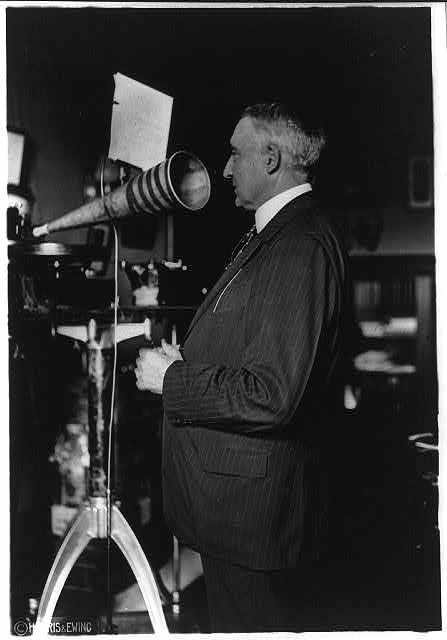
The voice America finally got to hear. Harding speaking into a funnel-shaped recording horn, capturing his voice for phonograph records — the acoustic-era cousin of the microphone he would make history with. Harding was the first president to deliver an amplified inaugural address, the first to have a radio set in the White House, and — at Fort McHenry on June 14, 1922 — the first heard live on broadcast radio. A president's voice, once something almost no citizen would ever hear, was suddenly everywhere. Photo: Library of Congress, Prints & Photographs Division, LC-USZ62-47664 (no known restrictions on publication).
Before there were networks, every station was an island, filling its own hours with its own local talent. A network changed that by chaining stations together so a single program from New York could play at the same moment on dozens of transmitters across the country — and the chain was not made of radio waves. It was made of telephone wire. The networks leased AT&T's long-distance lines to carry their programs from city to city, which is why the practice was literally called "chain broadcasting." The transmitter put the signal on the air; the phone company put the network together.
The first chain belonged to two colors at once. In 1926 RCA bought AT&T's pioneering New York station WEAF, along with its fledgling network, for a million dollars, and launched the National Broadcasting Company on November 15, 1926. Oddly, NBC ran not one network but two: NBC Red, anchored by WEAF, and NBC Blue, anchored by RCA's other New York station, WJZ. Red was the flagship — the marquee entertainment and music, the famous stars, the paying sponsors, and a roster of powerful clear-channel affiliates heard nationwide. Blue got the news, the public affairs, and the cultural programs, much of it "sustaining," meaning unsponsored. As for the names: the story goes that they came from the red and blue pencils AT&T's engineers used to trace each network's lines across the map.
Competition came fast. In 1927 a rival appeared — the Columbia Broadcasting System — which a young cigar heir named William S. Paley took control of in 1928 and built into NBC's equal. Then, in 1934, a fourth network arrived with a completely different shape: the Mutual Broadcasting System was not a corporation feeding programs down to its affiliates but a cooperative owned by its member stations — WOR in New York, WGN in Chicago, WLW in Cincinnati, and WXYZ in Detroit, the station that gave Mutual The Lone Ranger. Mutual was the scrappy outsider, and it struggled, because NBC and CBS had already signed up nearly all the powerful stations worth having.
That very lock became the networks' undoing. Mutual complained, the FCC investigated, and in 1941 the Commission handed down its "Chain Broadcasting Regulations," one of which struck straight at NBC: no single company could operate more than one network. NBC and CBS fought it all the way to the Supreme Court — and lost. In NBC v. United States (1943) the Court upheld the FCC, and RCA was forced to sell one of its two networks. It let go of the less-profitable Blue, for $8 million, to Edward J. Noble — the man who had made his fortune on Life Savers candy. In 1945 the Blue Network took a new name: the American Broadcasting Company. ABC was, quite literally, the half of NBC that NBC had been ordered to give up.
So the four great networks of radio's golden age — NBC, CBS, ABC, and Mutual — were really three companies and one act of government: NBC Red kept the NBC name, NBC Blue became ABC by federal decree, CBS rose on Paley's nerve, and Mutual ran as a league of independents. When television arrived, the stars and the sponsors followed the networks to the new screen, and radio's network era quietly faded. But the corporate map of American broadcasting had already been drawn — in red and blue pencil, on an AT&T engineer's wall.
Every license, every allocation table, every docket on this page exists because of seven months in 1926 when American radio had no law at all. The story of how the dial went feral — and how the panic that followed created the Federal Radio Commission, the FCC's direct ancestor — is the founding trauma of broadcast regulation.
A law from the Titanic era. Broadcasting was governed, absurdly, by the Radio Act of 1912 — written for ship-to-shore telegraphy months after the Titanic sank, years before anyone imagined entertainment broadcasting. It told the Secretary of Commerce to issue licenses; it never clearly said he could refuse one, or dictate a frequency, or limit power. Herbert Hoover, as Commerce Secretary, spent the early 1920s stretching that thin statute over a exploding industry — assigning channels, brokering time-sharing, convening four National Radio Conferences — mostly by bluff and the industry's voluntary cooperation. The courts started calling the bluff: in 1923, when Hoover tried to deny a renewal, the Court of Appeals ruled in the Intercity case that the 1912 Act gave him no power to say no.
Zenith jumps the fence. The fatal blow came from Chicago. In January 1926, Zenith's station WJAZ, fed up with a time-share that gave it two hours a week, simply moved itself to a frequency reserved by international agreement for Canada — and dared Washington to do something about it. The press called it wave piracy; Zenith called it a test case. In April 1926, the federal court agreed that the 1912 Act gave Hoover no authority to enforce assignments, and that July the Attorney General made it official: the Secretary of Commerce could license stations but could not tell them what frequency to use, what power to run, or what hours to keep. Hoover, with nothing left to enforce, stopped trying — and invited Congress, pointedly, to fix it.
Seven months of bedlam. What followed is the great natural experiment in unregulated spectrum. Stations jumped to better frequencies at will, cranked power, and abandoned their time-share schedules; more than 200 new stations signed on with nothing to stop them, pushing the total past 700 on a band engineered for far fewer. Heterodyne squeals, cross-talk, and roving carriers made whole regions of the dial unlistenable night after night — in parts of the country it became hard to receive any station cleanly. The industry that had spent five years fighting regulation began begging for it: broadcasters, set makers, and listeners converged on Congress with the same message, that radio was strangling itself in public.
Order, with a phrase that stuck. The Radio Act of 1927, signed by Coolidge on February 23, 1927, created the Federal Radio Commission and handed it the powers Hoover never had: to assign frequencies, set power and hours, deny and revoke licenses — and to do all of it according to a standard the Act made immortal: the "public interest, convenience, or necessity." The FRC spent its first years shoveling out the wreckage: General Order 32 culled the weakest of the 700-station pile-up, and General Order 40 in 1928 rebuilt the entire band — creating the clear-channel, regional, and local structure whose descendants (see AM Station Classes and the dockets section) still organize the dial today. In 1934 the FRC was folded into the new Federal Communications Commission, which inherited the 1927 Act's machinery nearly intact.
The lesson outlived everyone involved: the seven-month breakdown became the standard citation — in Congress, in the Supreme Court, in every spectrum fight since — for why broadcast spectrum is licensed at all. When the dial was free, nobody could hear anything. Every orderly frequency on this page (and every orderly reshuffle of them since) is downstream of the year the music stopped.
From a ship-to-shore statute to the FRC. Two court losses stripped Hoover's authority; seven lawless months did the rest.
Sources: Radio Act of 1927 (Pub. L. 69-632) and FCC historical archive; United States v. Zenith Radio Corp., 12 F.2d 614 (N.D. Ill. 1926); Bensman, "The Zenith-WJAZ Case and the Chaos of 1926–27," Journal of Broadcasting (1970); First Amendment Encyclopedia (Radio Act of 1927); Museum of Broadcast Communications (Federal Radio Commission).
At 3:00 a.m. Eastern time on March 29, 1941, almost every radio in North America was suddenly tuned to the wrong station. Overnight, on one coordinated cue, roughly 800 of the United States' nearly 900 AM stations jumped to new frequencies — part of a continent-wide reshuffle of about a thousand stations in all. Broadcasters called it "Moving Day." Listeners woke to find their favorite station a notch or two up the dial, every printed program listing instantly obsolete, and the frequency numbers painted on millions of radio cabinets quietly wrong.
Why the whole band moved at once. The cause was the North American Regional Broadcasting Agreement (NARBA) — the "Havana Treaty" — signed in the Cuban capital on December 13, 1937 by the United States, Canada, Mexico, Cuba, the Dominican Republic, and Haiti. AM licensing in the 1920s and '30s had been a free-for-all, and signals from a crowded, uncoordinated band increasingly stomped on one another across borders — not least the Mexican border blasters running outrageous power straight at American ears (see Border Blasters, whose studio-to-transmitter telephone trick the treaty also moved to outlaw). NARBA carved the band into an orderly plan that handed Canada, Mexico, and Cuba their own protected clear channels and, to make room, nudged hundreds of U.S. stations aside.
How they pulled it off. The planners worked to keep the disruption — and the cost — as low as possible: wherever they could, a station stayed put or slid to an adjacent channel, sparing owners the expense of retuning transmitters, phasing networks, and antennas. But the new foreign clear-channel grants meant some stations had to climb as much as 40 kHz up the dial. The agreement also stretched the top of the band out to 1600 kHz and sorted all 106 channels into three tiers — 59 clear, 41 regional, and 6 local — the classification skeleton that still shapes the band today (see AM Station Classes). Those six crowded local channels became the famous "graveyard" frequencies (see The 400 Club).
The legacies. Moving Day left fingerprints all over the modern dial. It created New York's tidy 660 / 770 / 880 lineup — and bumped the future WABC from 760 up to 770, without which the immortal "Sev-en-ty-se-ven, W-A-B-C" jingle would never have scanned. It also left a puzzle for generations of engineers: a station that moved up in frequency kept its existing tower, which was now electrically taller than a station on that channel would ever need to build — one quiet reason some AM towers look "too tall" for their frequency (see The Development of Vertical & Directional AM Antennas). Not everyone treated it solemnly: when Philadelphia broadcasters asked their mayor to proclaim an official "Radio Moving Day," he flatly refused, grumbling that mayoral proclamations "mean just exactly nothing."
| Station (then → now) | City | Old kHz | New kHz |
|---|---|---|---|
| WJZ (now WABC) | New York, NY | 760 | 770 |
| WABC (now WCBS) | New York, NY | 860 | 880 |
| WLS | Chicago, IL | 870 | 890 |
| WWL | New Orleans, LA | 850 | 870 |
| WHP | Harrisburg, PA | 1430 | 1460 |
| WINS | New York, NY | 1180 | 1000* |
| WQXR (now WQEW) | New York, NY | 1550 | 1560 |
*WINS later shifted again to 1010.
Sources: Wikipedia (North American Regional Broadcasting Agreement; Canadian allocations changes under NARBA; WABC; WHP) · Radio World ("In 1941, Stations Confronted 'Moving Day'") · The Broadcasters' Desktop Reference ("The Great Frequency Change of 1941") · The SWLing Post.
The clear channels weren't just an American idea — they were an international bargain. The North American Regional Broadcasting Agreement (NARBA), signed in Havana on December 13, 1937 by the United States, Canada, Mexico, Cuba, the Dominican Republic, and Haiti, divided the entire AM band among the signatories. When it took effect at 3:00 a.m. Eastern on March 29, 1941, roughly 800 U.S. stations changed frequency overnight — the largest single reshuffling of the dial in broadcast history — partly to make room for the other countries' protected channels. The treaty handed six Class I-A clear channels each to Canada and Mexico, and one to Cuba. A 1950 revision added the Bahamas to the club. These weren't courtesy listings: U.S. stations on those frequencies had to protect the foreign occupant's nighttime skywave just as foreign stations protected WLW, KFI, and WSM.
Canada's clears. Canada's protected frequencies went largely to the CBC: 540 (CBK, Watrous, Saskatchewan — sited in the middle of nowhere on purpose, to blanket the prairies), 690 and 940 in Montreal, 740 (CBL, Toronto), 860 (CJBC, Toronto), 990 (CBW, Winnipeg), and 1010. The modern twist is that the CBC walked away from several of them. CBL left 740 for FM in 2000, and the treaty-protected 50 kW channel passed to a commercial station — today's CFZM "Zoomer Radio," which DXers across the continent still log nightly. Montreal's 690 and 940 went through the same cycle: CBC to FM, commercial successors, and in 940's case, eventually dead air on a continentally protected frequency.
Mexico's clears. Mexico used its channels for raw power. The treaty capped U.S. and Canadian clears at 50 kW, but Mexico faced no such ceiling on its own assignments: XEW Mexico City ran 250,000 watts on 900 kHz for more than 80 years — five times anything north of the border — before relocating its transmitter and dropping to a still-formidable 100 kW in 2016. XEWA on 540 in San Luis Potosí runs 150 kW; XEG Monterrey (1050) and XEB Mexico City (1220) run 100 kW. And 1570 belonged to XERF in Ciudad Acuña — the border blaster across the river from Del Rio, Texas, where Wolfman Jack made his name aiming Mexican kilowatts at American teenagers.
Cuba's clear — and the walkout. Cuba's single Class I-A was 640, home of CMQ Havana, a 50 kW powerhouse audible across the Caribbean and the southern U.S. After the 1959 revolution, Cuba simply stopped participating in the treaty system. Ever since, Cuban government networks — Radio Reloj with its relentless ticking clock and Morse "RR," Radio Rebelde, Radio Progreso — have parked high-power transmitters on or next to U.S. clear channels with no coordination and no obligations. East Coast DXers know the result well: Cuban audio grinding under WFAN on 660, heterodynes on 670 against WSCR, and a dial below 900 that belongs as much to Havana as to anyone after dark.
The Bahamas. The 1950 NARBA gave Nassau a seat at the table: ZNS-1, the national station of the Bahamas, holds Class A status on 1540 with 50 kW, sharing the channel with KXEL in Waterloo, Iowa — one of the odder couples in North American broadcasting.
From the West Coast, the treaty is still audible any clear night. On 540, CBK Saskatchewan and XEWA Mexico fight it out — two foreign clears on one channel, often mixing in California. XEG 1050 rolls in from Monterrey, XERF still booms on 1570, and CFZM 740 makes the trip from Toronto in winter. Every one of those signals occupies space that a 1937 conference in Havana carved out for it — a treaty older than nearly everyone still listening, enforced every night by physics and paperwork.
Sources: NARBA treaty history (Wikipedia: North American Regional Broadcasting Agreement; Clear-channel station); oldradio.com clear channel archives; Radio World, "Cuba Has Long Been a Radio Presence."
One AM station — WCJW in Warsaw, New York — feeds six FM translators, the most in the United States. Five more stations tie at five apiece. A fill-in rule, not ambition, is what keeps the record this low.
An FM translator is a low-power FM repeater — 250 watts maximum — that rebroadcasts another station's programming on a different frequency. It originates nothing of its own; it simply puts an existing signal onto a new spot on the dial. For a struggling AM station, that spot on the FM dial is a lifeline: it escapes the rising electrical noise floor that buries AM in any modern home, and it reaches the growing number of listeners whose radios — especially in cars — barely acknowledge the AM band exists. For a daytime-only AM the payoff is even bigger: an FM translator rebroadcasting a daytimer is allowed to keep transmitting at night even when its AM parent is off the air, so a station that legally goes dark at sunset can keep a voice on the air around the clock through its FM shadow.
Cross-service translators — FM translators carrying AM stations — were first permitted in 2009, but the floodgates opened with the FCC's AM Revitalization proceeding (MB Docket 13-249), an effort spearheaded by then-Commissioner Ajit Pai. It was an FCC rulemaking, not an act of Congress. The First Report and Order of October 23, 2015 relaxed AM coverage standards, eliminated the AM “ratchet” rule, eased MDCL filings, and lowered minimum antenna-efficiency requirements — but its headline was translators. The FCC opened two 2016 windows that let an AM move an existing translator up to 250 miles into its own market (Class C and D stations first), then two auction windows for brand-new translators: Auction 99 in 2017 and Auction 100 in January 2018. Translators won in those windows are permanently tied to their AM station and can never be split off. The result was a landslide — of roughly 4,570 AM stations today, about 3,100 hold at least one FM translator.
You might expect a big station to grab a dozen, but the rules forbid it. A cross-service translator's signal contour must stay within the greater of a 25-mile radius of the AM's transmitter or the AM's 2.0 mV/m daytime contour, so every translator has to huddle near its parent — you cannot scatter them across the country. Most AM stations that have any have exactly one; a couple hundred have two; only a tiny handful break three. That is what makes the leaders genuinely unusual.
The champion — WCJW, six translators. WCJW 1140, Warsaw, New York (“CJ Country”) is the most-translated AM station in the United States, feeding six FM signals. It is a textbook case of why: a Class D daytimer running 8 kW by day, cut to 2,300 watts during critical hours, with no nighttime authority at all — its power is throttled to protect co-channel WRVA in Richmond. On AM alone it would vanish from the rural Western New York dial every evening. Instead, six translators at Geneseo, Warsaw, Arcade, Batavia, Avon, and Alden stitch a daytime-only AM into a full-time FM presence across Wyoming, Livingston, and Genesee counties.
The five at five. Behind WCJW, five stations tie at five translators apiece, and they split into two opposite philosophies. Three are Alaska giants using translators to reach: KBRW 680 Utqiaġvik (“Top of the World Radio”), the North Slope's only station, which added five translators — one for each out-lying village: Point Hope, Point Lay, Kaktovik, Nuiqsut, and Anaktuvuk Pass; KJNP 1170 North Pole (“King Jesus North Pole”), a 50,000-watt clear-channel gospel station run from log cabins by volunteers, reaching interior villages such as Circle, Tok, and Fort Yukon; and KINY 800 Juneau (“Voice of Southeast Alaska”), threading signal through the islands and fjords of the Panhandle to Haines, Skagway, Angoon, and Hoonah. One is a rural fill-in: WCMT 1410 Martin, Tennessee, family-run Thunderbolt Broadcasting, which built a five-translator “mini-network” across the Ken-Tenn farm towns and has long billed itself as the only AM with five translators. WCJW also carries five. And one inverts the whole idea: KJOZ 880 Conroe, Texas (“La Calle,” Spanish tropical), whose five translators do not fill coverage gaps at all — they pile into metro Houston to blanket a large Hispanic audience on FM. Reach versus saturation, on the same leaderboard.
| Rank | Call | kHz | City of License | Translators |
|---|---|---|---|---|
| 1 | WCJW | 1140 | Warsaw, NY | 6 |
| 2 | KINY | 800 | Juneau, AK | 5 |
| 2 | KJNP | 1170 | North Pole, AK | 5 |
| 2 | KBRW | 680 | Utqiaġvik (Barrow), AK | 5 |
| 2 | WCMT | 1410 | Martin, TN | 5 |
| 2 | KJOZ | 880 | Conroe, TX | 5 |
The 25-mile fill-in leash is the real ceiling here. It is why a 50,000-watt clear-channel blowtorch does not dominate this list and a daytime-only country station in a New York farm town does: translators reward the stations that most need a second signal close to home, not the ones that already boom across half a continent. Counted from FCC licensing data, the record is six — and physics, not ambition, is what keeps it there.
Sources: FCC LMS facility database (June 2026); FCC AM Revitalization (MB Docket 13-249) and FM Translators & Boosters rules (47 CFR 74.1201); station licensee sites and Wikipedia; Radio World.
The stories behind the numbers — deeper explanations of the most interesting AM broadcast trivia.
KNFL 740 — The Most Complex AM Antenna Operation
KFBK 1530 — The Strongest AM Signal in America
KSTP 1500 — The Secret Strongest Signal
WWJ 950 — The Tightest Beam in American AM
KFXR 1190 — The 12-Tower Runway
KNTH 1070 — The Most Steel in the Sky
KEAR 610 & KVTO 1400 — Hollywood, History, and Radio
WHSQ 880 & WFAN 660 — Perry Como, a Plane Crash, and 100 KW
KICY 850 — The Three-Mode Gospel Cannon
KDWN 720 — The Rise and Fall of K-Dawn
KNZR 1560 — The Class A That Never Was
KFI 640 — The Tower That Took Four Years to Rebuild
Most AM stations operate in two modes — day and night. A handful run a third mode during critical hours. But KNFL on 740 kHz in Fargo, North Dakota, takes it further than almost any station in America: 50,000 watts through six towers with three completely different directional patterns, four pattern switches per day, and a power range that spans from 50 kW to 940 watts. It is the most powerful DA-3 station in the United States.
Three Patterns, One Array. KNFL's six-tower array sits at 46-58-28.9 N, 96-30-13.3 W, near Fargo. The same six towers serve all three modes, but the phasor settings — the current amplitudes and phase angles fed to each tower — are dramatically different for each one. During the day, the array runs 50 kW directional with 4 augmentations, producing an RMS field strength of 2,236.8 mV/m. During critical hours (the two hours after sunrise and two hours before sunset), the power drops to 7,500 watts with a different directional pattern and 4 augmentations, producing 866.3 mV/m. At night, everything changes again: power drops to just 940 watts — less than 2% of daytime — with yet another pattern and 1 augmentation, producing 288.7 mV/m.
Four Switches Per Day. Every day, the KNFL phasor must be reconfigured four times. At sunrise, the night pattern (940 W) switches to the critical hours pattern (7.5 kW). Two hours after sunrise, critical hours switches to the day pattern (50 kW). Two hours before sunset, day switches back to critical hours. At sunset, critical hours switches to night. Each switch means changing the current and phase to all six towers — a different set of phasor adjustments for each mode. If any switch is done incorrectly, the radiation pattern could violate FCC protection requirements for other stations on 740 kHz. This is why DA-3 is so rare: most station owners would rather accept a simpler antenna configuration with less optimal coverage than deal with the engineering complexity and risk of four daily pattern changes.
Why 740 kHz Is Hard. 740 kHz is a clear channel frequency — the dominant station is CBL in Toronto (50 kW, Class A). KNFL, as a Class B station, must protect CBL's nighttime skywave coverage, which is why the nighttime power drops 98% to 940 watts and the pattern is reshaped to minimize radiation toward the northeast. The critical hours pattern is a transitional compromise — more power than night but less than day, with a pattern that accounts for the ionosphere's unpredictable behavior during the sunrise and sunset transitions. Three different protection scenarios require three different solutions.
The Numbers. Only 14 AM stations in the entire United States operate DA-3 — three different directional patterns for day, night, and critical hours. Of those 14, only three run 50 kW during the day: KNFL (740, Fargo), KYES (1180, Rockville MN), and WIXC (1060, Titusville FL). KNFL has the most dramatic power swing of any DA-3 station: a 53:1 ratio between day (50,000 watts) and night (940 watts). The phasor room at KNFL contains three complete sets of component values — inductors, capacitors, and transmission line lengths — each precisely tuned for one of the three modes. It is, by any measure, one of the most demanding AM antenna operations in American broadcasting.
Every 50 KW AM station in America feeds the same maximum legal power into its antenna. So how does KFBK in Sacramento produce a daytime field strength of 3,545.89 mV/m — the highest of any AM station in the United States — from the same 50,000 watts everyone else uses? Three factors working together make KFBK an absolute monster.
The Franklin Antenna. KFBK operates the only FCC-certified Franklin antenna system in the country. Located approximately 25 miles north of Sacramento in Pleasant Grove, the site has two towers that form a Franklin array — a special segmented design that concentrates RF energy at a low radiation angle, maximizing groundwave coverage. The result is an effective radiated power estimated at 100 to 400 kilowatts from a 50 KW transmitter. That's not a typo — the antenna gain multiplies the power by 2× to 8× compared to a simple tower. The Franklin design also produces a low angle of radiation, which means the signal hugs the ground rather than wasting energy into the sky. This translates to a stronger, more consistent signal over long distances and less susceptibility to skywave fading at night.
Ground Conductivity. KFBK's transmitter sits in the middle of California's Central Valley — flat, irrigated farmland with rich, moist soil. Ground conductivity here measures 15 millimhos per meter, which is outstanding. AM groundwave signals travel through and along the earth's surface, so conductivity matters enormously. Moist agricultural soil is among the best ground types for AM propagation. Dry, rocky, or mountainous terrain absorbs and scatters the signal; the Central Valley's wet clay soils act like a mirror, helping the groundwave travel farther with less loss. A station with the same power and antenna on dry desert ground or rocky hillside would cover a fraction of KFBK's area.
The Result. The combination of Franklin antenna gain, excellent ground conductivity, flat terrain, and 50 KW of transmitter power makes KFBK's daytime signal cover much of Northern California — from the northern Sacramento Valley to the San Francisco Bay Area and deep into the Central Valley. At night, when AM signals bounce off the ionosphere as skywaves, KFBK has been heard clearly in Alaska (at S9+70 signal strength), in Ecuador, and across the entire western United States and Canada. DXers in Washington state report KFBK as one of the most reliable nighttime signals on the dial, often dominating 1530 kHz with no competition. One listener in central Alaska noted that KFBK came in stronger than local 10 and 50 KW stations in Anchorage. Because KFBK shares 1530 with WCKY in Cincinnati (another 50 KW Class A), it uses a directional antenna to limit its signal toward the east — but westward and northward, the Franklin array puts out a wall of RF that is, watt for watt, unmatched by any other AM station in America.
KFBK in Sacramento holds the official record for the highest published field strength of any AM station in the FCC database. But there's a station in Minnesota that may actually beat it — and almost nobody knows.
The Almost-Perfect Franklin. KSTP on 1500 kHz in St. Paul operates a single sectionalized tower from its transmitter site on U.S. Route 61 at Beam Avenue in Maplewood, Minnesota. The tower is composed of two stacked sections — each 0.498 wavelengths tall — separated by a mid-tower insulator, making the total electrical height 0.996 wavelengths. That's 99.6% of a perfect full wavelength, missing the textbook Franklin definition by a hair. A true Franklin antenna consists of two half-wave radiators stacked end-to-end and fed in phase. KSTP's tower does exactly that, just barely short of the ideal dimensions. The result is the same low-angle radiation pattern that makes KFBK so dominant — concentrating energy into the groundwave rather than wasting it skyward.
The Numbers Game. Here's where it gets interesting. The computed field strength of KSTP at 1 kilometer distance is 3,618.76 mV/m — which actually exceeds KFBK's published record of 3,545.89 mV/m. So why isn't KSTP listed as the champion? The answer is a quirk of FCC bookkeeping. The FCC publishes 1 km field strength values for single-tower stations based on a standard reference power of 1 KW, not the station's actual operating power. Under that method, KSTP's published figure is only 511.77 mV/m. KFBK, as a two-tower directional array, gets its field strength published differently — as an actual measured value at operating power. When you scale KSTP's single-tower reference value up to its actual 50 KW operating power, the computed result beats KFBK. Whether KSTP or KFBK truly puts more signal on the ground depends on how you measure it — but by raw calculated millivolts per meter, KSTP is the quiet champion.
The Station. KSTP signed on March 29, 1928, and has been owned by Hubbard Broadcasting since its founding — one of the longest continuous ownership runs in American radio. The station is a Class A clear-channel operation on 1500 kHz, running 50 KW day and night. During the day it uses the single sectionalized tower non-directionally; at night it switches to a three-tower directional array at a nearby site in Maplewood to protect co-channel WFED in Washington, DC. The station currently airs sports talk programming as "SKOR North." The sectionalized tower — with its mid-tower insulator clearly visible from the highway — remains one of only nine sectionalized AM towers in the entire United States, and the only one that comes close to matching a true Franklin antenna's performance.
WHO's tower in Des Moines is one of the strangest antenna designs in American broadcasting — a shortened Franklin variant that fires an enormous lobe of energy into the sky at a steep angle, unlike almost every other AM antenna ever built.
The Design. The WHO tower is a Type 2 center-fed sectionalized antenna — grounded at the base, fed at the center, with only the top section excited. It is also top-loaded, making it the tallest single top-loaded tower in the US at 745.7 feet (227.3 meters). The bottom section of the tower is essentially a pedestal; RF energy enters at the mid-tower feed point and excites only the upper portion, which is electrically lengthened by the capacitance hat on top. This is not a standard quarter-wave monopole and it's not a true Franklin — it's something in between, a hybrid that produces a radiation pattern unlike anything else on the AM band.
The Lobe. Most AM stations are designed to push their signal along the ground — low radiation angles mean stronger groundwave coverage and less skywave interference at night. WHO's tower does the opposite. Its omnidirectional pattern pushes a mammoth 15.8 dB gain lobe at 41 degrees elevation above the horizon — probably the highest-gain skywave lobe of any station in the United States. During the day this energy is absorbed by the ionosphere's D layer and doesn't matter much. But at night, when the D layer disappears and the F layer reflects medium-wave signals back to earth, that 41-degree lobe turns WHO into a skywave cannon. The signal bounces off the ionosphere and comes down hundreds or thousands of miles away. This is why WHO has historically been one of the most widely heard AM stations in North America at night — not because of an especially strong groundwave, but because the antenna literally aims its strongest radiation at the sky.
KFBK in Sacramento holds the record for the highest omnidirectional field strength. But if you count directional patterns, there's a station in Michigan that blows it away — more than doubling KFBK's number in a single direction.
The Numbers. WWJ on 950 kHz in Detroit produces a nighttime field strength of 7,980 mV/m at 1 km in its primary beam direction — the highest single-direction field strength of any AM station in the United States. For comparison, KFBK's record omnidirectional figure is 3,545.89 mV/m. WWJ's six-tower nighttime array concentrates all 50,000 watts into a narrow beam aimed north from the transmitter site near Newport, Michigan, in the downriver district south of Detroit. The signal fires straight up through the metro area and into northern Michigan — reaching the Upper Peninsula and Mackinac areas at night via both groundwave and skywave propagation. A DXer in Siberia logged WWJ at usable strength, receiving it on a 280-meter beverage antenna pointed at 350°.
The Array. The FCC data tells the story of how tight the pattern is. The six-tower nighttime array uses towers with field ratios ranging from 0.521 to 1.0, with phase angles spread across 337° and electrical heights of 138° to 168°. The array also carries three augmentations — corrections to the theoretical pattern to account for real-world ground conductivity and terrain — which further sharpen the beam. During the day, WWJ drops to a five-tower pattern that's wider and more conventional. The nighttime switch to six towers is all about squeezing maximum signal into the Detroit metro while protecting co-channel stations elsewhere on 950 kHz.
History. WWJ is one of the oldest radio stations in America, first going on the air August 20, 1920, as experimental station 8MK — operated by the Detroit News from the newspaper's building with a 200-watt transmitter. The station pioneered regular news broadcasting, first play-by-play sports, and first symphony concert broadcast (Detroit Symphony Orchestra, February 1922). For most of its life, WWJ was a modest-power station — it didn't reach 50 KW until the late 1990s, when CBS built the current six-tower array in the downriver district. That upgrade — described by one radio engineer as "the six-tower monster" — transformed WWJ from a mid-power regional into a 50 KW powerhouse that could scorch the Detroit market with an unprecedented directional signal. The station has been all-news "Newsradio 950" since 1973 and is currently owned by Audacy.
KFXR on 1190 kHz holds the record for the most nighttime towers of any AM station in the United States — twelve. But the real story isn't just the number of towers. It's that KFXR operates from two completely separate transmitter sites, 30 miles apart, and the nighttime array is so unusual that a pilot once tried to land on it.
Two Sites, Two Identities. During the day, KFXR runs 50,000 watts from a four-tower directional array in Irving, Texas, just west of Dallas. The daytime pattern is massive — covering north to Sulphur, Oklahoma, east to Longview, west nearly to Abilene, and south almost to Waco. But at sunset, everything changes. The Irving transmitter shuts down and a completely different transmitter fires up 30 miles to the northeast in Rockwall, Texas, running just 5,000 watts through a twelve-tower directional array. This is one of the only AM stations in America that physically switches transmitter sites between day and night.
The Twelve-Tower Array. The Rockwall night site was built in 1968, back when the station was the legendary KLIF — Gordon McLendon's Top 40 powerhouse that was one of the most listened-to stations in America. The twelve towers were necessary to protect other stations on 1190 kHz, most critically WOWO in Fort Wayne, Indiana, as well as stations in San Antonio and Kansas City. The array is half a mile long, arranged in two parallel rows of six towers spaced 200 feet apart. The nighttime pattern is surgically tight — the nulls are so deep that engineers visiting the site in the late 1970s reported sitting in a car within 50 feet of the reference tower and clearly receiving WOAI on 1200 kHz from San Antonio, 200 miles away, hearing only faint sideband splatter from 1190. The joke around Dallas was that KFXR's night pattern was so directional that if you were listening on Elm Street downtown, you'd lose the signal if you drove up on the sidewalk. Another version claimed the pattern was so tight it would go down the middle of a street without touching either side.
The Runway Incident. From the air, the twelve towers with the paved service road running between them look exactly like a small airfield. Engineers needed the road because there was no way to walk to all twelve towers and read the meters within the required time — they drove a Jeep from tower to tower with turnarounds at each end. At some point, a pilot actually attempted to land on the strip, pulling up at the last moment when he realized it was a tower array and not an airfield. After that, large X's were painted on the paved surface so no future pilot would make the same mistake.
The Future. The twelve-tower site in Rockwall has been surrounded by subdivisions and an elementary school over the decades. With half-million-dollar houses pressing in on all sides, the land is worth many times more than the station itself. Several AM stations with large tower fields have gone dark in recent years when their sites were sold to developers. Whether KFXR's remarkable twelve-tower array survives much longer is an open question — but for now, it remains the most complex nighttime antenna system in American broadcasting.
While KFXR in Dallas holds the record for the most nighttime towers, KNTH on 1070 kHz in Houston holds a different distinction: the most daytime towers of any AM station in America — eleven — and more total feet of steel in the air than any other AM site anywhere.
The Array. KNTH's transmitter site is in Northwest Harris County on Welcome Lane near T.C. Jester Boulevard in the Bammel Village area. The eleven-tower daytime array includes nine towers over 500 feet tall and two shorter sticks, adding up to a staggering 4,551 feet of total tower height — nearly a mile of steel standing in the Houston sky. Not all eleven towers are actively driven at once for every pattern, but they're all part of the array and all need to be maintained. At night, the station drops to 5,000 watts and switches to a nine-tower pattern. The station is DA2, meaning it uses different directional patterns day and night.
Why So Many Towers? 1070 kHz is a clear channel frequency — KNX in Los Angeles is the dominant Class A station on the channel, running 50 KW non-directional from a single tower. KNTH, as a Class B station with only 10 KW, needs all that directional complexity to squeeze its signal into the Houston market without interfering with KNX or the other stations sharing the frequency. Each additional tower gives the engineers another degree of freedom to shape the radiation pattern — pushing signal where it's wanted and pulling nulls where it isn't. With eleven towers to work with, the daytime pattern can be sculpted with surgical precision.
Maintenance Nightmare. Running an eleven-tower array is an engineering and financial challenge. Every tower needs FAA obstruction lighting, regular structural inspections, ground system maintenance, and transmission line upkeep. The phasing and coupling equipment for eleven towers is enormously complex — back in the days of manual meter readings, an engineer doing a proof of performance would have had to record current and phase readings for every tower, a process that could cause serious writer's cramp. Modern remote monitoring has eased the burden, but the physical infrastructure remains expensive to maintain. Combined with its neighbor KGOW (1560 kHz), which operates from a separate site with 6 day towers and 9 night towers, Houston may have more AM tower steel per square mile than any other market in America.
History. The station signed on January 17, 1968, as KENR — a 5,000-watt daytimer playing country music. It was KENR that helped launch Mickey Gilley's career when DJ "Dr. Bruce" Nelson flipped over a local jukebox single and played the B-side, "Room Full of Roses," which became Gilley's first of sixteen #1 country hits. In 1971, KENR began 24-hour operations and increased to 10 KW day / 5 KW night with the directional array it still uses today. The station has cycled through formats over the decades — country, soft AC, classic rock, simulcasts, Christian talk — and is currently "AM 1070 The Answer" under Salem Media Group, running conservative talk programming. Through all those format changes, the eleven towers have stood, quietly holding the record for the most daytime steel of any AM station in the country.
On the shore of the Berkeley Aquatic Park, wedged between Interstate 80 and San Francisco Bay at the foot of Ashby Avenue, sits a modest block building with a 449-foot guyed tower behind it. Two AM stations — KEAR on 610 kHz and KVTO on 1400 kHz — diplexed on the same tower, transmit from this site today. But the building and its tower have witnessed more radio history than almost any other transmitter site in America.
KRE — A Century of Radio. The site sprang to life in 1937 as the transmitter building for KRE, Berkeley's hometown AM station, which had been on the air since March 11, 1922 — making it one of the oldest stations in California. The call letters KRE were originally issued to the side-wheeler steamship Bay State, and later to a World War I merchant marine vessel, the Florence H., which was destroyed in an explosion at Quiberon Bay, France in 1918. The Maxwell Electric Company put KRE on the air and it was soon sold to the Berkeley Daily Gazette, then to the First Congregational Church of Berkeley. The original 1937 building was modest — a small block structure in front of a 178-foot self-supporting tower. In 1965, a taller 449-foot guyed tower replaced it. The station went through a parade of call letters over the decades: KRE became KPAT (1963), then back to KRE (1972), KBLX (1986), KBFN (1989), KBLX again (1990), and finally KVTO (1994), broadcasting Chinese-language programming as "Voice of the Orient."
KFRC Moves In. In 1968, San Francisco's legendary KFRC moved its transmitter to the Ashby Avenue site, and the two stations began diplexing from the same tower. The 610 kHz frequency had been home to KFRC since September 24, 1924 — over eight decades. In the 1960s and 1970s, KFRC was one of the most famous Top 40 rock stations in America, a powerhouse that defined Bay Area radio. The frequency stayed KFRC through format changes to adult standards, then oldies, until 2005 when Family Stations acquired the 610 AM frequency and it became KEAR, the flagship of the Family Radio network.
American Graffiti. In August 1972, Northern California native George Lucas was scouting locations for his coming-of-age film "American Graffiti" and needed a plausibly 1950s-vintage radio studio for the scenes with Wolfman Jack. He found it right here at the foot of Ashby Avenue. The exterior shots of the Wolfman's remote radio station — Curt Henderson (Richard Dreyfuss) driving up a dark road and gazing at the transmission tower — were filmed at KTOB in Petaluma. But every interior scene was shot inside the KRE studio in Berkeley: Curt talking to the Wolfman through the intercom at the station's front door, and the pivotal conversation in the broadcast studio where Curt discovers the popsicle-eating disc jockey is actually the Wolfman himself. KRE leased out the studio to Lucas's crew for the night filming. The scene became one of the most memorable moments in American cinema — the shy kid meeting the mysterious voice on the radio — and it was shot in a working AM transmitter building on the shore of San Francisco Bay. Most of the Wolfman's radio patter heard throughout the film came from actual tapes of his 1966–71 XERB broadcasts; only about 10–20 percent was recorded new for the movie.
The Site Today. After the studios were vacated, the building fell into disrepair through the 1990s — covered in graffiti and boarded up. The California Historical Radio Society (CHRS) leased the building and restored it inside and out, including returning the old KRE studio to its configuration during the American Graffiti filming. During open house events, visitors could sit behind the console in Wolfman Jack's chair. CHRS later acquired its own museum facility in Alameda, but the Ashby Avenue building remains an active transmitter site — still diplexing KEAR and KVTO from the same tower, still broadcasting, over a century after KRE first went on the air. Both stations are now owned by Pham Radio Communication, which also owns KVVN 1430 in Santa Clara and KLIV 1590 in San Jose.
On a small uninhabited island in Long Island Sound, off the tip of City Island in the Bronx, two of the most powerful AM signals in the eastern United States share a single tower. WHSQ on 880 kHz (formerly WCBS) and WFAN on 660 kHz each run 50,000 watts non-directional — 100 KW total through one stick. Getting them both to work from that one tower is one of the great engineering stories in American broadcasting, and it only happened because of a famous crooner and a plane crash.
Perry Como's House. The High Island facility was originally built in the early 1960s for WNBC on 660 kHz, which had been transmitting from Sands Point on Long Island. NBC was developing a separate nearby site for 660's transmitter when singer Perry Como decided he wanted that property for his New York City home. With their planned site gone, NBC diplexed 660 into the new tower that CBS had just built on High Island for 880. After over two years of construction, both stations went into operation from the shared tower in 1963. The tower — a diplexed Franklin design, sectionalized to serve both frequencies — was optimized for 880 kHz. Making it work efficiently on 660 was a different matter entirely. The shorter electrical length of the antenna relative to 660's longer wavelength meant it didn't meet the FCC's required radiation efficiency for the lower frequency. Engineers had to do considerable work — likely involving folded unipole techniques or top loading — to bring 660's efficiency up to the required level without disrupting 880's performance. Getting two non-directional 50 KW signals to coexist on a single tower, 220 kHz apart, with neither degrading the other, remains one of the most demanding diplexing arrangements in the country.
The Plane Crash. On August 27, 1967, a small private airplane crashed into the High Island tower, killing the pilot and a passenger and destroying the antenna. Both WCBS and WNBC were knocked off the air — and the timing could not have been worse. WCBS was scheduled to launch its all-news format the very next day, August 28, after months of preparation. With the tower gone, the all-news debut happened instead on sister station WCBS-FM 101.1, which had been readying its own new format. WNBC, meanwhile, found a temporary home by diplexing into the tower of rival WABC 770 in Lodi, New Jersey — and listeners could hear WABC's audio faintly bleeding through behind WNBC's signal on 660. WCBS accepted an offer from WLIB 1190 to use the transmitter site in Astoria, Queens, that WLIB had just abandoned. Within a few weeks, both stations were back on High Island with a temporary tower, but it took until the end of 1967 before they were fully restored to 50 KW. The permanent replacement was built with a second, shorter backup tower — 300 feet, later rebuilt in 2001 — so that a single antenna failure could never again take both stations off the air simultaneously.
The Island. High Island itself is a small rocky hump — once called Shark Island for the sand sharks in Pelham Bay — connected to City Island by a sandbar that emerges at low tide and a small private bridge. It was a stone quarry in the 1800s, then a summer resort with rental cottages in the 1920s, before NBC acquired it for the transmitter site. The proximity of two 50 KW AM transmitters to the residential neighborhood of City Island has, at times, caused interference on telephones and electronic equipment. As of 2025, High Island and both towers are owned by Audacy, Inc. The main tower stands 548 feet; it is the last AM transmitter site remaining within New York City limits.
The Stations. WFAN 660, which took over WNBC's frequency in October 1988, became America's first all-sports radio station and remains one of the most listened-to AM stations in the country. WCBS 880 ran its all-news format for 57 years — from 1967 to August 2024 — before Audacy ended the format and leased the signal to Good Karma Brands, which relaunched it as WHSQ "ESPN New York 880." The WCBS call letters, which had been on 880 since 1946, were retired. Through all the format changes, ownership transfers, and call sign shuffles, the two stations have shared that one tower on High Island for over sixty years — 100,000 watts of non-directional AM power, diplexed through a single antenna, on a tiny island in the Bronx.
Most AM stations operate in two modes — day and night. KICY on 850 kHz in Nome, Alaska, operates in three: non-directional by day, non-directional by night, and directional during critical hours only. It is the only station in the United States with this particular configuration, and the reason has nothing to do with protecting another station. It has to do with reaching Russia.
Three Modes. During daytime and nighttime hours, KICY runs 50,000 watts from a single tower, non-directional — its signal radiating equally in all directions across western Alaska, serving isolated Inupiaq, Yup'ik, and Cup'ik Native villages on the Seward Peninsula, the Yukon-Kuskokwim Delta, and throughout the bush. But during the critical hours transition periods — roughly 11 PM to 4 AM, when the ionosphere is in flux and skywave propagation is at its most unpredictable — KICY fires up a three-tower directional array. The three towers, all at 78.4° electrical height (76.81 meters), are spaced 90° apart with the array aimed due west — straight across the Bering Strait into Siberia, Chukotka, and Kamchatka. During these critical hours, KICY switches to Russian-language programming, beaming the Gospel into regions of the Russian Far East where other forms of media are scarce or nonexistent.
Why Critical Hours? The critical hours window — the two-hour periods around local sunrise and sunset — is when AM skywave propagation is transitional and most effective for medium-distance skip. The D layer of the ionosphere, which normally absorbs medium-wave signals during the day, is either forming or dissipating. During this window, a signal aimed at a low angle can skip off the F layer and reach locations 1,000 to 3,000 miles away with remarkable strength. By directionaling only during critical hours, KICY concentrates its 50 KW westward during the exact window when the skip path to Russia is most reliable — while running non-directional the rest of the time to serve its local Alaskan audience in all directions. It's an elegant engineering solution to a missionary broadcasting problem.
The Station. KICY signed on Easter Sunday, April 17, 1960, operated by the Arctic Broadcasting Association, a non-profit affiliated with the Evangelical Covenant Church. The station runs on donations and volunteer staff from its studios at 408 West D Street in Nome — just south of the Arctic Circle, on the edge of the Bering Strait, 161 miles from Russia. In 2001, KICY increased to 50 KW full-time. The station holds Class A status — one of only 16 Class A stations in Alaska, a privilege granted because of the state's extreme geographic isolation. Alaska is also the only state where the FCC permits stations to broadcast personal messages over the air, because radio is often the only way to reach people in remote bush villages. KICY's programming is a mix of Southern Gospel music, Christian teaching, Native singing in indigenous languages, and — during those critical hours — Russian-language broadcasts aimed at listeners who may have no other way to hear them.
KDWN 720 signed on April 7, 1975, in Las Vegas, Nevada. By the 1980s it was running 50,000 watts day and night on clear channel 720 — one of the most powerful AM signals in the western United States. At night, KDWN’s signal reached across Nevada, California, Arizona, Utah, Oregon, Washington, Idaho, Wyoming, Montana, north into British Columbia, and south into Mexico. It was a blowtorch.
In 1983, a young broadcaster named Art Bell joined KDWN as an overnight host. A decade later, his show went into national syndication as “Coast to Coast AM” — one of the most iconic late-night radio programs in American history. It started on KDWN 720 Las Vegas.
In January 1980, KDWN shifted to talk around the clock and became the dominant news/talk outlet in the Las Vegas market. For decades, KDWN was the station Las Vegas turned to for news, weather, traffic, and talk.
But 720 kHz is a clear channel frequency — Class A, reserved for WGN in Chicago. KDWN operated as a Class B and eventually had to reduce power to protect WGN. By the 2000s, the station was running 25,000 watts by day and 7,500 watts at night — half its former glory, but still a significant signal.
Then the land got more valuable than the signal.
In 2020, Beasley Broadcast Group sold KDWN’s Henderson tower site to housing developers. The station was moved and diplexed onto the KXST 1140 tower site in North Las Vegas. Beasley then traded KDWN to Audacy in exchange for 107.5 KXTE. But Audacy didn’t acquire KDWN to improve its programming or invest in its future. Audacy wanted the land.
The KXST/KDWN tower site near Nellis Air Force Base and Las Vegas Motor Speedway had once been surrounded by empty desert. By 2023, three sides of the property were surrounded by Amazon warehouses. Audacy sold the land for $40 million.
On March 1, 2023, at one minute before midnight, KDWN fired up a final 10-minute full-power test — 25,000 watts — so DXers across the west could log the station one last time. Then the switch was thrown. KDWN 720 went dark after 47 years on the air. Sister station KXST 1140 went dark the same night.
The Rescue That Never Happened. Audacy’s engineers tried to save both stations. In September 2023, they filed with the FCC to relocate KDWN and KXST to the four-tower array used by co-owned KXNT 840, diplexing all three stations onto the same towers. KDWN would have kept 25,000 watts by day but dropped to just 4,000 watts at night. KXST would have run 12,000 watts by day and 100 watts at night. It was a sound engineering plan to keep two AM signals alive.
It never happened. Audacy, deep in bankruptcy, never spent the money to build it out. On March 11, 2024, Audacy surrendered the licenses for both KDWN 720 and KXST 1140 after failing to restore operations before the FCC deadline. The licenses were cancelled. The frequencies went silent — permanently.
KDWN’s programming lives on as “101.5 FM K-Dawn” via translator K268CS, fed by KMXB-HD3. The talk shows are still there. The call letters are still there. But 720 AM in Las Vegas is dark, and the 50,000-watt blowtorch that once lit up the western sky is gone.
The former tower site has been developed as a warehouse.
The Frequency Nobody Wants. 720 kHz is a Class A clear channel frequency — one of only 25 in the United States. When Audacy surrendered KDWN’s license in March 2024, it didn’t just open up a frequency in Las Vegas. It opened up a clear channel frequency across the entire western United States. Anyone could apply for 720 in Los Angeles, San Francisco, Phoenix, Seattle, San Diego — any major west coast market. In the golden age of AM, broadcasters would have been lined up five deep to grab a clear channel in LA or San Francisco. It has been over two years. Nobody has applied — anywhere. As of May 2026, the FCC AM Query shows no applications and no construction permits for 720 kHz. The only west coast station on 720 is KFIR in Sweet Home, Oregon — 10,000 watts by day, 184 watts at night. A clear channel frequency, available in every major market west of the Rockies, and nobody wants it. That may be the most telling statistic on this entire page.
KNZR 1560 in Bakersfield holds Class A clear channel status — one of only 25 in the United States — sharing the frequency with WFME in New York City. But KNZR has never run 50,000 watts. It operates at 25,000 watts by day and 10,000 watts at night. It is the only Class A station in the contiguous 48 states that does not run 50,000 watts around the clock.
How It Got There. The station signed on in 1935 as W6XAI, later becoming KPMC. In the early 1960s it was a Class 1-B station running 10,000 watts on 1560 kHz. At the time, 1560 was classified as a Cuban clear channel frequency. When international AM agreements were renegotiated and 1560 was reclassified as a US clear channel, KNZR was already on the frequency. It was elevated to Class A status by virtue of already being there — grandfathered in, not because it applied for it.
Use It or Lose It? KNZR could have upgraded to 50,000 watts at any time — Bakersfield is far enough from New York that a directional antenna would have easily protected WFME. But in a market the size of Bakersfield, the investment in a 50 kW transmitter, upgraded towers, and higher electric bills was never worth it. About 10 to 15 years ago, KNZR increased its daytime power from 10,000 to 25,000 watts but kept 10,000 watts at night. A Class A clear channel station that has never once run at full power — 91 years and counting.
KFI on 640 kHz is one of the original West Coast flamethrowers — a Class A clear channel station running 50,000 watts non-directional from La Mirada, California, less than two miles from Fullerton Municipal Airport. The tower that carried that signal stood 760 feet tall, originally erected in 1948. On December 19, 2004, it was destroyed in seconds.
The Crash. At 9:45 a.m. on a clear Sunday morning, a rented single-engine Cessna 182 struck the KFI tower approximately 10 to 15 feet below the top. The plane erupted into a fireball and the 760-foot tower collapsed to the ground, with pieces of the burning aircraft still entangled in the steel. Jim and Mary Ghosoph of Temple City, both 51, were killed. No one on the ground was injured — almost miraculously, the tower fell within its fenced compound, missing surrounding commercial buildings by 20 to 30 yards. The tower had been completely refurbished just seven months earlier. A motorist on nearby Interstate 5 watched the plane converging on the tower and said to his passenger, “If that plane does not make a radical turn, he’ll hit the —” A fireball finished the sentence. Sun glare was particularly strong that morning. The tower was depicted on VFR charts and listed in the Airport/Facility Directory, and pilots were routinely cautioned about it.
Four Years of Fighting. Service was restored within an hour using a 200-foot auxiliary tower on the same site, but KFI was knocked down to 25,000 watts — half power on a stubby antenna, a painful demotion for one of America’s most listened-to AM stations. What should have been a straightforward tower replacement turned into a four-year ordeal. Pilots from Fullerton Airport and city officials fought the rebuild, arguing the tower was an obvious hazard — after all, it had already killed two people. The FAA conducted reviews, the California Department of Transportation filed petitions, and the La Mirada City Council held hearing after hearing. Pilots testified that the tower stood so far above surrounding landmarks that even experienced aviators were surprised by it. “I barely missed that tower once,” said one La Mirada pilot. The FAA ultimately ruled that a rebuilt tower would pose “no greater risk” than the original, but required a compromise: the new tower would stand 684 feet — 76 feet shorter than the original. To make up the lost electrical length, the replacement would carry a 50-foot diameter top hat at the 675-foot level.
The Second Collapse. In January 2008, the La Mirada City Council finally approved the rebuild. Construction began in March. On March 18, 2008, with the new tower at approximately 250 to 300 feet, a guy wire turnbuckle failed. The partially completed tower tipped over and crashed to the ground — for the second time in four years. No one was injured. The guy anchor system was redesigned with redundant turnbuckles in parallel, and construction restarted.
The Return. On August 12, 2008 — three years, seven months, and twenty-four days after the crash — morning host Bill Handel closed a ceremonial knife switch and KFI returned to full 50,000-watt power on its new tower. The station’s coverage improved dramatically after nearly four years on the short, heavily top-loaded auxiliary at 25 KW. The story received a final, sad postscript when John Paoli of the Clear Channel engineering staff — the man who had spent years navigating the permits, the politics, the FAA reviews, and two tower collapses — died unexpectedly in October 2008, just weeks after the project he had given so much of himself to was finally complete.
And then the truck. There's a darkly fitting coda. Not long after the new tower finally went into service, the 200-foot auxiliary tower that had carried KFI through the entire four-year ordeal met its own end — a semi truck jumped the curb in the site's parking lot and took out one of the aux tower's guy anchors, dropping it. A plane, a turnbuckle, and finally a truck: three different towers at one address, each brought down a different way.
KWAL was a small 1,000-watt country station in the Idaho Silver Valley, on the air since 1938 (it moved to 620 kHz and 1 kW in 1948). It had exactly one genuinely unique claim to fame — and that same quirk is ultimately what killed it.
The only array with an interstate running through it. The town of Osburn sits in a narrow east-west canyon with steep mountains close on both sides. When Interstate 90 was punched through the valley, there was simply no open land for KWAL to relocate to — so the station ended up with one tower on the north side of the freeway and one on the south, making it the only AM antenna array in the country with an interstate highway running between its towers. By day it ran 1 kW non-directional; at night the two towers worked together as a directional figure-8, firing northwest and southeast to protect other 620 stations as far off as Portland, Phoenix, and Regina.
April 9, 2016. A pickup truck backed into one of the guy wires anchoring the north tower. With a single guy gone, the tower — part of an array dating to the late 1940s — came down, toppling into the South Fork of the Coeur d'Alene River. There is no figure-8 with only one tower, so the FCC let KWAL stay on the air using the surviving south tower alone, at just 250 watts overnight — a signal that barely reached the next towns up and down the canyon.
The slow fade. The FCC gave the owners roughly two years to rebuild the lost tower. Rebuilding a guyed tower is expensive, and for a small-market AM station in a mountain canyon the math didn't work; the north tower never went back up. KWAL surrendered its license on November 4, 2019, and the FCC cancelled it on February 13, 2020. In 2021 crews brought down the last remaining tower — 21 guy wires, each about 450 feet long — and the array that once straddled an interstate was gone for good.
The trivia. Set it beside KFI (see The Tower That Took Four Years to Rebuild) and you have the same accident with opposite endings. KFI's tower was taken out by an airplane, then a second time by a failed turnbuckle during the rebuild — and a 50,000-watt Los Angeles clear-channel had the resources to fight four years and come back. KWAL's tower was taken out by a pickup truck nudging a guy wire, and a 1,000-watt station in a canyon simply faded off the dial. A guy wire turns out to be a very thin thing to hang a radio station on.
WRDT on 560 kHz is a Class D station licensed to Monroe, Michigan, running 500 watts daytime from a four-tower directional array with 11 augmentations — one of the most complex low-power antenna systems in the country. But at sunset, WRDT abandons that array entirely and switches to a completely different transmitter site 40 miles to the north, where 13 watts — roughly the output of a decent light bulb — feed into the tallest tower radiating an AM signal in the United States.
The Night Site. WRDT’s nighttime transmitter sits at the base of the Detroit Metro Media Center tower in Oak Park, Michigan, at 42-27-13.1 N, 83-09-49.7 W. The tower stands 992 feet tall — a massive broadcast structure carrying FM stations, TV translators, and microwave links. At 560 kHz, 992 feet works out to 203.4 electrical degrees — over a half wavelength, well past the optimal quarter-wave point, and deep into the territory where antenna gain starts doing remarkable things. The FCC records tell the story: RMS Theoretical: 394.75 mV/meter (per kW) or 45.01 mV/meter at 0.013 kW. That’s nearly double the 199.56 mV/m per kilowatt that WRDT’s four-tower daytime array in Monroe produces. Watt for watt, the nighttime antenna is 76 times more efficient than the daytime array. Even at just 13 watts, the Oak Park tower produces 45.01 mV/m non-directionally across the Detroit metro. The 500-watt daytime array, with 38 times more power flowing through four towers and 11 augmentations, produces only 199.56 mV/m. The giant tower does more with a light bulb’s worth of power than most stations do with hundreds of watts and multiple towers.
The Skirted Antenna. The tower doesn’t belong to WRDT — it’s a shared commercial broadcast tower loaded with FM and TV antennas. WRDT’s AM signal rides on it through a wire skirt antenna, one of the most unusual AM antenna designs in use. A skirted antenna works by hanging a set of wires — the “skirt” — from a point partway up the tower, running them down and outward to a feed point below. At the top, the skirt wires are shorted to the tower structure at a calculated point — around 203 electrical degrees for 560 kHz. At the bottom, they connect to an antenna tuning unit through coaxial cable. The skirt and the portion of the tower above the short point together form the radiating element — effectively creating an AM antenna on a tower that was never designed for AM. The FM and TV antennas at the top of the tower are completely unaffected. The guy wires have insulators spliced in to prevent them from coupling with the 560 kHz signal and distorting the radiation pattern. The ground system is minimal — reportedly only three radials, because the tower base is surrounded by parking lots and commercial buildings that make a conventional 120-radial ground system impossible.
Two Sites, Two Worlds. The contrast between WRDT’s two sites could not be more extreme. By day, 500 watts feeds a four-tower directional array with 11 augmentations in Monroe — a complex, precisely engineered system 40 miles south of Detroit, protecting other stations on 560 kHz with surgical pattern shaping. At night, the Monroe array goes dark and a wire skirt on a shared tower in the suburbs carries the signal at 1/38th the power — and does it with an antenna so efficient that those 13 watts produce a quarter of the field strength that 500 watts achieves through four towers. The station is owned by Crawford Broadcasting, which also operates WMUZ 1200 in nearby Taylor, Michigan — a 50 KW station with 10 nighttime towers. Crawford runs both one of the most powerful and one of the least powerful AM signals in the Detroit market, and the least powerful one has the better antenna.
Most AM stations transmit from a single site 24 hours a day. But approximately 40 stations in the United States operate from physically separate transmitter locations for daytime and nighttime service — switching between sites at sunrise and sunset. Some are a few miles apart; others are in different cities or even different states. KFXR 1190 in Dallas, already on the trivia page, is the most famous example (Irving by day, Rockwall by night, 30 miles apart). Here are the others we've confirmed so far.
| Call | kHz | City of License | Day Site | Night Site | Notes |
|---|---|---|---|---|---|
| KTRB | 860 | San Francisco, CA | Sears Point / Sonoma Raceway (50 kW) | Hills south of Livermore (50 kW DA, diesel generators) | Had THREE sites including critical hours at Bethel Island. See full story below. |
| WGAC | 580 | Augusta, GA | Martinez, GA (5 kW ND) | North Augusta, SC (840 W, 4 towers DA) | Day and night sites in different states. |
| KDIA | 1640 | Vallejo, CA | Point Isabel, Richmond (diplexed onto KKSF tower, piers in SF Bay) | Vallejo (10 kW, 4-tower DA, 979.3 mV/m) | Expanded band Class B. Day site on piers in the Bay, night site across the Carquinez Strait in a different city. |
| WVOA | 1540 | East Syracuse, NY | Near Thruway (1 kW, conventional tower) | Downtown rooftop (57 W, 33-ft Valcom whip) | Shortest AM tower in the US (33 ft). See Antenna Oddities. |
| WEBY | 1330 | Milton, FL | 3-tower array, 20 mi south in swamp (15 kW) | Original downtown tower (100 W) | Biggest daytime AM signal in Central time Florida. |
| KFXR | 1190 | Dallas, TX | Irving (50 kW, 4 towers) | Rockwall (5 kW, 12 towers) | 30 miles apart. 12-tower night array. Already on trivia page. |
| WHBC | 1480 | Canton, OH | NE of Canton (15 kW, 4 towers) | SW of Canton (5 kW, 5 towers) | Two separate multi-tower arrays on opposite sides of the city. |
| KCIS | 630 | Edmonds, WA | Freemont Ave N, Seattle | Kaltenborn Rd, Snohomish | Day and night sites in different cities. |
| KSLR | 630 | San Antonio, TX | China Grove | Off I-10 toward Seguin | — |
| WNTD | 950 | Chicago, IL | Rooftop near Loop (1 kW ND) | Different site (5 kW DA) | Rooftop day site. See Rooftop Towers. |
| KSTP | 1500 | St. Paul, MN | Sectionalized tower, Maplewood (50 kW ND) | 3-tower DA, nearby Maplewood site | Day site is the "Secret Strongest Signal" on main trivia page. |
| WOKV | 690 | Jacksonville, FL | 50 kW ND, 1 tower | 25 kW DA, 6 towers (3 augmentations) | Sites ~15 miles apart. Class B (accepted as A1 by ITU). |
| WCPT | 820 | Willow Springs, IL | 5.8 kW ND, 1 tower | 1.5 kW DA, 6 towers | Sites ~20 miles apart. |
| WMIX | 940 | Mt. Vernon, IL | 5 kW DA, 2 towers | 1.5 kW DA, 5 towers | Sites ~5 miles apart. FM translator W243AV. |
| WKDN | 950 | Philadelphia, PA | 43 kW DA, 3 towers | 21 kW DA, 4 towers | Sites ~15 miles apart. |
| WYLL | 1160 | Chicago, IL | 50 kW DA, 2 towers | 50 kW DA, 6 towers | Sites ~30 miles apart. Also has 15 kW DA-6 from night site (critical hours or second day authorization). |
| WILY | 1210 | Centralia, IL | 10 kW DA, 2 towers | 0.003 kW (3 watts!) ND, 1 tower | Class D. 3 watts at night — flea power champion. Also 1.1 kW DA critical hours from different site. Two FM translators. |
| KTKZ | 1380 | Sacramento, CA | 5 kW DA, 3 towers | 5 kW DA, 4 towers | Sites ~20 miles apart. Different arrays day and night. |
| WQLL | 1370 | Pikesville, MD | 50 kW DA, 6 towers | 24 kW DA, 6 towers | Sites ~20 miles apart. Different 6-tower arrays day and night. |
Approximately 40 US AM stations have split-site transmitters. This table includes the 19 confirmed so far. WCBM 680 Baltimore, KXFN 1380 St. Louis, and KIFM 1320 (formerly KCTC) West Sacramento were checked via FCC AM Query and found to use the same site day and night — not split-site. Remaining stations to be identified.
KTRB 860 is the ultimate cautionary tale in AM broadcasting — a station whose owner spent a decade fighting the FCC, built three separate transmitter sites including one powered by diesel generators on a remote hilltop, and lost everything.
Harry Pappas — The Man Behind the Move. Harry Pappas (March 14, 1946 – April 24, 2024) was the youngest son of Greek immigrants in Modesto, California. He pooled the $5,000 he'd saved for college with his twin brothers Mike and Pete to buy KVEG radio in Las Vegas. Working as a salesman and on-air talent under the name "Harry Holiday," the three brothers put the station in the black in less than 90 days. In 1971 they launched KMPH TV — "M" for Mike, "P" for Pete, "H" for Harry — as an independent UHF channel in the San Joaquin Valley, financed by issuing stock to 117 local investors who knew the brothers from radio. Harry convinced Barry Diller and Rupert Murdoch that a fourth national broadcast network was feasible and helped pioneer Fox Kids, later worth several hundred million dollars. Pappas Telecasting grew to over 30 television stations — at one point the largest privately-held commercial TV broadcast group in the United States. Harry was inducted into the Broadcast and Cable Hall of Fame.
But KTRB 860 in Modesto was the family's original radio heritage — on the air since 1933. Moving it to San Francisco wasn't a business decision. It was personal. Harry was driven to put a 50 kW signal into a top-5 market no matter the cost.
Three Sites. Harry Pappas spent more than ten years fighting the FCC for permission to move KTRB from Modesto to San Francisco and run 50 kW day and night. The FCC finally approved in 2003, but to achieve the required nighttime protection pattern, Pappas had to build three separate transmitter sites:
KTRB may be the only AM station in America that ever operated from three separate transmitter locations. The Livermore hills night site was the most impractical — a major 50 kW broadcast facility running on generators on a remote hilltop with no utility power, no paved access, and terrible ground conductivity in dry rocky rangeland. Someone had to drive up there regularly to refuel the generators.
The Fall. KTRB moved to San Francisco on July 10, 2006. But the massive expense of three sites, generator fuel bills, and maintenance on remote hilltop equipment pushed Pappas into financial trouble. By 2008 the company was in distress. Comerica Bank took over as lender and the station went into receivership around 2010–2012. Pappas lost KTRB — the family heritage going back to 1933, gone. Comerica petitioned the FCC multiple times for permission to operate non-directionally at reduced power instead of maintaining the nighttime site.
Salem Media eventually acquired KTRB and consolidated it to the KFAX 1100 site, diplexing with KFAX. After all that expense — ten years of FCC battles, three transmitter sites, generators in the hills — it all ended up on someone else's towers anyway. KTRB 860 is still on the air today in San Francisco as "860 AM The Answer" running conservative talk.
Harry Pappas passed away on April 24, 2024, at age 78. He was surrounded by his family. A kid from Modesto who started with $5,000 and built an empire — and whose determination to put KTRB into San Francisco no matter the cost became one of the most remarkable stories in AM broadcasting history.
The Moral. Just because the engineering says the pattern works from those hills doesn't mean it's practical to operate a major broadcast facility on a generator-powered hilltop with no utility service. The engineering was right on paper. The economics weren't.
AM transmitter sites require large amounts of flat land for towers and ground radial systems. Many were built on cheap farmland or hilltops on the outskirts of cities decades ago. As cities grew around them, the land became worth far more than the stations themselves. Several AM stations have gone dark or been forced to relocate when their tower sites were sold to developers.
| Call | kHz | City | What Happened |
|---|---|---|---|
| KOGO | 600 | San Diego, CA | Signed on 1925 (as KFSD). Twin 416-ft Dresser-Ideco towers on Emerald Hills hilltop since 1948 — 76 years. Land became too valuable. Moved to KGB-AM 760 site near Santee in November 2024, now diplexes with KGB. Old site slated for housing. Station still on the air at 9 kW day / 10 kW night DA — but from shorter towers at a less favorable site. |
| KCBQ | 1170 | San Diego, CA | Famous Top 40 station's 6-tower array in Santee demolished. Replaced by a big-box hardware store. Fans paid for a granite memorial that now sits in the shopping center parking lot. |
| KKDZ | 1250 | Seattle, WA | Night site sold ~2015. Developed into 29 houses at $900K each. Station now runs a reduced night signal from the day site. |
| KFXR | 1190 | Dallas, TX | The 12-tower Rockwall night site is surrounded by subdivisions and an elementary school. Half-million-dollar houses on all sides. The land is worth many times more than the station. Still standing — for now. |
The Pattern. Every one of these tower sites was built when the surrounding land was empty — farmland, hilltops, swamp. Decades later, cities grew around them. A 12-tower array on 20 acres in Rockwall, Texas, or a hilltop in San Diego with two 416-foot towers is now sitting on land worth millions to a housing developer. For stations struggling to sell advertising, the math eventually becomes impossible to resist — the land under the towers is worth more than everything else the station owns combined. The result is that iconic transmitter sites — some operating for 50, 60, 70 years — are being bulldozed for subdivisions and retail. The towers come down, the copper radials get ripped out, and the station either moves to a less favorable site (KOGO), goes dark, or diplexes onto someone else's tower at reduced power.
KEST 1450, San Francisco — one hundred years of being chased by real estate. No station illustrates this section's theme over a longer run than San Francisco's graveyard-channel survivor on 1450. It signed on in 1925 as KGTT — among the city's first stations — became KSAN in 1939, KSOL in 1964, and KEST after that, and in a full century of broadcasting it has never once owned the dirt under its antenna. San Francisco land economics have moved it again and again.
The tour: from 1939 the transmitter was a rooftop tower on the Merchandise Mart at 1355 Market Street — 250 watts from a short, badly compromised radiator (see Rooftop AM Towers). In the mid-1970s the station moved to China Basin, with the transmitter at Pier 47B — a patch of waterfront that today is, quite literally, home plate at the Giants ballpark. When stadium construction took that site in the late 1990s, KEST landed on a piece of leased ground in the Dogpatch district — industrial San Francisco, surrounded by junk yards and scrap operations, the kind of land nobody wanted. For decades that was the secret of KEST's stability: the tower stood on land too ugly to covet. Then Dogpatch gentrified, the condos and tech offices marched south, and the junk land simply got too valuable. The lease ended the way every KEST site eventually has.
Today KEST runs its 1,000 watts from a short backup tower at the 1260 kHz transmitter site on Candlestick Hill — a tenant on another AM station's spare antenna (see Diplexing). The hilltop is a storied address in its own right: it's the 1937 Julia Morgan–designed KYA site that has lost its main tower twice, once to wind and once to the Loma Prieta earthquake (see When the Ground Took the Steel). A century after KGTT first crackled onto the San Francisco dial, the station survives as radio's ultimate renter — still on the air, still on somebody else's land, now on somebody else's tower too.
KEST addendum sources: Bay Area Radio Museum (KSAN Merchandise Mart tower) · RadioDiscussions (station veteran account of the China Basin / Pier 47B site) · Wikipedia (KEST) · N6JET firsthand recollection (Dogpatch site and current Candlestick Hill operation).
KAZA 1290 — when the ranchland turns into rooftops. The South Bay version of the same story. KAZA signed on in 1957 as KPER and spent decades radiating from a leased parcel on the east side of Morgan Hill, just south of San Jose — a two-tower site surrounded by farmland and ranches, the kind of open ground AM stations were built on. Then Silicon Valley's housing market came south. The land got too valuable, KAZA lost its lease, and a residential subdivision rose where the towers had stood.
The landing spot tells you what losing a site costs. KAZA today is a Class D operation diplexed onto a single shared tower near San Martin — the same stick that radiates KZSJ 1120 (see Diplexing) — running 1,500 watts by day and a 19-watt nightlight after dark (a figure that would fit right into The 1-Watt Club), with its city of license moved from San Jose down to Gilroy. From its own two-tower plant on its own piece of the valley floor to a tenant's share of somebody else's antenna: the standard arc of this section, compressed into one station.
There's a fitting coda in who shares the tower. Both stations on that San Martin stick now serve San Jose's Vietnamese community — KZSJ as Quê Hương, KAZA as Viên Thao — making one displaced AM antenna the radio home of the largest Vietnamese population outside Vietnam. The subdivision got the ranchland; the listeners kept the signal.
KAZA addendum sources: FCC LMS / Wikipedia (KAZA; KZSJ — shared transmitter coordinates) · N6JET firsthand recollection (Morgan Hill two-tower site and its loss to residential development).
AM engineers have known for a century that mountaintops are terrible for AM — poor ground conductivity, inability to install proper radial systems, difficult access. But stations keep ending up there because sometimes there's nowhere else to go.
| Call | kHz | City | Power | Site | Notes |
|---|---|---|---|---|---|
| KVML | 1450 | Sonora, CA | 940 W | Sierra Nevada hilltop | Shunt-fed onto FM tower (KZSQ-FM 92.7). Only 4 ground radials instead of 120 — can't bury copper in granite. |
| KBRT | 740 | Corona, CA | 50 kW / 190 W | Santa Ana Mountains, eastern Orange County | Moved from Catalina Island to a 12-acre mountaintop parcel. 5-mile switchback dirt road to the site. Previously home to KPLS (now KLAA 830). |
| KPLS (now KLAA 830) | 830 | Orange County, CA | — | Same mountaintop as KBRT | Generated ALL its own power with diesel generators — no commercial electricity on the mountain. Hauled diesel up a switchback dirt road weekly, sometimes impossible in rain. Eventually abandoned the site. Federal government later trenched in primary power for a nearby NOAA Doppler radar. |
| KTRB | 860 | San Francisco, CA | 50 kW | Hills south of Livermore (night site) | Generator-powered nighttime site on remote hilltop. No utility power, no paved access. The nightmare that bankrupted Harry Pappas. See KTRB story above. |
| KSFB / KEST | 1260 / 1450 | San Francisco, CA | — | Bayview hilltop | Two AM stations sharing a hilltop site in the city. |
| KOGO | 600 | San Diego, CA | 50 kW | Emerald Hills hilltop | Twin 416-ft Dresser-Ideco towers built 1948. Hilltop location, unusual for AM. Sold for housing development 2024; towers coming down. |
Why Mountaintops Are Bad for AM. FM and TV stations want to be on mountaintops — height gives them line-of-sight coverage over vast areas. AM is the opposite. AM signals propagate as groundwaves that travel along the earth's surface, and the ground itself is part of the antenna system. A proper AM installation requires 120 buried copper radials, each a quarter wavelength long, radiating outward from the tower base in a flat field. Mountaintop soil is typically rocky, dry, and shallow — terrible ground conductivity (2–4 millimhos/m versus 15 for good farmland or 5,000 for salt water). You can't bury copper in granite. The ground radial system that makes AM work is impossible to build properly. Add in no utility power, no paved roads, weather exposure, and the cost of getting equipment and fuel up a mountain, and the engineering case against mountaintop AM is overwhelming. Yet stations end up there anyway when no other land is available.
There was a moment — roughly the late 1990s through the mid-2000s, right at the peak of station values — when the biggest name in broadcasting was still spending serious capital building new AM facilities. Not maintaining old ones: buying stations to silence them, fighting land-use battles for new tower farms, and pouring concrete for half-wave radiators. CBS Radio did all three in Northern and Central California in the span of a few years, and the projects — one that died, one that triumphed — bookend the last era when network-scale money still chased AM coverage.
The prisoner of Belmont. San Francisco's 1550 has spent its whole life pointed the wrong way. Its three-tower, 10 kW directional array in the Belmont wetlands along Highway 101 aims the signal up the Peninsula at San Francisco — and puts a huge null over everything to the south. From Belmont, that null writes off the entire lower Peninsula and South Bay: everything from the transmitter site south to San Jose, by then one of the largest cities in America, was barely served. The arithmetic of a move was irresistible — relocate the transmitter to the San Jose area and the station keeps the Peninsula and converts its own null into coverage, picking up the whole Belmont-to-San-Jose corridor where the Bay Area's population and money were actually growing. That was worth chasing. (The Belmont site is a museum piece in its own right: one of the last plants in the country feeding its towers through an open-wire five-wire coaxial line, and its three red-lit towers were a Highway 101 landmark for over half a century.) For the station — KKHI, then KPIX-AM, then KYCY under Westinghouse/CBS — the southern null wasn't a quirk; it was the market's growth locked behind a wall of physics.
The escape plan. CBS decided to break out, and spent like it meant it. In 1998 the FCC approved a move-and-upgrade, and Westinghouse/CBS cleared the path by buying the first-adjacent channel outright: KMBY 1540 in the Monterey Bay area — the station radiating from the famous Aptos golf-course flagpoles — had its license cancelled May 4, 1998 as part of the deal. Local recollection in the South Bay holds that an early version of the plan would have moved 1550 onto the three-tower site of KLOK 1170 in San Jose, with a fourth tower added — and that San Jose neighborhoods wanted no part of a new tower. What reached the official record by 2000 was grander: a CEQA filing for a brand-new plant at the Newby Island Landfill in Alviso, at I-880 and Dixon Landing Road — ten acres, a directional array of four 400-foot guyed towers in an L-pattern, and 50,000 watts daytime aimed at finally serving the whole Bay. Opposition from South Bay civic groups ground the plan down for years, and in the fall of 2005, CBS/Infinity quietly withdrew the application. 1550 sits in Belmont to this day — 10 kW, null intact, now KZDG "Radio Zindagi" — a station that watched its rescue get cancelled. The Aptos flagpoles, silenced for a move that never came, stand as the deal's strangest monument.
Epilogue on Eggo Way. KLOK 1170 itself didn't keep its towers either. Like so many South Bay sites, the land was worth more than the license (see Tower Sites Lost to Development), and KLOK ultimately moved in with the neighbors: it now triplexes from the shared towers of KZSF 1370 and KSJX 1500 beside the Bayshore Freeway — three San Jose AMs, one set of steel (see Diplexing) — running 50,000 watts by day and, in a small irony, picking up a night increase from 5 to 9 kW in the move. The site 1550 couldn't get a fourth tower onto no longer exists at all.
The one that got built. Two hundred miles south, the same CBS money finished the job. CBS Radio had acquired KMJ 580 Fresno in 1998 in the American Radio Systems merger — a heritage 1922 station still running 5,000 watts from a single tower in Kerman. Around 2000, CBS built KMJ the plant it had deserved for sixty years: a new four-tower directional array near Orange Cove, each tower 840 feet tall — a true half-wave at 580 kHz — carrying 50,000 watts day and night. On a regional channel, that is a clear-channel-class facility, and the result speaks for itself: KMJ's daytime signal blankets the Central Valley from Sacramento to Bakersfield and lays a city-grade signal over much of the Bay Area. The author can date the construction by ear: listening through the build-out, the station was wall-to-wall with CBS cross-promotion for a brand-new network show called Survivor (premiered May 31, 2000) — and longtime KMJ host Ray Appleton marked the milestone on the air when the station began broadcasting from its new 50 kW site. The old Kerman tower still stands as the fallback; KMJ retreated to it at 5 kW as recently as 2013 while the big array was repaired.
The one that stayed on the drawing board. The same ambition reached Los Angeles. KFWB 980 — Group W's legendary all-news station, in the CBS family since the 1995 merger — had wanted more power since Westinghouse bought it in 1966, and around 2001 its chief engineer, Richard Rudman, was at last preparing the construction permit application: 5 kW non-directional to 50 kW directional, because, as he put it, Los Angeles County was growing horizontally and KFWB had to grow with it. The plan even anticipated carrying digital data streams for traffic and emergency alerts alongside the audio. It never happened. KFWB transmits 5,000 watts non-directional to this day — and in 2016, CBS's trust sold the station for $8 million.
What it meant. Add it up: an entire station purchased and silenced, a multi-year environmental and land-use campaign, four 400-foot towers planned on a landfill, four 840-foot towers actually raised in an orange grove, a 50,000-watt Los Angeles upgrade drafted and abandoned — all of it AM, all of it after 1998, all of it in the #2 and #4 radio markets and the Central Valley. CBS sold KMJ and its Fresno cluster to Peak Broadcasting for $90 million in 2006, and within a decade the industry's capital was flowing anywhere but AM. The Newby Island towers were never built, and nothing like them has been proposed in the Bay Area since. KMJ's half-wave array in the orange groves may stand as the last great AM transmitter plant built in California — the closing act of the era when the biggest broadcaster in the country looked at the AM band and saw something worth building for.
Sources: Bay Area Radio Museum / bayarearadio.org (Fred Krock's history of 1550 kHz; KKHI Belmont site); CEQAnet SCH 2000072106 (KYCY Radio Transmitter Facility Project, Newby Island); newballpark.org (CBS/Infinity withdrawal, fall 2005); RadioInsight (KLOK triplex application); Wikipedia (KZDG, KLOK, KZSF, KSJX, KMJ); The Pajaronian (KMBY 1540 cancellation); author's recollection (KLOK-site plan; KMJ construction era and Ray Appleton's announcement).
Most directional AM stations are forced to directionalize by the FCC to protect other stations. But a handful of Class A clear channel stations choose to be directional — because the antenna gain makes their signal dramatically stronger in the directions that matter.
| Call | kHz | City | Power | Mode | Pattern | Effective Power in Main Lobe |
|---|---|---|---|---|---|---|
| WBZ | 1030 | Boston, MA | 50 kW | DA-1 | Cardioid — nulls the Atlantic, concentrates signal westward into metro Boston. Two 500-ft towers in Hull, MA on the coast. | ~350 kW equivalent |
| KGO / KSFO | 810 | San Francisco, CA | 50 kW | DA-1 | Figure-8 — main lobes NNW and SSE along the California coast, nulls east (protects WGY 810 Schenectady) and west (Pacific Ocean). Site in Fremont near the Dumbarton Bridge. | ~150 kW equivalent |
| WWL | 870 | New Orleans, LA | 50 kW | DA-2 | 2 towers, 16 augmentations. RMS theoretical 2,798.7 mV/m; RMS 3,934.90 mV/m augmented — highest directional RMS field strength of any US AM station. | — |
Why DA-1 Is Smart Engineering. KGO on 810 could run non-directional during the day if it wanted — the nighttime protection of WGY 810 in Schenectady is the only FCC requirement. But KGO keeps DA-1 (same directional pattern 24 hours a day) for sound engineering and maintenance reasons: no sunrise/sunset switching means no daily pattern changes, no different phasor settings, no critical hours complications, and only one pattern to measure for proof of performance. The gain benefit applies all day, not just at night. WBZ in Boston makes the same choice — no requirement to be directional, but the cardioid concentrates 50 kW into roughly 350 kW equivalent toward metro Boston by nulling the empty Atlantic Ocean. Same transmitter power, dramatically different coverage where it matters.
The Gain Math. A non-directional 50 kW station radiates equally in all directions, including over ocean and empty land. A directional 50 kW station with a cardioid pattern (WBZ) concentrates all that energy into roughly half the compass — effectively 350 kW in the main lobe direction. A figure-8 pattern (KGO) concentrates into two lobes — effectively 150 kW in each. The physics is the same as putting your thumb over a garden hose: same water, but it shoots farther. The power from the null directions doesn't disappear — it adds to the lobe directions.
Almost every AM station does the opposite of what you'd expect from this list: it cuts power at sunset. After dark the ionosphere's D-layer fades and AM signals that traveled only a few dozen miles by groundwave during the day begin bouncing off the sky for hundreds of miles, so the FCC forces most stations to reduce power, go directional, or sign off entirely to keep from interfering with distant stations on the same channel.
A small group goes the other way and is licensed for more power at night than during the day. Nationwide, 73 U.S. AM stations do this. The ten below are the highest-powered members of that club, ranked by how big the daytime-to-nighttime jump is. ("Night increase" is measured against the daytime power — KGB's 50 kW is 900% of, i.e. ten times, its 5 kW daytime power.)
| # | Call | kHz | City, State | Dir | Day | Night | Night Increase |
|---|---|---|---|---|---|---|---|
| 1 | KGB | 760 | San Diego, CA | DAN | 5 kW | 50 kW | 900% (10×) |
| 2 | WLIB | 1190 | New York, NY | DA2 | 10 kW | 30 kW | 200% (3×) |
| 3 | WKDM | 1380 | New York, NY | DA2 | 5 kW | 13 kW | 160% (2.6×) |
| 4 | KPLS | 1510 | Littleton, CO | DA2 | 10 kW | 25 kW | 150% (2.5×) |
| 5 | WJLK | 1160 | Lakewood Township, NJ | DA2 | 5 kW | 8.9 kW | 78% (1.8×) |
| 6 | WWTC | 1280 | Minneapolis, MN | DA2 | 10 kW | 15 kW | 50% (1.5×) |
| 7 | WSAU | 550 | Wausau, WI | DA2 | 15 kW | 20 kW | 33% (1.3×) |
| 8 | WHBY | 1150 | Kimberly, WI | DA2 | 20 kW | 25 kW | 25% (1.25×) |
| 9 | WBBM | 780 | Chicago, IL | ND2 | 35 kW | 42 kW | 20% (1.2×) |
| 10 | KABC | 790 | Los Angeles, CA | DAN | 6.6 kW | 7.9 kW | 20% (1.2×) |
Why night power can be higher. Eight of these ten use a two-pattern directional array (mode DA2, or non-directional by day and directional by night, DAN). By day the station runs non-directional or a loose pattern whose power is held down by groundwave protection to a nearby co-channel neighbor. At night it switches to a multi-tower array with deep nulls aimed at the distant stations it has to protect from skywave interference — and that tight pattern control is exactly what lets it pour more transmitter power into the favored directions while staying under the limit toward the protected stations. KGB is the textbook case: non-directional 5 kW from a single tower by day, then a 3-tower directional array at 50 kW after dark. As of late 2024 the KGB site near Santee also hosts KOGO 600, which relocated there after losing its longtime Emerald Hills tower site to development (see Tower Sites Lost to Development).
The clear-channel exception. WBBM 780 Chicago is the odd one out: it is non-directional day and night (mode ND2). Its 35 kW-day / 42 kW-night split comes straight from its Class A clear-channel license rather than any antenna-pattern trick — and it's frequently listed incorrectly as a flat 50/50.
KGB's tenfold jump is the largest on this list, and the two New York multicultural stations, WLIB and WKDM, both more than double. For the biggest day-to-night ratio of all 73 stations — rather than the highest-powered ones — see Directional by Choice: WLAN 1390 multiplies its power roughly 61× at night, but from a far smaller base.
Sources: FCC AM Query (March 2024) · FCCinfo.com · Radio-Locator.com
AM Engineering · The Cost of the Array
After sunset the AM band turns into a continent-wide traffic jam, and the rules that keep stations out of each other's way are also the rules that make them expensive to run. The cheapest way out is to power down and tear the towers out.
By day, an AM signal is groundwave — it hugs the earth and stays local. At night the ionosphere stops absorbing the signal and it skips hundreds of miles by skywave. To stop every station from piling onto its channel coast to coast, the FCC makes most of them do one of three things after dark: cut power sharply, switch to a directional antenna that steers a null toward the stations it has to protect, or both. The protection is real engineering — and it is paid for in land, copper, and towers.
A directional array is the costly part. A nulled nighttime pattern needs several towers, spaced and phased to a few degrees of tolerance, each sitting on its own buried ground system — ideally 120 copper radials a quarter-wavelength long. That is acres of real estate, miles of wire, a phasor to tune it, and a periodic proof of performance to keep it legal. A single non-directional stick needs one tower and one ground screen. When the land under an array is worth more as housing than as a transmitter site, the math gets loud.
Pulled from the full FCC AM Query database (June 2026): across the U.S. band, 70 stations hold a granted construction permit that lets them run lower nighttime power than their current license — 87 counting applications still pending. And the reduction is rarely gentle. 45 of them abandon the directional array entirely, dropping from a multi-tower nighttime pattern to a single non-directional stick running a handful of watts. The map plots every one; amber stations are shedding the array, cyan are cutting power only.
Dot size grows as the cut deepens (smaller surviving % of licensed night power). Hover or tap a station for its licensed vs. permitted night facility. Off-map permits: WIPR (SAN JUAN, PR), WEGA (VEGA BAJA, PR).
At the extreme, a station can go from kilowatts of directional signal to the power of a nightlight. WINZ in Miami is licensed for 10 kW directional at night; its permit authorizes 16 watts, non-directional — about one-six-hundredth of the licensed power, with the array gone.
| Call | City | Licensed night | Permitted night | of lic. |
|---|---|---|---|---|
| WINZ | MIAMI, FL | 10 kW Directional | 16 W ND | 0.16% |
| KSEV | TOMBALL, TX | 1 kW Directional | 4 W ND | 0.4% |
| KZIZ | PACIFIC, WA | 900 W Directional | 4 W ND | 0.44% |
| WPLM | PLYMOUTH, MA | 5 kW Directional | 25 W ND | 0.5% |
| WDMG | DOUGLAS, GA | 5 kW Directional | 28 W ND | 0.56% |
The data proves the change, not the reason. A permit on file is an auditable fact — power, pattern, file number. Why a given station files is not in the data: sites get sold or redeveloped, towers corrode, interference gets renegotiated. Lower power and fewer towers do cut land, copper, and upkeep costs, but this page won't pin a motive on any named station that hasn't stated one.
The permits aren't happening in a vacuum. The FCC has spent a decade making the engineering floor cheaper to meet, and the broadcast lobby is pushing to remove what's left. The distinction that matters — what is rule versus what is still request:
AM Revitalization First Report & Order (MB Docket 13-249) lowered the minimum antenna-efficiency standard, letting stations meet their requirement with much shorter towers than the old rule demanded.
The Commission removed the 1985-era rule that a power-change application had to seek at least a 20% increase (MB Docket 24-626 / GN Docket 25-133, FCC 26-14), part of the "Delete, Delete, Delete" effort. Incremental facility changes — in either direction — are now simpler to file.
§73.190 Figure 8 already applies correction factors when a ground system has fewer than 120 radials (but at least 90), or radials shorter than a quarter wavelength — so a cheaper-than-textbook ground system is already accommodated.
The NAB is urging the FCC to eliminate the minimum antenna-efficiency and ground-system requirements outright — less land and copper to put a signal on the air, antennas on smaller and cheaper lots closer to the audience. As of June 2026 this is advocacy before the Media Bureau in the open AM docket, not a rule.
Put together: skywave protection forces low night power; low night power makes a six-figure directional array hard to justify; and regulators keep lowering the bar an antenna has to clear. The construction permits are the ground truth of stations doing that arithmetic tonight.
The FCC has reorganized AM station classes twice. Understanding the old system helps decode vintage FCC documents, engineering references, and the history behind every station on this page.
Underneath the class labels is a simpler idea: the FCC splits the AM band into three kinds of channel — clear, regional, and local — and each was engineered for a different reach. Specific frequencies are reserved for each tier, so you can often read a station's intended reach right off its dial position. Tune the dial below to see which tier a frequency belongs to and what it was built to cover. (What a station actually covers depends on ground and interference — see Reading the Coverage Map.)
Interactive · Read the Dial
Each AM frequency is reserved for one tier. Tap a mark, drag the slider, or step channel by channel — the readout shows the channel type, the class that lives there, and what it was designed to reach.
This is the treaty behind the overnight band-wide frequency shift of March 29, 1941 — see The Night the Dial Changed.
| Class | Description | Power | Examples |
|---|---|---|---|
| I-A | True clear channel, sole dominant station on frequency, nominally non-directional. The kings of AM radio. | 50 kW | WSM, WLW, WGN, KFI, KDKA |
| I-B | Clear channel, shared frequency with another I-B station, required directional at night. | 50 kW | KGO/WGY (810), WBBM/WHAS (780/840) |
| I-N | Alaska stations with 10 kW or greater fulltime. | 10+ kW | KICY |
| II-A, II-B | Secondary stations on clear channels, unlimited time, had to protect Class I stations. | Varies | — |
| II-D | Daytime only on clear channels. The "D" means daytime. | Varies | — |
| III-A, III-B | Regional stations, limited to 5 kW. | ≤5 kW | — |
| IV | Local "graveyard" channel stations. The 1230, 1240, 1340, 1400, 1450, 1490 kHz stations. | 250 W (later 1 kW day / 250 W night) | All 400 Club stations |
| Old Class | New Class | Description |
|---|---|---|
| I-A, I-B, I-N | A | Clear channel, 10–50 kW, protected skywave. Only about 60 stations. The elite. Former I-As are omnidirectional except WBZ and WWL (directional by choice). |
| II-A, II-B, III-A, III-B | B | 250 W–50 kW, unlimited time. The workhorse class. Most full-time AM stations. |
| IV | C | The graveyard stations. Six frequencies (1230, 1240, 1340, 1400, 1450, 1490). Originally 250 W, now up to 1 kW. Every 400 Club station is Class C. |
| II-D, some III-B | D | Daytime dominant. Less than 250 W at night, no nighttime protection. Includes former daytime-only stations and stations like KSCO that voluntarily downgraded. |
Reclassification. Existing Class B stations can voluntarily reclassify to Class D if they find it advantageous — trading their nighttime power and directional array for a simpler, cheaper single-tower low-power nighttime operation. KSCO 1080 in Santa Cruz did exactly this: went from Class B (10 kW day / 5 kW night DA) to Class D (10 kW day / 28 watts night ND) after the FCC caught them operating outside their license for over 30 years.
The 250-watt floor in the tables above is a daytime figure. It sets a station's primary, full-strength service — the groundwave coverage AM is built to deliver in daylight — and it is really a minimum-signal rule, not a wattage rule. Section 73.21 puts the Class B / C / D minimum at 0.25 kW, yet a station may run less as long as its antenna is efficient enough to still radiate at least 107.5 mV/m at 1 km. What the FCC actually cares about is the field strength a station puts on the ground, not the watts fed to the antenna. It ties back to the minimum-efficiency rules (§73.45 and §73.189): a licensee has to build a radiating system good enough to cover its own community of license, and AM applications that fall short of the minimum efficiency generally are not accepted. A daytime signal that can't reach its own town would defeat the reason the license exists.
The standard is older than it looks. It dates to the 1920s, when electric power was scarce and land was cheap — so the rule pushed broadcasters to put up tall, efficient antennas rather than simply burn more power. (That premise gets argued backwards today: land is now the scarce resource, which is why petitioners have asked the FCC to loosen the efficiency standard in favor of a straight minimum-radiation test.)
A number in dispute. The current rule (§73.21) puts the sub-250 W antenna requirement at 107.5 mV/m at 1 km — but the FCC's own "Low Power Radio" information page still lists 141 mV/m, as did the 2015 edition of the CFR. The codified standard was relaxed and at least one FCC page was never updated. Both numbers sit on FCC paper; this is a live discrepancy, not a settled figure.
So how does a station run under 250 watts by day? Under the Federal Radio Commission's General Order 40 (1928), local-channel stations were capped at 100 watts (regional at 1,000, clear at 50,000). The daytime maximum for local stations was later raised to 250 watts, and the older 100-watt stations were grandfathered, not evicted — the rules still name them: a 100-watt Class C station can even apply to raise its daytime power to 500 watts, and stations licensed at 0.1 kW may keep operating as licensed. New sub-minimum stations, though, are shut out — anything below the efficiency floor is turned away at the application stage. The few stations still running under 250 watts in daylight get there by efficiency, not brute power: a tall, efficient tower that clears the field minimum on tiny power. WMBA in Ambridge, PA does it at just 120 watts — the lowest licensed daytime power in the country (a couple of others are grandfathered Class C holdouts). See Lowest Daytime Power in America.
How low can it actually go? Because the requirement is a field, not a watt figure, there is no single “lowest legal power” — an efficient enough antenna is simply allowed less of it. What keeps daytime power from sliding toward nothing is §73.24(i): a new or relocating station's daytime 5 mV/m contour must cover the entire community of license. Coverage, not a wattage number, is the real floor — which is why nothing sits below the low-hundred-watt daytime figures in that list.
A floor with no on-ramp. In practice the whole question is academic, because the rule has no way in. A new AM station can only be applied for during an FCC filing window, and there has not been one for new AM stations in over twenty years; the FCC's own guidance states it is not accepting applications for new AM stations, and that across much of the country no frequency is open without interfering with an existing one. So the 250-watt minimum is real on paper but effectively unreachable — new low-power community broadcasting has been routed to FM instead (LPFM and translators), and the one active push to reopen the door targets the expanded band, where in 2026 the NAB asked the FCC for a filing window, noting the lower AM band is saturated.
Sources: 47 CFR §73.21, §73.24(i), §73.45, §73.189 (eCFR / Cornell LII) · FCC "AM Station Classes," "Low Power Radio," and "How to Apply" information pages · FCC Figure 8 / §73.190 minimum-efficiency guidance · FCC NPRM 13-139 (AM revitalization) · Broadcast Law Blog (D. Oxenford) on AM filing windows · NAB 2026 expanded-band filing request · Wikipedia, "Wheeler resolution" and "General Order 40."
Connections to this page. Every station in the 50 kW non-directional ranking is a former Class I-A, now Class A. Every 400 Club station is Class C (former Class IV). The "clear channel" in "clear channel stations" has nothing to do with the media company Clear Channel Communications (now iHeartMedia) — it refers to the frequency being "cleared" of other stations at night for skywave protection.
The FCC uses specific codes to describe how an AM station's antenna operates. These codes appear on every station's license and facility record, and they show up throughout this page.
| Code | Meaning | Example |
|---|---|---|
| ND1 | Same constants day and night. One tower, one power, no switching. Just turn it on. | KFI 640, WGN 720, WSM 650 |
| ND2 | Different constants day and night. Same tower, same omnidirectional pattern, but different power levels. | KSCO 1080 (10 kW day / 28 W night) |
| ND3 | Different constants day, night, and critical hours. Three different power levels from one tower. | — |
| Code | Meaning | Example |
|---|---|---|
| DA-1 | Same pattern day and night. One pattern 24/7, no switching at sunrise/sunset. | WBZ 1030, KGO/KSFO 810 |
| DA-2 | Different patterns day and night. Must switch at sunrise/sunset. Different phasor settings for each. | KFBK 1530, KFXR 1190 |
| DA-3 | Different patterns day, night, and critical hours. Rarest — three different phasor settings. | — |
| DA-N | Directional nighttime only. Non-directional during the day, switches to DA at sunset. | What KGO could do but chooses not to. |
| DA-D | Directional daytime only. Rare — DA during day, ND at night. | — |
The Complexity Ladder. Every step up adds equipment, maintenance cost, and potential for failure. ND1 is the simplest — one tower, one power, no switching. DA-2 needs two complete sets of phasor adjustments and must switch between them correctly at sunrise and sunset every day. DA-3 has three sets — and must switch at sunrise, again two hours after sunrise (end of critical hours), again two hours before sunset (start of critical hours), and again at sunset. Four pattern changes per day. This is why KGO runs DA-1 instead of DA-N: why add a daily sunrise/sunset switch when DA-1 gives you gain all day and protects WGY at night? One pattern, no switching, less maintenance, better signal.
"Constants" in FCC language. "Constants" refers to the operating parameters — power level, tower currents, phase relationships, and pattern shape. "Same constants" means nothing changes at sunrise/sunset. "Different constants" means something changes, whether that's just the power level (ND2) or the entire directional pattern (DA-2).
Most AM stations that run a directional antenna do it at night. Daytime-only directional — antenna mode DA-D — is the rare inverse: a directional array during the day, then at night the array switches off, the power drops to a small fraction of the daytime figure, and the station radiates non-directionally.
A station only builds a directional array when it is forced to protect another station — and what it owes depends on the time of day. In daylight the ionosphere absorbs skywave, so a signal travels only as groundwave, and the only stations it can interfere with are co-channel neighbors close enough that their groundwave contours overlap. After sunset the ionosphere lets skywave bounce for hundreds of miles and interference explodes. Because the night problem is almost always the harder one, a station that needs an array usually needs it at night — the common DA-N case. Daytime-only directional is the opposite, and it takes an unusual set of circumstances.
Two things have to line up. First, the station must run enough daytime power, close enough to a co-channel neighbor, that its groundwave would swamp that neighbor's service area — so the FCC requires it to steer a null toward them by day. Second, its licensed nighttime power must be so small that an omnidirectional signal no longer reaches far enough to bother anyone after dark. When both hold, the array earns its keep only in daylight: the station nulls toward its neighbor by day, then collapses to a single non-directional radiator and a handful of watts at night.
That profile is essentially the Class D station — full daytime operation paired with tiny, secondary nighttime authority — which is why 20 of these 32 stations are Class D, and why 27 of them sit above 1000 kHz, on the crowded regional channels where daytime groundwave conflicts are most common. A directional array is expensive to build and to keep proofed, so no one runs one a minute longer than the rules demand. Nationwide there are just 32 licensed DA-D stations — against 470 that are directional at night only.
The night cutback can be brutal. WPGR outside Pittsburgh runs 5 kW by day and a single watt at night — a 5,000-to-1 drop. WAZX near Atlanta goes 50 kW to 16 watts; KOUU in Pocatello, 50 kW to 24 watts.
| Call | kHz | City | St | Day kW | Night kW |
|---|---|---|---|---|---|
| WRDT | 560 | Monroe | MI | 0.5 | 0.013 |
| WVFN | 730 | East Lansing | MI | 0.5 | 0.05 |
| WRSO | 810 | Orlovista | FL | 2.0 | 0.021 |
| KKNX | 840 | Eugene | OR | 1.0 | 0.17 |
| WURD | 900 | Philadelphia | PA | 1.06 | 0.124 |
| KDYK | 1020 | Union Gap | WA | 4.0 | 0.4 |
| KWIQ | 1020 | Moses Lake North | WA | 2.0 | 0.4 |
| WGRI | 1050 | Cincinnati | OH | 2.5 | 0.25 |
| WMCL | 1060 | McLeansboro | IL | 2.5 | 0.002 |
| WEWC | 1160 | Callahan | FL | 5.0 | 0.25 |
| WCFO | 1160 | East Point | GA | 50.0 | 0.16 |
| WMTI | 1160 | Barceloneta-Manati | PR | 5.0 | 3.5 |
| KQEQ | 1210 | Fowler | CA | 5.0 | 0.37 |
| KRPU | 1210 | Rocklin | CA | 5.0 | 0.5 |
| WILY | 1210 | Centralia | IL | 10.0 | 0.003 |
| WDYT | 1220 | Kings Mountain | NC | 25.0 | 0.106 |
| KOUU | 1290 | Pocatello | ID | 50.0 | 0.024 |
| WQBN | 1300 | Temple Terrace | FL | 5.0 | 0.16 |
| WEBY | 1330 | Milton | FL | 25.0 | 0.079 |
| † WCHB | 1340 | Royal Oak | MI | 1.0 | 1.0 |
| † WLEW | 1340 | Bad Axe | MI | 1.0 | 1.0 |
| KOSS | 1380 | Lancaster | CA | 1.0 | 0.02 |
| KWMF | 1380 | Pleasanton | TX | 4.0 | 0.16 |
| KNTX | 1410 | Bowie | TX | 0.5 | 0.15 |
| WROK | 1440 | Rockford | IL | 5.0 | 0.27 |
| WPGW | 1440 | Portland | IN | 0.5 | 0.045 |
| WQXM | 1460 | Bartow | FL | 10.0 | 0.155 |
| WPJX | 1500 | Zion | IL | 0.25 | 0.002 |
| WPGR | 1510 | Monroeville | PA | 5.0 | 0.001 |
| WAZX | 1550 | Smyrna | GA | 50.0 | 0.016 |
| † WBQN | 1580 | Aguadilla | PR | 1.0 | 1.0 |
| WMDX | 1580 | Columbus | WI | 5.0 | 0.004 |
† Full power day and night — directional by day only. See the note below.
Rare Within the Rare — Three That Keep Full Power. Twenty-nine of these stations follow the pattern above: directional by day, then a collapse to a handful of watts after dark. Three do not. WCHB, WLEW, and WBQN run the same power day and night and change only the antenna — a directional array by day, a single non-directional radiator at night, full power throughout. Their nighttime ND operation isn't bought with low power; it's bought a different way.
WCHB (Royal Oak, MI) and WLEW (Bad Axe, MI) both sit on 1340 kHz, one of the six “local” channels. Dozens of small Class C stations share each local channel nationwide, and the rules grant them no protection from one another's nighttime skywave — that hash is simply accepted. So a 1340 station never needs a night array; there is nothing to protect after dark. Daytime groundwave service still has to be protected, though, and a nearby co-channel neighbor can force a daytime null. Directional by day, non-directional by night, 1 kW the whole time.
WBQN (Aguadilla, Puerto Rico) is the trio's lone Class B station — 1 kW day and night on 1580 kHz — where only the daytime groundwave calls for a custom pattern. Three stations, on one of the rarest modes on the band, that wear the directional array like a daytime coat and hang it up at night.
Source: FCC AM Query (LMS) facility data, June 2026. DA-D identified as facilities whose licensed daytime record is directional and licensed nighttime record is non-directional; power figures are licensed daytime and nighttime authorizations.
The whole station-class system is built on a measurement most listeners never hear named: signal strength in millivolts per meter (mV/m), drawn as contour lines on a map. A few of these contours do all the legal work.
The 2 mV/m contour is the traditional "city-grade" line — the strong-signal core where a station is expected to blanket an urban area cleanly. The 0.5 mV/m contour marks primary/rural service for many classes — solid daytime listening out in the country. Much fainter lines (down around 0.025 mV/m) describe secondary and skywave service. And at night the controlling number is the nighttime interference-free (NIF) contour — not a fixed value, but wherever the station's own signal still rises above the combined interference piling in from every co-channel station after dark.
This is why two stations with identical 50 kW transmitters can have utterly different "real" coverage: the one over high-conductivity soil pushes its 0.5 mV/m line far into the countryside, while the one on poor ground sees the same contour collapse toward the transmitter. It's also why a clear-channel Class A station is so jealously protected — its enormous nighttime contour is precisely what the directional arrays of dozens of other stations are shaped to avoid stepping on.
Sources: FCC 47 CFR 73.182 (contours and classes) · NAB Engineering Handbook.
The map is the license made visible. A field-strength contour connects every point where the signal has fallen to the same level, and the rings tell the station's whole regulatory story at a glance: the 5 mV/m line must blanket the city of license, the 0.5 mV/m line is the fence other stations must stay out of, and the 0.1 mV/m fringe is where the signal fades into the DXer's territory. The rings are never circles, even from a non-directional tower, because groundwave range is set by the dirt it crosses — the same 5 kW that rides damp river-valley soil for an extra county gives up early against dry mountain rock (that's the M3 conductivity story from the propagation section). Engineers prove the lines the old-fashioned way: drive out along radials from the tower, measure the field at point after point, and plot where each value falls. Add a directional pattern and the blobs stretch into the kidney and peanut shapes in the directional-array sections above.
On the AM band, more power is supposed to mean more coverage. WION, on 1430 in Ionia, Michigan, is the standing exception: it cut its daytime power, improved its daytime signal at home, and by day it lights just one of its towers to do it.
The move turned on economics. A station has two ways to keep from interfering with a distant neighbor on its channel — aim a null at it with a directional array, or simply run a little less power and stay non-directional. The array is the costly path: WION’s daytime service had ridden a three-tower directional array at 5,000 watts, with the phasing system, base tuning units, antenna monitor, and recurring proofs that every array demands. In a license granted in 2009, WION shaved its daytime power to 4,700 watts — a hair under the five-kilowatt line — and that small trim was enough to meet its protection obligations with no directional pattern at all. The three-tower directional array still stands — it swings back into a directional pattern at night, throttled to a token 330 watts — but through the daylight hours WION radiates from a single tower, non-directional, its daytime pattern and the proofs that go with it set aside.
And the smaller signal reached more of its home area, not less. Groundwave coverage is about field strength in the direction that matters, not the watts on the license — and the old three-tower pattern, bent to shield others, had pinched WION’s reach on the side of its service area facing the null. One plain tower, radiating evenly, filled that gap. Fewer watts, the daytime pattern set aside, and a bigger daytime audience. It is the AM band’s favorite paradox: a smaller non-directional signal can out-cover a larger directional one — and, as WION found, it is the cheaper way besides.
The numbers on a license aren't aspirational. Two tolerances in particular keep the band orderly, and they're tighter than you'd guess.
Frequency: ±20 Hz. An AM station must hold its carrier within twenty hertz of its assigned frequency. On a 1,000,000 Hz carrier that's a tolerance of 0.002% — and it matters, because two stations on the same channel that drift even slightly apart produce an audible heterodyne whistle in the overlap zone. (It's exactly that beat note that gives the graveyard channels their eerie nighttime howl.)
Power: +5% / −10%. A station must operate within five percent above and ten percent below its authorized power. Combined with the modulation rules — negative peaks may not exceed 100% (that would punch a hole in the carrier and splatter), while positive peaks are allowed to run higher, commonly up to 125% — these limits are the boundary every transmitter's automatic power control and modulation processing is built to respect.
Sources: FCC 47 CFR 73.1545 (frequency tolerance), 73.1560 (operating power), 73.1570 (modulation).
The AM broadcast band and its expanded band extension occupy 530–1705 kHz. But before AM broadcasting claimed these frequencies — and even after — other services shared or bordered this same spectrum. Here's what has occupied the AM broadcast band and the frequencies immediately above it.
| Frequency | Service | Status | Notes |
|---|---|---|---|
| 530–1600 kHz | AM Broadcast Band | Active | The original US AM broadcast band. 107 channels spaced 10 kHz apart (540–1600). Every station on this trivia page operates here or in the expanded band below. |
| 1600–1700 kHz | Police Dispatch | Dead | "POLICE" printed on old radio dials above 1600 kHz. Families listened to police calls at home — it was entertainment before television. Moved to VHF FM in the 1940s–1950s, freeing up the spectrum for the expanded band. |
| 1605–1705 kHz | AM Expanded Band | Active — opened 1988 | Replaced police frequencies. 10 channels (1610–1700). KDIA 1640 is a split-site expanded band station on this page. |
| 1650 kHz | Maritime Radiotelephone (Voice) Distress | Dead | Voice distress frequency before 2182 kHz took over in 1950. Was right in the middle of what is now the expanded band — ships called for help on a frequency that today carries broadcast programming. |
| 1665–1770 kHz | First-generation cordless phones (base-to-handset, FM) | Dead | Anyone with a good AM radio could eavesdrop on your cordless phone calls. The base-to-handset link ran FM on frequencies just above the expanded band. FCC moved cordless phones to 46–49 MHz after October 1984. |
Key Points. The AM expanded band (1605–1705 kHz) exists because police dispatch moved to FM and freed up the frequencies. Old AM radios from the 1930s and 1940s literally had "POLICE" printed on the dial above 1600 kHz — listening to police calls was a popular pastime before television. Maritime voice distress at 1650 kHz was right in the middle of what is now the expanded band. And the first cordless phones operated just above the expanded band — close enough that a decent AM receiver could pick up your neighbor's phone conversations.
Why the 1610–1700 kHz space exists — police dispatch vacating it, the old "POLICE" dial markings — is covered in The AM Broadcast Band. This is the other half of the story: how stations actually got up there, and the strange 20-year deal that decided who stayed.
By the 1980s the regular AM band was a traffic jam — 107 channels packed with overlapping signals, directional arrays, and after-dark interference. Relief came from above. On June 8, 1988, an ITU conference in Rio de Janeiro agreed to extend the Americas' AM band upward, adding ten new channels from 1610 to 1700 kHz, effective July 1, 1990. The plan kept things deliberately simple: a standard 1 kW, expandable to 10 kW where it wouldn't cause interference. After a band full of byzantine power-and-pattern arrangements, the expanded band would be clean.
The list of 88. Opening the spectrum was the easy part; deciding who got in was not. The FCC's idea was to use the roomy new channels to relieve congestion — move some of the worst interference-causing stations up top, where each could run a simple non-directional signal. After two earlier draft lists were scrapped over computer errors, the Commission published its final allotment on March 17, 1997: exactly 88 stations were invited to move to 1610–1700 kHz. With a single later exception (WRCR in Ramapo, NY, granted a waiver to 1700 in 2006), that 1997 list is the only way any station ever legitimately reached the expanded band.
The twin-station deal: keep both for a while, then give one back.
The twin-station deal. Here's where it got interesting. Rather than simply moving a station, the FCC let each chosen broadcaster fire up an expanded-band twin — a brand-new station on the new frequency, usually simulcasting the original — and run both at once. The catch: after five years the owner was supposed to surrender one of the two licenses and pick a home, old frequency or new. That was the theory. In practice the deadline was extended over and over; many twins ran side by side for a decade or more, and some of the final surrenders didn't happen until 2015 and beyond. A few owners, having tasted life on a clean channel, gave up storied old dial positions to keep the quiet of the expanded band; others let the new twin lapse and stayed put.
Why the top of the dial is different. Because the whole expanded band was planned at once — rather than accreting station by station over a century — it's the tidiest neighborhood on AM. Most expanded-band stations run a simple 10 kW by day, 1 kW at night, non-directional — no six-tower arrays, no elaborate nulls. It's also sparsely populated, which is exactly why it became the favorite home for the band's smallest tenants, the Travelers' Information Stations. Up here at the lonely top of the dial, a 10-watt highway-advisory whisper and a 10,000-watt ethnic broadcaster can be near neighbors.
| Item | Detail |
|---|---|
| Frequencies added | 1610–1700 kHz (ten 10 kHz channels) |
| Authorized | ITU Rio conference, June 8, 1988 — effective July 1, 1990 |
| Stations invited | 88 (FCC final list, March 17, 1997) |
| Sole later exception | WRCR, Ramapo NY — waiver to 1700 kHz (2006) |
| Typical operation | 10 kW day / 1 kW night, non-directional |
| The deal | Run original + expanded twin together, then surrender one license (nominally 5 years; extended for ~18) |
So the next time you spin past 1600 on the dial into that quiet stretch above it, remember it's the only part of the AM band that was master-planned — and that nearly every station up there once had a twin it eventually had to let go. For a station that used both ends of this deal, see the split-site expanded-band entry in Stations With Separate Day & Night Sites.
Sources: Wikipedia (AM expanded band; List of AM Expanded Band station assignments, March 17, 1997; WRDW; WDDD; KBJD; WRCR) · NorthPine: Upper Midwest Broadcasting · FCC.
When the FCC opened the top of the dial in 1997, it allotted 88 channels between 1610 and 1700 kHz and invited stations to migrate up from the crowded standard band. Far fewer made the trip: 67 applied, 66 permits were granted, and 21 authorized stations never built at all. Today just 49 stations actually broadcast in the expanded band. Expanded-band stations are capped at 10 kW by day and 1 kW at night — a handful hold higher nighttime authority. Here are ten of the most notable.
| Call | kHz | City, State | Day | Night | Notes |
|---|---|---|---|---|---|
| KDIA | 1640 | Vallejo, CA | 10 kW | 10 kW | Moved from 1190. Rare full 10 kW day and night. |
| WWRU | 1660 | Jersey City, NJ | 10 kW | 10 kW | One of the few at full 10 kW around the clock. |
| KHPY | 1670 | Moreno Valley, CA | 10 kW | 9 kW | Keeps nearly full power after dark. |
| WRCR | 1700 | Haverstraw, NY | 10 kW | 1 kW | Moved from 1300. The only post-1997 exception — a 2006 waiver for Indian Point emergency coverage. |
| KFSW | 1650 | Fort Smith, AR | 10 kW | 1 kW | Moved from 1320. The rare case the FCC allowed separate owners on the pair. |
| WMLB | 1690 | Avondale Estates, GA | 10 kW | 1 kW | Moved from 1470 (as WBIT, Adel). “Freedom 1690,” eclectic Atlanta indie. |
| WVON | 1690 | Berwyn, IL | 10 kW | 1 kW | Historic Chicago talk heritage on the expanded band. |
| WEUP | 1700 | Huntsville, AL | 10 kW | 1 kW | On the very top channel of the band. |
| KCJJ | 1630 | Iowa City, IA | 10 kW | 1 kW | Independent local powerhouse. |
| KZLS | 1640 | Enid, OK | 10 kW | 1 kW | Shares 1640 with KDIA, a coast apart. |
If you read the radio press in the 1980s and '90s — the monthly FCC-actions columns in Popular Communications, the trade sheets, the DX bulletins — you saw the same ritual every issue: lists of new construction permits, power increases, frequency changes, and brand-new AM stations granted up and down the dial. Readers learned to follow them the way you'd follow box scores. And slowly, a second realization set in: an awful lot of those announcements never turned into radio stations. The same unbuilt CPs reappeared year after year. The band was full of paper stations — authorized, listed, extended, traded, but never built.
Why paper outlived concrete. The mechanics made it possible. In that era a construction permit ran 18 months — but the FCC extended permits routinely on request, and a CP could be kept alive almost indefinitely while its holder hunted for financing, a transmitter site, or simply a buyer, because an authorization for a frequency was itself a sellable asset. Meanwhile the economics of actually building were collapsing: AM's audience was eroding, so for many permittees the rational move was to hold the paper and never pour the concrete. The result was a regulatory attic full of stations that never existed — each one dutifully reported in the magazines when granted, extended, modified, extended again, and finally, quietly, cancelled.
The expanded band: the paper era's masterpiece. Nothing concentrated the phenomenon like the ten new channels at the top of the dial (the band's origin, the list of 88, and the strange twin-station deal that followed are covered in The Expanded Band). When the FCC asked in 1993 who wanted to migrate, 688 stations raised their hands. After two draft allotment plans were scrapped over computer errors, the third and final plan — March 17, 1997 — named 88 winners. Then the attrition began: only 67 ever filed applications to build — 21 stations that had won a coveted allotment never even applied — 66 got construction permits, and in the end just 54 were ever licensed in the expanded band. From 688 hopefuls to 54 signals: under eight percent. The cancellation dates in the FCC's own records tell the story in bureaucratic deadpan — "CP cancelled December 22, 2000… January 9, 2001… January 15, 2004" — the paper burning off, line by line.
How the paper era ended. In its 1998 Streamlining proceeding, the FCC tore up the extension culture: construction permits would now run a hard three years, the clock stoppable only for narrowly defined causes outside the permittee's control — Acts of God, zoning litigation, challenges to the permit itself — with waivers reserved for "rare and exceptional circumstances." No more routine extensions: build it or lose it. Within a few years the great backlog of phantom authorizations burned off, and the monthly columns got noticeably shorter. It is one of radio's quieter ironies that the paper stations died off in the very years — 1998 to the mid-2000s — when the industry's biggest player was pouring real concrete into real AM facilities a few pages over (see The Last Big Bets on AM): the same band, the same decade, paper and steel passing each other on the way out and in.
The old columns themselves survive: the complete run of Popular Communications, 1982–2013, is scanned at worldradiohistory.com — every monthly list of stations that were going to be built, any day now.
Sources: FCC, 1998 Biennial Regulatory Review — Streamlining of Mass Media Applications, Rules, and Processes (MM Docket 98-43); FCC First Report and Order, MB Docket 13-249 (Oct. 2015); Wikipedia, "List of AM Expanded Band station assignments issued March 17, 1997" (and FCC notices cited therein); Broadcasting, "AM Pioneers chosen for expansion band" (Oct. 24, 1994) and "FCC refigures AM moves" (Sept. 11, 1995); Broadcast Law Blog on construction-permit tolling; worldradiohistory.com Popular Communications archive.
Not licensed broadcast stations, but part of AM radio history. Carrier current stations fed a low-power AM signal into a building's AC power wiring — the entire electrical grid of the building acted as the antenna. Any AM radio plugged in or near the wiring could receive the signal.
The Invention. In 1936, students at Brown University built "The Brown Network" between dorm rooms — starting as an intercom that evolved into a radio station fed through electrical wiring. Hundreds of colleges used them from the 1940s through 1980s: UC Berkeley (KALX), Villanova, University of Minnesota, Texas Tech, SUNY Albany, Kent State, and many more. Each dorm had its own transmitter. Wires sometimes ran through steam tunnels between buildings — called "steam-tunnel networks." No FCC license was required; they operated under Part 15 rules with no official call signs.
The Equipment. LPB Inc. was the major manufacturer of carrier current transmitters. Founded in 1960 by Dick Crompton in Frazer (later Malvern), Pennsylvania, LPB built tube-era models (RC-5, RC-5A with two 6AL11 compactron tubes, RC-6A, RC-25 up to 20W) and later solid-state models (AM-5, Model 25C) with the TCU-30 coupling unit. LPB has ceased operation. Today, Radio Systems Incorporated of Logan Township, New Jersey, is the only commercial manufacturer of carrier current AM broadcasting equipment in the world — when they stop, the technology dies. Their current model is the TR-6000: solid-state Class D AM transmitter, frequency synthesized, 0–10 watts standard (30W and 100W versions available), 4 pounds, runs on 24 VDC, mean time between failure of 60+ years.
Three Antennas, One Transmitter. The TR-6000 serves three completely different applications depending on what it's connected to. For carrier current (campus stations): output goes through a coupling unit into the building's AC power wiring — the electrical wiring is the antenna, less than 1 watt effective radiated power, signal reaches about 200 feet from the wires. For Traveler's Information Stations (TIS): feeds a short vertical whip or leaky coaxial cable buried along the roadside — those "tune to AM 1610 for traffic information" highway signs. For Part 15 low-power broadcasting: conventional short vertical antenna. Same transmitter, three completely different "antennas" — building wiring, roadside cable, or a conventional whip.
No Records Exist. Because carrier current stations were unlicensed — no FCC filings, no call signs — there's no official database. The only records are in university archives, yearbooks, and memories. Hundreds of stations operated for decades and nobody kept a master list. The Intercollegiate Broadcasting System (IBS), formed in 1940, coordinated activities between college carrier current stations.
Death and Afterlife. Carrier current AM was mostly dead by the late 1980s. When Class D 10-watt FM licenses became available in the 1970s, colleges abandoned carrier current AM for FM. But the technology survives in one unexpected place: drive-in movie theaters. The old underground speaker wiring serves as a near-field antenna grid. When you tune your car radio to hear the movie soundtrack, that's carrier current technology.
A transmitter, a coupler, and a building full of antenna. Carrier current is AM broadcasting with no tower at all: a low-power transmitter in the basement couples its signal into the building's electrical wiring, and every circuit in the walls becomes the radiator. The coupling unit is the heart of it — a capacitor-and-coil network that pushes RF into the panel while blocking the 120/240 V, 60 Hz power from flowing back into the transmitter. Radios anywhere within a few dozen feet of any wire in the building hear the station; walk outside and it fades within a couple hundred feet of the lines. The coverage boundary is built into the power grid itself: utility transformers pass 60 Hz happily but look like a wall to radio frequencies, so the signal dies at the first pole transformer — which is precisely why a campus with its own electrical distribution made the perfect "city of license." From the 1940s through the 1980s this was the standard launchpad of college radio; legendary student stations spent decades living in the dorm wiring under the FCC's license-free low-power rules before ever touching an FM transmitter.
Most of this page is about big commercial broadcasters fighting for coverage. But scattered across the AM band — especially at its lonely far ends — lives a quieter kind of station you've almost certainly heard without thinking about it. You know the roadside signs: "Tune to 1610 AM for parking information," "When flashing, tune to 530 AM." Those belong to Travelers' Information Stations (TIS), also called Highway Advisory Radio (HAR). They are real, licensed AM stations — just tiny ones, with a very specific job.
The most recognizable thing on the AM band that isn't a radio station — until you realize it is one.
Where they live, and why. A majority of TIS stations sit on 530 kHz — a channel reserved exclusively for the service, just below the start of the regular AM dial — or up on the expanded band, 1610–1700 kHz, the least congested stretch of AM (see The AM Broadcast Band). Those edges were chosen on purpose: with so little else there, a 10-watt whisper can be heard without stomping on a real broadcaster. On 1610 kHz the service even holds co-equal priority with broadcast stations; everywhere else on the dial it runs strictly secondary, yielding to licensed broadcasters.
Tiny by law. The FCC created the service in 1977 after two years of study. The rules are deliberately modest: a maximum of 10 watts into an ordinary vertical antenna (or up to 50 watts feeding a "leaky" radiating-cable antenna), antenna height capped around 15 meters, and a hard field-strength ceiling — the signal may not exceed 2 mV/m measured about 1.5 km out. The practical result is a coverage bubble of roughly three to five miles. Audio is low-pass filtered (originally 3 kHz, later loosened to 5 kHz for intelligibility), because nobody needs hi-fi to hear "left lane closed ahead."
| Feature | Detail |
|---|---|
| Service name | Travelers' Information Station (TIS) / Highway Advisory Radio (HAR) |
| Created | 1977 (FCC, after two years of study) |
| Home frequencies | 530 kHz (exclusive) and 1610–1700 kHz; licensable anywhere 530–1700 kHz |
| Power limit | 10 W (vertical antenna) / up to 50 W (radiating-cable antenna) |
| Typical coverage | ~3–5 miles |
| Who can hold a license | Government entities & public agencies only — no individuals, no businesses |
| Content allowed | Traffic, hazards, directions, lodging/rest-stop/fuel info, points of interest — no ads, no music |
| Regulated under | 47 CFR Part 90.242 (Public Safety Pool) |
The licensing quirk. Here's the part that surprises people: a TIS license can only be held by a government entity — a city, county, park district, airport authority, or transit agency. There are no private TIS licenses. That's because the service technically lives in the FCC's public-safety pool, not the broadcast service at all, and is administered today through the FCC's Public Safety and Homeland Security Bureau (national-park stations are licensed by the NTIA instead). Private attractions that want one have to find a government sponsor: the information station for Arizona's Meteor Crater, for instance, is actually licensed to the nearby City of Winslow. Roughly 1,200 of these licenses are active across the country.
From parking lots to emergencies. What began as a way to murmur parking and detour information has quietly become emergency infrastructure. When a disaster overloads the cell networks, a local TIS can switch from "lot C is full" to evacuation routes and shelter instructions on a frequency any $5 radio can find — the same logic that keeps AM at the heart of national emergency alerting (see The Emergency Alert System). A few engineering oddities are worth knowing, too: long airport approach roads like the one at Dulles use radiating-cable antennas — literally a leaky coax buried alongside the road that re-radiates the signal — chained in segments to blanket miles of roadway, and one New Jersey county (Hudson) even holds the lone U.S. license to operate up at 1710 kHz, technically past the top of the dial.
So next time you roll past a flashing "tune to 530 AM" sign, you're looking at the smallest, strangest tenants on the AM band — government-run, ad-free, barely a candle's worth of power, hiding in the quiet corners of the dial that the big stations never wanted. Related: the open frontier they share at the top of the band, The Expanded Band (1610–1700 kHz), and the other unconventional residents in Carrier-Current AM.
Sources: FCC (47 CFR Part 90.242; Federal Register, Travelers' Information Stations) · Radio World ("TIS Is a Stalwart of Our Radio Landscape") · Wikipedia (Travelers' information station; Highway advisory radio) · CommLawBlog · computer.rip (TIS licensing analysis).
For about a decade, the police were a radio service the public could hear. From the late 1920s into the late 1930s, big-city police departments broadcast their dispatches one way — from a transmitter at headquarters to receivers in the patrol cars — on or just above the AM broadcast band. The cars couldn't talk back. And because the frequencies sat where ordinary home radios could reach them, the whole city could ride along.
Detroit invents the police station — the radio kind. After seven years of experiments dating to 1921 under Commissioner William Rutledge, the Detroit Police Department's station on Belle Isle began regular one-way dispatching to its patrol cars on April 7, 1928, with 500 watts — the moment land-mobile police radio was proven practical. The call sign was perfect: KOP. The licensing was even better: since no police radio service existed yet, KOP had to be licensed like any other station — officially an entertainment broadcaster. To stay legal, officers played phonograph records between the lists of stolen cars and descriptions of missing children. A police dispatcher, spinning music between calls, because the license demanded programming.
The idea spreads. Cleveland signed on in December 1929, and Detroit radio man Kenneth Cox took a leave of absence that year to help Chicago build its system. By 1931, more than 60 departments had radio cars; by 1933 there were around 120 municipal police radio systems and a dozen state police networks. The Federal Radio Commission eventually carved out dedicated police channels just above the broadcast band's then-top of 1500 kc — principally 1712 and 1730 kc — plus a second police allocation up around 2.3–2.5 Mc. The call letters came from their own blocks: Los Angeles was KGPL, Jacksonville WPFG (on 2442 kc), Miami Beach WPFX, Palm Beach WPFZ.
KGPL, Los Angeles — the famous one. LAPD's station signed on May 1, 1931 at 1712 kc from a 400-watt transmitter in Elysian Park, serving 44 receive-only patrol cars (the building still stands, and stayed in service for decades). It shared 1712 with the Pasadena police — and at night, skywave brought in the St. Louis, Dallas, and Chicago police departments on the same channel. Police DX was a real pastime: dispatchers signed each broadcast with their name, and LAPD's Sergeant Jesse Rosenquist — "ROSE-n-quist!" — became a celebrity to home listeners hundreds of miles away. When CBS launched the LAPD drama Calling All Cars in 1933, the producers hired Rosenquist himself to voice the dispatches for authenticity. The show ran six years and was a direct ancestor of Dragnet.
The POLICE band on the dial. This is why so many 1930s console and table radios have a dial that runs past the broadcast band with a position marked POLICE: the manufacturers built the audience right into the hardware. Tuning in the cops was a legitimate living-room entertainment — free drama, real crimes, your own city. The old 1712/1730 kc police channels sat just above where today's expanded band ends at 1700 kHz; spin an analog dial to the top and you're parked where the squad cars used to live.
Why it ended. One-way AM dispatch had obvious limits — the car couldn't acknowledge, couldn't report, couldn't call for help. Bayonne, New Jersey built the first practical two-way VHF police system in 1933, LAPD went two-way in 1938, and the FCC moved police work onto dedicated allocations far above the broadcast band. The dispatches left the living-room dial for good — and the public's seat in the patrol car wasn't restored until the scanner era decades later.
Why old radios say POLICE on the dial. 1930s sets were built to tune past the top of the broadcast band into the police channels — the audience was part of the design.
Sources: IEEE Milestone, "One-Way Police Radio Communication, 1928" (ETHW); LAPD Communications Division history; North Florida Amateur Radio Society / JaxRadio police radio history; RadioReference (KGPL anniversary); Wikipedia ("Calling All Cars," Jesse Rosenquist).
Nearly 2,000 AM stations in the United States now rebroadcast their signal on a low-power FM translator. For many of them, the FM translator carries more listeners than the AM signal itself.
What Is an FM Translator? An FM translator is a low-power FM transmitter — typically 10 to 250 watts — that receives a primary station's signal and rebroadcasts it on a different FM frequency. It's not a full radio station; it has no studios, no staff, no programming of its own. It simply repeats whatever the primary station is broadcasting. The translator has its own FCC license, its own call sign (like W288DZ or K228FV), and its own antenna — usually mounted on an existing tower, building, or utility pole.
Why AM Stations Need Them. AM radio has three problems that FM translators solve:
The FCC AM Revitalization Program. In 2009, the FCC began allowing AM stations to acquire FM translators specifically to rebroadcast their AM signal. This was part of the AM Revitalization initiative — the FCC's recognition that AM radio was in trouble and needed help. The practice had actually started a year earlier, under an interim FCC experiment that granted temporary authority case by case; one of the earliest AM stations to take advantage was WZBK 1220 in Keene, New Hampshire, which began rebroadcasting on an FM translator (W276CB, 103.1 FM) on May 16, 2008. The program was enormously popular. By 2025, nearly 2,000 AM stations had FM translators, and for many of them the translator had become the primary way listeners heard the station.
The FCC Rule That Kills Translators. Under FCC Section 74.1263(b), an FM translator cannot operate when its primary AM station is off the air. This rule was designed for a world where AM was the primary service and the translator was a supplement. But when WJLX 1240 in Jasper, Alabama, lost its tower to theft in 2024, the FCC denied their request to keep the FM translator running — killing both signals. The station's entire audience was on the translator. Nobody had noticed when the AM signal went silent. The rule hasn't caught up with the reality that for many stations, the FM translator IS the station.
The Daytime-Only Exception. There’s one deliberate carve-out to that rule, aimed at exactly the stations that need it most. A translator rebroadcasting a Class D daytime-only AM — one that signs completely off at sunset — is allowed to stay on the air after dark, and may even originate its own programming during the hours the AM is silent (FCC §74.1231). Without it, a daytimer’s translator would go dark every night at precisely the hours FM coverage matters most. So while the AM transmitter sleeps at sundown, its FM translator plays on through the night — the rare case where a translator legally outlives its parent station each day.
The Irony. AM stations spent decades and millions of dollars building elaborate tower arrays, directional systems, and ground radial networks to squeeze every watt of coverage out of their AM signals. Now many of those same stations are heard primarily through a 250-watt FM translator mounted on someone else's tower. The 50 kW transmitter and the 6-tower array still run — but the listeners are on 106.9 FM.
Today it looks like a symptom of AM's decline when a heritage station leans on a full-power FM simulcast (see When AM Stations Lead with Their FM Frequency). But the AM–FM simulcast is older than almost anything else on this page. When FM broadcasting got going in the 1940s and '50s, most FM stations were owned by an AM station and simply rebroadcast the AM signal — there was little original FM programming and almost no FM audience to hear it anyway. The FCC never saw duplication as a good use of FM; it tolerated the practice only as a stopgap to get the fledgling FM band on its feet. The simulcast wasn't the exception — it was the norm.
That eventually became a problem. By the early 1960s the FCC had decided FM would never develop an identity of its own as long as stations could just pipe the AM through it. On July 1, 1964 it adopted the FM Non-Duplication Rule: in cities over 100,000, an FM station co-owned with an AM could simulcast no more than 50% of the AM's programming. The commissioners called excessive simulcasting wasteful and an impediment to FM's growth. Broadcasters fought it — new staff and equipment cost money — but the courts upheld the rule in 1968, and FM was finally pushed to become its own medium. In 1976 the limit was tightened to just 25% of a co-owned AM's weekly schedule.
What followed was a regulatory pendulum that has swung several times since:
| Year | Action | Effect on AM/FM simulcasting |
|---|---|---|
| 1940s–50s | FM launches as AM's companion | Simulcasting is the norm — FM is the ride-along |
| 1964 | FM Non-Duplication Rule adopted | Cities over 100k capped at 50% duplication |
| 1976 | Rule tightened | Cap lowered to 25% of the co-owned AM's week |
| 1986 | Rule repealed | Full simulcasting legal again as FM matured |
| 1992 | Rule revived | 25% cap on commonly-owned, same-band, overlapping stations |
| 2020 | Rule repealed entirely | Floodgates open — the modern AM-on-FM wave |
| 2024 | Reinstated for FM | Pendulum swings back once more |
For a Bay Area listener, the classic example is KABL. Dallas broadcaster Gordon McLendon bought Oakland's KROW in 1960 and rebuilt it on 960 kHz as one of the first beautiful-music stations in the country — the call letters saluting San Francisco's cable cars, complete with a cable-car bell as the station's signature sound. In 1965 he paired it with 98.1 FM (the former KAFE), which became KABL-FM. For years the two carried that lush, string-filled sound across the bay — how completely they could simulcast at any given moment depending on whichever version of the duplication rule was in force. KABL was hardly alone: the 1990s Bay Area dial was thick with full-power FM simulcasts — KOIT 1260 with 96.5, KFRC 610 with 99.7, KDFC 1220 with 102.1, KKHI 1550 with 95.7, and KSFO 560 with 93.3 KYA, among others. (98.1 lives on today as KISQ, "The Breeze.")
The real twist is in the polarity. In KABL's heyday the AM was the star and the FM was the free ride-along carrying its signal. Today the relationship is inverted: the FM gets top billing and the once-mighty AM is the afterthought (see When AM Stations Lead with Their FM Frequency). The simulcast never really went away — it just flipped which band was in charge.
Sources: FCC — FM Non-Duplication Rule (Docket 15084, 1964; AM-FM Program Duplication, Docket 20016, 1976); FCC Radio Duplication Rule repeal (2020) and FM reinstatement (2024) · Federal Register · Wikipedia (FM Non-Duplication Rule; KISQ; KNEW [AM]) · Bay Area Radio Museum · Radio World.
Heritage AM stations that have broadcast for decades — some for over a century — are burying their AM identity in favor of a full-power FM simulcast frequency. These are not translators. These are separately licensed FM stations carrying the same programming, and the branding tells you which signal the station considers its future. For how the AM–FM simulcast got to this point — and the federal rule that once banned it — see The Simulcast Pendulum.
| Station | AM | FM Simulcast | On-Air Branding | Market |
|---|---|---|---|---|
| KCBS | 740 kHz (50 kW, Class B) | 106.9 KFRC-FM (80 kW) | "All News 106.9 and AM 740 KCBS" | San Francisco |
| KNBR | 680 kHz (50 kW, Class A) | 104.5 KNBR-FM (7.1 kW) | "KNBR 104.5 and 680" | San Francisco |
| WINS | 1010 kHz (50 kW, Class B) | 92.3 WINS-FM (6 kW) | "1010 WINS on 92.3 FM" | New York |
| WSB | 750 kHz (50 kW, Class A) | 95.5 WSBB-FM (100 kW) | "95.5 WSB" | Atlanta |
| WBBM | 780 kHz (35–42 kW, Class A) | 105.9 WCFS-FM | "Newsradio 105.9 WBBM" | Chicago |
| KNX | 1070 kHz (50 kW, Class A) | 97.1 KNX-FM (21 kW) | "KNX News 97.1 FM" (until May 2026) | Los Angeles |
In every case, the FM frequency gets top billing — or the AM frequency is not mentioned at all.
These Are Not Translators. A translator is a low-power FM transmitter — typically 10 to 250 watts — that rebroadcasts an AM signal (see Why Do AM Stations Have FM Translators?). The stations in this table are full-power, separately licensed FM stations that have been repurposed to simulcast an AM signal. The backstories reveal how much the industry has changed — and what was sacrificed along the way.
KCBS 740 / KFRC-FM 106.9 (San Francisco, Market #6). In 2005, Viacom needed to sell a Bay Area radio station to satisfy FCC ownership limits before it could buy Sacramento TV station KOVR. The company traded its legendary KFRC 610 AM — on the air since 1924 — to Family Radio for $35 million, and in return acquired Family Radio's 106.9 FM signal (then KEAR, a Christian broadcaster). Viacom paid roughly $60 million total for the FM facility, netting a $25 million premium to move from AM to FM. For years 106.9 operated independently under various formats. It wasn't until declining AM listenership forced the issue that Audacy (successor to CBS Radio) simulcast KCBS 740 on 106.9, and the station began identifying as "All News 106.9 and AM 740 KCBS" — FM first.
KNBR 680 / KNBR-FM 104.5 (San Francisco, Market #6). Cumulus Media owned both KNBR 680 AM (sports) and KFOG 104.5 FM (alternative/classic rock) in San Francisco. KFOG was beloved — one of the most respected AAA/rock stations in the country for 36 years. But by 2019, KFOG's ratings had fallen to a 1.1 share, ranking 27th in the market. On September 6, 2019, Cumulus killed KFOG and flipped 104.5 to a full simulcast of KNBR sports. To prevent any competitor from reviving the KFOG brand in the Bay Area, Cumulus warehoused the call letters on a 2,000-watt AM station in Little Rock, Arkansas. A legacy San Francisco rock station, gone — so a sports AM could have an FM signal.
WINS 1010 / WINS-FM 92.3 (New York, Market #1). In October 2022, Audacy killed ALT 92.3 (alternative rock, formerly the home of Howard Stern's WXRK) and gave the frequency to 1010 WINS as a full FM simulcast. The move paid off — within a year, WINS saw measurable audience growth. But it also sealed the fate of sister station WCBS 880. With two all-news stations in the same building and only one getting an FM lifeline, Audacy had tipped its hand. In August 2024, WCBS Newsradio 880 — a 50 kW Class A clear channel, one of the most famous all-news brands in America, on the air since 1967 — ceased all-news operations after 57 years. The frequency was leased to Good Karma Brands for ESPN New York sports programming. The call letters were retired, replaced by WHSQ. A 57-year-old all-news institution in the nation's #1 radio market, gone.
WSB 750 / WSBB-FM 95.5 (Atlanta, Market #7). WSB signed on in 1922 and is one of the oldest and most powerful AM signals in the South — 50,000 watts, Class A clear channel, reaching 30 states at night. Cox Media Group paired it with 95.5 FM (100,000 watts) and rebranded almost exclusively as "95.5 WSB." The century-old 750 AM signal is barely mentioned on the air.
KNX 1070 / KNX-FM 97.1 (Los Angeles, Market #2). KNX got an FM simulcast on 97.1 and rebranded as "KNX News 97.1 FM." It lasted only a few years. In May 2026, Audacy flipped 97.1 to sports as "97.1 The Fan," stranding KNX back on AM only in the nation's second-largest radio market.
What It Means. When a station like WSB — one of the oldest and most powerful AM signals in America, a 50,000-watt clear channel that signed on in 1922 — chooses to identify primarily as "95.5 WSB," it tells you everything about where the industry sees AM broadcasting headed. The transmitters are still running. The towers are still standing. But the brand has moved to FM, and the AM signal has become the backup.
As FM siphoned away music listeners through the 1970s, the AM industry pinned its hopes on stereo. The idea was old — stations had experimented with stereo since the 1920s — but a true single-signal system, one that still sounded normal on an ordinary mono radio, arrived with Leonard Kahn's design, first demonstrated in 1960 on the Tijuana border blaster XETRA — then signing as XEAK, the Mighty 690 (see Border Blasters). By the late 1970s, five companies were pushing rival systems to bring stereo to the AM dial — and that was exactly the problem.
The five systems were incompatible with one another, and the FCC couldn't pick a winner. It first anointed the Magnavox system in 1980, was promptly accused of sloppy testing, reversed itself, and on March 18, 1982 simply gave up — declaring it would let the marketplace decide. That non-decision proved fatal. With five rival systems and no standard, receiver makers held back, only about one AM station in ten ever installed stereo, and listeners never got a real chance to embrace it.
| System | Company | Approach |
|---|---|---|
| C-QUAM | Motorola | Compatible quadrature AM — the eventual winner |
| Kahn–Hazeltine | Kahn / Hazeltine | Independent sideband — left channel on one sideband, right on the other |
| Harris | Harris Corp. | Variable-angle compatible phase multiplex (V-CPM) |
| Magnavox | Magnavox | Phase multiplex — briefly the FCC's 1980 pick |
| Belar | Belar Electronics | RCA-derived design; dropped out early over receiver distortion |
KDKA 1050 in Pittsburgh is generally credited as the first U.S. AM station to broadcast in stereo, in 1982 — one more entry in its long list of firsts (see KDKA — The Station of Firsts). Motorola's C-QUAM (Compatible Quadrature Amplitude Modulation, invented at Motorola in 1977) slowly pulled ahead: in 1984 GM, Ford, and Chrysler began factory-installing C-QUAM receivers for the 1985 model year, and Harris abandoned its own system to back it. Belar had already bowed out.
The standard finally arrived — a decade too late. Congress forced the issue with the 1992 Telecommunications Authorization Act, and in 1993 the FCC named Motorola C-QUAM the sole U.S. AM stereo standard. By then the fight was moot: of the stations still broadcasting in stereo, 591 used C-QUAM, 37 the Harris system, and fewer than 20 Kahn's. Music kept migrating to FM, AM turned to talk and sports, and by 2001 nearly all AM stereo had gone dark. One modern footnote: C-QUAM and today's all-digital HD Radio can't share the same signal, so an AM station has to choose one or the other.
Sources: FCC — AM Stereo Broadcasting (MM Docket 21313; ET Docket 92-298) · Wikipedia (AM stereo; C-QUAM; AM broadcasting) · Museum of Broadcast Communications.
Every station on this page, every tower in the 400 Club, every split-site transmitter was built during AM's golden age when the investment made sense. Now those same stations are struggling to pay the electric bill on the transmitters their predecessors built when AM was worth a fortune.
AM radio's peak was roughly 1955 to 1978 — the era of Top 40 rock and roll radio. Before FM caught on, AM was the only game in town. There was no internet, no streaming, no satellite radio. If you wanted to hear music, news, or sports, you turned on AM. DJs were celebrities. A major market AM license was a license to print money.
| Call | kHz | City | What Made It Legendary |
|---|---|---|---|
| KHJ | 930 | Los Angeles | "Boss Radio." Bill Drake's format: less talk, fewer commercials, more music. The Real Don Steele. Every kid in LA kept the dial on KHJ. |
| KFRC | 610 | San Francisco | "The Big 610." Dr. Don Rose, Jack Armstrong. Rivaled KHJ as the best Top 40 in America. CBS later sold the AM signal for $35 million to Family Radio. |
| WABC | 770 | New York | Dominated the nation's largest market. Cousin Brucie, Dan Ingram, Ron Lundy. At its peak, more listeners than many TV shows. |
| WLS | 890 | Chicago | Dick Biondi, Larry Lujack. Claims to have been the first US station to play The Beatles (February 1963). 50 kW clear channel heard across half the country at night. |
| WCFL | 1000 | Chicago | "The Voice of Labor." Went Top 40 in 1966, rose from 16th to #2 in ratings. Epic ratings war with WLS. |
| KLIF | 1190 | Dallas | Gordon McLendon's Top 40 powerhouse. The 12-tower Rockwall night site was built for this station (now KFXR on the trivia page). |
The transition started when FM radios became standard equipment in automobiles in the mid-1970s. Before that, most cars only had AM. FM offered stereo sound and less static; music migrated to FM. By the early 1980s, FM had overtaken AM in total listening. AM shifted to talk, news, and sports. Talk radio (and Rush Limbaugh in particular) saved many AM stations through the 1990s and 2000s, but podcasts, streaming, and the internet eroded even that base.
The Numbers. The FCC counted 4,342 AM stations at year-end 2025, down from 4,383 a year earlier — a net loss of 41 stations in one year. The pace of decline has slowed but the trend continues.
The Electric Bill Problem. A 50 kW AM transmitter draws roughly 80–100 kW from the wall (50–60% efficiency). Running 24/7, that's approximately 700,000–875,000 kWh per year. At typical commercial electric rates: $50,000–$100,000 per year just in electricity — before tower maintenance, ground system upkeep, transmitter parts, land leases, engineers, studios, or anything else. For a station struggling to sell advertising, the electric bill alone can be fatal. The 400 Club graveyard stations with their 500-foot towers running 490 watts may actually be better positioned to survive than the 50 kW giants — their electric bills are tiny.
Stations Going Dark or Losing Their Identity.
| Call | kHz | City | What Happened |
|---|---|---|---|
| WCBS (now WHSQ) | 880 | New York | All-news since 1967, nearly 60 years. Home of Charles Osgood, Ed Bradley, Charles Kuralt. Audacy ended the all-news format August 26, 2024. Leased to ESPN. Call letters retired, replaced by WHSQ. |
| KSFO (now KZAC) | 560 | San Francisco | On the air since 1925. Cumulus moved KSFO talk to KGO 810 in January 2025. Renamed 560 as KZAC with "format TBA." The format never appeared. Cumulus pulled the plug March 3, 2025 — a 100-year-old station, silenced. |
| KDWN | 720 | Las Vegas | Went completely dark March 1, 2023 after 47 years. Owned by Audacy (which went through bankruptcy). |
| KCBQ | 1170 | San Diego | Famous Top 40 station's 6-tower array demolished. Replaced by a hardware store. Granite memorial in the parking lot. |
| KOGO | 600 | San Diego | 76-year-old Emerald Hills site sold for housing 2024. Moved to KGB's site. |
The FM Translator Lifeline. Nearly 2,000 FM translators now rebroadcast AM station signals. For many AM stations, the FM translator carries more listeners than the AM signal itself. Some major-market stations have gone further — acquiring full-power FM simulcasts and rebranding with the FM frequency first (see When AM Stations Lead with Their FM Frequency). Electric cars dropping AM radios (Ford reversed course after Congressional pressure) has accelerated the shift. Some stations are reducing power voluntarily to save on electric bills — smaller signal, smaller bill, stay alive.
By the 1970s, radio drama was supposed to be dead — television had killed it two decades earlier, scattering the writers and actors and silencing the theater of the mind. Then, on January 6, 1974, CBS did something nobody expected: it handed an entire hour, every single night, back to that vanished art. The show was CBS Radio Mystery Theater, and it would run for nearly nine years.
Its creator, Himan Brown, was no newcomer chasing a fad — he had produced Inner Sanctum Mysteries back in 1941, and he brought its most famous sound with him: the slow, dreadful creak of a heavy door swinging open. Each night, host E. G. Marshall welcomed listeners to "the sound of suspense — the fear you can hear," and for the better part of an hour a single tale of mystery, murder, or the supernatural unfolded in sound alone, built from original scripts and adaptations of Poe, Stevenson, Twain, and Conan Doyle. When Marshall stepped away near the end, the stage actress Tammy Grimes took the host's chair.
The real surprise was who showed up to perform. In an age when radio drama was treated as a museum piece, the Mystery Theater drew genuine talent to the microphone. It reunited the great voices of radio's golden age — Agnes Moorehead, Richard Widmark, Celeste Holm, and Mercedes McCambridge, whom Orson Welles had called the world's greatest living radio actress — and it caught a wave of future stars on their way up, among them a young John Lithgow, Mandy Patinkin, Fred Gwynne, Kim Hunter, and Sarah Jessica Parker. For a medium everyone had pronounced dead, that was extraordinary company.
And it lasted. By the time it signed off at the end of 1982, CBS Radio Mystery Theater had produced 1,399 original episodes — close to 3,000 broadcasts counting repeats — and collected a Peabody Award along the way. Curiously, in its own home city it aired not on CBS's New York station, the all-news WCBS, but on WOR — the old Mutual pioneer — which announced it simply as Radio Mystery Theater. It stands as the last great flowering of American radio drama: proof that a full generation after television was supposed to have buried it, the theater of the mind could still pull an audience into the dark for an hour, on nothing more than a creaking door and a voice.
A station that does nothing but news, traffic, and weather, cycling around the clock so you can tune in at any moment and catch up — it seems obvious now, but somebody had to invent it, and the first attempts came from unlikely places. In 1961 the Texas format wizard Gordon McLendon put "XTRA News" on XETRA, a 50,000-watt border blaster licensed to Tijuana but aimed at Los Angeles, reading wire copy around the clock with no reporters of its own; his Chicago follow-up, WNUS — the call letters spelled "news" — didn't stick either. The idea was sound; the formula hadn't been found yet.
It was found in Manhattan. On April 19, 1965, Westinghouse's Group W dropped Top 40 from 1010 WINS and went all-news, with real field reporters, a tight repeating cycle, and a slogan that became the format's anthem: "You give us 22 minutes, we'll give you the world." This time it worked, and it never stopped — WINS is the oldest continuously running all-news station in America. Group W spread the format to KYW in Philadelphia and KFWB in Los Angeles.
CBS followed in 1967, converting its New York flagship WCBS — though the launch was nearly cursed, since a plane had crashed into the station's tower, forcing the first broadcasts out over its FM sister. CBS then flipped AM outlets nationwide: KNX in Los Angeles, WBBM in Chicago, and — closest to home — KCBS in San Francisco, the direct descendant of KQW, Doc Herrold's San Jose station, the first broadcaster of them all. The station that started broadcasting now never stops reporting it.
And this was no niche. All-news became the most valuable real estate on the dial. The stations that carried it were the 50,000-watt clear-channel giants — WINS, KNX, WBBM, KCBS, KYW, WBZ — each able to blanket a quarter of the country after dark, and each a perennial ratings leader in its market for half a century. The clearest measure is the money: WTOP, the all-news station in Washington, has been the single highest-billing radio station in the entire United States for thirteen of the last fourteen years, pulling in $66 million in a single year — more than any music station in any market. In the national revenue rankings, all-news brands routinely take four of the top ten slots. For decades, talk was cheap and news was king.
All of that came at a price, because an all-news station is the most labor-intensive format on radio. There are no records to fill the hours — every minute is live, original journalism, which means a serious all-news operation runs a newspaper-sized newsroom on the air around the clock. It takes rotating teams of anchors for every daypart; writers, editors, and producers behind them; beat and field reporters out in the city; business and sports desks; and the traffic reporters who famously called the morning rush from helicopters overhead. WTOP's newsroom alone counts more than a hundred journalists, staffed every hour of every day, all 365 of them. That payroll is the whole arc of the format in miniature: it made all-news authoritative and prize-winning — these were real newsrooms, stacked with Murrow awards — but it also made the format ruinously expensive to run, and when the advertising thinned, that cost was exactly what the owners stopped being willing to carry.
A roster of the format's major stations — the living and the gone — shows both its reach and its recent contraction:
| Station | Market | Freq. | All-News Era | Status / Notes |
|---|---|---|---|---|
| WINS | New York | 1010 · 92.3 | 1965–present | Oldest continuous all-news; now NYC's only one |
| KYW | Philadelphia | 1060 | 1965–present | Group W pioneer; rare Eastern three-letter "K" |
| WCBS | New York | 880 | 1967–2024 | Ended after 57 yrs → ESPN sports (WHSQ) |
| KNX | Los Angeles | 1070 · 97.1 | 1968–present | CBS-affiliated since 1936 |
| WBBM | Chicago | 780 · 105.9 | 1968–present | "Newsradio 105.9" |
| KCBS | San Francisco | 740 · 106.9 | 1968–present | Formerly KQW — the first broadcasting station |
| KFWB | Los Angeles | 980 | 1968–2009 | "News 98" → talk, then sports |
| WTOP | Washington | 103.5 FM | 1969–present | Highest-billing radio station in the U.S.; left AM (orig. 1500) |
| WWJ | Detroit | 950 | 1973–present | Detroit's only all-news station |
| KRLD | Dallas | 1080 | 1978–present | Pulled back toward drive-times in 2024 |
| WMAQ | Chicago | 670 | 1988–2000 | Closed so all-sports WSCR could take 670 |
| WBZ | Boston | 1030 | 1992–present | 50 kW clear-channel heritage station |
| KNWN | Seattle | 1000 · 97.7 | 2000–present | Formerly KOMO (renamed 2022) |
But the format is shrinking, and the losses have come fast. Los Angeles's KFWB, which battled KNX for forty years, gave up all-news in 2009; Chicago's WMAQ — the city's oldest station — was shut down in 2000 so an all-sports outlet could take its 50,000-watt dial position. Then came the big one: on August 25, 2024, after 57 years, WCBS Newsradio 880 in New York signed off for the last time, its anchor closing with "and for the final time, this is WCBS, New York." Audacy leased the powerful 880 signal to ESPN for sports and kept only WINS, leaving the nation's largest city with one all-news station where it had long had two.
And then the deeper cut. On May 22, 2026, CBS News Radio itself shut down for good — the national network that had fed newscasts to American stations since 1927, that carried Edward R. Murrow through the Second World War and the country through Pearl Harbor, the Kennedy assassination, and September 11. Its reach went far beyond the all-news giants: roughly 700 affiliate stations — small-market AM outlets, music stations, and news-talkers with no newsroom of their own — had leaned on CBS for the headlines they aired at the top and bottom of every hour. For much of the country, that feed simply was the national news. When it went silent — the last of the three original networks to go dark, signing off in Murrow's name — hundreds of stations scrambled to replace it with ABC, NBC, Fox, or Salem, and the all-news outlets it once supplied switched their hourly updates to ABC News and carried on. The local voice survives; the grand old network behind it does not. And in one of the dial's quiet ironies, the station still talking in San Francisco is KCBS — born as KQW in a San Jose garage, the first broadcaster of them all, now outliving the very network whose initials it bears.
Every radio you own needs power — except one. The crystal set has no battery, no plug, no power switch, and no off position, because it was never on in the conventional sense: every bit of energy that reaches the earphone was radiated by the broadcast station, captured by the listener's antenna, and spent directly as sound. It is the only receiver that literally runs on the program it's receiving — and for the first few years of broadcasting, it was how most of America listened.
Four parts, four honest jobs. A long wire antenna — the longer and higher the better — and a good earth ground (the classic was a clamp on a cold-water pipe) form the collector: RF currents from every station in town flow down the wire through the set to ground. The tuning coil, often hand-wound on an oatmeal box with a sliding contact, forms a resonant circuit with the antenna's capacitance; slide the tap and one station's frequency is favored while the rest are rejected. The crystal itself — a chip of galena (natural lead sulfide) probed by a fine springy wire called the cat's whisker — is nature's diode: it passes current one way and blocks the other, slicing the radio wave in half. And a sensitive high-impedance earphone, pressed tight to the ear in a quiet room, turns what remains into voice and music.
Four parts, one free lunch. Antenna and ground collect the energy; the coil and slider choose the station; the galena crystal slices the wave one-sided; the earphone averages what's left into sound. Panels 1–3 below the drawings show the whole trick in waveforms — the audio is the envelope, and rectification is all it takes to recover it. Panel 4 is the fine print: an all-digital AM signal carries its program as coded sidebands under a flat envelope, so the same crystal that played Caruso in 1922 would deliver nothing but hiss.
Why slicing the wave makes sound. An amplitude-modulated carrier wiggles thousands of times faster than any earphone diaphragm can move — but its envelope, the outline traced by the peaks, is an exact copy of the audio (see How AM Is Actually Modulated). The earphone can't follow the RF, but after the crystal removes one half of the wave, the average current through the earphone rises and falls with that envelope. The crystal doesn't decode anything; it just makes the wiggle one-sided, and the audio falls out for free. Detection-by-rectification is the simplest demodulator possible — one part, no power — and it exists only because AM carries its audio in the open, written on the outside of the wave.
The AM band was its natural kingdom. Stations ran enormous power into efficient antennas over conductive ground, so the absolute energy arriving at a backyard wire — microwatts, but honest microwatts — was enough to drive an earphone directly. A farm kid with a hundred feet of wire on the bedpost could pull in a 50 kW clear-channel station from hundreds of miles away at night, no electricity required: the station was, in a real sense, powering radios it would never know existed.
The lore runs deep. Galena crystals were hunted for their "hot spots" — you probed with the cat's whisker until the music jumped out, then guarded that spot like a claim. The crystal set built broadcasting's first mass audience in the early 1920s (see The Golden Age), before vacuum-tube sets were affordable, and it never entirely died: in WWII, soldiers built "foxhole radios" with a blued razor blade as the crystal and a pencil lead as the whisker, proving the idea works with literal trash. It remains the traditional first project of young radio experimenters — many a ham's license (this author's included) traces back to a coil, a diode, and an earphone that worked the first time.
The fine print on a hundred-year guarantee. The crystal set works only as long as AM stays AM. The set is an envelope detector, and an all-digital AM signal (the HD Radio MA3 mode some stations have already adopted — see AM Goes Digital) has no audio envelope to detect. The program is carried as digitally encoded sidebands; the waveform's outline no longer traces the sound, it traces data. Put a crystal set on an all-digital station and the diode dutifully rectifies away — and delivers nothing but a faint, steady hiss, the sound of information your one-part decoder cannot read. If the band ever completes the switch, every crystal set on Earth goes silent at the same moment: the only radio that never needed power, turned off forever by a change in the language of the wave.
Ask which radio program ran the most episodes, and the answer surprises twice over — first by the sheer size of the number, and then by the discovery that every show at the top of the list is the same kind of show: a daytime soap opera. The champion is The Romance of Helen Trent, which aired an almost unbelievable 7,222 episodes on CBS between 1933 and 1960. Across all of them, its heroine — a Hollywood dress designer forever testing the premise that "romance can begin at 35" — never married, and never aged past 35.
The five most-broadcast scripted programs in the history of American radio:
| # | Show | On the Air | Episodes |
|---|---|---|---|
| 1 | The Romance of Helen Trent | 1933–1960 | 7,222 |
| 2 | Ma Perkins | 1933–1960 | 7,065 |
| 3 | Backstage Wife | 1935–1959 | several thousand* |
| 4 | Just Plain Bill | 1932–1955 | several thousand* |
| 5 | Our Gal Sunday | 1937–1959 | several thousand* |
*Exact totals were never tabulated, but each ran daily for roughly 22–24 years. Honorable mention: Pepper Young's Family (1932–1959), long enough to contend but broken by title changes and gaps.
There is a simple reason they are all soaps. The daytime serial was the only scripted format that aired every weekday, fifteen minutes at a time, year after year — five episodes a week across twenty-five years runs straight past seven thousand. The famous nighttime shows everyone remembers, the comedies and anthology dramas like Jack Benny or Lux Radio Theatre, aired just once a week for a season of thirty-odd weeks; even a twenty-year weekly hit tops out under a thousand episodes. The soaps didn't win by being better loved. They won by showing up every single day.
And there is a second pattern hiding in the list: every one of the top five came from the same two people. Frank and Anne Hummert ran what amounted to a radio factory — the two of them sketched the plots while an assembly line of writers filled in the dialogue, Anne reportedly supervising up to two million words a year. Out of that shop came Helen Trent, Ma Perkins, Backstage Wife, Just Plain Bill, and Our Gal Sunday, plus forty-odd more serials running at once. No one before or since has produced so much of a single medium's output.
One honest footnote. These are the champions among scripted shows. Open the field to everything on the air and the raw record slips away to the newscasters, for the very same reason the soaps beat the comedies: frequency wins. Lowell Thomas read the nightly news six days a week from 1930 to 1976 — forty-six years, well past ten thousand broadcasts — and Paul Harvey ran daily for even longer. Whether they count depends on a question with no settled answer: is a nightly newscast a show with episodes, or a single program that simply never stopped? By that measure, The Romance of Helen Trent is radio's most-broadcast story — which may be the more meaningful crown.
Sources: Wikipedia (The Romance of Helen Trent, Ma Perkins, Just Plain Bill); otrcat.com; thebesttimes.com; Lowell Thomas (Poynter, Britannica, Radio Hall of Fame).
If the soap opera ruled radio's daytime, the police drama owned its evenings — and unlike most entertainment, it arrived with a mission. In the early 1930s Hollywood had made folk heroes out of gangsters, and a wave of radio crime shows set out, quite deliberately, to flip that script and make heroes of the men who chased them. The form reached its peak in Dragnet, the most influential police series in American media history — but it had begun a full generation earlier.
Ranked by influence and popularity rather than any single number, the five police dramas that mattered most:
| # | Show | On the Air | What Made It Matter |
|---|---|---|---|
| 1 | Dragnet | 1949–1957 | Jack Webb's Sgt. Joe Friday; real LAPD cases; the genre's gold standard |
| 2 | Gang Busters | 1936–1957 | Real case files nationwide; closed with real fugitive bulletins; gave us "came on like gangbusters" |
| 3 | Calling All Cars | 1933–1939 | The pioneer — hosted by the actual LAPD chief |
| 4 | The Line Up | 1950–1953 | Hard-boiled CBS procedural (its TV successor moved to San Francisco) |
| 5 | Tales of the Texas Rangers | 1950–1952 | Film star Joel McCrea; real Ranger cases — "Dragnet with a Western flavor" |
Honorable mentions from a crowded field: 21st Precinct (NYC, 1953–56), Broadway Is My Beat, Mr. District Attorney, and the federal G-men of This Is Your FBI.
These shows were, in a real sense, public relations for the badge. Calling All Cars, the genre's 1933 pioneer, was hosted by the sitting chief of the Los Angeles Police Department and dramatized real cases from his own files. Gang Busters took the idea national with "authentic police case histories" drawn from departments across the country; it opened with a barrage of whistles, sirens, and machine-gun fire so aggressive that it handed English a new phrase — to arrive "like gangbusters" — and it closed each episode with descriptions of real fugitives still at large, clues that led to genuine arrests.
Then Jack Webb perfected it. Dragnet, which premiered in 1949, stripped out the melodrama and replaced it with the deliberately unglamorous realism of actual police work — the paperwork, the legwork, the terse prowl-car shorthand Webb had picked up riding with the LAPD at night. "The story you are about to hear is true; only the names have been changed to protect the innocent." It was convincing enough to measurably lift the public's regard for the police, and it became the template that every procedural since has followed.
The wave rolled on into the early 1950s: CBS answered Dragnet with the hard-boiled The Line Up and the precinct-house realism of 21st Precinct, while NBC countered with Tales of the Texas Rangers — film star Joel McCrea cracking real cases in what amounted to Dragnet under a Stetson. The genre's DNA never died. It runs straight through Adam-12 and Hill Street Blues to Law & Order and the ride-along reality of Cops. Radio didn't merely entertain a nation with cops and robbers — it taught the country to root for the cops.
Sources: Wikipedia (Calling All Cars, Gang Busters, Tales of the Texas Rangers, 21st Precinct); Britannica & EBSCO (Dragnet); OTRR archives; Kathleen Battles, Calling All Cars (U. Minnesota Press, 2010).
The game show was born on radio, and it was made for its moment. Cheap to produce and built on the irresistible spectacle of ordinary people winning real money, the form exploded out of the Depression and never let go. It turned housewives and schoolchildren into national figures, minted catchphrases the whole country repeated, and grew powerful enough to rename a town and chase a comedy legend off the air.
Ranked by popularity and lasting influence, radio's five greatest game shows:
| # | Show | On the Air | What Made It Matter |
|---|---|---|---|
| 1 | Truth or Consequences | 1940–1957 | Ralph Edwards' stunt show — a New Mexico town renamed itself after it |
| 2 | You Bet Your Life | 1947–1960 | Groucho Marx and the "secret word"; the quiz built around a comic legend |
| 3 | Information Please | 1938–1951 | Listeners tried to stump an erudite panel — radio's prestige quiz |
| 4 | Take It or Leave It | 1940–1947 | Home of the "$64 Question" — ancestor of TV's $64,000 Question |
| 5 | Stop the Music | 1948–1952 | A phone-in giveaway so popular it drove Fred Allen off the air |
Honorable mentions: Quiz Kids (the brilliant-children panel), Professor Quiz (the 1936 pioneer), Dr. I.Q., Break the Bank, and People Are Funny.
The genre announced its character — equal parts fun and humbug — right at the start. Radio's first quiz hit was Professor Quiz on CBS in 1936, hosted by a man who was neither a professor nor a college graduate. The respectable end of the dial belonged to Information Please, where ordinary listeners mailed in questions hoping to stump a panel of wits and won a prize when they managed it. The money end belonged to Take It or Leave It, whose contestants climbed a ladder of ever-harder questions toward a jackpot of sixty-four dollars — a figure so famous it entered the language as "the $64 question," and a format that would return, with three more zeros, as television's $64,000 Question.
Two stories show how far the format could reach. In 1950 the people of Hot Springs, New Mexico voted 1,294 to 295 to rename their town Truth or Consequences, taking Ralph Edwards up on his promise to broadcast his stunt show from any town that would do it — the name still stands. And Stop the Music, which telephoned listeners at random and buried the winners in prizes, became so addictive that it did what no rival comedian ever had: it eclipsed the great Fred Allen in the ratings and helped drive him off the air in 1949, ending a seventeen-year radio career. (Allen, unbowed, offered $5,000 to anyone who could prove the show had called while they were tuned to him; no one ever collected.) The opposite pole of the genre was pure personality — You Bet Your Life was nominally a quiz, but really a stage for Groucho Marx and his secret word.
When television came, the game show walked straight over — cheap, proven, and beloved. The "$64 Question" grew into The $64,000 Question, the big-money quiz became a national mania, and in 1958 the whole craze detonated in the rigging scandals that destroyed Twenty-One and its coached champion, Charles Van Doren. But the radio bloodline never broke: Bob Barker came up hosting Truth or Consequences before settling in for half a century on The Price Is Right. Radio didn't just invent the game show — it wrote the rules the whole genre still plays by.
Sources: Wikipedia (Stop the Music, Truth or Consequences, and the individual shows); worldradiohistory / jimramsburg (Fred Allen); NBC News (town vote); Game Show Confidential (Professor Quiz).
Radio comedy has a fair claim to being the most influential comedy in American history — in barely a decade it rewrote the country's sense of humor. And it pulled off a trick no one has matched since: it did sight gags on a medium with no sight. The overstuffed closet that buried Fibber McGee in an avalanche of junk, Jack Benny's wheezing Maxwell jalopy, a ventriloquist's dummy — you never saw any of it, and that was the point. Each listener painted the picture privately, so a single joke landed in millions of slightly different versions, coast to coast.
Ranked by ratings and lasting influence, radio's five greatest comedies:
| # | Show | On the Air | What Made It Matter |
|---|---|---|---|
| 1 | The Jack Benny Program | 1932–1955 | Radio's #1 comedy for two decades; the eternally-39 cheapskate whose biggest laugh was a pause |
| 2 | Edgar Bergen & Charlie McCarthy | 1937–1956 | A ventriloquist as a radio superstar — the medium's perfect absurdity |
| 3 | Fibber McGee and Molly | 1935–1959 | Wistful Vista, the overstuffed hall closet, and "'Taint funny, McGee" |
| 4 | Amos 'n' Andy | 1928–1960 | A national obsession that shaped the sitcom — and a racial caricature voiced by two white men |
| 5 | Burns and Allen | 1934–1950 | George and Gracie's double act — "Say good night, Gracie" |
Honorable mentions: The Fred Allen Show (and its mock feud with Benny), The Bob Hope Show, The Red Skelton Show, The Great Gildersleeve, and Our Miss Brooks.
The supreme example sat at number two. Edgar Bergen was a ventriloquist — an act built entirely on not catching the performer's lips move — and he became one of the biggest stars in all of radio, a medium where no one could see his lips at all. It didn't matter, because the trick was never the point; the point was Charlie McCarthy, the saucy, top-hatted dummy whose insolence Bergen voiced. Audiences didn't tune in to be fooled. They tuned in for a personality who happened to be made of wood.
At the very top stood Jack Benny, radio's number-one comedian for the better part of two decades. His genius was a character — the impossibly vain, perpetually 39-year-old skinflint — and his single most famous laugh was a silence: held up at gunpoint and ordered "Your money or your life!", Benny let the pause stretch and stretch until the audience was howling, then snapped, "I'm thinking it over!" He also ran a years-long "feud" with fellow comedian Fred Allen that both men entirely invented and the whole country happily played along with.
And then there is the show that out-drew them all and is the hardest to celebrate. Amos 'n' Andy was a national obsession in the early 1930s — a nightly serial so popular it is often credited with inventing the situation comedy and selling a generation of radio sets. It was also a minstrel act: two white performers, Freeman Gosden and Charles Correll, voicing Black characters in broad dialect, a caricature protested in its own day and largely withdrawn from circulation in the decades since. You cannot tell the story of radio comedy without it, nor tell that story honestly without saying plainly what it was. When television came, the rest of the giants simply walked across — Benny, Burns and Allen, the spun-off Great Gildersleeve — but radio comedy's real monument stayed behind, invisible: the millions of private pictures it painted in the dark.
Sources: jimramsburg "All-Time Top 100" & otrcat ratings-by-year; PBS Make 'Em Laugh (radio); Wikipedia (Fred Allen and the individual shows).
The detective was radio's perfect hero, because a private eye is essentially a voice alone in the dark narrating his own story — which is exactly what radio is. The genre ran in two strains. There was the genteel deductive sleuth, inherited from England, solving puzzles by pure logic; and there was the American hard-boiled private eye, a cynical loner prowling rain-slicked streets with his own code of justice. And where the police shows celebrated the system from the inside, the private eye worked the shadows just outside it — distrusted by the cops, trusted by no one, narrating every wisecrack as he went.
Ranked by influence and iconic standing, radio's five greatest detectives:
| # | Show | On the Air | What Made It Matter |
|---|---|---|---|
| 1 | The Shadow | 1937–1954 | "Who knows what evil lurks…?" — the invisible crimefighter Lamont Cranston (Orson Welles, 1937–38) |
| 2 | The Adventures of Sam Spade | 1946–1951 | Howard Duff as Hammett's Spade — the hard-boiled private eye, crystallized |
| 3 | The Adventures of Philip Marlowe | 1948–1951 | Gerald Mohr as Chandler's Marlowe — the genre at its most atmospheric |
| 4 | Yours Truly, Johnny Dollar | 1949–1962 | "The man with the action-packed expense account" — and the last radio drama of all |
| 5 | The New Adventures of Sherlock Holmes | 1939–1950 | Basil Rathbone & Nigel Bruce — the world's great deductive detective |
Honorable mentions: The New Adventures of Nero Wolfe (Sydney Greenstreet), Richard Diamond, Private Detective (Dick Powell), Boston Blackie, The Thin Man, and Casey, Crime Photographer.
The most famous of them all barely qualifies as a detective at all. The Shadow began in 1930 as nothing more than a sinister voice narrating a mystery anthology — but the voice was so popular that by 1937 he had a body, a name, and a gimmick made for radio: Lamont Cranston, a wealthy man-about-town who had learned in the East "the power to cloud men's minds" so that no one could see him. A 22-year-old Orson Welles gave him his eerie laugh for the first season, the year before War of the Worlds made Welles infamous. The opening — "Who knows what evil lurks in the hearts of men? The Shadow knows!" — is still one of the most recognized lines the medium ever produced, and the character became a prototype for the costumed crimefighters, Batman among them, who followed.
But the heart of the genre was the hard-boiled private eye, and he was born in the pulps the moment Dashiell Hammett introduced Sam Spade in 1930. Radio was built for that voice — the cynical first-person narration, the wisecrack in the dark — and it delivered two definitive versions. Sam Spade, played by Howard Duff, gave the archetype its swagger; Raymond Chandler's Philip Marlowe, played by Gerald Mohr, gave it its poetry, opening each week with the warning that "crime is a sucker's road, and those who travel it wind up in the gutter, the prison, or the grave."
And fittingly, it was a detective who turned out the lights. Yours Truly, Johnny Dollar — the freelance insurance investigator who narrated each case through the line items of his expense account — was radio's most durable private eye, and on September 30, 1962, his final case aired alongside the last episode of Suspense, the broadcast generally marked as the end of the Golden Age of Radio. The deductive sleuths and the hard cases alike fell silent that night. The detective had talked radio drama into being, narrating in the dark — and in the end, a detective narrated it out.
Sources: OTRR archives & greatdetectives.net; Wikipedia / Open Culture (The Shadow, Welles); thisoldradioshow.com (Philip Marlowe); OTRR (Johnny Dollar end-date).
Most radio shows came back each week with the same characters in the same place. The anthology did the opposite: a brand-new play every single week, no recurring cast, no continuing story — just the promise that next Sunday would be something entirely different, performed once, live, and gone. It was radio's "theater of the air," and it became at once the medium's most prestigious form and its most daring. It drew the biggest stars in Hollywood, produced the most famous single broadcast in radio history, and was where radio first proved it could be genuine art.
Ranked by influence and acclaim, radio's five greatest anthology dramas:
| # | Show | On the Air | What Made It Matter |
|---|---|---|---|
| 1 | Lux Radio Theatre | 1934–1955 | Hollywood's A-list redoing hit movies every week, hosted by Cecil B. DeMille |
| 2 | The Mercury Theatre on the Air | 1938 | Orson Welles — and War of the Worlds, the most famous hour in radio history |
| 3 | Suspense | 1942–1962 | "Radio's outstanding theater of thrills" — home of "Sorry, Wrong Number" |
| 4 | Escape | 1947–1954 | High adventure — "Three Skeleton Key" and "Leiningen Versus the Ants" |
| 5 | The Columbia Workshop | 1936–1943 | Radio as art — Norman Corwin and the medium's boldest experiments |
Honorable mentions: The Campbell Playhouse (Mercury's sponsored successor), Cavalcade of America, The Screen Guild Theater, Academy Award Theater, and Lights Out.
At the top sat sheer star power. Every Monday night, Lux Radio Theatre brought Hollywood's biggest names to the microphone to perform hour-long versions of their hit films, presided over by no less a figure than the director Cecil B. DeMille, whose courtly "Lux presents Hollywood" opened the most popular dramatic hour on the air. For a nation that couldn't yet see its movie stars at home, this was the next best thing — the A-list, live, in your living room.
But the anthology's immortal moment belonged to a 23-year-old. On Halloween eve, 1938, Orson Welles and his Mercury Theatre adapted H. G. Wells's War of the Worlds as a string of fake news bulletins interrupting an ordinary evening of dance music — and because the show ran with no commercials to break the spell, the illusion of a live Martian invasion of New Jersey was nearly seamless. Legend has it the broadcast threw the whole country into panic; in truth, that panic was mostly invented the next morning by newspapers eager to paint their upstart radio rival as dangerous. Most listeners knew exactly what they were hearing. (The press-versus-radio feud behind that manufactured panic is its own story — see The War of the Worlds Panic.) Either way, the night made Welles a household name and carried him within three years to Citizen Kane — and it remains the single most legendary hour the medium ever produced.
The rest of the form showed its range. Suspense, "radio's outstanding theater of thrills," spent two decades putting big stars through twenty-odd minutes of dread — never better than "Sorry, Wrong Number," with Agnes Moorehead as a bedridden woman who overhears her own murder being planned. Escape carried listeners off to jungle rivers and lighthouses under siege. And the Columbia Workshop proved radio could be literature, handing Norman Corwin and a generation of writers a laboratory for verse plays and sound experiments no other medium could attempt. Suspense finally went dark on September 30, 1962 — the same night radio drama itself signed off — the last curtain on the theater of the air.
Sources: Wikipedia, National Archives & BBC (War of the Worlds and the panic-myth correction); greatdetectives.net (Mercury / Campbell Playhouse); standard OTR records (Lux, Suspense, Escape, Columbia Workshop).
Bong. Bong. Bong. For half a century, the most famous sound on American radio was not a voice — it was three chime notes: G, E, C. The G just below middle C, the E just above it, then middle C itself — an arpeggiated C-major chord rung on the hour and half-hour across the NBC networks. Every American radio listener of the golden age could hum it. Most never knew it was not there for them at all.
An audio traffic signal. The chimes were born as plumbing, not branding. NBC’s Red and Blue networks fed dozens of affiliates over AT&T long lines, and every half-hour those stations had to switch feeds and insert local IDs. The chimes — rung at :29:30 and :59:30 — were the cue: a constant-amplitude tone that told NBC and AT&T switching engineers down the line to throw the switch now, while conveniently masking the pops and clicks of the switch itself. The listening public just thought it sounded classy.
Seven notes were too many. Announcer Phillips Carlin is credited with the idea, and NBC bought its first sets of dinner chimes on December 22, 1926 — five weeks after the network’s first broadcast — for $48.50. The first sequence had seven notes (G-C-G-E-G-C-E), which announcers proved incapable of striking in the right order twice running. It was trimmed to four, then to three. The familiar G-E-C rang out for the first time on November 29, 1929.
The machine. Hand-struck chimes varied in tempo, volume, and timing — a real problem when the tone is a switching cue. In 1932 Captain Richard H. Ranger of Rangertone, inventor of the RCA radio facsimile, built an electromechanical chime machine: a rotating drum plucking tuned reeds, each reed forming one plate of a capacitor in an oscillator circuit, the whole thing amplified by a single pentode. A music box that ran a broadcast empire.
The fourth chime. There was a secret variant. Per a 1933 internal memo, a fourth note appended to the sequence began life as an emergency paging system — executives and engineers hearing it anywhere were to phone the NBC operator at once. It became the newsroom’s alarm bell for history itself: first rung on the air for the Hindenburg disaster in May 1937, then the Munich crisis of 1938, the morning of Pearl Harbor, and in the pre-dawn hours of June 6, 1944, moments before NBC announced the invasion of Europe. NBC titled its 1944 wartime history of its news operation The Fourth Chime.
First sound ever trademarked. On April 4, 1950, the three notes became the first purely audible service mark ever registered with the US Patent Office — the ancestor of every sonic logo since. The radio registration lapsed in 1992 after the NBC radio network was sold off, but a 1971 registration covering television remains in force, and the chimes still close NBC broadcasts today — a 1920s network switching cue outliving the network radio era itself.
| Date | Milestone |
|---|---|
| Dec 22, 1926 | First dinner chimes purchased — $48.50 |
| Nov 29, 1929 | Three-note G-E-C sequence first heard on air |
| 1932 | Rangertone electromechanical chime machine deployed |
| May 6, 1937 | Fourth chime’s first on-air emergency use — the Hindenburg |
| Jun 6, 1944 | Fourth chime rings for D-Day |
| Apr 4, 1950 | First purely audible US service mark registered |
The Trivia. The G-E-C-equals-General-Electric story is broadcasting’s favorite legend — GE was an early RCA shareholder, but the sequence was not a GE reference, though Atlanta’s WSB, an early affiliate, claims the chimes were inspired by its own three-note xylophone cue: the opening notes of “Over There.” The chimes were always struck by a human announcer, never a timer — NBC feared cutting off a sponsor mid-sentence. And in 1938 NBC sold novelty hand-chime sets to the public, N-B-C stamped on the bars.
The sound. Anyone who fell asleep to the Larry King Show on a distant AM signal knows the sound without knowing its name: a quick, chirpy two-note electronic figure — “bee-DOOP” — punctuating every hour of Mutual Broadcasting System programming. Introduced in July 1974 and formally called the “Mutualert” tones, they rang at the start and end of newscasts and programs, between commercials, and at network ID breaks, and Mutual kept them to the end of its days. NBC had solved network cueing in 1929 with dinner chimes and human engineers (see The NBC Chimes); Mutual — by 1979 the network with the most affiliates in America, some 950 — solved it with electronics.
What the tones actually did. The bee-doop spoke to two audiences at once. To a human board operator at an affiliate, it was the cue: local break now, rejoin now. To an automated station, it was a machine command — affiliates installed Mutual’s TD-01 tone-decoder cards, which recognized specific tone pairs and fired the local automation directly: insert the spot set, roll the local ID, play the weather, rejoin the network. Collectors who study Mutual airchecks note the tone pairs differ from cue to cue — different pairs, different commands. If the scheme sounds familiar to anyone with a scanner, it should: it’s the same two-tone sequential signaling family as fire-department paging, the tones television made famous on Emergency!
The volume war nobody heard. Here’s the engineering tension at the heart of the bee-doop: it never needed to be audible at all. Coherent tone decoders can pull a valid tone pair out of noise at levels far below human hearing — a former Mutual network engineer recalled prototyping exactly that, dropping the tone level until it was inaudible while the TD-01 cards kept firing flawlessly. Automated affiliates loved it: no more bee-doop on the air. But affiliates with live board operators revolted — humans can’t take a cue they can’t hear — and the levels went back up. The bee-doop stayed audible for the rest of Mutual’s life not because the machines needed it, but because the people did.
Phone lines to space. The tones began their life riding the same leased telephone lines that had carried network radio since the 1920s — where they came through hard-edged and harsh. Then Mutual, under Amway ownership, built the first nationwide commercial broadcast satellite network in radio, ending a half-century of dependence on the phone company — and the bee-doops made the trip to orbit, coming back down noticeably softer and cleaner on the satellite feed. A 1974 cue tone outlasting the technology it was designed for, twice.
The Trivia. The bee-doops outlived their own network — when Westwood One absorbed Mutual and shut down its programming in 1999, the tones kept right on running for several more years. CBS Radio had its own network cue tone and didn’t retire it until 2009. And the tones live vividly in the memory of overnight board operators: at automated affiliates, the station’s music automation would backtime to about :29:50, the network tone would fire, and the local ID would roll — night after night, a two-note conversation between a network in Arlington and a thousand transmitters, with no humans required.
Filmmakers keep reaching for the same character: the AM radio station. Not as scenery — as a voice. A blind DJ guiding a fugitive across the desert. A lighthouse jazz show warning a town about the fog. A jailhouse guitar picker turned demagogue. A border blaster stitching together every car radio in Modesto on one summer night. When a movie needs an unseen presence that connects strangers in the dark, it builds an AM station — sometimes borrowing a real one, sometimes inventing call letters from thin air. Here are the stations of the silver screen, real and fictional alike.
| Film | Station | Real? | The Station’s Role |
|---|---|---|---|
| A Face in the Crowd (1957) | KGRK, Pickett, Ark. | Fictional | Small-town AM discovers Lonesome Rhodes in the county jail and launches a demagogue |
| Play Misty for Me (1971) | KRML 1410, Carmel | Real | Eastwood’s DJ Dave Garver stalked by a caller; shot at the actual studio — station still on the air |
| Vanishing Point (1971) | KOW, Goldfield, Nev. | Fictional | Blind DJ Super Soul monitors police radio and guides Kowalski’s Challenger west |
| American Graffiti (1973) | XERB | Real | Wolfman Jack’s border blaster ties every car radio in town together; real 1966–71 airchecks |
| American Hot Wax (1978) | WROL, New York | Fictional | Stand-in for WINS in the Alan Freed biopic; rock and roll vs. the “don’t play” list |
| The Fog (1980) | KAB 1340, Antonio Bay | Fictional | Stevie Wayne’s lighthouse station warns the town as the fog rolls in — on a generator when the lines go down |
| Talk Radio (1988) | KGAB, Dallas | Fictional | Shock jock Barry Champlain murdered in the station parking lot — built on the real 1984 assassination of Alan Berg of KOA Denver |
| Talk to Me (2007) | WOL 1450, Washington | Real | Ex-con Petey Greene talks DC down from the ledge the night Dr. King is killed — it happened |
| Pontypool (2008) | CLSY 660, Ontario | Fictional | Entire film inside a church-basement station as a virus spreads through language itself |
1971 — the year the AM station became a movie star. Two films released months apart put the DJ at their center: Eastwood’s directorial debut at real-life KRML in Carmel, and Super Soul at fictional KOW, broadcasting from the derelict Goldfield Hotel in a Nevada near-ghost town. One footnote from Goldfield: the impressive rack gear behind Super Soul, tape reels spinning, wasn’t radio equipment at all — those were 1970s computer tape drives playing dress-up. And KRML got the strangest afterlife on this list: depicted as a jazz station when it actually ran easy listening, the real KRML adopted a jazz format in the 1980s and kept it for three decades. The station spent thirty years becoming its own movie.
The XERB time machine. American Graffiti is set in August 1962 — but Wolfman Jack’s XERB era didn’t begin until 1966, so the film beams the Mighty 1090 four years into its own past (see Border Blasters). The patter on the soundtrack is overwhelmingly genuine XERB tape from 1966–71, jingles included, and the movie’s one station is secretly three: XERB’s studio played by KRE in Berkeley, the tower and nighttime arrival shot at KTOB in Petaluma — both of which live second lives on the Bay Area dial. The real XERB transmitter still broadcasts from Rosarito today as XEPRS.
The graveyard coincidence. Whoever picks fictional frequencies has good instincts: KAB sits on 1340 and WOL on 1450 — two of the six graveyard channels, exactly where a tiny coastal-town local and a scrappy DC community station belong. Carpenter’s crew chose jazz for KAB’s format for the most radio reason imaginable: the royalties were cheaper than rock. And Freed’s story carries the dial’s cruelest irony — three months to the day after he died broke in 1965, WINS, the station he made the home of rock and roll, became America’s first all-news station.
The one that really happened. Talk Radio’s KGAB is fictional, but its shadow is not. The film is built on the June 18, 1984 assassination of Alan Berg — the combative talk host on Denver’s 50,000-watt clear-channel KOA 850 — a station half the DXers in the West have logged after dark — gunned down in his own driveway by members of the white-supremacist group The Order for what he said on the air. Berg’s former producer served as the film’s technical advisor, and Barry Champlain’s biography — the menswear salesman discovered by a radio host, the broken marriage — is Berg’s own, detail for detail. It remains the only entry on this list about a broadcaster who died for his broadcast, and the film’s parking-lot ending simply moved Berg’s driveway to Dallas.
The station with no name. One film belongs in this section without a single call letter to its credit: All the King’s Men (1949), the Best Picture winner about the rise of demagogue governor Willie Stark. Radio saturates the movie — an unnamed announcer narrates Stark’s march to power, and the film’s moral indictment is delivered in one line: “The first thing Stark did was to take over the newspapers and the radio stations.” No station is ever named, because Stark doesn’t have a station — he takes them all. And the film completes a remarkable triangle with the top of this table: Robert Penn Warren openly modeled Willie Stark on Huey Long, and Kazan and Schulberg built Lonesome Rhodes of KGRK partly on Long as well. The same real-life master of the microphone produced Hollywood’s two great warnings about broadcast power — one where a nobody rises through a radio station, and one where a governor seizes every radio station in the state.
Check the window — the set-dressing call signs. Some movie stations exist only as scenery. In the opening of The Maltese Falcon (1941), look through Sam Spade’s office window: a rooftop sign reads KLVW — call letters that never existed anywhere in 1941, invented by Warner Bros. set decorators (correctly starting with a K, no less) so the film wouldn’t advertise a real station. AM DXers eventually ran the mystery down and confirmed it: pure studio fiction. The richer joke is the address — Spade’s office at 111 Sutter Street, the Hunter-Dulin Building, was NBC’s actual West Coast headquarters from 1927 to 1942. Noir’s most famous fictional detective worked beneath real network radio while a fake station glowed outside his window.
Check the fuselage. The set decorators invented KLVW — but sometimes the real thing simply flies into the shot. The Enforcer (1976), the third Dirty Harry picture, opens its San Francisco establishing footage with a Bell 47J Ranger crossing the frame, downtown in the background, and the markings on it read “KGO Radio 81.” The genuine article: KGO 810’s real helicopter, wearing the station’s real dial-position handle, filmed in the summer of 1976 just as ABC’s 50,000-watt talker was beginning a ratings reign that would last nearly three decades. It was the perfect establishing shot — in 1976 there was nothing more San Francisco than KGO. Which makes the frame an accidental time capsule twice over: the call letters, on 810 since January 8, 1924, were retired on January 1, 2025, when Cumulus moved KSFO’s programming up from 560 and took the century-old calls off the dial. The helicopter is long gone; now so is the name on its side. (The chopper over Alcatraz in the finale is a different aircraft — a Hughes 500 playing SFPD.)
The Trivia. Only three stations on this list are real, and all three still exist in some form: KRML broadcasts from Carmel, XERB’s transmitter carries on as XEPRS, and WOL — the station in the movie — became the seed of Radio One, one of the largest Black-owned media companies in America, after Dewey and Cathy Hughes bought it. Pontypool was consciously built on the model of Welles’s 1938 War of the Worlds broadcast — recounting horror rather than showing it. And this list is a living one: candidate stations awaiting verification include O Brother’s WEZY, The Warriors’ unnamed DJ, and Howard Stern’s very real WNBC.
A movie visits a radio station for two hours; a television series moves in and lives there for years. When TV wanted a workplace where big personalities collide in small rooms on a deadline every single day, it kept building the same set: a struggling AM station. These are the stations that never existed — and became more famous than most that did.
| Station | Series | Format | The Joke in the Calls |
|---|---|---|---|
| WKRP 1530, Cincinnati | WKRP in Cincinnati (1978–82) + sequel (1991–93) | Easy listening → Top 40 | Creator Hugh Wilson: it stands for C-R-A-P |
| KBHR 570, Cicely, Alaska | Northern Exposure (1990–95) | Whatever Chris in the Morning feels like | “K-Bear” — the town’s one voice |
| KACL 780, Seattle | Frasier (1993–2004) | Talk (briefly all-salsa) | The creators’ initials: Angell, Casey, Lee |
| WNYX 585, New York | NewsRadio (1995–99) | All-news | A frequency that cannot exist (see below) |
The station that stood for C-R-A-P. WKRP in Cincinnati is the most radio-literate show television ever made, because creator Hugh Wilson wasn’t guessing — he’d worked in advertising sales at Atlanta Top 40 powerhouse WQXI, and he strip-mined it for material. Dr. Johnny Fever was WQXI jock “Skinny” Bobby Harper; the Carlsons were general manager Jerry Blum, unorthodox promotions and all — including the one where the turkeys didn’t fly. Wilson told the Cincinnati Enquirer the call letters were chosen to stand for C-R-A-P, and radio people recognized the show as documentary wearing a laugh track: the format flip that opens the series — easy listening to rock, alienating the Shady Hill Rest Home account — is simply how format flips go. Two details for the careful viewer: the “WKRP” tower in the opening credits actually belongs to Cincinnati TV station WLWT, and the office building shown is the Cincinnati Enquirer’s. And a detail for the frequency-minded: the original series never named a dial position — promos claimed only “the highest available frequency on the AM dial.” The 1530 spot was canonized in the 1991–93 sequel series, which parked the fictional 5,000-watt Class B squarely on the real Cincinnati 1530: a 50,000-watt Class A clear channel. Somewhere, a fictional consulting engineer has a lot of explaining to do.
The impossible frequency. NewsRadio’s WNYX billed itself at 585 AM — and any DXer can tell you what’s wrong with that: American AM allocations run in 10-kilohertz steps, so 585 does not and cannot exist on a U.S. dial. Your radio will tune 580 and 590 and nothing between. For four seasons, New York’s fictional all-news leader broadcast from a spot on the dial that physics-of-regulation forbids — the perfect frequency for a station that was never there. Frasier’s KACL played it straight by contrast: 780 is a legitimate dial position, the call letters honor series creators Angell, Casey and Lee, and the show’s single most realistic moment was the season-six stunt where new owners flipped the station to all-salsa overnight and fired the entire airstaff — which is exactly how real format flips feel from inside the building.
The one-station town. Northern Exposure’s KBHR 570 — “K-Bear” — gave Cicely, Alaska its entire media landscape in one storefront studio, with Chris in the Morning reading Whitman between community announcements. It’s fiction telling the truth: the sole-station bush outpost is a real and honorable Alaska institution (see the real KBRW in Utqiaġvik, feeding one translator per village, in the FM translator records elsewhere on this page). The calls have their own real-world echo — an actual KBHR broadcasts from Big Bear City, California as “K-Bear, The Bear is Everywhere,” and an online tribute station still plays Cicely’s 570 for the faithful. Honorable mentions for the genre: AMC’s Remember WENN (1996–98) went full circle by setting a TV series inside a 1940s Pittsburgh radio station — television dramatizing the medium it replaced — and The Simpsons’ KBBL chose its calls to suggest exactly what fills the airwaves: babble.
The homecoming. For 48 years, the joke was that WKRP in Cincinnati didn’t exist in Cincinnati — the calls wandered through Indiana, Georgia, and a Raleigh low-power FM instead. Then in May 2026 it finally happened: a Cincinnati-area station at 97.7 FM bought the call letters, played the theme song continuously from midnight, and signed on as WKRP in Cincinnati — with Gary Sandy, Andy Travis himself, voicing the station liners. The frequency has its own screen pedigree: 97.7 was formerly WOXY, the “97X — bang! — the future of rock and roll” that Dustin Hoffman’s Raymond recites in Rain Man. A fictional station made real, on a real frequency made famous by fiction — the dial finally caught up with the television set.
In radio’s golden age, a transmitter site was not a shed behind a fence — it was a public statement. A station that had spent a fortune on a 50,000-watt transmitter wanted the world to see the investment, so it hired real architects and built showplaces: Art Deco temples in open fields, Colonial Revival houses beneath record-setting towers, studio palaces with roof gardens. Some still radiate today, time capsules from the era when engineers lived at the plant and the building mattered as much as the signal. Here are the monuments AM built — the standing, and the lost.
| Site | Built | The Architecture | Today |
|---|---|---|---|
| WSM 650, Brentwood, Tenn. | 1932 | Blaw-Knox diamond over a Colonial Revival transmitter house | Still radiating |
| WLW 700, Mason, Ohio | 1934 | Blaw-Knox diamond, the 500 kW veteran | Still radiating; on the city seal |
| KNBR (ex-KPO) 680, Belmont, Calif. | 1933 | GE bayshore plant, kitchen and bath intact | Still radiating |
| WJR 760, Riverview, Mich. | 1934 | Zigzag Art Deco in ceramic tile, alone in a field | Still the transmitter site |
| KRE 1400, Berkeley, Calif. | 1937 | Deco block standing in the water of Aquatic Park | Still radiating (KVTO + KEAR) |
| WGY 810, Rotterdam, N.Y. | 1938 | 625-ft square-face tower signed “81 WGY” | Still radiating |
| WMCA 570, Kearny, N.J. | 1940 | Art Deco jewel in a salt marsh | Standing |
| WPTF 680, Raleigh, N.C. | — | Art Deco with neon call letters on the facade | Standing |
| KSCO 1080, Santa Cruz, Calif. | 1947 | Art Deco, studios and transmitter under one roof | Still the station’s home |
| KEEN 1370, San Jose, Calif. | 1947 | Transmitter house in an orchard, two-tower array | Razed 1992 for housing |
The diamonds. The most photographed silhouette in AM is a tower: the Blaw-Knox diamond cantilever, patented in 1930, guyed only at its widest point, balancing on a ball-and-socket ceramic insulator — a 1942 ad claimed 70 percent of American radio towers were Blaw-Knox builds. WSM’s went up first, radiating the Grand Ole Opry from October 5, 1932: 878 feet, the tallest tower in North America, trimmed to 808 in 1939 when engineers found the extra height was cancelling its own signal in the fringe — the amputated top became a school flagpole. Below the 35-foot waist of the diamond sits the other half of the monument: a Colonial Revival transmitter house by architect Russell Hart, built the same year. The same erection crew moved on to Mason, Ohio and raised WLW’s diamond in 1934 — the tower that carried the 500,000-watt experiment, so beloved that it appears on Mason’s official city seal, while a replica of WSM’s is built into the Country Music Hall of Fame. Only a handful of diamonds survive, and every one of them is still doing its original job: radiating AM.
The Deco temples. WJR’s 1934 transmitter building in Riverview, Michigan is the genre’s masterpiece: zigzag Art Deco by Cyril Schley, apprentice to Detroit’s great theater architect C. Howard Crane — stepped rooflines, bronze doors, ceramic tile in red, yellow, green and black — standing entirely alone in an open field, a jewel dropped on farmland. WMCA built its Deco plant in a New Jersey salt marsh in 1940, where construction crews dug up petrified tree stumps that were shipped to the American Museum of Natural History. WPTF’s Deco transmitter outside Raleigh still wears neon call letters on its facade. And the genre never quite died in California: KSCO signed on in 1947 in a distinctive Art Deco building constructed for the station on the Santa Cruz shore — and nearly eighty years later, studios and transmitter still live in it (see The Economics of Cutting Night Power for the rest of the KSCO story).
Living on the water. The Bay Area put its monuments in the Bay. KRE built its 1937 transmitter house on filled tideland in the middle of Berkeley’s Aquatic Park — reached by a narrow causeway, flooded so often that staff sometimes arrived by boat — beneath a 178-foot tower wearing illuminated KRE call letters visible for miles. A full Art Deco second story arrived by 1950; the original tower fell in a 1957 storm; and the 449-foot replacement still radiates two stations today, KVTO 1400 and KEAR 610 (see AM at the Movies — Wolfman Jack’s American Graffiti scenes were shot in this building’s studio — and the Bay Area dial). Twenty miles south, General Electric built KPO’s 50,000-watt plant on the Belmont bayshore in 1933, its ground radials running into the bog; the building, now KNBR 680’s, remains a time capsule — full kitchen and bathroom preserved essentially untouched since the fifties, from the era when transmitter engineers didn’t visit the plant, they lived there.
The tower that fell. KFI’s monument was the stick itself: the roughly 750-foot vertical raised at La Mirada in 1948. On December 19, 2004, a Cessna 182 on approach to Fullerton struck it 10 to 15 feet below the top, killing both aboard; the tower dropped almost vertically, missing every building in the business park that had grown up around it. The rebuild took nearly four years of zoning hearings against objecting pilots’ groups, plus one construction collapse when a turnbuckle failed — and the compromise tower that returned KFI to 50,000 watts in 2008 stands about 685 feet, wearing a 50-foot top hat that makes it electrically identical to the original. The transmitter building below holds a quieter monument: an unpatched bullet hole in the ceiling, fired accidentally by a National Guardsman on December 10, 1941, deliberately preserved ever since as a memorial to the station’s wartime watch.
The palaces. The showplace impulse ran downtown too. Earle C. Anthony gave KFI a 1939 studio building on Vermont Avenue with an audience auditorium — and the station’s original 50-watt transmitter mounted in a showcase in the lobby. Albert Kahn designed WWJ Detroit’s 1936 studios with a windowless fluted limestone facade, because broadcasting demanded no windows: “Good design is always founded on appropriateness.” The saddest palace is San Francisco’s: NBC Radio City at 420 Taylor Street, finished in 1941 with a roof garden where staff writers worked in their swimsuits and a VIP suite that hosted Harry Truman — called one of the finest radio facilities of the Golden Age, and completed just as network radio finished moving to Hollywood. It stood mostly unused, a cathedral consecrated after the congregation had left; KNBR, the last tenant of the radio it was built for, moved out in 1967.
The twin fates of Sunset Boulevard. In 1938, the two great networks each opened a broadcasting palace on the same Hollywood street — and their opposite endings tell the whole preservation story. CBS dedicated Columbia Square on April 30: William Lescaze’s International Style “machine for broadcasting,” the most expensive broadcast facility yet built at two million dollars, with a 1,050-seat playhouse, raised on the site of the Nestor Film Company — Hollywood’s first movie studio. Norman Corwin’s “On a Note of Triumph” marked VE Day from Studio A, and the I Love Lucy pilot was shot in the same room in 1951; KNX broadcast from the Square for 67 years, signing off in 2005 as the last radio station operating in Hollywood, and the landmarked complex was restored. Five months after CBS’s opening night, NBC answered a block away at Sunset and Vine: Radio City Hollywood, a blue-green Streamline Moderne showplace trimmed in aluminum by John C. Austin — architect of Griffith Observatory and Los Angeles City Hall — with four theater-studios, a half-mile of corridors, and a forty-foot “Spirit of Radio” mural in the lobby. It was demolished in 1964 for a bank branch, and the wreckers unearthed a 1954 time capsule containing a recording of the Jack Benny Program — the demolition digging up its own eulogy. Same year, same street, same style: one restored as a monument, one remembered by a plaque at a bank.
The showroom studios — and the dummy antenna. Before the networks built palaces, West Coast radio lived upstairs from commerce — department stores, hotels, and most gloriously, car dealerships. Don Lee, the West Coast’s exclusive Cadillac distributor, bought KFRC in 1926 and installed it in his showroom building at 1000 Van Ness Avenue in San Francisco — a 1912 landmark by Weeks & Day, architects of the Mark Hopkins and Sir Francis Drake hotels — Cadillacs on the floor, studios on the mezzanine, antenna towers on the roof. His Los Angeles Cadillac building got the same treatment for KHJ, three studios and a full pipe organ. And across Van Ness stood the marble-columned dealership of his archrival: Earle C. Anthony, the Packard distributor — and owner of KFI in Los Angeles. Because Lee’s building wore a radio antenna, Anthony erected a giant antenna atop his own, with “KFI” mounted proudly on the towers. No station was attached to it. It was a dummy — four hundred miles from KFI’s transmitter, radiating nothing but dealer pride, so the Packard building would not stand under the Cadillac building’s steel. The Don Lee building survives as a national historic landmark, its showroom now a movie multiplex — while NBC’s first San Francisco home in the Hunter-Dulin Building lives on elsewhere on this page, glowing behind Sam Spade’s window in AM at the Movies.
Signed steel. The era signed its work. WGY’s 1938 tower at Rotterdam, New York is a 625-foot half-wave radiator with a square face — General Electric’s engineers rejected the standard triangular design — built to cure the self-cancellation that plagued the old T-top antenna, and it carries giant “81 WGY” call letters on its southwest face, once lit by spotlight at night. KRE’s illuminated call letters glowed over Aquatic Park the same way. A tower was not just infrastructure; it was the station’s signature written on the sky.
Gone: the orchard transmitter. And then there are the ones that vanished. From 1947 to 1992, KEEN 1370’s transmitter house stood in an orchard on the Old Oakland Highway near Wayne Avenue in San Jose, feeding a two-tower directional array, with a backup studio inside — while the station itself spent its first 27 years broadcasting from the Hotel De Anza downtown, opening on June 21, 1947 with a grand-opening broadcast featuring Red Skelton. The ending was pure Santa Clara Valley: the City of San Jose’s housing department planned 246 homes for the site, KEEN went dark on December 31, 1992, and the building and towers came down shortly after — the station returning years later diplexed at another site near Highway 101 and an Eggo factory. The orchards and the transmitter buildings of the Valley went the same way, often into the same subdivisions. (For the strangest California survival story of all, see the Aptos flagpoles in the daytimer pages — a directional array disguised as patriotism that outlived its own station by 22 years.)
AM radio has never stayed entirely indoors. Before the FRC locked every station to a city of license, whole stations toured the country on trucks; after that, the stations stayed put and sent their machines out instead — remote trucks, traffic cars, airplanes, helicopters, and one immortal motorhome. This is the story of broadcasting’s mobile fleet, from vaudeville to the freeway.
The licensed rovers. In the 1920s, a radio station didn’t have to live anywhere. The government authorized roughly 45 “portable” broadcast stations between 1922 and 1929 — complete stations, licensed to no fixed city, free to set up wherever business took them. The impresario of the class was C. L. Carrell, a Chicago theatrical booking agent who by the end of 1926 controlled seven portables (WHBM, WIBJ, WKBG, WIBM, WBBZ, WHBL, WIBW), leased to theaters in small Midwestern towns that had no station of their own — a week of radio as a traveling vaudeville attraction. “Come See — Hear, and be taken into the mysteries of radio broadcasting,” promised a 1926 ad for WBBZ’s stand in Manitowoc. The engineers toured too: Zenith’s truck-mounted station (WJAZ, later WSAX) was driven to Escanaba, Michigan in January 1925 to broadcast from inside the path of totality during a solar eclipse. And in 1928, station KGGM was mounted on a bus to accompany a cross-country foot race from Los Angeles to New York — a station that survives today as KNML Albuquerque, arguably the only major-market AM that began life chasing runners across America.
The FRC grounds the fleet. Portables popped up anywhere and answered to no allocation map, and the new Federal Radio Commission had no patience for it. General Order 30, adopted May 10, 1928, decreed that every portable without a permanent home would cease operating by July 1; General Order 34 counted eleven still on the road, their licenses expiring at 3 a.m. that morning. Carrell rooted four of his stations in the towns where they happened to be standing — and fought for the other three all the way to the D.C. Court of Appeals, which sided with the Commission in language that ended the era flat: portable broadcasting “is not in the public interest.” But the grounded rovers put down real roots. WBBZ simply stayed where its last theater run left it — Ponca City, Oklahoma — managed by Carrell until his death in 1933 and then by his widow Adelaide until 1949, and it broadcasts from Ponca City on 1230 to this day. WHBL settled in Sheboygan and WIBW in Topeka, both still wearing their portable-era call letters — vaudeville tour buses that parked in 1928 and never left.
The remote truck. Grounded stations sent machines out instead, and by the late 1930s the machines were remarkable. WWJ Detroit’s 1938 remote van carried a 100-watt shortwave transmitter designed and built by the station’s own staff, covering 1,500 to 50,000 kilocycles, racks of National, Hallicrafters and Collins receivers — and a Finch radio facsimile printer, a fax machine over the air in 1938. The van wore both WWJ’s 920 and the call sign of the station’s experimental “Apex” high-fidelity transmitter, W8XWJ.
Eyes over the freeway. Possibly the first airborne traffic report in radio history went out on August 10, 1935, when a New York deputy police commissioner surveyed the city’s clogged routes from a Goodyear blimp for WINS. Chicago followed in 1948 with the Cook County Sheriff’s “Birds Eye” helicopter reports over WMAQ — the crew had to land periodically to phone them in. The modern art was born in the mid-fifties: Gordon McLendon’s KLIF Dallas was probably the first station broadcasting live from its own aircraft in 1956, WOR New York’s “Flying Studio” took off in March 1957, and in 1958 the fleet went national — WLW, KABC, KXYZ, WJBK, WPEN, and KGO San Francisco all put reporters in the air. In Los Angeles, Max Schumacher and Donn Reed’s Airwatch flew for KABC — and after their 1958 engine failure, Schumacher passed up an empty-looking school playground for a worse landing spot because there were children on it, a decision that got both men badly hurt and Schumacher honored as a hero. Gene Autry bought Airwatch for KMPC in 1959 and built it into three helicopters, a twin Beechcraft — and a fleet of radio-equipped ground cars, which grew from two to six, prowling the freeways and calling reports in by two-way. Bay Area stations ran the same play: KGO fielded mobile ground reporters phoning traffic in from the freeways for years, the invisible half of every drive-time newscast.
The air force of 810. KGO’s air operation, begun in that 1958 wave, ran more than half a century. Its flagship was the bright red Jet Copter 810 — for years called the “Hurley Bird” after pioneering traffic reporter Lu Hurley, whose Commodore Aviation based the helicopter at the Sausalito seaplane harbor. At the operation’s mid-1990s peak, KGO’s traffic contractor kept four fixed-wing aircraft plus the helicopter aloft for morning and afternoon drive — an operation one veteran described as “an air force larger than many foreign countries.” The fleet earned its keep on October 17, 1989: with the Bay Bridge down and traffic frozen after Loma Prieta, the KGO helicopter landed on a patch of concrete hemmed in by power lines to pick up an engineer and ferry him forty miles to the station’s dead transmitter — a flight that helped put 810 back on the air when the Bay Area needed it most. The Jet Copter made its final traffic flight on the last day of April 2010, retired in an era of freeway cameras and consolidated traffic services.
The Sturgeon. The most beloved mobile unit in Bay Area radio wasn’t an aircraft — it was a GMC motorhome. KFRC 610 launched its converted coach on November 1, 1980 at a fairgrounds food fair, a full broadcast studio on wheels built for promotion — and for survival: the Big 610’s studios sat in an unreinforced building, and the “Sturgeon” was the station’s plan for staying on the air after the earthquake. In 1982, chief engineer Phil Lerza pulled off a stunt nobody had tried: the first live moving broadcast, the disc jockey running a regular show while the Sturgeon drove around the Bay Area, its Marti remote signal relayed through an airplane circling overhead. Larry King once did his national radio show from it while cruising the streets of San Francisco. Retired in 2005 and later found abandoned, the Sturgeon was rescued in 2014 by KFRC alumni, restored to its 1980 glory in Reno, and rolls today as a radio museum on wheels — still playing the Big 610’s airchecks. The government grounded the rolling stations of the twenties by decree; the Sturgeon simply refused to stop.
The price of the sky. The airborne era had a cost the ground never asked. Max Schumacher, the man who invented the Los Angeles traffic beat, was killed in a 1966 midair collision with a police helicopter near Dodger Stadium. WOR fill-in pilot Frank McDermott died in 1969 when his helicopter fell into a Queens apartment building; KFI traffic legend Bruce Wayne died in his 1986 crash; a WGR Buffalo crew went into the Niagara River off a fog-hidden power line in 1993. That same year WOR ended its flights, ownership consolidation after 1996 merged the surviving fleets, and state camera networks finished the job. The traffic reporters came down from the sky — but for fifty years, the voice on the AM dial really was up there looking at your commute.
Before television, before tape, an AM station was a live performance venue. Stations kept musicians on salary the way they kept engineers; the biggest built studios the size of concert halls, sold tickets, and seated audiences by the thousand. This is the era when the radio station was a theater — and sometimes the theater was a hotel.
Every station its own symphony. In 1929, Broadcast Weekly reported matter-of-factly that Don Lee’s KHJ and KFRC each maintained “its own Don Lee Symphony Orchestra, dance band and organ” — a full musical establishment per station, as ordinary then as a news department is now. KPO San Francisco, NBC’s West Coast flagship, kept a full-time orchestra and five studios busy. The summit of the idea belonged to David Sarnoff, who had pitched the “radio music box” in 1916 so that listeners might enjoy concerts — and who decided in 1937 that radio was failing his own promise. His answer was the NBC Symphony Orchestra, built expressly for Arturo Toscanini: the highest orchestra salaries in America on 52-week contracts, players raided from the great orchestras, Pierre Monteux hired just to train them. First broadcast, November 13, 1937; Toscanini’s debut, Christmas night. A radio network had built itself one of the world’s great orchestras — and kept it for seventeen years.
The Auditorium Studio. The orchestra’s home was Studio 8-H at NBC Radio City in Rockefeller Center — built in 1933 as the largest radio studio in the world: 132 by 78 feet, three stories tall, seating up to 1,250 people, designed for symphonies and for variety shows with live audiences. The first performance anywhere of Samuel Barber’s Adagio for Strings happened in that room. Its acoustics were infamously dry — engineered for microphones, not ears — until Leopold Stokowski insisted on an acoustic shell in 1941. The building around it matched the room: 27 studios, a master control desk 27 feet long requiring four operators, and batteries sized to run the entire facility for a week without outside power. And 8-H’s afterlife may be the best trivia on this page: converted for television in 1950, the room built for Toscanini has been the home of Saturday Night Live since 1975. Every week, sketch comedy goes out live from the hall where the Adagio for Strings was born.
The audiences that paid. Live radio drew crowds — and one show could charge them admission. WLS Chicago’s National Barn Dance, on the air from April 19, 1924, grew so popular it burst out of the station’s studios and moved in 1931 into the 1,200-seat Eighth Street Theatre, which it packed week after week until 1957, with a listening audience surveyed at better than ten million on the WLS clear channel. Gene Autry, Patsy Montana, and George Gobel all rose through its Hayloft Gang. And the show’s dynasty runs straight through this page: announcer George D. Hay left WLS for Nashville, started the WSM Barn Dance in 1925, and in 1927 renamed it the Grand Ole Opry — the program that built the WSM diamond tower a five-decade audience. The network palaces ran the same play with free tickets: Columbia Square’s 1,050-seat playhouse and NBC Hollywood’s four theater-studios kept lines of fans down Sunset Boulevard (see Cathedrals of the Carrier Wave), ushers from one sometimes poaching the other’s queue.
Check in, tune in: the hotel studios. Before radio built its palaces, it rented rooms — the grand hotel gave a young station an address, a ballroom full of musicians, and instant respectability. The genre’s masterpiece is Chicago’s Drake: in July 1923, a tornado scattered the antenna of WDAP, and the station moved into two handball courts on top of the hotel — an eleventh-floor studio deliberately fitted out as a “show affair,” open to hotel guests, decorated by the Drake’s own decorator, with a Roebling T-antenna slung between rooftop masts and a globe in the studio charting the station’s distance record (8,400 miles by June) for visitors. The station became WGN there in 1924, sending the Gold Coast Room’s big bands out over the Midwest. The pattern was everywhere: NBC itself was born in a hotel, making its inaugural network broadcast from the ballroom of the Waldorf-Astoria on November 15, 1926, and running its first West Coast operation from San Francisco’s St. Francis; KFRC signed on from the Hotel Whitcomb in 1924; KPO began on the roof of the Hale Brothers department store; KEEN spent its first 27 years in San Jose’s Hotel De Anza (see Cathedrals of the Carrier Wave); and WDSU New Orleans moved into the DeSoto Hotel in 1928 — a considerable upgrade from its first five years broadcasting from the owner’s backyard chicken coop. When the boom of the 1930s came, the stations checked out and built showplaces of their own — which is exactly where the story of AM’s cathedrals begins.
The Trivia. The staff-orchestra era refused to end on NBC’s schedule. When the network disbanded the NBC Symphony after Toscanini’s retirement in April 1954, the musicians regrouped on their own as the Symphony of the Air — and gave their first public concert that October 27 before an empty conductor’s rostrum, led only by a nod from the concertmaster, in tribute to the Maestro who wasn’t there. They played on until 1963. The audience era never ended at all: the Grand Ole Opry, born as a barn dance on a 1925 AM station, remains the longest-running live radio program in American history — still on WSM 650, still selling tickets, one century on.
Ask anyone what Edwin Howard Armstrong invented and you'll hear one word: FM. He is remembered as the father of AM's great rival — the man who spent his last two decades trying to replace amplitude modulation altogether. But the AM band has the stronger claim on him. Of the four landmark inventions Armstrong produced in his lifetime, three of them are the machinery of AM radio's golden age. Every AM receiver built since the 1920s — including the one in your car right now — is, at its heart, an Armstrong design.
Regeneration (1912). As a Columbia undergraduate, Armstrong did what nobody else had bothered to do with Lee De Forest's Audion tube: he measured it until he understood it. Then he fed a little of the tube's output back into its input. In the fall of 1912 that feedback loop suddenly amplified signals a thousandfold — distant stations, which a crystal set delivered as whispers in headphones, now played loudly enough to hear across the room. And Armstrong noticed something more: pushed past a threshold, the same circuit stopped being a receiver and became an oscillator — a generator of clean, continuous radio waves. One discovery had produced both ends of the broadcast chain. Regeneration made the sensitive receiver possible, and the oscillating Audion became the ancestor of every master oscillator in every AM transmitter ever licensed.
The longest patent war in radio. De Forest, who had not understood his own tube, claimed the discovery anyway — and the resulting litigation ran thirteen courtroom battles across twenty years, reaching the U.S. Supreme Court twice. In May 1934 the Court ruled, on the paper record, for De Forest. The engineering profession simply refused to go along: when Armstrong tried to return the Institute of Radio Engineers' Medal of Honor, awarded for regeneration, the Institute's board declined to take it back, and the Franklin Institute later awarded him its Franklin Medal for the same invention. The law said De Forest; the people who actually built radios said Armstrong.
The superheterodyne (1918). Armstrong's masterpiece came in wartime Paris, where he served as a major in the Army Signal Corps working on the problem of receiving very weak, very high-frequency signals. His solution was a piece of lateral genius: don't fight the incoming frequency at all. Mix it with a local oscillator inside the receiver, convert any station to one fixed intermediate frequency, and do all the difficult amplification and filtering there, at a frequency the engineer chooses once and optimizes forever. Tune the front end, and the rest of the radio never changes. He patented it in 1920 and sold it to Westinghouse that fall for $335,000.
The superheterodyne is the reason AM broadcasting could become a mass medium. Early regenerative and tuned-RF sets demanded a skilled hand on multiple dials; a superhet brought in stations with one knob, and it could be mass-produced cheaply because the critical IF stages were identical in every set. RCA's Radiolas carried it to the public in 1924, and by the mid-1930s essentially every AM receiver made was a superhet — a state of affairs that has never reversed. The All American Five is Armstrong's architecture distilled to five tubes: the 12BE6 converter is his mixer and local oscillator in a single envelope, the 12BA6 is his IF amplifier, the 12AV6 his detector. Even today's DSP car radio chips begin by doing, in silicon, exactly what Armstrong did in Paris with triodes.
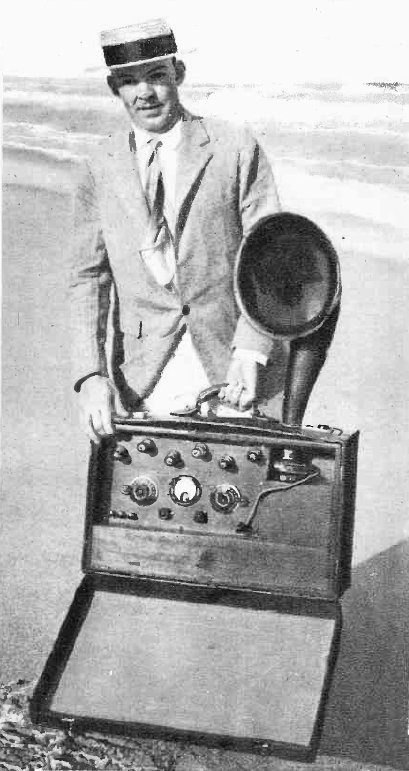
Armstrong, 1923, with the first portable superheterodyne receiver — built as a wedding present for his bride, Marion, and carried on their honeymoon. The architecture inside this suitcase is the architecture inside every AM radio since. (Photo: public domain, via Wikimedia Commons.)
Super-regeneration (1922) — and a seat at RCA's table. Armstrong's third invention squeezed still more amplification out of a regenerative detector by quenching it in and out of oscillation thousands of times a second. RCA bought it for cash and stock — a deal that made Armstrong the largest individual shareholder of the Radio Corporation of America. It also brought him into David Sarnoff's offices, where he met and married Sarnoff's secretary, Marion MacInnis. Super-regeneration never conquered broadcast receiving, but it lived for decades in police radios, aircraft sets, and eventually garage-door openers and radio-controlled toys.
The irony. Having built AM's transmitters a clean oscillator and AM's listeners the perfect receiver, Armstrong spent the 1920s attacking the one enemy left: static. His conclusion — that the answer was not a better AM receiver but a different modulation entirely — became wideband FM in 1933, and it set him against the industry his patents had built, including RCA itself. The fight over FM's spectrum, royalties, and credit consumed his fortune and his health, and on February 1, 1954, Armstrong took his own life. His widow Marion carried on the infringement suits against the radio industry — and won or favorably settled every one of them.
FM got his last twenty years. But AM got the first twenty — the regenerative detector that made broadcasting worth listening to, the oscillator at the heart of the transmitter, and the superheterodyne inside every radio on the band. By any honest accounting, every AM radio is an Armstrong radio.
Armstrong's superheterodyne, 1918 — inside every AM radio since the 1920s. The gold labels show where each job lives in the All American Five.
Sources: Encyclopaedia Britannica (Edwin H. Armstrong); IEEE / Wireless History Foundation; Linda Hall Library; Mayo Clinic Proceedings biographical sketch; Lawrence Lessing, Man of High Fidelity.
Between the crystal set and the transistor, one circuit owned American radio: the "All American Five," a five-tube superheterodyne built in the millions by hundreds of manufacturers from the 1930s into the 1960s. Whatever the name on the cabinet — Philco, Zenith, Emerson, Motorola, or a department-store house brand — the chassis inside was overwhelmingly likely to be the same five tubes doing the same five jobs: converter, IF amplifier, detector/first audio, audio output, and rectifier. It was the Model T of radio, and its entire design philosophy fit in one sentence: make it as cheap as possible without making it bad.
The trick: delete the transformer. The most expensive single part in a radio was the power transformer, and the AA5's defining move was to not have one. The five tube heaters were wired in series across the AC line, like old-style Christmas lights — and the elegance is hiding in plain sight in the tube numbers, because the first number of each type is its heater voltage. Add up the classic 1950s lineup — 12BE6, 12BA6, 12AV6, 50C5, 35W4 — and you get 12 + 12 + 12 + 50 + 35 = 121 volts, against a 120-volt wall outlet. That is not a coincidence: the tubes were designed as a matched family, all drawing the same 150 mA, summing to the line voltage so that no transformer and not even a dropping resistor was needed. Plate voltage came straight off the line through the rectifier; even the dial lamp was powered from a clever tap on the rectifier's own heater, with the set's B+ current routed through it to balance the string. Every last penny was engineered out.
It worked — and it cleared the field. Cheap did not mean bad. A well-aligned AA5 had sensitivity limited by man-made noise rather than by the radio itself, selectivity that could separate stations 40 kHz apart, and enough pickup from its built-in loop antenna that most homes never needed an outside wire. Two knobs — volume and tuning — and anyone's grandmother could run it. The economics were merciless: Atwater Kent, one of the grand names of 1920s radio, chose to shut down entirely rather than compete with the cheap AA5 "midget" sets. By the 1940s the five-tube formula was simply what a radio was, from Catalin-cased Fada beauties now worth thousands to brown Bakelite kitchen-shelf sets sold for $9.95.
The catches. The deleted transformer had also been the radio's safety isolation, so one side of the AC line was connected directly to the metal chassis — the infamous "hot chassis." Get the plug in the wrong way around and the chassis sat at 120 volts above ground, which is why AA5s lived in carefully insulated cabinets with recessed mounting screws and why generations of repairmen learned to touch the chassis with the back of the hand first. The series string had the old Christmas-light failure mode, too: one heater opens and all five tubes go dark. And the design's "AC/DC" badge was real — plenty of American buildings still had DC mains into the 1940s, and on DC the radio played only with the plug inserted the right way around.
The AA5 is the receiver of AM's golden age — the box the soap operas, the war news, and the ballgames actually came out of. It displaced the crystal set on one end and was itself retired by the transistor on the other (see The Regency TR-1), though tube AA5s kept rolling off lines into the 1960s because the formula was so cheap that nothing — for a while — could undercut it. Millions survive in attics and on collectors' shelves, and most will still play today with nothing more than new filter capacitors — the Model T of radio, still running.
Sources: Wikipedia (All American Five); G. Rabjohn, "The All-American Five" (rabjohn.ca); Fun With Tubes, "The All American Five: Introduction and Power Supply"; Antique Radio Forums.
In 1954 the transistor was six years old and had conquered exactly one consumer product: the hearing aid. The reason was money — a transistor cost around $20 against a dollar for a vacuum tube — and Texas Instruments, then a little-known maker of oilfield instrumentation sitting on a production line of germanium transistors, badly needed a product that would make the world want them. TI built a prototype pocket radio and shopped it to the radio industry. Every major maker — RCA, Philco, Emerson — said no.
The yes came from a company almost nobody had heard of: I.D.E.A. (Industrial Development Engineering Associates) of Indianapolis, founded by two ex-RCA engineers, whose main business was TV signal boosters for rural viewers. Under its Regency brand, I.D.E.A. took TI's prototype and made it manufacturable: engineer Richard Koch cut the transistor count from eight to four — each one saved real money — and laid out a circuit board with the components soldered directly on, shrinking everything to fit a case the size of a shirt pocket. From handshake to store shelves took about six months, on a deadline chosen for one reason: Christmas.
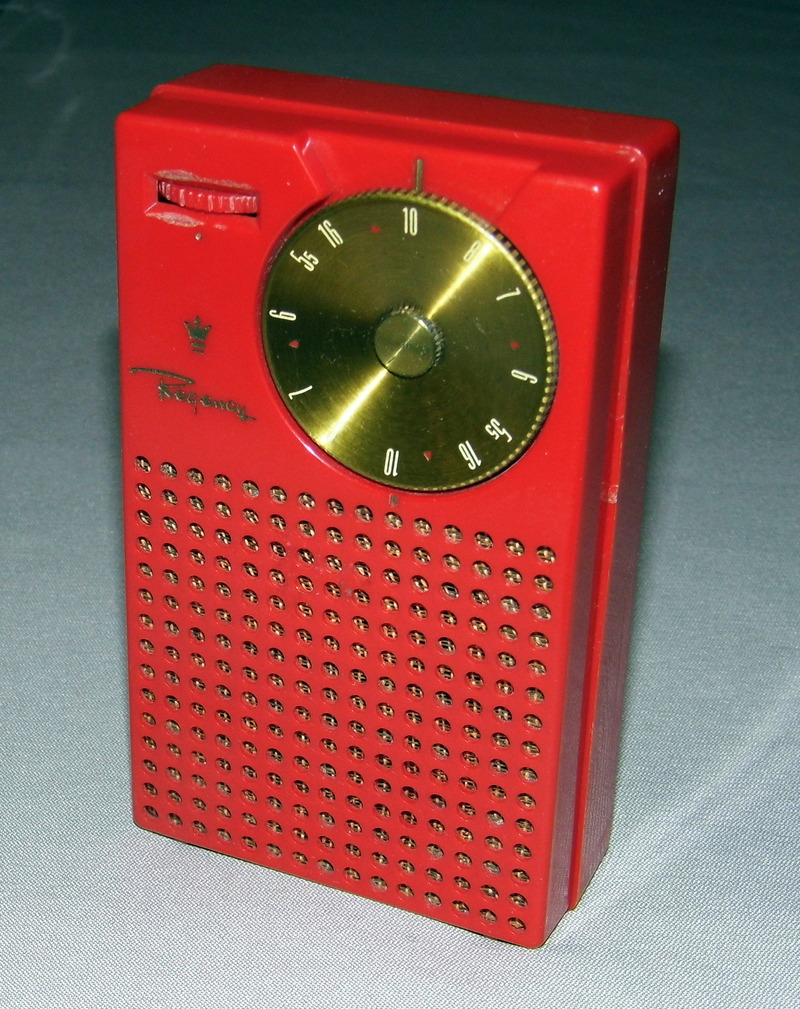
The Regency TR-1 was announced on October 18, 1954 and went on sale in New York and Los Angeles on November 1: four germanium transistors, a 22.5-volt battery good for more than twenty hours, eleven ounces, $49.95 — over $500 in today's money, for a radio that, frankly, didn't sound very good. The cost-cutting that got it down to four transistors also gutted the audio output, and reviewers said so. It didn't matter. The TR-1 was sold as a fashion object — mandarin red, turquoise, lavender, pearl white, lime — in an era when radios came in wood-tone boxes, and it was the first radio in history you could carry in a pocket and forget you were carrying. About 100,000 sold in the first year.
What it changed was the relationship between the listener and the AM band. Radio had been furniture — the family gathered around the console. The TR-1 made it personal: rock and roll went to the beach, the ballgame rode in a work-shirt pocket, and a generation of kids discovered nighttime skywave with a transistor under the covers, parents none the wiser — the recruiting tool of the clear-channel DXing hobby. This is also the generation in which the ferrite loopstick became the universal AM antenna: the transistor shrank the radio, and the ferrite bar shrank the antenna to fit inside it (see The Tunable Loop). The transistor portable arguably extended AM's golden age even as television was ending it (see The Golden Age & Decline of AM Radio) — the console audience was lost to TV, but the pocket audience was brand new.
The TR-1 also won a race it didn't know it was in. Raytheon crossed the line the following year with a larger "picnic portable," and close behind came an unknown Japanese firm, Tokyo Tsushin Kogyo, whose transistor portables would soon flood the American market — after the company renamed itself something Americans could pronounce: Sony. The TR-1 itself was made for only about a year, which is why survivors are prized collectibles today, selling for thousands of dollars in the right color — and, in fine TR-1 tradition, usually not working.
Sources: Engineering and Technology History Wiki, "T.I. Unveils Transistor Radio"; Wikipedia (Regency TR-1); collectornet.net Regency TR-1 facts and figures; regencytr1.com; EDN, "TI announces 1st transistor radio."
For a band everyone keeps writing off, AM has a surprising trick: it can broadcast in digital. Not someday — now, legally, nationwide. The technology is called HD Radio, and it comes in two flavors that matter very differently for AM's future.
Hybrid mode — digital riding alongside analog. The common form keeps the station's normal analog AM signal and tucks a digital sideband next to it. Listeners with an HD receiver get cleaner, wider audio — even stereo and on-screen metadata — while everyone with an ordinary radio still hears the regular analog broadcast. One engineer described the difference on his hybrid AM HD station bluntly: music in stereo, voices far clearer, and the hum from home computers, LED lights, and phone chargers simply gone. The trouble is that the AM band is electrically noisy and tightly packed, so the hybrid digital sideband is fragile and has never spread widely.
All-digital mode (MA3) — the real leap. This drops analog entirely and broadcasts the whole channel as digital. The landmark station is WWFD "The Gamut," 820 kHz, in Frederick, Maryland (Hubbard Broadcasting), which in 2018 became the first licensed U.S. station to shut off its analog AM signal and run purely in digital MA3 mode under an FCC experimental authorization. It worked beautifully — the all-digital signal stayed solid far past where analog would have dissolved into static.
Hybrid keeps an analog core for ordinary radios; all-digital gives the entire channel to the digital signal.
How far does it reach? In testing, WWFD's all-digital signal held together out to roughly the 0.1 mV/m contour — about one-fifth the strength of the old analog daytime standard, and only about 5% of the signal level normally considered usable on today's radios. In plain terms, the digital signal stayed listenable in places where analog AM would have been unintelligible hiss.
WWFD's reach by contour — all-digital stays solid where analog would have faded out. (Population figures from the station's own coverage study; not to geographic scale.)
The FCC opened the door. In October 2020, on the strength of the WWFD experiment, the FCC approved an all-digital option for any AM station that wants it. The rules are pragmatic: a station must give 30 days' public notice before flipping the switch, must provide at least one free over-the-air digital stream as good as or better than analog, and must keep participating in the Emergency Alert System. The Commission approved only HD Radio's MA3 mode, declining for now to consider the European Digital Radio Mondiale standard — while explicitly leaving the door open to other technologies down the road.
Why this is the optimistic chapter. The pieces are quietly falling into place. Every HD Radio already in a car dashboard can receive all-digital AM — tens of millions of receivers, no new hardware required — because AM and FM HD were always sold as one package. WWFD has now run all-digital full-time past its five-year experiment and stayed on the air, and its champion, engineer Dave Kolesar, says he's more optimistic today than when he started: FM-quality sound, song and station metadata on the dash, and newer in-car platforms like DTS AutoStage helping put AM stations on a level playing field with everything else on the screen. All-digital won't save every AM station, and uptake so far has been a trickle. But for the first time in decades, the band has a credible technical future that doesn't depend on nostalgia: a path where AM sounds as clean as anything else in the car, carries data like its rivals, and reaches farther than it ever did in analog. The bet is placed. The receivers are out there. The rest is whether broadcasters decide to jump.
It's a fitting next chapter after the Golden Age & Decline story — and the spiritual successor to the band's last big technical gamble, AM Stereo, with one crucial difference: this time the receivers are already in the field.
Sources: Radio World (All-Digital MA3 coverage analysis; FCC Approves All-Digital Option; Kolesar interview; Takeaways From the AM Digital Order) · FCC (All-Digital AM Report & Order, Oct 2020) · HD Radio / Xperi · Wikipedia (WWFD).
It sounds like a tall tale: a radio with a single tube, a coil of wire, and a pair of headphones, pulling in stations from clear across the country — and on a good night, from across the ocean. But the one-tube receiver was real, it was popular for decades, and it worked thanks to one of the most ingenious tricks in all of radio: regeneration.
Ordinarily a tube detects a signal once and passes it along. Edwin Armstrong's insight, made while he was still an undergraduate at Columbia — invented in 1912, patented in 1914 — was that radio-frequency energy still lived in the tube's output circuit after detection, and that a controlled trickle of it could be fed back to the input through a small "tickler" coil. Round and round the signal went, amplifying itself on every pass, until a single tube delivered as much as seventeen hundred times the gain it had alone. That one tube now did three jobs at once — amplifying the radio signal, detecting it, and amplifying the audio — which is exactly why it could stand in for a whole receiver. In an era when vacuum tubes were expensive, wringing everything from one tube wasn't a stunt; it was the whole point.
It took a feel in the fingertips. The set had a regeneration control, and the trick was to advance it right up to the brink of oscillation, where sensitivity peaked, without tipping over — because one notch too far and the tube broke into a squeal that not only drowned the station but leaked back out the antenna to annoy the neighbors. Riding that knife-edge was the skill of the regenerative operator, and half the fun. There is a nice irony in the origin, too: Lee de Forest, who built the first tube, had stumbled onto this very feedback back in 1912 and spent his energy trying to get rid of the howl. Armstrong saw what it was worth.
The one-tube regen became the staple of the homebrew magazines — Short Wave Craft, Radio News, QST — whose readers built them on cigar boxes and breadboards from published plans. The most famous scheme came from a radio fan named Walter Doerle of Oakland, California, whose simple regen receiver, first published in December 1931, caught on like wildfire and was soon popularized by the radio shops along New York's fabled "Radio Row." For about four dollars — a couple of days' wages — a builder could put together a set like the Twinplex and have a working shortwave-and-broadcast receiver. These little sets earned an affectionate nickname: the "thrill box," for the thrill of sitting up late, nudging the regeneration, and suddenly hearing a foreign voice swim up out of the static from across the ocean.
The regenerative receiver eventually gave way to the superheterodyne, which was more stable and didn't squeal at the neighbors — but the one-tube wonder never really died. It lived on as the classic first project of anyone learning the craft, from the Knight-Kit Ocean Hopper to the kits builders still solder up today. It remains the purest demonstration of a beautiful idea: that with Armstrong's feedback trick, a single tube, a coil, and a long wire to the sky, you can reach out and touch the whole world.
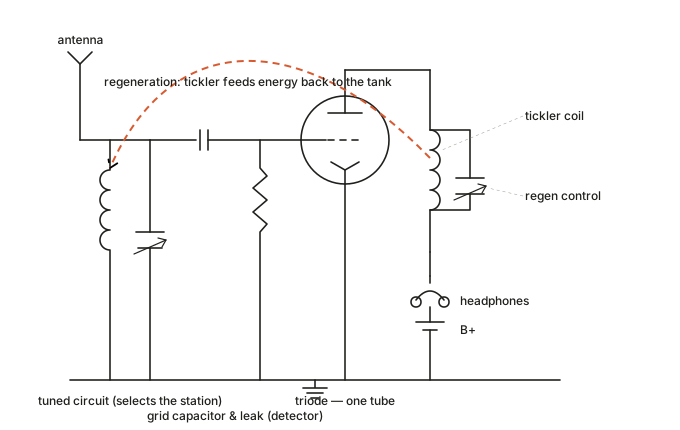
Sources: Wikipedia (Regenerative circuit; Edwin Armstrong); OneTubeRadio.com & W1UJR (Doerle sets); Short Wave Craft (one-tube type 30; Twinplex).
If the one-tube regenerative set was the wonder of the 1920s and '30s, the one-transistor radio was its solid-state heir. When the transistor arrived in the 1950s, the same beautiful idea crossed over intact: get the most from the least. A single transistor, a coil, a germanium diode, and a high-impedance earphone could pull a broadcast station out of the air — no tubes, no high voltage, no warm-up, just a flashlight battery and a little ingenuity.
Like the one tube before it, the one transistor earned its keep by doing more than one job. In a reflex circuit, the same transistor amplifies the incoming radio signal, hands it off to a diode to be detected, and then amplifies the recovered audio — double duty from a single device. And Armstrong's old trick carried over without a hitch: wind a feedback coupling into the coil and the transistor becomes a regenerative detector, feeding a controlled trickle of its output back to its input for enormous gain, right up to the edge of oscillation. The squeal, the knife-edge regeneration control, the late-night distance reception — all of it returned, now running on a couple of volts.
What turned this from a laboratory curiosity into a kid's-allowance hobby was a single humble part: the Raytheon CK722. Introduced in early 1953, it was the first low-cost junction transistor sold to the general public — and its origin is one of radio's great thrifty stories. Raytheon's hearing-aid transistors that didn't quite make the grade were re-graded and sold to hobbyists; the CK722 was, in effect, a premium part's reject given a second life. It started at $7.60, fell to $3.50, and by 1956 cost ninety-nine cents. Norman Krim, the Raytheon engineer behind it, arranged to sell it through a Boston outfit called Radio Shack, and the company seeded the hobby with design contests and project booklets. Hundreds of magazine projects followed.
The little radios showed up everywhere. In 1955, Popular Electronics launched a column called "Transistor Topics" and ran a one-transistor regenerative broadcast receiver built around the CK722 — about as sensitive as a good crystal set, the editors said, but far more selective. General Electric answered with its own hobbyist transistor, the 2N107, and the two parts became interchangeable in countless beginner projects. And just as the tube generation had the Knight-Kit Ocean Hopper, the transistor generation had Radio Shack's Science Fair and "P-Box" kits — the one- and two-transistor radios soldered up on kitchen tables by the thousands. Many were designed and documented by Forrest M. Mims III, whose hand-drawn project notebooks launched a generation of engineers.
The one-transistor radio never had much of a commercial life; the pocket sets you bought at the drugstore used six transistors or more. But that was never the point. Like the one-tube wonder, it was the purest possible demonstration that radio is not magic but understandable craft — and that you could hold the whole working thing, a single amplifying device and a coil of wire, in the palm of your hand. From a tube to a transistor, the lesson stayed the same: with a little knowledge and the simplest of parts, the airwaves are yours.
Sources: Wikipedia (CK722; 2N107); Computer History Museum / Semiconductor Museum (Jack Ward); OneTubeRadio.com; radioshackcatalogs.com; Hackaday.
In the first years of broadcasting, for most ordinary Americans there was really only one way to own a radio: build it yourself. Finished factory sets existed, but they were scarce and expensive, so the rest of the country wound a coil of wire, mounted a chip of galena crystal, and went hunting for stations by dragging a fine "cat's whisker" wire across the rock until a signal appeared. Building your own wasn't a hobby yet — it was simply the price of admission. And from the very beginning it carried a second purpose: the magazines and pamphlets that showed you how to build a set also taught you, coil by coil, how radio actually worked.
The entry point was the crystal set — the simplest receiver ever devised, an antenna, a coil, a tuning capacitor, a galena detector, and a pair of earphones, with no battery or power of any kind (it has its own section here). It was nearly free and nearly magical, and its first great craze swept the country in the 1920s. Anyone who wanted a louder signal and distant stations graduated to the regenerative receiver, built around a vacuum tube, and to branded build-at-home kits like National's Regenaformer. You could buy the parts loose from a catalog, follow a plan from Radio News, or assemble a kit on the kitchen table — but one way or another, you built it.
Cheap factory radios eventually made all that optional. By the 1930s a Crosley table set cost twenty dollars, and home building receded into a hobby. Then, after the Second World War, it came roaring back — and this time the selling point was learning. A Benton Harbor, Michigan businessman named Howard Anthony bought boxcars of surplus wartime electronic parts and, in 1947, turned them into the first Heathkit: a five-inch oscilloscope that sold for $39.50, a fraction of the factory price. It was a runaway hit, and it launched the golden age of the electronic kit.
Heathkit became the giant of the field — "the world's finest electronic equipment in kit form," by its own slogan — and over four decades it shaped two generations of hobbyists with test gear, ham radio, hi-fi, even color televisions and trainer kits built expressly for the classroom. It had plenty of company:
| Brand | Maker | Era | Known for |
|---|---|---|---|
| Heathkit | Heath Co., Benton Harbor MI | 1947–1990s | The giant: test gear, ham, hi-fi, even color TVs |
| Knight-Kit | Allied Radio, Chicago | 1950s–1970s | Beginner sets like the Ocean Hopper receiver |
| EICO | Electronic Instrument Co., Brooklyn | 1945–1970s | Test equipment and audio, a quality rival to Heath |
| Lafayette | Lafayette Radio, New York | 1950s–1970s | Audio and general hobby kits |
| Science Fair / Archer | Radio Shack (Tandy) | 1969–1990s | "xx-in-1" spring-clip project kits; the classic crystal radio |
| Dynaco / Fisher | various | 1950s–1970s | High-end hi-fi audio in kit form |
What nearly all of them shared was that second purpose from the 1920s, now made explicit: you built the thing in order to understand it. Heath sold trainer kits to schools; Radio Shack's Science Fair line, launched in 1969, put electronics into the hands of children and adults alike; and the humble crystal set became — and remains — the standard first project of the middle-school science fair and the Scout merit badge. Ask almost any engineer or ham of a certain age how they got started, and you'll hear about a kit on the kitchen table and the smell of rosin-core solder.
The kit era finally closed for a simple reason: imported electronics got so cheap, and their parts so tiny, that building your own no longer saved money or could even be done by hand. One by one the great names went dark — EICO, Knight, Dynaco, and at last Heathkit itself. But the impulse behind them never died. It runs straight through to today's Arduino boards, Raspberry Pi computers, and the whole maker movement — the same conviction that lit up the 1920s, that the surest way to understand the magic is to build it with your own hands.
Sources: Wikipedia (Crystal radio; National Radio Company); EE Journal & Nostalgic Kits Central (Heathkit, Knight-Kit, EICO); radioshackcatalogs.com; Hackaday; DZKit.
By the mid-1970s, the clock radio had become the most quietly universal appliance in the American home. It was the default gift — for a graduation, a birthday, a kid heading off to college — and cheap enough that a single household might own four or five, one glowing on every nightstand. It was also, for most people, how AM radio actually lived in the house. You didn't sit down in front of it the way your grandparents had; you woke up to it, the morning DJ and the news on the hour drifting out of a little plastic box at six o'clock sharp.
The idea was nearly thirty years old by then. The first dedicated clock radio was the Telechron Musalarm, model 8H59, introduced in 1948 — an AM-only tube set in a maroon plastic case that promised, in its own words, to "awaken you to radio music or automatically turn on your favorite radio program at any time selected." That single promise — wake to your station, not to a jangling bell — is the whole reason the clock radio existed, and it was there in the very first model. Telechron was a fitting inventor for it: the company had built its name on the synchronous electric clock, which kept time by counting the steady 60-cycle hum of the AC power line. Marry that accurate little clock motor to an All American Five–style AM radio, and you had the Musalarm.
The features that would define the breed were mostly in place early, then refined over the next two decades. A switch let you choose your wake-up: gentle radio, or the old-fashioned buzzer for heavy sleepers. A sleep timer — the "sleep" switch — let the radio play you off to sleep and then shut itself silently off after anywhere from a few minutes to an hour. And the snooze, that small daily mercy, arrived when General Electric-Telechron added the first snooze button in 1956; the famous nine-minute snooze interval was a quirk of the clock's gear teeth, and it has stuck around so long it now feels like a law of nature. Every bit of it, at first, was AM only.
| Year | Milestone |
|---|---|
| 1948 | Telechron Musalarm 8H59 — the first dedicated clock radio (AM only) |
| 1956 | GE-Telechron adds the first snooze button (the ~9-minute snooze) |
| mid-1960s | Sony's Dream Machine and the first digital clock radios appear |
| 1970s | Heyday — flip-numbers give way to red LED, FM is added, cheap house-brands everywhere |
What changed across the 1970s was the face of the thing. The early sets read out the time on a mechanical flip clock — little hinged leaves printed with numbers that physically tumbled over, with that soft, satisfying clack you could hear across a silent bedroom. Then the glowing red LED display arrived and, by the end of the decade, largely took over. Sony's Dream Machine line, a popular holiday gift since the early '70s, helped make the digital readout feel modern and aspirational. The cabinets were unmistakable: wood-grain vinyl on plastic, a slanted face, thumbwheels for tuning and volume, a long snooze bar across the top. Cheap house-brands — the Radio Shack and drugstore models — put one within reach of everyone, and only as the line matured did FM finally join the AM band that had been there from the start.
There's a straight line running through all of it. The clock radio was, in a real sense, the last act of the All American Five — the same five-function AM superheterodyne, now shrunk onto a transistor board and wedded to a clock motor. The living-room tube set of 1948 had become the transistor box that woke a teenager in 1976. For a couple of generations it was the first sound of the morning and the last of the night, the way AM radio threaded itself into the ordinary rhythm of the house. Then the smartphone swallowed the clock, the alarm, and the radio all at once — and the nightstands went quiet.
Sources: telechron.net; Radiomuseum (Musalarm 8H59); Wikipedia (Telechron; Sony Dream Machine); Hunker / hhhistory.com (first snooze button); Click Americana.
In the depths of the Great Depression, when most American families were buying the cheapest set that would pull in the local stations, a handful of manufacturers went defiantly the other way. They built radios as showpieces — towering chrome-chassis consoles with two dozen tubes and three loudspeakers, made for the buyer who wanted the finest set money could buy and didn't much care what it cost. These were the Rolls-Royces of the radio age, and a few of them genuinely cost more than a new automobile.
At the very top stood the custom houses. E.H. Scott of Chicago built what it advertised as the world's finest receivers — gleaming chrome-plated chassis assembled largely by hand, in models like the 30-tube Philharmonic and the almost mythical Quaranta, a roughly 40-tube monster made to order for the very wealthy. Its great rival McMurdo Silver answered with the aptly named Masterpiece series. Capehart was the king of the luxury radio-phonograph, with elaborate automatic changers that flipped the record to play both sides. And Stromberg-Carlson of Rochester sold itself on pure audio quality under a slogan that brooked no argument: "There is nothing finer." Even mighty Zenith, the self-styled Royalty of Radio, joined them at the top with a single breathtaking flagship.
That flagship makes the whole point. The Zenith Stratosphere, model 1000Z of 1935, was a 50-inch tower of Art Deco woodwork housing 25 tubes, a 50-watt amplifier, and three speakers — and it sold for $750, which Zenith cheerfully marketed as "a rich man's radio." To put that in perspective: a brand-new Ford automobile that same year cost $652. The radio cost more than the car. E.H. Scott's 23-tube All-Wave console ran about the same $750 — three to four times the price of most ordinary consoles — and a few years earlier the Continental R-105 had listed at a staggering $1,600. Set against the radio the average family actually bought, the gap is almost comic:
| In the mid-1930s… | Tubes | Price |
|---|---|---|
| Zenith Stratosphere 1000Z (1935) | 25 | $750 |
| E.H. Scott All-Wave 23 console | 23 | ~$750 |
| — a brand-new Ford automobile | — | $652 |
| — a typical console radio | 6–8 | ~$100 |
| — a basic table radio | 4–5 | ~$20–$40 |
Almost nobody could buy these sets when they were new — only about 350 Stratospheres were built across four years — and that scarcity is exactly why they became holy grails. Today the Zenith Stratosphere is widely called the most sought-after antique radio in the world, with fine examples bringing $20,000 to $30,000. The even rarer Sparton Nocturne of 1937 — a five-foot disc of cobalt-blue mirror glass designed by the industrial stylist Walter Dorwin Teague, fewer than 100 ever made — has sold at auction for as much as $149,000. There's an honest footnote, though: what makes a vintage radio precious today isn't always how well it was engineered. The Stratosphere earns its price on rarity and genuinely fine sound, but the Sparton mirror sets are treasured as Art Deco sculpture more than as receivers. Beauty and rarity, not tube count, write the auction price.
These were the radios that proved AM broadcasting could be the object of real craftsmanship and real extravagance — built in tiny numbers, for the few who could pay more for a radio than their neighbors paid for a car. Most sat in grand parlors and were heard, by the standards of the day, as something close to miraculous. A handful survived the decades, and the very excess that made them rare in 1935 is what makes them priceless now.
Sources: SWLing Post; Collectors Weekly; EDN ("What's It Worth: Zenith Radios"); Antique Radio Forums; Radios Past.
This page is a catalog of transmitters; this section is about the people on the other end. For as long as there have been clear channels, there have been listeners who stayed up past midnight trying to pull a station in from a thousand miles away — the AM DXers.
When the D-layer dissipates after dark and skywave opens the band, a quiet frequency in one state fills with distant signals fading in and out. DXers chase them deliberately: logging a faint station identification at the top of the hour, mailing a reception report, and collecting the QSL card a station sends back to confirm the catch. The hobby organized early — the National Radio Club dates to 1933, the International Radio Club of America followed — and their bulletins were where terms like "graveyard DX" and the graveyard channels themselves were coined. The gear runs from ferrite loopsticks and big tunable loop antennas to long Beverage wires and, today, software-defined radios that can record the entire band overnight for later combing.
The holy grails are the hard catches: a low-power flea on a clear channel, a trans-Atlantic signal on the 9 kHz European spacing bleeding into the East Coast, or one of the border blasters booming up from Mexico. Every record on this page — the tallest tower, the tightest beam, the lowest nighttime power — is, to a DXer, simply a target.
Sources: National Radio Club · International Radio Club of America · DX News archives.
If you tuned the AM band at night before 1980, you heard something that no longer exists: empty space. The Class I-A clear channels were exactly what the name promised — frequencies where a single 50,000-watt station owned the night, with no other U.S. station anywhere allowed on the air after dark to interfere. When skywave opened the band at sunset (see Groundwave, Skywave & the M3 Map), those channels were a map of the continent. Spin the dial in a parked car a thousand miles from anywhere: WSM Nashville on 650, WLW Cincinnati on 700, WCCO Minneapolis on 830, KFI Los Angeles on 640 — each one alone on its frequency, armchair copy on a pocket transistor radio, just a slow fade and flutter to remind you the signal was bouncing off the ionosphere. A kid in rural Idaho could listen to big-league baseball from Chicago like a local. That experience — the heart of the clear-channel DXing hobby — was engineered into the band on purpose. And in 1980, the FCC dismantled it on purpose.
The rule that did it. The instrument was the FCC's Report and Order in Docket 20642, Clear Channel Broadcasting in the AM Broadcast Band, 78 FCC 2d 1345 (1980), upheld on reconsideration in 1981. Its provisions were surgical:
On paper it was an allocation proceeding. On the radio it was the end of an era.
What crowding actually sounds like. A clear channel didn't fill up overnight — it filled up the way a quiet room fills with conversations. First the existing secondaries, parked on the clears for decades at reduced night power with deep nulls toward the dominant station, were freed to double their power once the protection radius shrank. Then came brand-new full-time stations on frequencies that had never had them. Each new arrival used a directional pattern to protect the giant — but nobody was protecting the listener 800 miles out. Where a DXer once heard one carrier, there were now three or four: the old dominant station, secondaries riding underneath it, growl and flutter where carriers a fraction of a hertz apart beat against each other, and the occasional 10 kHz heterodyne whine from a station one channel over. The dominant station still won inside its 750 miles. Outside it, the channel became a layer cake — and pulling one signal out of the pile became work.
The DXer's game changed. Before 1980, logging the clears was the easy part of the hobby — the entry drug. After 1980, the clears became the hard part, and in a strange way the hobby got more interesting even as casual listening got worse. Armchair copy gave way to technique: loop antennas turned to null the dominant station, listening windows at the top of the hour for a station ID buried under a stronger carrier, sunrise/sunset skew paths when one station faded before another, and patience measured in seasons. The new secondaries themselves became the catches. Hearing WSM was no longer an achievement; hearing the 1 kW station hiding under WSM was. The clears went from being the postcard stations every beginner logged in a week to a lifetime checklist — 670 alone now offers Chicago, Boise, and a half-dozen others, all stacked on one spot on the dial.
Two stations, both sides of the story.
Why the FCC did it. The Commission wanted nighttime service to the "white areas" — regions with no local night signal — and invoked its 1927 "Three-Legged Stool" criteria: a service to everyone, from as many diverse sources as possible, with local outlets in every community. The breakup was also sold as a path to minority ownership of major facilities, and the FCC argued it "didn't have time to wait" for alternatives like FM expansion. The irony was visible even then: the order's premise that AM was the only viable nighttime service was written by the same staff drafting FM Docket 80-90, the proceeding that would flood the country with new FM signals and make the premise obsolete within a decade.
The verdict, forty-five years on. Whether the new stations delivered the promised local service is debatable; what's not debatable is what happened to the band. The one-voice nighttime clear channel — the most distinctive sound in American radio for fifty years — is gone, and it isn't coming back. Today's noise floor, switching power supplies, and thinning station rosters have done further damage, but the layer-cake dial you hear after dark was designed, docketed, and ordered. For the DXer, the 1980 Report and Order is the dividing line in the hobby's history: everything before it was about distance; everything after it is about digging.
| Year | Event |
|---|---|
| 1928–41 | General Order 40 and NARBA establish the clear channels; I-A stations protected nationwide at night |
| 1945 | FCC opens Docket 6741, the "Clear Channel Matter" — 40 days of hearings, 1946–48 |
| 1961 | First breakdown: duplication ordered on 13 of the 25 I-A channels; 12 remain truly clear |
| 1979 | WSM's "Save the Grand Ole Opry" campaign fights the coming breakup; Congress pushes the 50 kW cap |
| 1980 | Report & Order, Docket 20642: second stations on the last 12 clears, protection cut to ~750 miles, 100+ new secondaries, 50 kW cap permanent |
| 1982 | The upgrades begin — KBOI 670 doubles to 50 kW nights, February 20 |
| 1983 | Rio Agreement: Class I-A/I-B become today's Class A (see AM Station Classes) |
| 1986 | The new arrivals sign on — KTNN 660, February 26 |
Sources: FCC, Clear Channel Broadcasting in the AM Broadcast Band, 78 FCC 2d 1345 (1980, Docket 20642; recon. 1981) · Mark Durenberger, "Behind the Clear-Channel Matter" (Radio World / NRC reprint, 2000) · Museum of Broadcast Communications · oldradio.com · RadioDiscussions (KBOI dates) · Wikipedia (Clear-channel station; KTNN).
The cheapest, simplest piece of serious AM DX gear ever made is a coil of wire and a variable capacitor: the passive tuned loop. It has no battery, no amplifier, and — the part that surprises people — no connection to the radio at all. You set it next to a portable radio, tune its knob to the same frequency the radio is on, and weak stations rise out of the noise. Commercial versions like the venerable Select-A-Tenna and the Terk AM Advantage are 9-to-11-inch discs; the homebrew version is a wooden cross-frame with a dozen turns of wire and a 365 pF variable capacitor salvaged from a junked radio. Either way the circuit is identical, and it is the entire circuit: one coil, one capacitor.
How a coil and a capacitor become gain. The loop and capacitor form a parallel resonant circuit. Tuned to the incoming station, the high-Q loop rings up a circulating current, and the magnetic field of that current is far stronger — right next to the loop — than the bare signal arriving from the sky. The radio's internal ferrite bar, sitting in that concentrated field, simply inhales it: inductive coupling, the same physics as a transformer with air for a core. The effect on a weak daytime signal can be startling — stations that were completely inaudible become comfortable listening. And because the boost only exists at the frequency the loop is tuned to, there's none of the overload a long random wire dumps into a small radio: the loop is an amplifier and a preselector at once, made of two parts.
The null is the real superpower. A loop hears in a figure-8: maximum off the two broadside directions, and two sharp, deep nulls. The peak is nice; the null is what DXers pay for. Rotate the loop to drop a co-channel pest, a first-adjacent splatter source, or a buzzing wall-wart into the notch — tilting the loop finds the last few dB — and a station 20 or 30 dB under the interference comes up out of the hole. Hobbyists routinely null nearby 50,000-watt locals down to a whisper to work the channel underneath. On today's crowded dial, where every former clear channel carries a stack of stations after dark (see When the Clear Channels Stopped Being Clear), the loop's null is how a listener un-stacks the pile — it's the receiving-end cousin of the directional array, doing with one rotatable coil what stations do with towers and phasors.
Old technology, never bettered. Big tuned loops were the receiving antenna of the 1920s — the elegant spiderweb and box loops that sat atop console radios before ferrite bars shrank the loop into the cabinet in the 1950s. The modern passive loop is the same idea brought back outside the box: the Select-A-Tenna has been sold essentially unchanged for decades, the Terk AM Advantage dresses the circuit up for the living room, and a homebrew frame loop built in an afternoon performs right alongside them. Practical notes: orient the loop's windings in the same plane as the radio's ferrite bar for best coupling; prove it to yourself on a weak daytime signal, because at night the radio's AGC masks the gain (the null still works fine — after dark it's the null you want anyway); and a radio with no internal ferrite bar can't couple inductively, which is why the commercial loops include a direct-connection adapter.
Sources: radiojayallen.com loop antenna reviews (Select-A-Tenna, Terk AM Advantage, Degen TG39); AA7EE, "A Tuned Loop Antenna for the AM Broadcast Band"; RADIO-TIMETRAVELLER ferrite loopstick series; Arcane Radio Trivia, "Inductive Coupling and the Select-A-Tenna."
An offshore "pirate" station puts the transmitter on a ship (or an abandoned sea fort) anchored in international waters: perfectly legal where the station is, merely unlicensed everywhere it's heard. The form is forever associated with 1960s Britain and Radio Caroline, but the story is bracketed — and substantially built — by Americans. (The land-based version of the same trick, with real licenses and outrageous power, is over in Border Blasters.)
America did it first — from a casino ship, 1933. Thirty-one years before Caroline, station RXKR signed on from the SS City of Panama, anchored in the gambling-ship fleet off Southern California. Panama had licensed the ship as a floating tourism showcase and the station for 500 to 1,000 watts of noncommercial programming on 815 kHz; the owners instead ran a floating speakeasy and casino, pumping out roughly 5,000 watts of popular music and paid advertising. The signal was logged on the East Coast, in Hawaii, and in northeastern Canada. The U.S. State Department leaned on Panama, the registry was withdrawn, and by August 1933 the ship was towed into Los Angeles harbor — the first offshore pirate, gone in a single summer. The gambling fleet itself kept using radio as a barker: mobster Tony Cornero's ship Rex, bankrolled by Bugsy Siegel, drew thousands of customers a night off Santa Monica with signals heard along the whole West Coast.
The Texas invasion of Europe. When offshore radio was reborn in the North Sea, the format — and much of the money — was Texan. Gordon McLendon, the Dallas owner of KLIF and one of the architects of Top 40 (the same showman behind the first traffic helicopter — see Eyes in the Sky — and the KABL simulcast caper in The Simulcast Pendulum), co-founded Radio Nord, broadcasting KLIF-style Top 40 with Dallas-made PAMS jingles — sung in Swedish — to Stockholm from 1960 to 1962. Then in April 1964 Don Pierson, a car dealer and small-town bank owner who was also mayor of Eastland, Texas, read about Radio Caroline's success in the Dallas papers and decided Britain needed a properly American station. He raised $500,000 from Texas investors, bought a former U.S. Navy minesweeper, renamed it the MV Galaxy, and launched Wonderful Radio London — "Big L" — in December 1964, deliberately modeled on KLIF, with McLendon as program consultant and PAMS of Dallas singing the jingles. The backers' original plan was to call it "Radio KLIF (London)." Big L became the most professional and most popular of all the British pirates and gave the BBC the template it copied for Radio 1. Pierson, after losing control of Radio London, came back in 1966 with one ship carrying two stations — Swinging Radio England and Britain Radio — staffed largely with American DJs. The UK's Marine Broadcasting Offences Act of August 14, 1967 ended the era; Big L signed off that same day.
The American pirates kept coming. In May 1984 Laser 558 appeared off the English coast with an all-American airstaff, U.S. backing, and the slogan "all Europe radio" — a tight, fast CHR format that pulled millions of British listeners and drove the authorities to mount a standing blockade. (When Laser folded in late 1985, Radio Caroline grabbed its 558 kHz frequency.) And in July 1987 the form finally came home: Radio Newyork International, the project of radio engineer Allan Weiner, anchored the converted fishing vessel Sarah in international waters off Long Island and signed on with 1620 kHz AM — then an empty channel above the U.S. band — plus FM and shortwave outlets. New York newscasts made it famous within days, and within days the federal government boarded the ship, ending the broadcasts. Weiner ultimately took the Caroline path to legitimacy: today he is the licensee of shortwave station WBCQ in Monticello, Maine.
That's the arc of offshore piracy from the American side: it opened on a mob casino boat off Santa Monica in 1933, conquered Britain with Dallas formats and Dallas jingles in the 1960s, and closed with a fishing boat off Long Island whose owner ended up with an FCC license — the pirates, in the end, all came ashore.
Sources: Offshore Radio Museum (RXKR, KLIF/McLendon, Radio London histories); offshoreradio.info (City of Panama, Rex, PAMS jingle history); Texas State Historical Association (Gordon McLendon); History Today, "Original Pirate Material"; Wikipedia (Radio Newyork International, Laser 558).
Nothing on the AM band is an accident. Every signal you hear — its frequency, its power, its pattern, even whether it's allowed on the air after sunset — was put there by a government proceeding with a file number. The FCC calls them dockets: a numbered folder opens in Washington, engineers and lawyers argue into it for years, and eventually a Report and Order comes out the other end and the band sounds different. Most listeners never hear of them. But if you want to understand why the band sounds the way it does tonight, the docket numbers are the chapter headings of its history. Here is the ladder, top to bottom.
Roads not taken. The dockets that didn't happen shaped the band too. The superpower applications of the 1930s–40s — WLW's 500 kW experiment and the 750 kW proposals filed into Docket 6741 — died with the 50 kW cap (see The Superpower Era). Around 1980–81 the U.S. seriously studied shifting Region 2 to 9 kHz channel spacing, which would have squeezed a dozen new channels into the band — and detuned every directional array on the continent; broadcaster and Congressional opposition killed it. And the proceeding that arguably did more to AM than any AM docket wasn't an AM docket at all: FM Docket 80-90, which flooded the country with new FM signals and pulled the audience — written by the same Commission, at the same time, as the 1980 clear channel breakup.
| Docket | Year | What it did |
|---|---|---|
| General Order 40 | 1928 | Founding allocation: clear / regional / local channel structure |
| 6741 | 1945–48 | Clear Channel Matter hearings — breakup vs. superpower, unresolved |
| 20509 | 1977 | Travelers' Information Stations at 530 / 1610 kHz |
| 20642 | 1980 | Clear channel breakup — protection cut to ~750 mi, 50 kW cap permanent |
| 21313 / ET 92-298 | 1980–93 | AM stereo "marketplace" punt; C-QUAM standard adopted too late |
| MM 87-267 | 1987–91 | AM Improvement — expanded band 1610–1700 kHz, NRSC standards |
| MM 99-325 | 2002 | Hybrid IBOC / HD Radio authorized |
| MB 13-249 | 2013– | AM Revitalization — FM translators, ratchet rule eliminated, MDCL |
| MB 19-311 | 2020 | Voluntary all-digital AM (MA3 mode) |
Sources: FCC Audio Division (AM Stereo Broadcasting; AM Revitalization; Digital Radio pages, fcc.gov) · Federal Register, All-Digital AM Broadcasting R&O, MB Dockets 19-311 / 13-249 (2020) · FCC, Clear Channel Broadcasting in the AM Broadcast Band, 78 FCC 2d 1345 (1980) · FCC Docket 20509 · Wikipedia (AM expanded band; General Order 40).
For a hundred years the car radio has been where AM lives. The band was built for the road: groundwave that follows the terrain, a signal that works in a moving vehicle with a whip antenna, no subscription, no cell tower, no login. Most AM listening today happens in a vehicle — which means the most consequential decision about the band's future isn't being made at the FCC at all. It's being made on dashboard spec sheets in Dearborn, Munich, and Fremont. And for the first time since the dockets in the previous section (Dockets That Shaped the AM Band), Congress itself has stepped in.
Who dropped it. In March 2023, Senator Ed Markey surveyed twenty automakers and found that eight had already removed AM radio from their electric vehicles: BMW, Ford, Mazda, Polestar, Rivian, Tesla, Volkswagen, and Volvo. This wasn't new — BMW had been shipping its i3 EV without an AM radio since 2014, and Tesla hadn't offered one in years — but the EV transition turned a quirk into a trend line. If the dashboard of the future is electric and the electric dashboard has no AM, the math for the band is grim.
The stated reason — and the real engineering. The automakers' explanation is electromagnetic interference: an EV's traction motor is driven by pulse-width-modulated current, and those fast-switching high currents induce noise that couples into the antenna system, raising a hash across the AM band — worst in the lower channels, roughly 500–700 kHz, right where the biggest clear-channel signals sit. The physics is real. The conclusion isn't. Interference is a shielding and filtering problem, not a law of nature — and the proof is on the road: General Motors and Stellantis EVs ship with working AM radios, as did earlier Ford EVs. Suppressing the noise costs money and engineering attention; deleting the receiver costs neither. Anyone who has chased RFI in a ham shack will recognize the choice being made.
The Ford saga. Ford went further than anyone: it announced AM would be deleted not just from EVs but from gasoline vehicles too, starting with the 2024 Mustang, arguing that less than 5% of its customers' in-car listening was AM and that streaming made the band redundant. The blowback was immediate — and it came from an unexpected direction: emergency management. AM isn't just nostalgia; it's the backbone of FEMA's National Public Warning System, built on hardened 50 kW Primary Entry Point stations (see PEP Stations) designed to keep broadcasting when everything else is down (see also EAS). On May 23, 2023, CEO Jim Farley publicly reversed course: AM would stay in all 2024 Ford and Lincoln vehicles, and owners of Ford EVs already shipped without it would get it back via a software update — a change delivered in software rather than hardware.
Washington pushes back. The same month, Senators Markey and Cruz introduced the AM Radio for Every Vehicle Act — about as bipartisan as Washington gets. The bill directs the Department of Transportation to issue a rule requiring every new passenger vehicle sold in the U.S. to include a receiver for AM (analog or digital AM) as standard equipment, easily accessible to the driver. Until the rule takes effect, any manufacturer omitting AM must say so on the window label and may not charge extra to add it; violations carry civil penalties. Despite majority support in both chambers, the bill died without a floor vote when the 118th Congress ended, was reintroduced in February 2025 (S.315 / H.R.979, with Bilirakis and Pallone leading in the House), and stalled again — until May 2026, when the House Energy and Commerce Committee voted 48–1 to fold it into the surface transportation package now headed for the House floor, with nearly 380 cosponsors across both chambers. As of June 2026, it is not yet law. If it passes, it will be something the band has never had in a century of regulation: a statutory guarantee of a receiver.
What it means for the band. Every previous fight on this page was about transmitters — who gets a frequency, how much power, what pattern. This one is about receivers, and that's new. A frequency allocation is worthless if the dashboard can't tune it; the quiet deletion of the AM receiver is, in effect, a deallocation conducted by purchasing departments. Whether the answer is a congressional mandate, better EMI engineering, or digital AM (see AM Goes Digital) riding inside the mandate's "digital audio AM" language, the dashboard war will shape the band's second century more than any docket since 1980.
| Automaker | AM in EVs (2023 Markey survey era) |
|---|---|
| BMW | Removed (since the i3, 2014) |
| Tesla | Removed (none offered for years) |
| Ford | Removed; announced gas-car deletion too — reversed May 2023, restored via software update |
| Mazda, Polestar, Rivian, Volkswagen, Volvo | Removed from EVs |
| General Motors, Stellantis | Kept — AM works fine in their EVs |
Sources: Congress.gov, S.315 / H.R.979, AM Radio for Every Vehicle Act of 2025 (119th Congress) · Markey automaker survey, March 2023 · IEEE Spectrum, "EV Interference Doesn't Have to Kill AM Radio" · The Drive / Detroit Free Press (Ford reversal, May 23, 2023) · NAB / Red River Farm Network (House E&C 48–1 vote, May 2026) · Broadcast Law Blog. Status current as of June 2026.
Today a radio is so deeply built into a car that the industry has to fight to keep it there (see The Dashboard War). It started as the opposite — a fragile, ruinously expensive luxury that took thirty years to become something you simply got with the car.
The radio that actually worked — Motorola, 1930. The car radio became real when brothers Paul and Joseph Galvin built the first commercially successful one in 1930. At about $120 it was still shocking — roughly a fifth of the price of a new car — but it sold. They needed a name, and since the most famous music machine of the day was the Victrola, they fused "motor" with "Victrola" to get Motorola: music in motion. It was an aftermarket set, not a carmaker's product.
Becoming factory equipment — Ford, 1933. The first real factory embrace came when Ford began offering Motorolas pre-installed at the plant in 1933. A 1934 deal to sell and install them through B.F. Goodrich tire stores helped drop the installed price to about $55 — and the long slide from luxury to commodity was under way.
Push-button presets — Motorola, 1936. By 1936 Motorola had added push-button station presets — credited as the first in a car radio — letting a driver jump to a favorite station with a single tap instead of hunting across the dial.
From luxury to standard. The price fell and adoption climbed with it. By the end of the Depression, roughly one American car in five carried a radio — and every one of them was AM. About nine million cars had built-in radios by the start of the postwar period, and by the late 1950s a factory radio was becoming standard on many models. The cost didn't vanish so much as disappear into the sticker price: the radio stopped being a line item you chose and became something that was simply there.
And radio had gone motoring even earlier — a working portable receiver rode along on a 1923 honeymoon, years before the purpose-built car radio existed (see The Armstrong Portable AM Radio).
Sources: Consumer Guide, "A Brief History of Car Radio" · Hagerty, "History of Obsolete Car Audio" · History.com, "First Company to Mass-Produce Car Radios Is Incorporated."
In 1923 Edwin Howard Armstrong (see Armstrong) built the first portable superheterodyne receiver and gave it to his bride, Marion, on their honeymoon. It was the superheterodyne — the circuit Armstrong had devised in 1918, the architecture inside very nearly every radio since — folded into a suitcase: receiver, batteries, and a loop aerial, all self-contained, its case a mix of Bakelite, leather, wood, and glass. That was a real novelty in 1923, when most "portable" sets still needed an outdoor wire and a fixed spot to sit.
Why it took batteries — and so many. A superheterodyne is a power-hungry design. Where a simple receiver got by on a tube or two, the superhet used a handful: Armstrong's original 1918 version ran eight tubes — mixer, oscillator, three stages of intermediate amplification, a second detector, and two audio stages — and the suitcase portables of 1923 carried six or seven. Every one of those tubes had to be fed, and in 1923 "fed" meant batteries — three different kinds, lettered for the path the electrons take through the tube.
The A, B, and C of it. American radios of the 1920s lettered their batteries for the path the electrons follow through the tube.
The "A" battery lit the filament — the wire heated until it boils off electrons. Low voltage, but high current, because heating takes real power. A set big enough to drive a loudspeaker wanted about 6 volts, usually from a lead-acid storage battery much like a car's; it was the heavy one, the thirsty one, and the one apt to leak acid.
The "B" battery fed the plate — the high-voltage supply (the "B+") that pulls electrons across the tube. It ran anywhere from 22.5 up to 135 volts, stacked from dry cells in 22.5-volt steps, but drew only a trickle of current.
The "C" battery set the grid bias — a small voltage on the control grid that holds the tube at its proper operating point. Because the grid draws essentially no current, the C battery barely discharged at all: its life in the set was little more than its shelf life. (Outside North America the same three went by LT, HT, and GB — low tension, high tension, grid bias.)
How Armstrong got it into a suitcase. The enabling trick was the tube. The portable superhets of this moment used UV-199 "dry-cell" tubes — built for a low-current filament that a light dry battery could supply, instead of the heavy 6-volt lead-acid cell a loudspeaker set demanded. With dry A, B, and C batteries and a loop aerial all folded into the case, the entire station traveled. Close the switch, the filaments lit, and a broadcast arrived in your lap — no wires, no wall outlet, anywhere you set it down.
The weak point — and a neat circle. Batteries were also the trouble. A dead one could kill the set in the middle of a program, a tipped lead-acid A battery could drip acid onto the carpet, and crossing the A and B leads could destroy the tubes. Those headaches are precisely why the industry chased "battery eliminators" — boxes that let a radio run on household current — and then all-AC sets. Here is the small, satisfying circle: the company that would later give the world the car radio, Galvin Manufacturing, got its start building battery eliminators, before Paul Galvin ever built the Motorola (see The AM Car Radio). And for the one kind of radio that needed no batteries whatsoever, see The Crystal Set.
Sources: The Henry Ford (first portable superheterodyne receiver, 1923) · Washington Post, July 15, 1923 (self-contained suitcase superhet, six UV-199 tubes) · "Edwin Armstrong: Superheterodyne Radio Development," Electronics Notes (eight-valve 1918 original) · RadiolaGuy.com, "Battery-Powered Radios of the 1920s & '30s" · HandWiki, "Vacuum tube battery."
Towers on this page tend to be celebrated for going up. Worth noting is how they come down — because an AM tower is uniquely vulnerable in ways its FM and TV cousins aren't, and the page already collects several spectacular endings.
Weather is the oldest enemy. Tall, slender, heavily guyed radiators are punished by ice loading and by wind, and hurricanes have taken named towers outright — the original Blaw-Knox diamonds at WBT Charlotte were destroyed in a hurricane and rebuilt as exact reproductions, a rare happy ending. Aircraft are a recurring hazard around the taller arrays: the page's own 12-tower KFXR night site so resembled a runway that a pilot once tried to land in it, and KKOB lost its daytime tower to a hot-air balloon in 2024. Development simply buys towers out of existence — see the stations whose sites were lost to sprawl and sold for the land under the radials.
And then there's the newest and strangest threat: theft. An AM ground system is tens of thousands of feet of buried copper, and a tower is tons of scrap steel, both of which have a cash value that has tempted thieves into vandalizing or even dismantling antenna systems — most audaciously in the case of the stolen WJLX tower, carted off entirely while the station was off the air. A 50 kW flamethrower and a one-watt graveyard station face exactly the same indignity: in the end, a tower is just valuable metal standing in a field.
The previous section is a catalog of the ways a tower dies — ice, wind, aircraft, thieves. This one is about why, at a serious AM plant, the death of the tower doesn't mean the death of the signal. Walk a major station's site and you'll often find the answer standing quietly off to the side: a second, usually shorter tower, fed by nothing, doing nothing, waiting. That's the auxiliary antenna — the standby — and it embodies a fifty-year-old broadcasting ethic: the signal does not stop.
Licensed redundancy. The FCC formally provides for auxiliary facilities: a station can license a spare antenna (and spare transmitters) alongside its main, with the aux's own measured or modeled parameters on file, ready for use whenever the main is down for maintenance, damage, or repair — typically at reduced power and sometimes with a compromised pattern, but on the air. The same philosophy runs through the whole plant: main and standby transmitters (the modern version of the era when the transmitter was staffed around the clock precisely so failures got caught in seconds), automatic switchover, generators behind the power company, and at the Primary Entry Point stations the philosophy goes all the way to hardened buildings and weeks of fuel — because the federal government is itself a customer of AM's stay-on-the-air ethic.
What the aux is, physically. Sometimes it's a purpose-built short stick — 60 or 90 degrees of cheap steel with modest efficiency, fine for a few days at half power. Sometimes it's yesterday's main tower kept alive: when a station builds a new radiator, the cheapest insurance in broadcasting is to leave the old one standing and relicense it as the aux. The Bay Area's best example is one this page has already met: at KNBR 680's Belmont site, the auxiliary is the surviving 1933 KPO self-supporting tower — the companion of the pair that once held up the flat-top wire antenna, outliving its twin (dismantled when the hatted Franklin went up in 1949) by three-quarters of a century because a standing tower next to the doghouse is too useful to scrap. A directional station can go further still: licensed authority to run non-directional from one tower of the array at low power when the phasor or a tower is down — a degraded whisper of the licensed signal, but never silence.
When the standby earns its keep. Walk the sites of the heritage 50 kW stations — KMOX, KNX, KFI, and most of their class — and you'll find an aux standing by; at that level, a spare antenna is simply part of what "50,000-watt clear-channel station" means. KFI provided the textbook demonstration: in December 2004 a light aircraft struck its 760-foot main tower at La Mirada and dropped it, and the station kept right on broadcasting from the auxiliary at reduced power — not for days but for years, while the replacement tower ground through permitting and construction. Every disaster in the tower-loss catalog has the same second act when there's an aux to star in it: stations back on the air within hours of an ice-storm collapse, running fractional power into the short stick while the steel is rebuilt; engineers switching over at 2 AM for tower-light repairs without losing a minute; and in the saddest modern cases — like WJLX's stolen tower — the absence of an aux is exactly what turns a tower problem into an existential one. The aux is also the maintenance enabler: painting, guy-wire replacement, base insulator work, and feed system rebuilds all happen on the main because the aux is carrying the signal meanwhile. No standby, and every wrench turn costs dead air.
It's an old idea wearing modern clothes: the shrinking transmitter section describes how AM sites became their stations' backup studios; the standby tower is the same instinct pointed at the steel. Redundant antenna, redundant transmitter, redundant power, redundant studio — the full stack of paranoia that lets a good AM station treat "off the air" as a choice it simply declines to make.
The anatomy of never-off-the-air. A licensed aux antenna, a standby transmitter, and a generator: the three-layer insurance policy of serious AM.
Sources: FCC auxiliary-facility licensing practice (AM technical rules); NAB Engineering Handbook (plant redundancy); John F. Schneider / Bay Area Radio Museum (Belmont site — the 1933 KPO tower as KNBR's auxiliary); trade-press accounts of post-storm auxiliary operations (Radio World).
For a few decades in the middle of the 20th century, the most expensive thing many an AM station owned wasn't its transmitter — it was its aircraft. As the postwar car boom clogged American cities, stations discovered that a reporter circling overhead with a microphone could do something no studio could: tell drivers, in real time, which way to go. The airborne traffic reporter was born, and for a while every big-market station wanted one.
The first ones up. The earliest airborne traffic report of all may date to August 10, 1935, when a New York deputy police commissioner spotted congestion from a Goodyear blimp and described it on the air for WINS. But the first station generally credited with flying its own aircraft for regular live traffic was KLIF in Dallas — owned by Gordon McLendon, the same broadcasting showman behind the border blaster XTRA / the Mighty 690 (see Border Blasters) and the KABL simulcast (see The Simulcast Pendulum). In 1956 McLendon put a helicopter up over Dallas for hourly traffic reports. New York's WOR followed in March 1957 with a fixed-wing "Flying Studio" that handled both traffic and breaking news.
The boom. In 1958 the idea exploded across the country, with WLW Cincinnati, KABC Los Angeles, KGO San Francisco, KXYZ Houston, WJBK Detroit and WPEN Philadelphia all taking to the air. Most stations chose helicopters over fixed-wing planes despite the much higher cost — a chopper could hover over a jam and dart between trouble spots in a way an airplane never could. That same year WGN Chicago launched its daily "Trafficopter," and the airborne reporter became a fixture of the morning and evening drive.
The man who made it famous. If the era had a face, it was Officer Leonard Baldy of the Chicago Police, who gave his first helicopter traffic report over WGN in November 1958. "Flying Officer Baldy," with his wry running commentary on Chicago's gridlock, became a household name — at his peak he reportedly drew some 3,000 fan letters a month. Just weeks into the job, during the December 1958 Our Lady of the Angels School Fire, he circled the disaster and radioed route guidance to fire and ambulance crews threading the city's clogged streets; he and WGN later received public-service awards for it. He showed what the job could be at its best — not just a convenience, but a genuine public service.
A dangerous beat. It was also one of broadcasting's most hazardous jobs. Flying low and slow over a city, day after day, in all weather, took a steady toll on the reporters and pilots who did it.
| Date | Station | Reporter | What happened |
|---|---|---|---|
| May 2, 1960 | WGN, Chicago | Officer Leonard Baldy (and pilot) | Helicopter threw a main rotor blade and crashed |
| 1966 | KMPC, Los Angeles | Capt. Max Schumacher | Killed in a midair collision |
| Aug 10, 1971 | WGN, Chicago | Patrolman Irv Hayden (and pilot) | Helicopter struck a utility pole |
| June 4, 1986 | KFI, Los Angeles | Bruce Wayne | Fixed-wing Cessna crashed shortly after takeoff |
| Jan 11, 1993 | WGR, Buffalo | Mike Roszman (and pilot) | Helicopter hit a power line in fog, went into the Niagara River |
The slow descent. The heyday of the air traffic reporter began to fade in the early 1990s. WOR ended its traffic flights in 1993 and sold its helicopter to WCBS, and after the 1996 Telecommunications Act let companies own clusters of stations in a single market, one aircraft (and one weary pilot) increasingly served several stations at once instead of each running its own. Roadside cameras, cell-phone tips and GPS data eventually did much of what the helicopter once did, for a tiny fraction of the cost.
A last word from above. The airborne reporter never entirely disappeared, and on at least one morning the perch proved historic: WCBS 880's helicopter traffic reporter, flying up the Hudson on September 11, 2001, saw the first fireball at the World Trade Center and went on the air to say something had happened — by some accounts the first broadcast report of the attack. The eye in the sky, born to watch the morning rush, had become an eyewitness to history.
Sources: Radio World ("Remember the Radio Traffic Cowboys of the Skies") · Wikipedia (Leonard Baldy) · Chicago Police Memorial Foundation · WGN Radio · Business Jet Traveler.
The splatter era. Into the 1980s, an AM station’s audio bandwidth was limited by exactly nothing. Channels sit 10 kHz apart, but stations transmitted whatever high end their processing could generate — and to cut through on cheap radios, many piled on ferocious high-frequency pre-emphasis. The result: signals 30 kHz wide or more, smearing “monkey chatter” sideband splatter across their neighbors two and three channels away. Receiver makers defended their products the only way they could — by narrowing the IF passband until the interference went away, and most of the audio with it. Broadcasters boosted highs to punch through dull radios; radios got duller to reject the boosted highs. The band processed itself into the muffled sound everyone now associates with AM.
A truce at one table. The National Radio Systems Committee — jointly sponsored by the NAB and the Electronic Industries Association — put broadcasters and receiver manufacturers in the same room to negotiate a ceasefire. The deal, formally adopted January 10, 1987 as NRSC-1: stations would cap transmitted audio at a hard 10 kHz with a steep low-pass filter and apply one standardized pre-emphasis curve (a modified 75-microsecond characteristic), and in exchange receiver makers — finally knowing exactly what a transmitted AM signal looked like — would build wideband radios with the matching de-emphasis. Compliance was voluntary. NRSC-2 followed in June 1988, translating the audio cap into an RF emission mask.
Voluntary becomes law. The FCC liked the industry’s homework and adopted it: the First Report and Order in MM Docket 88-376, released April 27, 1989, wrote the NRSC emission limits into the rules as Section 73.44 — one more entry for the century of paper covered in Dockets That Shaped the AM Band. Every AM engineer knows the legacy: the annual “NRSC measurement,” proving the station’s occupied bandwidth stays inside the mask, a yearly ritual since 1994.
The math. A 10 kHz audio ceiling doesn’t mean a 10 kHz signal — AM is double-sideband, so full NRSC audio occupies 20 kHz of RF, still overlapping the first-adjacent channels. The standard’s real victory was second-adjacent interference: with the wild pre-emphasis tamed and everything above 10 kHz gone, the splatter that once reached two and three channels out vanished. First-adjacent overlap was left to distance separation, as it always had been.
The half that never happened. Broadcasters kept their side of the bargain — every US AM transmitter has been NRSC-clean for over three decades. The wideband receivers never came. Manufacturers kept building narrow radios; measurements of modern receivers found the median response down roughly 31 dB at 10 kHz — the transmitted top octave simply discarded at the radio. AM’s muffled reputation persists not because the signal is narrow, but because almost no radio ever built bothers to receive what stations have been faithfully transmitting since 1990. It was the same-era companion to AM Stereo: two engineering rescues of AM fidelity, one adopted and half-honored, the other strangled in a format war.
The mirror image of the 400 Club. Where those graveyard overachievers run tiny power into giant towers, these stations do the opposite — they barely whisper even at high noon. Classic “flea power” is a nighttime story, the one-watt authorizations stations use after dark to protect distant clear channels. But these five run almost nothing in broad daylight, when AM is supposed to be at full strength.
| Rank | Watts | RMS Theo. mV/m per kW | Field mV/m @ power | Tower | Call | Freq | City, State |
|---|---|---|---|---|---|---|---|
| 1 | 120 | 433.12 | 150.04 | 213.8° | WMBA | 1460 | Ambridge, PA |
| 2 | 125 | 423.49 | 149.73 | 209.5° | WLTG | 1430 | Panama City, FL |
| 3 | 140 | 424.00 | 158.65 | 208.6° | WSMX | 1500 | Winston-Salem, NC |
| 4 | 145 | 365.78 | 139.28 | 170.2° | WUCO | 1550 | Morganfield, KY |
| 5 | 166 | 311.07 | 126.74 | 98.2° | KOBO | 1450 | Yuba City, CA |
RMS theoretical is antenna efficiency at a 1 kW reference (mV/m at 1 km), straight from the FCC record — it measures the tower, not the power. Field is the actual signal at licensed watts. The figure tracks tower height: the three tall sticks (208–214°) all clear 420 mV/m per kW, while KOBO’s short 98° tower manages only 311 — the same height-beats-power lesson as the 400 Club.
WMBA 1460, Ambridge PA — the champion at 120 watts, lower than any other licensed AM station’s daytime power in the country. To put that in scale: a clear-channel blowtorch runs 50,000 watts. WMBA runs 120 — about four hundredths of one percent as much power — and does it in daylight.
The pattern is no accident: these stations cluster at the high end of the dial (1430–1550 kHz), on the regional and local channels where a low-power signal can fit between bigger neighbors. KOBO 1450 is a grandfathered Class C station on a graveyard frequency — one of the rare sub-250-watt holdouts on the most crowded channels in the band (see The 400 Club).
The attack on Pearl Harbor is the only event in American history that was navigated by a Top 40 station. The discovery that a friendly broadcast signal is also an enemy navigation beacon arrived on the morning of December 7, 1941 — and the reaction to it shaped American emergency broadcasting for the next half century, all the way through CONELRAD to the system in your radio today.
KGMB, all-night beacon. The night of December 6, Honolulu's KGMB (5,000 watts on 590) was on the air all night — at the Army Air Forces' request, and on the Army's dime. It was routine: whenever B-17s ferried over from California, the Army paid KGMB to stay on so the bombers could home on its signal across 2,400 miles of featureless ocean. A broadcast station was, quite officially, part of the military's navigation system. The problem was that radio waves don't check affiliation. Two hundred miles north of Oahu, Admiral Nagumo's strike force had been monitoring KGMB all night too — partly for navigation, partly because ordinary programming meant Honolulu suspected nothing. As the first wave flew south, Commander Mitsuo Fuchida tuned his radio compass to KGMB and let Hawaii's most popular station lead his 183 aircraft in; around 7:15 AM he even caught the station's weather forecast — scattered clouds over the mountains, a fine morning. In one of the war's bitter symmetries, eighteen Dauntless dive bombers flying in from the carrier Enterprise were homing on Honolulu's other station, KGU, at the same hour — and arrived in the middle of the attack.
11:45 AM: off the air. The order came from Army intelligence before the smoke cleared: KGMB and KGU were silenced so they could not guide a feared second strike. Hawaii's stations spent the following weeks dark except for authorized announcements, flashing on briefly and vanishing again. The same logic hit the mainland within a day. With invasion rumors flying and the Fourth Interceptor Command reporting unidentified aircraft off California, West Coast stations were ordered into silence during alerts beginning the night of December 8 — whole cities' worth of AM transmitters switching off together, repeatedly, through that December and into 1942, so that no enemy pilot could do to San Francisco or Los Angeles what Fuchida had done to Honolulu with a commercial radio station. For listeners it was profoundly eerie: the dial, the era's lifeline for news, going dead precisely when the news mattered most.
The dilemma nobody solved in 1941. Silence worked as a countermeasure and failed as policy: a public facing possible air raids needs information, and the only mass medium was the thing being switched off. The crude wartime compromise — sporadic silences, jittery and improvised — satisfied nobody, and the question hung there for a decade: how do you keep broadcasting to your own people without navigating the enemy to the target? When the Cold War made the threat nuclear, the answer became CONELRAD — CONtrol of ELectromagnetic RADiation, the 1951 system whose entire baroque design (every station leaping to 640 or 1240 kHz, clusters switching on and off in sequence) exists to defeat exactly the trick Fuchida used. The 640/1240 triangles on 1950s radio dials are, in a direct line, a memorial to KGMB's all-night Hawaiian music.
One more N6JET-flavored footnote: the December 1941 silences were also, accidentally, the strangest DX opportunity in band history — with entire regions of high-power stations off the air, distant and normally buried signals surfaced on a suddenly empty dial, noted with guilty fascination by listeners up and down the coast.
December 7, 1941, on 590 kHz. The same signal served American bombers, Japanese attackers, and Honolulu's breakfast audience — until 11:45 AM, when it served no one.
Sources: Adventist World Radio / Wavescan historical series (KGMB & KGU, Dec 7 timeline); Warfare History Network (Fuchida and KGMB, Enterprise SBDs on KGU); qsl.net History of Radio in Hawaii (Scouting Six report); oldradio.com Hawaii archives; contemporary press accounts of West Coast alert silences, Dec 1941.
In 1951, at the height of the early Cold War, President Truman created CONELRAD — short for CONtrol of ELectromagnetic RADiation. It had two jobs at once, and the second one is the strange part. The obvious job was to tell Americans what to do if the bombs were coming. The hidden job was to make sure those same broadcasts couldn't guide the bombers in. Military planners knew the Nazis had used radio navigation, and suspected Japanese aircraft had homed on Honolulu stations on the way to Pearl Harbor — and they refused to hand a Soviet bomber crew a city-sized radio beacon.
The fix was clever. On activation, almost every station in the country went silent. The handful that stayed on air all crowded onto just two frequencies — 640 and 1240 kHz. Stations in the same metro were grouped into clusters of three or more sharing one frequency, taking turns: one would transmit briefly at low power, drop off, and the next would pick up the same program seconds later. To an enemy direction-finder, 640 and 1240 became a smear of overlapping signals that constantly jumped location — impossible to fix on. The price was honesty about coverage: with reduced power and only two frequencies nationwide, suburban and rural listeners might hear the audio fade and gap.
The two CD frequencies — every other station went dark
The alert itself was a sequence operators learned to dread: a station cutting off for five seconds, on for five, off for five, back on, then a 960 Hz tone for fifteen seconds. A few "key stations" got the warning directly; everyone else simply monitored a designated local station and followed it down.
The triangles on grandpa's radio. Starting in 1953, every AM radio sold in the United States was required by law to print a tiny Civil Defense triangle — the "CD mark" — at 640 and 1240 on the tuning dial, so a panicked listener could find the emergency frequencies without hunting. Look at almost any radio built between 1953 and 1963 and the triangles are still there. The rule died with CONELRAD in 1963, but the dials outlived it by decades.
The culture around the dial. Those triangles were the household face of a much larger civil-defense machine. This was the era of "duck and cover," of the black-and-yellow fallout-shelter trefoil bolted to school and courthouse basements, of families stocking canned water against an attack everyone half-expected. In that world the AM radio wasn't entertainment — it was the survival link, the one thing that would still be talking after the sirens. CONELRAD made that link official: when the triangles lit up, you tuned to 640 or 1240 and waited for instructions that, mercifully, never came.
By the early 1960s the threat had changed. Intercontinental ballistic missiles didn't fly slowly enough to home on a radio station, so the whole anti-beacon premise was obsolete. CONELRAD was retired on August 5, 1963, and replaced by the Emergency Broadcast System. The name faded; the little triangles on the dial did not.
Sources: Wikipedia (CONELRAD) · Radio World · Hagerty Media · FAS / nuke.fas.org · oldradio.com (Barry Mishkind).
The Emergency Broadcast System replaced CONELRAD on August 5, 1963, and for 34 years its weekly drill burrowed into American memory: "This is a test of the Emergency Broadcast System... had this been an actual emergency..." — followed by that flat two-tone attention signal. Gone was CONELRAD's frequency-hopping trick — by the missile age there was no point hiding the transmitters — so EBS stations stayed on their normal dial positions and simply interrupted programming. The job was now pure delivery: get the President to the public, fast.
How a real alert was proven genuine. A true national activation arrived over the AP and UPI news teletypes as an Emergency Action Notification (EAN). To keep a prankster or a glitch from triggering the nation, every EAN carried an authenticator — a secret codeword that changed every day. Each station kept the day's valid words on a sealed card beside the teletype; when an alert clattered in, the operator tore open the card and compared. If the word on the wire matched the word on the card, the alert was real and you acted on it. If it didn't match, you ignored it. The words were deliberately ordinary, random English — precisely so no one could guess the day's key.
February 20, 1971 — the codeword was "Hatefulness." EBS is best remembered for the morning it went off for real by mistake. At the National Warning Center deep inside Cheyenne Mountain, a veteran teletype operator named W. S. Eberhardt sat down for the routine Saturday test — and loaded the wrong tape. Instead of a test, the machines nationwide spat out a genuine activation order. The trouble was that it carried the day's correct authenticator, so the very safeguard built to catch fakes instead confirmed the accident as real:
DJs tore open the sealed card, checked "Hatefulness" against it, and found it matched. For more than forty minutes the country sat in confusion. The first cancellation was useless because it carried the same codeword as the alert; only a later message with the codeword "impish" finally cleared it. Eberhardt's own explanation became legend — he simply couldn't imagine how he'd done it. Many stations, sensing a test was scheduled, never broke programming at all, which raised its own chilling question about whether the system would actually work.
The fallout was repair, not firing. Investigators physically separated the real alert tapes from the test tapes, eliminated the most alarming "imminent attack" message from the script, and suspended automatic national activation entirely from February 1971 until late 1972 while they rebuilt the safeguards. The scare is why, for the rest of the EBS era, the weekly test carried a faint nervous respect: everyone now knew the difference between the drill and the real thing was one wrong tape.
EBS served until January 1, 1997, when it gave way to the Emergency Alert System. Its real-world failure during the 1989 Loma Prieta earthquake (see The Night the EBS Failed) was part of the case for the change.
Sources: HISTORY · Emergency Alert System Wiki · Oscar-Zero · CONELRAD Adjacent · Wikipedia (Emergency Broadcast System).
On January 1, 1997, the Emergency Alert System replaced EBS, and the change you actually hear is the harsh digital stutter at the start and end of an alert. That burst isn't noise — it's SAME data (Specific Area Message Encoding): a machine-readable header that carries who sent the alert, what it is, exactly which counties it covers, and how long it lasts. For the first time the system could target a single county for a tornado instead of interrupting an entire region, and it could fire automatically from the National Weather Service without a human in the loop.
EAS widened the job far beyond its Cold War origins. The same pipes now carry weather warnings, AMBER alerts, and — through the related Wireless Emergency Alerts program — the messages that buzz your phone. But the original purpose still sits at the top of the stack: the National Emergency Message (the old "Emergency Action Notification"), the channel reserved for the President to address the nation, designed to reach the public within about ten minutes. The backbone that carries it is the hardened network of Primary Entry Point stations — many of them big AM clear-channels — which is where the lineage that began with two crowded frequencies in 1951 still quietly lives.
| Year | Milestone |
|---|---|
| 1951 | CONELRAD created — 640 & 1240 kHz, anti-beacon frequency hopping |
| 1953 | CD triangles required on every AM radio dial |
| 1963 | EBS replaces CONELRAD (Aug 5) |
| 1971 | The "Hatefulness" false alarm (Feb 20) |
| 1997 | EAS replaces EBS (Jan 1) — digital SAME headers |
| Today | PEP / NPWS — hardened AM stations, 60-day fuel, EMP protection |
Sources: Wikipedia (Emergency Alert System) · FCC (47 CFR Part 11) · FEMA / DHS (IPAWS, National Public Warning System).
When the President needs to reach the entire country at once, the message doesn't begin on television or the internet — it begins on AM radio. Seventy-seven stations make up the National Public Warning System, better known as the Primary Entry Point (PEP) stations: the first link in the Emergency Alert System's daisy chain. FEMA hands the alert to the PEPs, and every other broadcaster in the country monitors a nearby PEP and relays the message outward. Together, the 77 reach more than 90% of the U.S. population.
Almost all of them are high-power AM stations — mostly 50,000-watt clear channels — for a simple reason: nothing else blankets so much ground with so few transmitters. One clear-channel signal covers several states after dark. The roster reads like a hall of fame of the great AM powerhouses; FEMA maintains the full list of 77 and does not publish it as an open roster, but a number have been confirmed publicly:
| Station | City | kHz | Note |
|---|---|---|---|
| WJR | Detroit, MI | 760 | First PEP modernized (2016) |
| WLW | Cincinnati, OH | 700 | Second modernized — "The Nation's Station" (see The Superpower Era) |
| WBZ | Boston, MA | 1030 | 13th all-hazards upgrade (2021) |
| WWL | New Orleans, LA | 870 | Upgrade unveiled 2022 |
| KIRO | Seattle, WA | 710 | |
| KOA | Denver, CO | 850 | |
| KHKA | Honolulu, HI | 940 |
Authorized by an act of Congress in 2015, FEMA began rebuilding the PEPs in 2016 — WJR Detroit first, WLW Cincinnati second. Each receives an "all-hazards" shelter at the transmitter site: a self-contained studio hardened against chemical, biological, and nuclear contamination and shielded against the electromagnetic pulse of a nuclear detonation, with air filtration, bunks, and a 60-day supply of food and water for the engineers inside, fed by a generator and a large on-site fuel reserve (reported at 60,000 gallons). The design goal is brutally simple: keep one or two people broadcasting from a sealed bunker through the worst day imaginable. FEMA spends roughly $1.5 million per station.
FEMA didn't choose these stations at random — the big clear channels were already built to survive. Redundancy has been an AM tradition since the 1920s: when a station buys a new main transmitter, the old one isn't scrapped but moved to the standby position, exercised regularly (the FCC requires auxiliary transmitters to be tested), and kept ready to fire. The 50 kW flagships often run three deep. WJR Detroit, for example, keeps three 50,000-watt transmitters, a 10,000-watt backup, and — inside the FEMA shelter — a fifth transmitter at 5,000 watts. The federal upgrades simply layered nuclear-grade hardening and a redundant link back to FEMA's Mount Weather operations center on top of infrastructure these stations had spent a century building. It's a strange second act for a band people keep calling obsolete: when everything else goes dark, the country's last word is meant to arrive over AM.
Sources: Radio World · Inside Radio · FEMA / Department of Homeland Security (National Public Warning System asset listing) · Hackaday.
At 5:04 p.m. on October 17, 1989, just as Game 3 of the World Series was about to start at Candlestick Park, a magnitude 6.9 earthquake struck the Santa Cruz Mountains. It killed 63 people, collapsed a section of the Bay Bridge and the Cypress Viaduct, and knocked out power and phone service across much of the Bay Area. Most radio and TV stations went off the air. And the one system built for exactly this moment — the Emergency Broadcast System — never activated. When stations clawed their way back on the air, they simply went straight to the news; the formal EBS chain that was tested every week sat silent during the real thing.
What carried the region instead was AM radio, improvising. The most dramatic case was KGO 810, the Bay Area's dominant news-talk signal. Its transmitter sat on three 300-foot towers in the soft bayland mud at the foot of the Dumbarton Bridge near Newark — and the shaking corkscrewed two of the three towers, leaving them bent and inoperable. With the transmitter 40 miles from the studio, bridges down, and traffic frozen, KGO's only way to reach the site was its own traffic helicopter: the pilot set down on a small concrete patch beside the station, picked up an engineer, and flew him out to the wreck. There the engineer dropped the power, switched the array to non-directional on a single surviving tower, and put KGO back on the air — off, by one staffer's estimate, for the better part of an hour.
Elsewhere on the dial, all-news KCBS 740 anchored Bay Area coverage (it remains the region's designated Local Primary station today), while 70 miles south — far closer to the epicenter — KSCO 1080 in Santa Cruz, the official emergency-broadcast station for the Monterey Bay, stayed on the air round the clock for the following week (see KSCO 1080 — 30 Years of Cheating).
| Station | That night |
|---|---|
| KGO 810 | Two of three 300-ft towers corkscrewed in the bayland mud near the Dumbarton Bridge; engineer flown in by helicopter; returned non-directional on one tower at reduced power. |
| KCBS 740 | All-news; anchored Bay Area coverage. Today the region's designated EAS Local Primary (LP1). |
| KSCO 1080 | Santa Cruz; the Monterey Bay's official emergency-broadcast station; stayed on the air round the clock for the week that followed. |
The lesson stuck. The EBS's poor showing — here and in other emergencies where it failed to reach the public — was part of the case for replacing it with the modern Emergency Alert System in 1997, the framework behind today's Primary Entry Point stations. For all the new technology, the night of the big one still came down to the oldest idea in broadcasting: a transmitter, a tower, and an operator determined to stay on the air.
Sources: Bay Area Radio Museum · Media Museum of Northern California (KGO veteran's account) · CoveringTheCity ("15 Seconds in October") · USGS / NBC Bay Area photo archives · ABC7 · 1989quake.com (KSCO) · It's About TV (EBS). 810 kHz carried the KGO call letters from 1924 to 2024 and is now KSFO.
At 5:04 PM on October 17, 1989, minutes before Game 3 of the World Series at Candlestick Park, a magnitude 6.9 earthquake ruptured the San Andreas Fault near Loma Prieta peak in the Santa Cruz Mountains. Sixty-three people died, the Cypress Freeway and a span of the Bay Bridge collapsed — and on the AM band, the quake did something earthquakes almost never manage to do: it put broadcast towers on the ground. (For what the quake did to the alerting system that night, see The Night the EBS Failed.)
Tall, slender AM radiators are surprisingly good earthquake survivors — flexible steel, light mass, and a guyed tower will sway through shaking that flattens masonry. Wind, ice, and aircraft fell far more towers than earthquakes ever have (see How AM Towers Die). Loma Prieta is the great American exception: in fifteen seconds it took down towers at three different AM stations, at three very different distances from the fault.
| Station | kHz | Transmitter Site | Distance from Epicenter | What Fell |
|---|---|---|---|---|
| KOMY | 1340 | Watsonville | ~10 miles | Single tower down |
| KGO | 810 | Newark salt marsh, east end of the Dumbarton Bridge | ~33 miles | 2 of 3 array towers down |
| KOIT (ex-KYA) | 1260 | Candlestick Hill, San Francisco | ~55 miles | Single hillside tower down |
KOMY 1340 — at ground zero. Watsonville sat practically on top of the rupture, and the town was devastated — roughly a third of its downtown destroyed. KOMY's tower came down with it. The damage to the original Watsonville transmitter site was the end of that site: when the Zwerling family (owners of KSCO) acquired the station shortly afterward, they moved KOMY to Santa Cruz, where it operates today from KSCO 1080's facility (a station with its own colorful history — see KSCO 1080).
KOIT 1260 — the tower that fell twice. Fifty-five miles from the epicenter stood AM 1260's tower on Candlestick Hill in southeast San Francisco — the art deco hilltop site designed by architect Julia Morgan for Hearst's KYA, on the air since June 1, 1937. The remarkable part: this site had already lost its tower once, on February 14, 1986, when the original self-supporting radiator came down in 115-mph winds, a failure traced to a faulty tower section. Forty-four months later, Loma Prieta put its replacement on the ground too. One mountainside site, one tower down to wind, one down to earthquake — in under four years.
KGO 810 — two towers down, back on the air anyway. The most consequential casualty was the Bay Area's 50,000-watt clear-channel news station. KGO's three-tower directional array stands in the salt marsh at the east end of the Dumbarton Bridge in Newark, 33 miles from the epicenter — soft bay mud that shakes like jelly. Two of the three 300-foot towers came down; a station veteran described one as having "corkscrewed." And here the story turns from destruction to engineering: KGO's engineer reached the transmitter, dropped power, switched to non-directional operation on the single surviving tower, and put the station back on the air — off perhaps 15 to 45 minutes, on the very night the Bay Area needed its news station most. A directional array degrades gracefully: lose towers and you lose pattern and power, not the ability to radiate (see Directional Arrays — How They Work). That improvised one-tower signal carried earthquake coverage to a region with no power, no phones, and battery radios.
The lesson in the steel. Notice what the map shows: distance didn't decide who fell. KOIT's tower dropped at 55 miles while thousands of Bay Area towers far closer rode out the shaking untouched. What mattered was the site — a hilltop that amplifies ground motion, bay mud that liquefies, and the particular tower's structural history. It's the same verdict seismologists rendered on the buildings: Loma Prieta didn't punish proximity so much as it punished geology and weak details. And KGO's one-tower save is why broadcast engineers keep the non-directional contingency in their back pocket to this day — when the array is bent, a single hot tower and an FCC call for special temporary authority will keep a 50 kW voice on the air.
Sources: USGS (Loma Prieta event summaries) · Bay Area Radio Museum / bayarearadio.org (KGO tower collapse photos; KYA Candlestick Hill transmitter site) · Media Museum of Northern California (KGO veteran account) · Wikipedia (KOMY; KSFB; 1989 Loma Prieta earthquake) · N6JET firsthand recollection.
For decades, hundreds of AM stations were strictly daytime-only — they signed off at sunset every day and went silent until sunrise. In winter that could mean signing off at 4:30 PM and not coming back until 7:30 AM. The transmitter literally shut off.
Why? Skywave. At night, AM signals bounce off the ionosphere hundreds of miles. The FCC required daytime-only stations to go dark to protect the clear channel Class A stations. A 1 kW station in Ohio on 720 kHz would wipe out WGN Chicago's nighttime skywave coverage if it stayed on.
The Timeline.
| Era | What Changed |
|---|---|
| Pre-1970s | Hundreds of AM stations strictly daytime-only. At sunset, sign off. No exceptions. |
| 1960s–1970s | Pre-Sunrise Authority (PSRA) — daytime stations could sign on at 6 AM local time at up to 500 watts, even before actual sunrise. Huge for winter morning drive. |
| 1980s | Post-Sunset Authority (PSSA) — stations could stay on after sunset at reduced power (often just a few watts to a few hundred watts). The game-changer. |
| December 1, 1987 | FCC stopped authorizing new daytime-only stations entirely. |
| 1990s–2000s | Most former daytime-only (now Class D) stations gradually received nighttime authorizations at very low power — sometimes as little as 1 watt (WCKB 780 on this page). |
| 2009–present | FM translators became the real solution. FCC let AM stations acquire FM translators to rebroadcast 24/7 on FM, solving the nighttime problem entirely. |
The Economics Were Brutal. Daytime-only stations lost their entire evening audience every day. Advertisers wouldn't pay full rates for a station that went dark at 5 PM. In winter markets like Minneapolis or Seattle, a daytime-only station might have only 8–9 hours of airtime per day — while the FM station across town was on 24/7. Many AM stations fought for nighttime authorization at ridiculously low power just to keep the license alive: WCKB at 1 watt, WMQM at 35 watts, stations running 10–20 watts just to say they were "full time." The split-site stations on this page exist partly because of this — some stations built separate nighttime sites specifically to get nighttime authorization without interfering with other stations.
Critical Hours. The two hours after sunrise and two hours before sunset, when the ionosphere is transitioning. Even daytime stations had to be careful during these periods because skywave was starting (or ending). Some stations had to reduce power during critical hours. The FCC adopted critical hours rules in 1959 after a rulemaking that started in 1947 — it took 12 years to figure out. KICY 850 in Nome, Alaska, on this page, is the only station in the US that uses critical hours directional mode exclusively — non-directional day and night, directional only during critical hours to beam into Russia.
The Daytimers Today. The class never vanished — it just shrank. As of 2026, about 444 AM stations are still licensed day-only with no full nighttime authorization, and all but one are Class D, the modern name for the old daytime-only service. They cluster hard in the rural South and Appalachia: North Carolina leads with 40, then Tennessee (30), Georgia (27), Texas (26), Alabama (24), and Virginia (22) — the Bible Belt and the mountains, where hometown AM held on longest.
Fifty Thousand Watts — and Still Dark. The survivors span an astonishing range. At the bottom are sub-quarter-kilowatt locals; at the top — and this is the surprise — a dozen stations run a full 50,000 watts by day and still have no night facility at all, going dark once the post-sunset window closes. A 50 kW blowtorch that vanishes at sunset is the daytime-only rule at its most extreme:
| Call | Freq | Location |
|---|---|---|
| WUST | 1120 | Washington, DC |
| WWNL | 1080 | Pittsburgh, PA |
| WTJZ | 1110 | Norfolk, VA |
| KCTA | 1030 | Corpus Christi, TX |
| KTBI | 810 | Ephrata, WA |
| WFTD | 1080 | Marietta, GA |
| WYMM | 1530 | Jacksonville, FL |
| WWBC | 1510 | Cocoa, FL |
| KVTT | 1110 | Mineral Wells, TX |
| WDRU | 1030 | Creedmoor, NC |
| WCEO | 840 | Columbia, SC |
| WBAJ | 890 | Blythewood, SC |
A companion to The Daytime-Only Era: if a "daytimer" can only broadcast between sunrise and sunset, what happens in the dark margins of the day — the commute before dawn, the dinner hour after dusk? The answer is a pair of FCC authorizations with a long and slightly cursed history.
The whole problem starts with physics. After dark, AM signals stop dying at the horizon and instead bounce off the ionosphere, skipping hundreds of miles — the skywave effect that lets a clear-channel giant be heard three states away at midnight. Wonderful for the giant; ruinous for everyone sharing its frequency. To prevent thousands of stations from smearing across each other after sunset, the FCC created the lowest class of AM station, Class D "daytimers," which must sign off (or slash power to almost nothing) at night. The trouble is that sunrise and sunset don't care about human schedules: in winter a daytimer might be forbidden from signing on until well after the morning commute has started, and forced off before people get home for dinner.
The fix: a dim buffer at each end. Pre-Sunrise Authorization (PSRA) and Post-Sunset Authorization (PSSA) are the FCC's compromise. They let a qualifying daytimer operate at reduced power during the two hours immediately before local sunrise and the two hours immediately after local sunset — enough to catch the edges of the commute without throwing a damaging skywave signal across the country. It's a deliberately weak signal: power is capped at 500 watts (and can never exceed the station's own licensed daytime power), and the allowed level is computed in 15-minute steps, ratcheting up toward sunrise and back down after sunset as the interference math allows.
A daytimer's day: a low pre-sunrise step, full power between sunrise and sunset, a low post-sunset step — then silence.
The daylight-saving curse. Because the windows are pegged to local clock time around actual sunrise and sunset, they're sensitive to the calendar — and that's where the story turns comic. When the 2005 Energy Policy Act lengthened Daylight Saving Time starting in 2007, every sunrise/sunset clock time shifted, so the FCC had to recalculate every station's authorizations. It withdrew all PSRAs and PSSAs issued before February 2007 to redo the math — and then its computers spit out wrong power levels. The fix became a freeze: rather than issue bad numbers, the Commission simply stopped granting new authorizations altogether. That freeze lasted 17 years. Not until July 2024 did the FCC's Audio Division finish new software and reopen the door, letting daytimers once again request a PSRA, a PSSA, or both by letter.
| Item | Detail |
|---|---|
| PSRA | Pre-Sunrise Authorization — low power for the 2 hours before local sunrise |
| PSSA | Post-Sunset Authorization — low power for the 2 hours after local sunset |
| Who it's for | Class D "daytimer" AM stations that must otherwise sign off at night |
| Power cap | 500 watts max (never more than the station's licensed daytime power) |
| How it's calculated | In 15-minute increments, based on protecting co-channel stations |
| Why it exists | Lets daytimers cover the dawn/dusk commute without damaging nighttime skywave interference |
| The 17-year gap | Suspended 2007 (DST recalculation + software errors); reopened July 2024 |
The result is one of AM's quiet subtleties. A small-town daytimer you can hear clearly at noon may, at 6:30 on a December morning, be running barely a few hundred watts — a dim placeholder of itself, just loud enough for the local commute, fading as the sun comes up and then surging to full power the instant the FCC's clock says "day." Some stalwarts still lean on it: 50,000-watt daytimer KCTA in Corpus Christi, for instance, signs on well before a Texas sunrise on its pre-sunrise authority. It's the AM band negotiating, fifteen minutes at a time, with the turning of the Earth.
Sources: FCC (47 CFR 73.99; Audio Division Public Notice, July 2024) · Radio World · Radio Ink · CommLawBlog / Fletcher Heald & Hildreth · Texas Association of Broadcasters · Wikipedia (Pre-sunrise and post-sunset authorization).
For the first three decades of American broadcasting, a transmitter was never left alone. FCC rules required a licensed operator to be physically on duty at the transmitter during every hour the station was on the air — a live human watching the rig, all day and all night, every day of the year.
Why a human had to babysit the rig. The early transmitters were temperamental, high-voltage tube machines, and the electronic components of the day were not reliable — especially with kilovolts and RF sharing the same cabinet. Transmitters drifted, broke down, and threw tubes without warning, and a signal that wandered off frequency or off power could stomp on a distant station or violate the license. So the operator's job was constant scrutiny: sign the transmitter log, take a full set of meter readings every 30 minutes, and hold the station inside tight tolerances — power within +5/−10%, carrier frequency within ±20 cycles, and modulation between 85 and 100%. When something failed, the operator was there to fix it on the spot.
Alone in a field. Because the transmitter site was usually placed for good ground conductivity and clear takeoff — not for the convenience of the staff — it often sat miles from the studio downtown. That meant one licensed engineer spending an entire shift alone in a small building out in a field, surrounded by meters and the hum of the plate transformer, with the towers blinking overhead. As transmitters became more reliable through the 1950s and '60s, the rule stayed put for years, and the operator's idle hours were often filled with bench repairs, dubbing spots, and rewinding carts.
The slow unwinding. Relief came one cautious step at a time, and it took 45 years. The first crack opened in 1950, when the FCC proposed remote control for tiny 10-watt educational FM stations. In 1953 it authorized remote control for non-directional AM and FM stations at 10 kW or less — letting the required operator sit at a studio control point instead of out at the transmitter (the wrinkle being CONELRAD — see CONELRAD — which could demand an emergency frequency change). High-power and directional stations had to wait until 1957; television waited longer, with UHF cleared in 1963 and VHF in 1971. The decisive leap came in 1977, when the FCC accepted the Automatic Transmission System (ATS) — letting the equipment monitor itself and automatically correct or shut down an out-of-tolerance condition with no human in the loop. Finally, in 1995, the Commission allowed full unattended operation: no person standing by to watch the transmitter at all.
| Year | Step toward the empty transmitter building |
|---|---|
| Pre-1950 | A licensed operator must be on duty at the transmitter during all hours of operation; readings logged every 30 minutes |
| 1950 | FCC proposes remote control for 10 W educational (Class D) FM |
| 1953 | Remote control authorized for non-directional AM and FM at ≤10 kW — operator may sit at a studio control point |
| 1957 | Remote control extended to high-power and directional stations |
| 1963 / 1971 | Television remote control authorized — UHF in 1963, VHF in 1971 |
| 1977 | FCC accepts Automatic Transmission Systems (ATS) — self-monitoring and auto-shutdown |
| 1995 | Full unattended operation permitted for all AM, FM, and TV — no one need watch the transmitter |
The trivia. For roughly the first 30 years on the air, every station in America — from a 250-watt local to a 50 kW clear-channel flamethrower — had a licensed human sitting with the transmitter every minute it was broadcasting. Today that same 50 kW signal can run for months with nobody on site, watched only by software that phones home when something drifts. The lone operator in the field has been replaced by exactly the kind of remote monitoring and control that keeps a modern automated site (this one included) on the air.
Sources: Radio World ("Remote Controls Have a History All Their Own"; "Transmitter Control: Regulation and Implementation") · FCC (Unattended Operation of Radio and Television Stations; MM Docket 94-130 / FCC 95-412) · Wikipedia (Automatic transmission system).
For decades it was a familiar ritual: the national anthem, a sign-off announcement, then dead air until the morning crew fired the station back up around 6 AM. These weren't daytimers — those stations were forced dark at sunset by their licenses, hours earlier. These were full-time stations that could legally stay on all night and chose not to. Three things made signing off the sensible move, and when all three went away, so did the practice.
Money came first. Between midnight and dawn the audience shrank to a sliver, and the advertising those hours could sell shrank with it. For a standalone station, the cost of staying lit overnight — transmitter power, programming, and a paid body in the building — outran the revenue. Going dark was simply cheaper than broadcasting to almost no one.
The law said someone had to be there. For most of AM's history the FCC required a licensed operator — originally the First Class Radiotelephone ticket — physically on duty at the transmitter whenever the station was radiating. Keeping a body awake at the plant through the small hours for a handful of listeners made no sense. The station signed off and the operator went home.
The dark hours were the maintenance shift. Tube transmitters needed steady attention — tube changes, retuning, meter readings, tower-light checks — and the overnight window was the natural time to do it without cutting into programming. For many stations the sign-off and the maintenance were the same event.
All three reasons dissolved within about a decade. In the 1980s the FCC deregulated attended-operation and operator-license rules, so no one had to be on site overnight anymore. Automation systems let a station run itself, and cheap satellite-delivered overnight programming — syndicated music and talk, and especially paid religious, brokered, and infomercial blocks — meant the empty hours could be filled for almost nothing, and often sold. Solid-state transmitters arrived that didn't need the nightly babysitting. Overnight flipped from a money-losing cost center into either free airtime or a small revenue stream.
The economics inverted. Once staying on around the clock cost essentially nothing extra, signing off made no sense — it just handed your frequency to whoever stayed on. Today a full-time station going dark at midnight is a rarity, usually a very small operation or one taking maintenance time, rather than the nightly ritual it once was.
It wasn't enough to have someone watching the transmitter — for most of broadcasting's history, that someone had to hold the Radio Telephone Operator License, First Class, universally known as the "First Phone." It was the top of a three-tier ladder, and for decades it was the single most valuable piece of paper a broadcast engineer could own.
The ladder. The commercial radiotelephone licenses came in three grades, each a prerequisite for the next:
| Class | What it allowed |
|---|---|
| Third Class | Operate a transmitter by simple on/off — the classic holder was a police dispatcher keying a base station. Could not install or service transmitting equipment. |
| Second Class | Install and service communications-grade transmitters and certain safety equipment. |
| First Class ("First Phone") | Operate and maintain broadcast transmitters — the highest and most complex tier. Required to sit for it: you first had to pass the Third and Second exams. |
The exam everyone remembers. The First Phone was earned by written examination covering electronics theory, radio law, and transmitter practice, and it had a reputation as a genuine gauntlet — the ticket that separated the professionals from the hobbyists. For a generation of engineers (and a great many radio amateurs looking to turn the hobby into a paycheck), passing the First was a rite of passage and the key that opened the door to a full-time job in broadcasting. A station's transmitter site often displayed a "license wall" — the operators' soft-blue First Phone tickets framed and arranged by seniority beneath the station's own license.
Required, then not. Before 1963, every broadcast station had to be operated and maintained only by First Phone holders — no exceptions, regardless of power or mode. The requirement then eroded in stages. In 1963 the FCC let FM stations and non-directional AM stations of 10 kW or less be run by a lesser grade, including a hybrid "broadcast-endorsed Third Class" permit that allowed an operator to turn the transmitter on and off, keep the log, and adjust power — but not to maintain the transmitter. The high-power and directional stations held out longest, but in 1973 that last requirement fell too: from then on, all classes of broadcast station could be operated by a broadcast-endorsed Third, with a designated Chief Operator holding overall technical responsibility. 1973 was the last year a First Phone was required to run any U.S. broadcast station.
The end of the ticket. Deregulation finished the job. On January 5, 1979, the FCC dropped the Third Class requirement entirely and let holders of a mail-in Restricted Radiotelephone Permit operate transmitters of nearly all classes and powers. Then, on August 7, 1981, the Commission abolished the numbered license grades altogether and stopped issuing First and Second Class licenses, folding their authority into a single new credential — the General Radiotelephone Operator License (GROL), which survives today, required mainly for non-broadcast work like aviation and maritime gear. The First Phone was never required for broadcasting again, and after 1981 it could no longer even be earned. The license walls came down, and the proud blue tickets became collector's items.
Sources: Radio World ("The Demise of the First Phone," Charles "Buc" Fitch) · oldradio.com Broadcast Archive (U.S. broadcast regulation history) · FCC (Commercial Radio Operator License Program; General Radiotelephone Operator License) · Wikipedia (General radiotelephone operator license).
The ticket itself. A genuine First Class Radiotelephone Operator License from 1964 — the "First Phone" of the section title. A wallet-sized government certificate, earned through the three-exam ladder (Third, then Second, then First), and for decades the legally required credential to be the chief engineer of a broadcast station or to lay hands on a television transmitter. Many an engineer's career began the day this piece of paper arrived in the mail — and ended its run of usefulness in 1983, when the FCC stopped testing for it and folded the survivors into the lifetime GROL. Photo: Wikimedia Commons, user GarlandFamily, CC BY-SA 4.0.
For the first three decades of broadcasting, a station could not legally stay on the air without a licensed engineer sitting at the transmitter, watching the meters, every minute it was running (see The First Phone and The Operator on Duty). That single rule shaped the economics of the entire industry — and the first crack in it appeared, of all places, in Bakersfield. In 1956 a station called KGEE became the first in the country to automate, handing its overnight hours to a machine so it could stay on the air all night without paying anyone to be there.
The machine was the work of Paul Schafer, remembered ever since as the father of radio automation. His first system was gloriously low-tech: a pair of Seeburg jukeboxes loaded with 45s to play the music, three reel-to-reel tape decks to fire the commercials and station IDs, and an electromechanical switcher to run the sequence. It was crude, but it solved a real problem. The graveyard shift — roughly midnight to dawn — was the least profitable, hardest-to-staff stretch of the day, and so it was the obvious first thing to hand to a machine. Which is why nearly all early automation was exactly what you'd guess: the overnight hours, and little else.
None of it would have been legal a few years earlier. The reason a station needed a warm body at the transmitter was the FCC's operator rule, which required a holder of a First Class Radiotelephone license — the "First Phone" — on duty whenever the station was on. Automation became possible only as the Commission relaxed that rule. In 1953 it first allowed remote control of nondirectional stations of 10,000 watts or less, letting one engineer monitor and adjust the transmitter from the studio instead of the transmitter shack; Schafer built one of the first such remote-control units that year and installed it at KROW in Oakland. In 1957 the FCC extended remote control to all transmitters. Once the operator no longer had to be at the transmitter, the leap to no operator at all — to a machine running the late shift — was a short one.
| Year | What Changed |
|---|---|
| 1953 | FCC permits remote control of nondirectional AM stations ≤10 kW — the transmitter can be run from the studio |
| 1956 | KGEE, Bakersfield, becomes the first station to automate (overnight, Schafer system) |
| 1957 | Remote control extended to all broadcast transmitters |
| 1965 | AM-FM Non-Duplication Rule pushes ~200 big-market stations to automate their FM signal |
| 1977 | Automatic Transmission System (ATS) accepted — the rig monitors and corrects itself, or shuts down |
| 1981 | FCC stops issuing First & Second Class licenses; the "First Phone" era ends |
| 1988 | Requirement to log transmitter readings is dropped |
| 1995 | Full unattended operation permitted — no operator need watch the transmitter at all |
| 2017 | Main Studio Rule repealed — a station can run entirely from a distant hub |
Automation did not stay in the overnight hours for long. In 1965 the FCC, trying to breathe life into the neglected FM band, barred big-market owners from simply simulcasting their AM programming on FM — and rather than hire whole new staffs to fill the freed-up hours, roughly two hundred stations automated them instead. The format of choice was "beautiful music," whose long, forgiving segues hid the seams a tape system left; tight, fast Top 40 was beyond the early gear. Soon syndicators like Bill Drake's Drake-Chenault were shipping entire pre-packaged formats to hundreds of stations, and by the 1980s satellite networks were feeding complete formats — all-news, overnight talk — from a single distant studio to stations across the country.
Meanwhile the operator rules kept falling away. The 1977 Automatic Transmission System standard let the equipment monitor and correct itself; in 1981 the FCC stopped issuing the old First and Second Class licenses; by 1988 even the duty to log the transmitter readings was gone; and in 1995 the Commission permitted fully unattended operation, with no one standing by to watch the transmitter at all. The "First Phone" that had once hung framed on the transmitter-room wall became a souvenir. The last barrier fell in 2017, when the FCC repealed the requirement for a local main studio — so today a station's entire broadcast day can originate hundreds of miles away, with a voice-tracked announcer who recorded the local breaks earlier that day and automation running the rest. The convenience that began in Bakersfield in 1956 to cover one lonely overnight shift had, sixty years on, quietly emptied the studio for good.
Sources: Museum of Broadcast Communications; Radio World ("Remote Controls Have a History All Their Own"; "The Demise of the First Phone"); Wikipedia (Schafer automation system; Voice-tracking); The Broadcast Archive (oldradio.com).
For most of broadcasting's history, the transmitter building had no spare room. Today many of them have enough empty floor to hold a studio — and that's exactly what's moving in.
Then: the transmitter was the building. A high-power tube AM transmitter was a physical monster. The high-voltage power supply alone — plate transformers, mercury-vapor rectifier tubes, oil-filled capacitors, and a modulation transformer that could weigh as much as a car — could fill a basement or an entire first floor. The rig ran on thousands of volts, threw off enormous heat, and many older sites needed a dedicated "filter room" or "air-mixing room" full of blowers just to push cooling air through it. At the extreme, WLW's 500,000-watt amplifier (see The Superpower Era) famously filled its own purpose-built building with a cooling pond out back. The transmitter didn't sit in the building so much as the building was wrapped around the transmitter.
Now: a couple of cabinets along one wall. Solid-state transmitters changed everything. They run far more efficiently, throw off a fraction of the heat, replaced the room-sized modulation transformer with digital/PDM modulation, and swapped the giant linear power supply for compact switching supplies. A 50 kW rig that once filled a hall is now a couple of floor cabinets you could walk past, built from hot-swappable modules and running cool enough that the old blower rooms sit empty (see The Transmitters That Pay for Themselves). They're so reliable that some stations no longer keep a full backup transmitter at all.
The space that opened up. Subtract the basement-filling power supply, the blower room, and the spare-parts hoard for a temperamental tube rig, and a typical transmitter building suddenly has room to spare. For years that freed-up space just filled with tenant gear — two-way radio, paging, cellular. But increasingly it's being put to a more useful purpose for the station itself.
The studio moves in. Stations now build a studio at the transmitter site — most often as a backup or auxiliary studio so the station can keep originating programming if the main studio, or the link feeding it, goes down in a fire, flood, or outage. The transmitter site is the one building the station absolutely cannot lose, it already has the antenna and (usually) a generator, so it's the natural place to put the "if all else fails" studio. For some smaller operations, the transmitter-site studio has simply become the studio.
The rule that made it easy. This was held back for decades by the FCC's main studio rule — adopted in 1939, it required every AM, FM, and TV station to maintain a staffed studio, with program-origination capability, in or near its community of license. On October 24, 2017 the FCC eliminated the rule (effective January 8, 2018), dropping the staffing and origination requirements and keeping only a local or toll-free phone number. With the rule gone, a station was free to consolidate, shed an expensive downtown studio, and run from the transmitter site or anywhere else.
The trivia. It's a full circle. In the earliest days there was no separate studio — you had to be right next to the transmitter to play the records and announce, because there was no reliable way to send program audio any distance. The studio and the transmitter only moved apart once telephone lines got good enough to relay programming from a downtown studio out to a transmitter in a field. Now the transmitter has shrunk to the size of a refrigerator, the wires have been replaced by IP links, and the main studio rule is gone — so the studio is quietly moving back out to the transmitter site where it started. Eighty years later, the smallest building on the property is becoming the whole station again.
| Tube era | Solid-state era | |
|---|---|---|
| Transmitter footprint | Room- or hall-filling; power supply alone could fill a basement | A couple of floor cabinets along a wall |
| Cooling | Dedicated filter/air-mixing room with blowers | Built-in fans; old blower rooms now empty |
| Spare floor space | Essentially none | Enough for a studio |
| Typical use of the extra room | (there wasn't any) | Backup/auxiliary studio, sometimes the main one |
Sources: Radio World ("Selecting a New Transmitter"; "Rebuild That Relic of an AM Transmitter," Mark Persons) · Engineering Radio (transmitter-site design) · FCC Report & Order 17-137 (Elimination of the Main Studio Rule, Oct. 24, 2017) · CommLawBlog / Comm Law Center.
Same watts, vanishing iron. Every transmitter above makes the identical legal maximum — 50,000 watts — yet each generation needed a fraction of its predecessor's floor. The 1930s plant was an industrial installation: water-cooled tubes the size of fire extinguishers, motor-generator sets spinning out filament and plate supplies, a rectifier room, and often a cooling pond out back. Air-cooled tube designs of the 1950s–60s collapsed that into one wall of cabinets; the last great tube rigs of the 1970s–80s needed just a pair; and a modern solid-state transmitter — hundreds of small RF modules summed together — makes the full 50 kW in a single cabinet you could mistake for a server rack, efficient enough to skip the architectural cooling entirely. Footprints shown are representative orders of magnitude, not catalog specs. The punchline is in the section text: the floor space freed by shrinking transmitters — plus the 2017 end of the main-studio rule — is why the transmitter site quietly became the station's backup studio, bringing the oldest stations full circle to where broadcasting began.
The War Department established the Armed Forces Radio Service on May 26, 1942, and ran it out of Los Angeles — close to Hollywood, where the talent was — under U.S. Army Colonel Tom Lewis. Its job was to give troops overseas "a touch of home," and to drown out the propaganda broadcasts of Tokyo Rose and Axis Sally. It grew at a staggering pace: 21 outlets at the start of 1943, more than 300 in 47 countries by the end of that same year, and over 800 by 1945.
The delivery model was clever. The main feed came from the United States by shortwave, but the heart of AFRS was the transcription disc — 16-inch records flown out by the planeload every week in "Buddy Kits," carrying network shows with the commercials stripped out, plus AFRS originals like Command Performance, Mail Call, Jubilee, and GI Jive. At each base, a local low-power AM transmitter rebroadcast the programs to the troops nearby. These were small stations — a few hundred watts to a few kilowatts, nothing like the 50 kW clear-channel giants back home — because they only had to reach the barracks, the mess hall, and the motor pool.
On the AM dial, AFRS turned up everywhere. AFN London went on the air July 4, 1943 using borrowed BBC equipment and grew into a web of regional medium-wave transmitters on 1375, 1402, 1411, 1420, and 1447 kHz; German V-1 "buzz bombs" kept knocking it off the air, and on D-Day its crews waded ashore in France alongside the invasion force. After the war, occupation stations spread across Germany — and the small-base AM model outlived the fighting by decades:
| Station | Location | AM kHz | Note |
|---|---|---|---|
| AFN London | United Kingdom | 1375 / 1402 / 1411 / 1420 / 1447 | Network of regional medium-wave transmitters, from July 4, 1943 |
| AFN Munich | Munich, Germany | 1142 | First AFN station in occupied Germany (1945) |
| AFN Frankfurt | Frankfurt, Germany | 1411 | Started around 1 kW; a 150 kW transmitter took over in 1951 |
| AFN Garmisch | Garmisch, Germany | 1502 | So low-powered it barely reached 3 km out of town |
| KEAD | Wake Island | 1490 | 500 watts, into the 1970s; 9,000 AFRTS records found in its abandoned studio in 2011 |
AFRS became the Armed Forces Radio and Television Service in 1954, but the founding idea never changed: a few hundred watts in a Quonset hut, a stack of discs spun half a world from home, and just enough AM signal to reach the barracks. It proved a station didn't have to be loud to matter.
Sources: Encyclopedia.com · Museum of Broadcast Communications · Library of Congress (AFRTS Collection) · Wikipedia (American Forces Network; AFN Munich; KEAD) · radio-history archives.
AFRS proved in World War II that American troops would fight better with American radio behind them. Korea posed a problem the world war never had: a front line that moved hundreds of miles in both directions, repeatedly. The answer was an idea that sounds obvious only after someone did it — put the AM station on a truck and let it retreat, advance, and displace with the army it served.
From hotel to highway. American forces radio in Korea actually predates the war — an occupation station, WVTP, signed on in Seoul in October 1945. When the war broke out in June 1950, troops holding the Pusan Perimeter were served by transmitters in Japan; after the Incheon landing, broadcasters set up in Seoul at the Banto Hotel. They held it for about three months. When Chinese forces took Seoul in December 1950, the station retreated to Daegu — and the lesson was learned. Fixed studios were a liability in a war of movement.
The station on a 6×6. WWII-era mobile radio vans were shipped over from Japan, and the network rebuilt itself on wheels. By the end of 1954 there were nine stations — four semi-permanent and five mounted on 6×6 trucks. The mobile stations didn't use call letters at all; they used codenames: Vagabond, Gypsy, Homesteader. The Gypsy van, operating near Hwach'on, packed a complete AM plant into one vehicle: transmitter, console, microphone, two turntables, two shortwave receivers for network feeds, a tape recorder, a 35,000-record music library, and a wire antenna strung up like a clothesline. Most stations ran 18 hours a day, seven days a week, half of it locally produced. It remains the purest expression of broadcast AM's portability: the entire transmission chain, from announcer to antenna, rolling on Army tires.
The strangest broadcast of the war. The network's microphone made history on October 4, 1950, when General Douglas MacArthur used it to demand that Kim Il Sung lay down his arms and surrender his armies — an ultimatum to the enemy, delivered over the troops' own entertainment station. Radio was so scarce on the peninsula that the GI dial was, for a moment, the channel of record.
Settling down. When the armistice came in 1953, the trucks parked and the network became buildings: the American Forces Korea Network, AFKN, with fixed stations from Seoul to the camps along the DMZ. Some famous American voices passed through on the way up — Casey Kasem was an AFKN DJ in 1952, game-show host Jim Perry announced there, and Happy Days creator Garry Marshall served as a Korea broadcaster. And because the armistice never became a peace treaty, AFKN never signed off: it broadcasts today as AFN Korea, the longest continuously running armed forces network in the world. The trucks of 1951 became the institution of seven decades.
Korea was the bridge: AFRS invented armed forces AM, Korea proved it could follow a moving front, and Vietnam built it out to a 50,000-watt fixed network. Three wars, one continuous story on the AM band.
The AM station on a 6×6 truck. Korea's mobile stations carried the entire broadcast chain — announcer to antenna — and retreated, advanced, and set up again as the front moved.
Sources: U.S. Army (army.mil, "AFN Korea: The frontline network"; "Armed Forces Network Yongsan: End of an era"); Veritas Vol. 7 No. 2 (ARSOF History, "U.S. Armed Forces Radio Stations in Postwar Japan and Korea"); Defense Media Activity AFN history.
If AFRS took AM to war in 1942 and Korea put the station on a truck, Vietnam is where the idea reached full power — literally. By the late 1960s, American forces radio in Vietnam was running a 50,000-watt AM flagship, a chain of upcountry stations, and dozens of unattended relay transmitters, all so that a nineteen-year-old with a PX transistor radio could hear the Top 40 anywhere from the DMZ to the Mekong Delta. No American war before or since has been so thoroughly wrapped in a broadcast signal.
Scrounged on the air. It started the way armed forces radio always starts: informally. In early 1962 the South Vietnamese government cleared 820 kHz for American use in the Saigon area, AFRTS in the Philippines donated a World War II–vintage tactical transmitter, and studios were set up in the Rex Hotel downtown. Almost everything — audio gear, spare parts, the transmitter site at Phu Tho — was borrowed, scavenged, or "informally requisitioned." The station signed on at 6:00 AM on August 15, 1962.
Becoming a network. As the buildup accelerated, the lash-up grew into a real broadcast system. A second AM outlet at Da Nang signed on June 1, 1967, making it a true network, and on July 1, 1967 it took the name it kept: the American Forces Vietnam Network — AFVN. Detachments followed at Qui Nhon, Pleiku, Nha Trang, Tuy Hoa, and Chu Lai, mixing 10 kW and 50 kW AM transmitters with TV, while dozens of unattended 50-watt AM repeaters filled in firebases and remote installations. There was even a chapter in the air: before permanent TV studios existed, specially fitted C-121 Super Constellations — the "Blue Eagles" — orbited over South Vietnam transmitting programming from altitude, including one radio-only aircraft that relayed the 1965 World Series.
The big stick. The flagship was every inch a Class A–grade plant: Saigon studios feeding a 50,000-watt AM transmitter at Cat Lo, near Vung Tau on the South China Sea, on 540 kHz. The signal boomed across Southeast Asia — sailors offshore, troops upcountry, and DXers far beyond the war zone all logged it. Da Nang ran on 850, Pleiku on 560, Nha Trang on 900: a full AM allocation table for a country at war.
The other half of the circuit was in two million shirt pockets. The cheap Japanese transistor portable — the direct descendant of the Regency TR-1 — sold for a few dollars at every PX, ran on a 9-volt battery, and hung from rucksacks, bunker beams, and hooch rafters across the country. AFVN broadcast around the clock: Top 40, soul, country, hometown news, Bob Hope specials, and the syndicated serial Chickenman. The most requested song in-country was the Animals' "We Gotta Get Out of This Place." And the most famous six words in armed forces broadcasting came from the Saigon morning show: Air Force Sergeant Adrian Cronauer's "Goooood morning, Vietnam!" sign-on of 1965–66, carried into legend two decades later by the Robin Williams film.
The competition was on the same dial. Radio Hanoi aimed English-language programming at the GIs, fronted by the announcer the troops christened Hanoi Hannah — threats, propaganda, and surprisingly current American records. Most listened for the music and the unintentional comedy. It was the same dial war AFRS had fought against Tokyo Rose and Axis Sally, replayed on the AM band over Vietnam.
Broadcasting under fire. AFVN paid for its signal in blood. A 250-pound bomb at the Brinks Hotel knocked the Saigon station off the air on Christmas Eve 1964; a taxi packed with 110 pounds of TNT severely damaged the studios in May 1968; three AFVN newsmen died near Da Nang in 1969 when their jeep struck a mine; technicians took sniper fire while servicing remote antennas. And during Tet, Detachment 5 at Hue became the only armed forces station ever overrun by enemy forces. Nine men — eight broadcasters and a visiting civilian engineer — held the compound for five days until ammunition, food, and water ran out. Two died in the fighting, one escaped through the rice paddies and was hidden by Catholic priests, and six were captured; one of those was executed, and the other five spent more than five years as prisoners of war. Disc jockeys and transmitter engineers, fighting a siege at their own station.
Sign-off. After the Paris Peace Accords in early 1973, AFVN shrank with the force it served, handing facilities to the South Vietnamese and dwindling to a single civilian-run service in Saigon. The last four American technicians were evacuated in April 1975 as the country fell. From a scrounged transmitter in a hotel to a 50-kilowatt network and back down to nothing in thirteen years — the entire arc of an AM broadcast system, compressed into one war.
The AFVN AM network at its peak. Blue: the Saigon key station and its 50 kW Cat Lo flagship on 540. Red: upcountry detachments. Detachment 5 at Hue was overrun during the Tet Offensive — the only armed forces station ever taken by enemy forces.
Sources: AFVN veterans' association (afvnvets.net); North Florida Amateur Radio Society / JaxRadio AFVN history; U.S. Army (army.mil, "Trapped: Soldiers endure brutal firefight during siege of Hue"); HistoryNet, "The Last Stand of Detachment 5."
The AFVN section gives one sentence to the strangest broadcast plant of the Vietnam era; it deserves its own. From 1965 to 1970, the U.S. Navy operated the world's first — and still essentially only — squadron of flying broadcast stations: Lockheed NC-121J Super Constellations carrying complete AM, FM, shortwave, and television facilities, orbiting over Southeast Asia with a transmitting antenna trailing behind them on more than a mile of wire. The crews called the aircraft the Blue Eagles; the program was Project Jenny.
Born for Cuba, built for Vietnam. The idea — an airborne transmitter that could put broadcasting over denied territory — dates to the early 1960s, and the first target was Cuba: two prototype C-118s were being outfitted when the Missile Crisis came and went before they were ready. Under Navy Captain George Dixon, the project restarted in 1964 around the bigger Super Constellation, with RCA supplying television equipment despite its own engineers' written doubts that the thing was feasible. The radio fit was serious metal: a 10,000-watt AM transmitter (a Technical Materiel Corporation GPT-10K), a 1 kW FM transmitter, RCA TV transmitters for both low and high VHF bands, a complete onboard studio with tape and film chains, a dedicated generator (diesel, later gas turbine) just to feed it all — and the antenna farm to match, including the signature trailing-wire antenna: a long wire paid out behind the aircraft in flight with a torpedo-shaped weight on the end, turning the airplane and its wake into a longwire radiator sized for medium-wave work. A 10 kW AM station doing racetrack orbits at 10,000 feet has one enormous advantage over any tower on this page: its “antenna height” is two miles, and its horizon is everything.
First on the air: the 1965 World Series. In October 1965, a Blue Eagle orbiting over South Vietnam relayed the World Series — picked up via global circuits, rebroadcast on AM and shortwave to the troops below — making it the world's first operational airborne broadcast station. From February 1966 the TV birds carried it further: with no television transmitters yet built in-country, the Blue Eagles were Vietnamese television — flying nightly missions transmitting AFVN programming on channel 11 and the Republic of Vietnam's official THVN on channel 9, from a studio in an airplane. Two aircraft flew the TV orbits out of Tan Son Nhut; a third, based at Da Nang, flew radio missions of a darker flavor.
The PSYOPS bird. The Da Nang aircraft broadcast psychological-warfare radio for MACV-SOG, flying off the North Vietnamese coast — close enough that its 10 kW would locally overwhelm Hanoi's own stations, and airborne precisely so enemy direction finders could never put a pin in the map. Its programming included a fake clandestine resistance station, complete with theater: listeners were told the station operated secretly inside North Vietnam, forever one step ahead of the security services — and on occasion, mid-program, an announcer would break in shouting that Communist troops were approaching and the “station” would crash off the air. The station being hunted was an airplane the hunters could hear but never find.
Tet, and the handoff. The Blue Eagles' finest hour came when the ground network was bleeding: in February 1968, with AFVN's Hue detachment overrun and the Da Nang plant shot up (over 800 hits) and off the air, the TV birds flew broadcast missions over I Corps and simply were the network for the northern provinces until the ground stations recovered. By September 1970, AFVN and the South Vietnamese had built out enough ground transmitters that the flying stations were no longer needed; the Blue Eagles flew their last regular broadcast missions, left some of their equipment behind for AFVN, and passed their concept to the Air Force — whose Coronet Solo became Commando Solo, the airborne PSYOPS broadcasters that have orbited every American conflict since. The flying AM station never really landed; it just changed services.
A 10 kW AM station with a two-mile tower. The Blue Eagles of VXN-8 — the only squadron of flying broadcast stations ever operated.
Sources: blueeaglesofvietnam.com (Project Jenny overview & equipment list); afvn.tv / AFVN veterans' Project Jenny history and timeline; Old Asia Hands, "Project Jenny Brings TV to Vietnam."
Possibly the most bizarre story in AM radio history.
On February 2, 2024, a landscaping crew was sent to the WJLX 1240 transmitter site behind a local poultry plant on a dead-end road in Jasper, Alabama, for spring cleaning. They found the 200-foot tower gone. Not damaged, not fallen — gone. Thieves had cut the guy wires, downed the tower (built in 1957), stolen every piece of equipment from the transmitter building including the 1990s-era Harris transmitter, and hauled it all away. Station general manager Brett Elmore: "What do you mean the tower is gone? Are you sure you're in the right place?"
The tower was not insured. Replacement cost: an estimated $150,000, far outside the station's budget. WJLX asked the FCC for permission to keep its FM translator on the air while the AM was silent. The FCC denied: FM translators cannot operate when the primary AM station is off the air, no exceptions, even given "the unfortunate circumstances." The theft killed both the AM station and the FM translator. Total silence.
The Skeptics. Some questioned whether the tower was actually stolen or had been neglected for years. A YouTuber visited the site and filmed rusted guy wires, dilapidated fencing, unmowed grass, and a transmitter building in disrepair. He suggested the AM station may have been off the air for an extended period before the "theft." Nobody had noticed when the AM signal went silent because everyone was listening on the FM translator. A local TV station noted it was "seemingly impossible" that no one noticed a radio tower being hauled down a road — but that assumes anyone was paying attention to the AM site at all.
The Bigger Lesson. This is the state of AM radio: a tower can disappear and nobody notices. The FCC rule killing the FM translator when the AM goes dark was designed for a world where AM was the primary service. Now the FM translator is the station for many listeners. WJLX 1240 is a graveyard frequency — the same class as the 400 Club overachievers on this page. But at 1 kW with a 200-foot tower (now a 0-foot tower), WJLX was no overachiever.
KSCO 1080 in Santa Cruz, licensed since 1947, was authorized for 10 kW day non-directional and 5 kW night directional using a multi-tower array. In 1993, owner Zwerling Broadcasting got an FCC Special Temporary Authority (STA) to operate non-directional at 1 kW at night instead of using the directional array. The STA was extended several times — and then expired in November 1996. But KSCO just kept running 1 kW non-directional at night anyway. For over 30 years.
When confronted, Zwerling admitted it, arguing they'd never received a single complaint of interference and that "in the directional mode the station loses coverage to roughly 75% of the population we are here to serve." The FCC disagreed. After complaints in 2016 and 2020, the FCC proposed a $20,000 fine in October 2022 — 26 years after the STA expired. The fine was upheld on appeal.
The Punishment Was Worse Than the Fine. The FCC directed KSCO to apply for a license reflecting what it could actually do non-directionally at night. Co-channel Class A station KRLD 1080 in Dallas must be protected. Non-directional nighttime operation from Santa Cruz requires reducing power to just 28 watts. The new license, granted April 18, 2024: 10 kW day / 28 watts night, both non-directional. Station reclassified from Class B to Class D. KSCO went from 5,000 watts night to 28 watts — a 99.4% reduction. If they'd just maintained the directional array and operated legally, they'd still have 5,000 watts at night. Instead they cheated for 30 years to avoid the cost of maintaining the DA, got caught, and ended up with a nighttime signal that's basically a placeholder to keep the license alive.
The Math Worked. A $20,000 fine sounds like a penalty — but consider what Zwerling saved over 30 years by not maintaining a multi-tower directional array: no phasor equipment upkeep, no annual proof-of-performance measurements, no transmission line maintenance on multiple towers, and the electric bill difference between running 1 kW non-directional versus 5 kW through a DA. The fine was a rounding error compared to three decades of avoided maintenance and operating costs. Zwerling may have lost the battle but won the war — at least financially.
The Translators Are the Station. KSCO now relies on three FM translators to reach listeners: K300DD and K239CN in Watsonville, and K281CA in Santa Cruz. At 28 watts on AM at night, the translators carry virtually all of KSCO's nighttime audience. The FCC still lists KSCO's international (Region 2) classification as Class B — the category hasn't caught up with the US downgrade to Class D. And the station's license expires May 30, 2026.
Owner Michael Zwerling put the station up for sale on Craigslist for $1.5 million (station plus three FM translators plus sister station KOMY 1340), asking an additional $6 million for the 6.8-acre tower site. Possibly the only AM radio station ever sold — or attempted to be sold — on Craigslist.
For roughly two decades KSFO was the most-listened-to station in the San Francisco–Oakland market — and it did it on 5,000 watts, a fraction of the power of the clear-channel giants down the dial. Proof that in radio, programming beats wattage.
Some stations are remembered for their signal. KSFO is remembered for its class. It never ran more than 5,000 watts, yet through the 1960s and '70s it was the station the Bay Area felt it belonged to — the one whose theme song people requested like a hit record and still hum half a century later. "The World's Greatest Radio Station," its announcers called it, and for about twenty years the ratings backed up the swagger.
From a church transmitter to the Fairmont. The station began modestly in 1925 as KTAB, built by Oakland's Tenth Avenue Baptist Church to carry its services — the call letters later spun into an on-air motto, "Knowledge, Truth, And Beauty." It settled on 560 kHz in 1929, and in 1935 crossed the bay, re-licensed to San Francisco as KSFO. In 1937 it raised daytime power to 5,000 watts from a new 389-foot tower at Islais Creek — the same site where, during the war, owner Wesley Dumm built the shortwave stations KWID and KWIX at President Roosevelt's request, forerunners of the Voice of America.
The Golden West years. The magic began in 1956, when the singing cowboy Gene Autry and his partner Bob Reynolds bought KSFO for their Golden West Broadcasters chain (see Famous Names Who Owned AM Stations). Autry stocked it with a "Murderer's Row" of talent, anchored by morning man Don Sherwood — billed, not modestly, as "The World's Greatest Disc Jockey" — alongside Jim Lange (later the host of The Dating Game), Jack Carney, Del Courtney, and Al "Jazzbo" Collins. Sherwood made listeners feel like insiders, and his stunts became local legend: he once told drivers that on his cue they should all turn left, snarling traffic across the Bay Area; another morning he put a police siren on the air, and the resulting fender-benders made the news.
The Sound of the City. And then there was the sound. In 1960 Autry commissioned choral director Johnny Mann to write a sign-off theme, and what came back — "The Sound of the City," sung a cappella by eight studio voices — became something close to a civic anthem. It didn't so much sell the station as paint the city: the bay, the fog, San Francisco at night. Listeners requested it like a song and copies sold in record stores; two communications scholars of the day noted its melody and lyrics were so admired that listeners asked for it by name. Golden West's other stations borrowed it for their own markets, but none wore it like KSFO. (The bass voice on it is said to be Thurl Ravenscroft, better known as the growl behind Tony the Tiger.) The lyrics are not reproduced here, but a generation of San Franciscans could still sing them.
The paradox of the signal. Here is the twist that makes the wattage part of the story. For all its stature, KSFO ran only 5,000 watts by day and just 1,000 at night, pulling its pattern inward after dark with a directional array to protect other stations on 560. For a listener in the South Bay that thousand-watt nighttime signal was the whole difference: the beloved station of the daytime commute could be a struggle to pull in after dark from San Jose, fifty miles south. The affection was never about reach. (Night power was raised to 5,000 watts only later, using a two-tower array — long after the heyday.)
Sports, and the long fade. KSFO was a sports powerhouse as well, the radio home at various times of the Giants, 49ers, A's, and Stanford, with Russ Hodges and Lon Simmons on the call. The personality era ended when Golden West sold the station in 1983; through the next decade it drifted between formats before settling, in the 1990s, into the syndicated talk it carried to the end. The rest — the New Year's 2025 shuffle that moved the KSFO name up to the old 50 kW KGO signal on 810 and left 560 silent on its hundredth birthday — is told in Musical Chairs on the Bay Area Dial. The call letters finally got the big signal the station had chased since the 1940s, but only after the original 560 went dark. The ambition and the signal never lived at the same address.
Sources: Wikipedia (KZAC / KSFO; Don Sherwood) · Bay Area Radio Museum, "Timeline: KSFO Radio" · Fybush.com (Islais Creek site) · theradiohistorian.org · fromabirdseyeview.com · Rich Lieberman 415 Media · San Francisco Public Library ("KSFO: The World's Greatest Radio Station" recording, ca. 1963) · Johnson & Jones (San Diego State), on the jingle. — N6JET
In the space of a few weeks around New Year's 2025, Cumulus Media rearranged the San Francisco AM dial and, in the process, switched off two of the oldest and most storied callsigns in American broadcasting. It was done not for any programming reason a listener would recognize, but as a balance-sheet maneuver — and when the music stopped, one legendary signal carried a syndicated talk feed under a borrowed name, and another sat silent on its hundredth birthday.
KGO — the giant on 810. KGO was a pioneer in the most literal sense. After a run of late-night tests under the experimental call 6XG, it signed on as KGO on January 8, 1924, broadcasting from General Electric's transformer plant in Oakland at a then-impressive 1,000 watts. It was one of three stations GE built to blanket the country, alongside KOA in Denver and WGY in Schenectady — the same WGY it would later share the 810 clear channel with, aiming a directional pattern east to protect it. On December 1, 1947, KGO jumped to the full 50,000 watts; a trade report at the time noted the upgrade had "retired the nation's oldest regularly operating transmitter," the 7,500-watt rig in service since that first day in 1924. Then came its defining act: in 1962, ABC handed the struggling station to program director Jim Dunbar, who rebuilt it into one of the country's first news/talk stations, broadcasting live and local from spots like Johnny Kan's restaurant and the hungry i nightclub. Under manager Mickey Luckoff, KGO sat atop the Bay Area ratings for the better part of thirty years.
560 — the elder statesman. Its partner in the shuffle was nearly as old. The 560 signal began in 1925 as KTAB, a Baptist church station in Oakland, moved to 560 kHz in 1929, and became KSFO in 1935 when it was re-licensed to San Francisco. For most of a century it was a Bay Area mainstay, settling into full-time talk in 1993. By the 2020s both stations were Cumulus properties — the company owned the 50,000-watt stick on 810 and the 5,000-watt signal on 560.
The shuffle. Late in 2024 Cumulus decided the better-rated format deserved the stronger signal. Effective January 1, 2025, it moved KSFO's syndicated conservative-talk lineup — and the KSFO callsign itself — up to 810, retiring the KGO calls after 101 years on the air. The vacated 560 frequency was reassigned the meaningless new calls KZAC and, for a while, simply simulcast its old programming. Then, on March 3, 2025, Cumulus pulled the plug entirely and took KZAC dark, telling the FCC it was "in the process of deciding whether to change the format or sell the station." The 560 signal — first licensed in 1925 — had gone silent almost exactly on its hundredth birthday.
And then it was over. What looked like an open question in March 2025 — sell it or reformat it — resolved itself the quietest way possible: by nobody doing anything. As part of its 2025 restructuring, Cumulus moved to reject the tower lease for the 560 site, walking away from the very ground the signal stood on. A silent station with no transmitter site is a license with nothing underneath it — and federal law finishes the job on its own. Under Section 312(g) of the Communications Act, a broadcast license expires by operation of law the moment a station passes twelve consecutive months off the air: no hearing, no order, no ceremony. KZAC went dark on March 3, 2025. Twelve months later, on March 3, 2026, that clock ran out. Barring a brief power-up to reset it — of which there is no public sign — 560 kHz in San Francisco didn’t merely go quiet. It ceased to exist as a licensed station. A signal first heard in 1925 made it just past its hundredth birthday, and then was gone for good.
Why it was never worth saving. The transmitter site tells the rest of the story. KSFO’s 5,000 watts came off an eleven-acre directional array on the south bank of Islais Creek — land the station never owned. The towers stood on private industrial ground behind the old Royal Tallow & Soap Company plant at 429 Amador Street, today the Darling Ingredients rendering works; the station merely leased it. That reframes the whole shutdown. Once the money-making talk format moved up to the 50,000-watt signal on 810, the 560 license had no programming, no ratings, and no real estate of its own — nothing to put on the market. What it still had was a monthly ground lease on eleven acres of San Francisco waterfront, a bill that arrived whether the transmitter ran or not. That is why Cumulus never tried to sell 560 — it moved to reject the tower lease and walk. You sell a station when it has value; you surrender a lease when all it has left is a cost. The signal that once proved programming could beat wattage ended as the reverse of an asset: a modest carrier on expensive rented dirt.
| Frequency | Was | Now |
|---|---|---|
| 810 kHz · 50 kW | KGO (1924–2024) | KSFO — syndicated talk |
| 560 kHz · 5 kW | KSFO (1935–2024) | KZAC — dark; license lapsed 2026 |
Why KGO isn't coming back. Here is the part that makes this permanent — and it turns on a quirk of callsign history. KGO is a three-letter call, and the FCC stopped issuing new three-letter calls in 1930; the last one ever granted went to a South Carolina station in January of that year. Every three-letter call still on the air is a grandfathered survivor, allowed to continue only because it traces back in an unbroken line to a station originally issued those letters before the door closed. KGO has held that line since 1924. But the rule cuts only one way: a three-letter call may be kept, never newly assigned. So the moment Cumulus lets KGO lapse, it doesn't drop into a pool for the next applicant to claim — under 47 CFR § 73.3550, which today permits only four-letter assignments, it simply cannot be issued to anyone, ever again. A name that has been on the Bay Area dial since before the FCC existed wouldn't be recycled. It would be retired for good.
There is a pointed contrast just down the dial. KCBS 740 — the direct descendant of Doc Herrold's San Jose station, the first broadcaster of them all — is still going strong. KGO's own towers near the Dumbarton Bridge carry their own scar in these pages: two of the three partially collapsed in the 1989 Loma Prieta earthquake. And the 810 frequency itself is a relic of an earlier reshuffle, when KGO and WGY were moved from 790 to 810 in the 1941 "Moving Day" realignment. The Bay Area dial has always been a game of musical chairs. This time, two of the oldest players didn't get a seat.
Sources: Wikipedia (KGO (AM); KSFO; KZAC; List of three-letter broadcast call signs) · earlyradiohistory.us · Inside Radio · California Historical Radio Society · Bay Area Radio Museum · FCC 47 CFR § 73.3550 · RadioInsight (Cumulus lease rejections) · 47 U.S.C. § 312(g) · Bay Area Radio Museum (KSFO tower / Islais Creek site) · RE:Source & SF Examiner (429 Amador — Darling Ingredients).
Two stations, same power, same market — the one lower on the dial is far harder to keep alive. The reason is buried in the ground, literally, and almost nobody outside a station engineer ever explains it.
When an AM station goes dark, the obituary usually blames the economics — and the economics are real. But there is a quieter factor that decides which stations die first, and it has nothing to do with programming or ratings. It is the frequency itself. A license at the bottom of the AM band is far harder and more expensive to keep on the air than one at the top, and when the culling comes, the low end thins out first. Here is the physics behind it.
It starts with wavelength. An efficient AM antenna wants to be about a quarter-wavelength tall, and wavelength runs inversely with frequency — the lower the frequency, the longer the wave, the taller the tower. At 560 kHz a quarter-wave is roughly 440 feet of steel; at the top of the band, 1600 kHz, it is only about 150 feet. That alone makes a low-band station a bigger, costlier, more zoning-fraught proposition. But the tower is not the part that kills these stations. The land is.
The real killer is the ground system, not the tower. Every AM tower sits at the center of a buried copper “ground screen” — the FCC standard is 120 radial wires, each about a quarter-wavelength long, fanning out in a circle. Here is the trap: the tower height scales linearly with wavelength, but the radial field is a disc, so its area scales with the square of the wavelength. Drop from 1120 kHz to 560 — exactly one octave — and the tower merely doubles in height, but the buried copper field quadruples in area.
| Frequency | ¼-wave tower | Radial length | Ground field, per tower |
|---|---|---|---|
| 560 kHz | ~440 ft | ~440 ft | ~14 acres |
| 630 kHz | ~390 ft | ~390 ft | ~11 acres |
| 720 kHz | ~340 ft | ~340 ft | ~8.4 acres |
| 1120 kHz | ~220 ft | ~220 ft | ~3.5 acres |
| 1600 kHz | ~150 ft | ~150 ft | ~1.7 acres |
Those figures are per tower, for a single non-directional stick. Most big-market low-band stations run a directional array of several towers — each with its own radial field, and each spaced from the next by a fraction of a wavelength that is also larger at the low end. Stack the overlapping radial screens and the spacing, and a station like the old KSFO 560 sprawled across an eleven-acre site. That is the real estate a low-band AM demands: not a rooftop, but a small farm’s worth of unobstructed, high-conductivity ground — ideally coastal salt marsh, because low-band ground-wave coverage lives or dies on soil conductivity.
Why it can barely move. When a high-band station loses its site, it has an escape hatch: diplexing — sharing another station’s existing tower through a filter network. A 1500-kHz orphan can find a host almost anywhere, because even an ordinary 200-foot tower is electrically tall enough at high frequencies. A 560 or 630 orphan needs a host tower that is physically enormous, and those are rare and almost always already occupied. Worse, if the low-band station runs a directional pattern to protect its co-channel neighbors, it cannot just borrow one tower — it needs a whole host array with the right geometry, which effectively does not exist on the open market. High up the band, relocation is a phone call. Down at the bottom, it is a dead end.
Three deaths, one disease. Watch it play out on the West Coast dial in the space of a single decade — three stations, three cities, three different business stories, one physical truth underneath.
| Station | Freq | How it died |
|---|---|---|
| KIDD Monterey | 630 | Fifty-year-old towers rusted out on land that had become protected coastal wetland; new towers could not be erected there, and a borrowed single tower could not reproduce the directional pattern the rules required. Silent 2014; license surrendered 2023. |
| KDWN Las Vegas | 720 | The owner sold the tower-site land to a warehouse developer for $40 million, then tried to relocate onto sister station KXNT’s site — and could not finish before the one-year silence deadline. Silent 2023; license surrendered 2024. |
| KZAC (ex-KSFO), San Francisco | 560 | A century-old 5-kW signal on leased Islais Creek marsh. Once the money-making format moved up to 810, the owner moved to reject the tower lease rather than sell. Silent 2025; license lapsed 2026. |
Each sat on a large, specialized, low-band site that could not be economically replaced, and each proved the same thing: once the signal leaves that ground, a bottom-of-the-band license has nowhere to go. The KSFO 560 story is the one told in full elsewhere on this page; KIDD and KDWN are the same story with the serial numbers filed off.
The one-year guillotine. Federal law then makes it final. Under Section 312(g) of the Communications Act, a broadcast license expires automatically the moment a station passes twelve consecutive months off the air — no hearing, no order, no ceremony. For a low-band station that cannot re-site, that clock is a guillotine: the day the transmitter goes quiet, a one-year fuse starts burning, and there is rarely a way to beat it. And the FM translator many of these stations now feed makes surrender painless — the audience keeps the programming on FM while the expensive AM towers come down.
The regulators have noticed. This is no longer hypothetical. The National Association of Broadcasters is now pressing the FCC to eliminate the minimum antenna-efficiency standards that, in the NAB’s own words, keep AM stations from “locating antennas on smaller, less expensive parcels that are closer to their audiences.” Read that plainly: it is a push to let AM stations use less land. The minimum-efficiency rule is exactly what forces the tall tower and the sprawling radial field; relax it, and a station can put a smaller, less-efficient antenna on a modest lot. But there is a devil’s bargain inside — less land is bought with less signal. A 560 on a small parcel with a stubby antenna barely covers its own city; yet a barely-covering station that survives beats a silent one whose license has already lapsed.
The bottom line. The economics decide whether anyone wants to save a station. The physics of the low band decide whether they can. That is why, as the AM band slowly contracts, the bottom of the dial goes first — not because those signals matter least, but because they are the ones nobody can afford to keep, rebuild, or move. The great exception is the low-band clear-channel giant — a KFI 640 or a WSM 650 — that owns its land outright and whose 50,000-watt reach is still a genuine asset; those may outlast everything around them. But the ordinary regional station at the bottom of the band is running out of ground, in every sense.
Sources: FCC AM technical rules, 47 CFR §§ 73.45 & 73.189 (antenna systems / minimum efficiency) & 47 U.S.C. § 312(g) · RadioInsight (KIDD Monterey Goes Dark; Audacy Surrenders KDWN & KXST) · Bay Area Radio Museum (KSFO / Islais Creek) · Radio World & Inside Radio (NAB AM revitalization / antenna-efficiency filing) · N6JET.
AM radio is fundamentally different from FM and TV in one way that surprises most people: the entire tower is the antenna. There is no separate antenna mounted on top. The steel structure itself radiates the signal.
The Base Insulator. Every AM tower sits on a porcelain or fiberglass insulator at its base, electrically isolating the entire structure from the ground. The transmitter feeds RF energy into the tower at the base, and the whole thing — every crossmember, every bolt, every guy wire anchor — becomes a radiating element. This is the opposite of FM and TV, where the tower is just a support structure and the actual antenna is a small assembly mounted at the top. On an AM tower, if you touch the steel while it's energized, you're touching the antenna.
Lightning Protection. Because the tower is insulated from ground, lightning has no direct path to earth. Ball gaps or horn gaps — two metal spheres or horns mounted at the base with a small air gap between them — provide a spark-over path for lightning. Under normal operation the gap is too wide for the RF voltage to jump across. But a lightning strike produces enough voltage to arc across the gap, dumping the strike safely to ground without passing through the transmitter. After the strike, the arc extinguishes and the tower goes back to normal operation.
Tower Lighting. The FAA requires obstruction lighting on towers over 200 feet. But you can't just run ordinary wiring up an energized AM tower — the RF energy would couple into the lighting circuits and either burn out the lights or radiate from the wiring. Austin ring transformers solve this: toroidal transformers that pass AC power across the base insulator while blocking RF. The lighting circuit is RF-isolated from the tower, so the lights work without interfering with the signal and the signal doesn't destroy the lights. Every lit AM tower in America has Austin rings at the base.
Walk past any AM station today and the tower you see is the antenna — the whole energized steel structure radiates the signal. It wasn't always so. Through the 1920s, broadcasters hung horizontal wire antennas — "flat-tops," "cages," and T-antennas — strung between two self-supporting towers, often perched on a rooftop beside the studio. The towers were just scaffolding; the wire did the radiating.
The man who upended that was Dr. Stuart Ballantine. His research pointed out the flaw hiding in plain sight: those support towers weren't neutral — currents induced in them distorted the radiation pattern. So why string a wire between towers at all? Why not drive a tower itself as the radiator? Bell Telephone Laboratories and Western Electric took the idea to the Blaw-Knox company in Pittsburgh, which built a low-capacitance tower, insulated from the ground at its base so the entire structure could be energized as an antenna.
The first one rose in 1931 at Wayne Township, New Jersey, for the Columbia Broadcasting System's New York flagship — the station called WABC, which would become WCBS in 1946. At roughly 665 feet it was a half-wave vertical radiator feeding 50,000 watts on 860 kHz, and it is widely credited as the world's first medium-wave insulated-base vertical radiator. It caused a sensation, earning a cover story in the November 1931 Radio-Craft. (Mind the call letters: this WABC is the CBS station that became WCBS — not today's WABC 770, which was WJZ until 1953.)
And yet — the first irony — it was slow to catch on. The half-wave height, and the diamond-shaped Blaw-Knox "cantilever" towers that followed, turned out to throw too much energy skyward, worsening the very nighttime fading engineers were trying to avoid; by the 1940s the industry had dropped the diamond design for shorter guyed masts. The idea that the tower could be the antenna stuck for good — but the specific tower at Wayne did not last long at all.
Because around 1941, CBS went chasing saltwater. The company bought a one-acre tidal rock in Long Island Sound — Little Pea Island, soon renamed Columbia Island — after test transmissions proved its seawater ground conductivity would blanket New York, New Jersey, and deep into Connecticut. With the 1941 North American Regional Broadcasting Agreement the station shifted from 860 to 880 kHz, a 410-foot top-loaded tower went up on the rock, and power arrived through underwater cables run out from New Rochelle. The pioneering New Jersey vertical radiator, barely a decade old, was abandoned — beaten not by a better antenna but by better dirt, or rather better water.
A few years later the signal hopped once more, to nearby High Island, where it joined 660 — the old WEAF, later WNBC, today WFAN — diplexed onto a single shared tower. That tower has its own dark footnote: a private plane fatally crashed into it in 1967, knocking the station off the air the day before WCBS launched its famous all-news format. The two clear-channel giants, 880 and 660, share that High Island tower in the Sound to this day — now the last AM transmitter site left within New York City limits. The tower that became the antenna ended its journey on a rock surrounded by saltwater, which, as every old AM engineer knew, was the best ground a signal could ever ask for.
Set a frequency, slide the tower up and down, and watch where it lands on the curve — with a to-scale tower drawing, live numbers, and the universal field-vs-electrical-height relationship.
Set frequency, tower height, and ground-radial length, and watch the two halves of an AM antenna fight it out — the tower’s radiation resistance against the ground system’s losses. Where the explorer above shows the field-versus-height curve, this one adds the efficiency: shorten the tower and watch the radiation resistance collapse; thin out the radials and watch the signal bleed into the earth. It is the hands-on version of why the bottom of the band dies first.
Field & radiation-resistance model: base-fed monopole, sinusoidal current, perfect ground. Ground-loss model: K4ERO / ARRL Antenna Book, average soil. FCC minimum-efficiency floors per 47 CFR § 73.189; ground-system standard per § 73.190. — N6JET.
The sections above made the case that the tower IS the antenna. That leaves an intensely practical question: you have several hundred feet of steel and a transmitter in a building beside it — how, exactly, do you get the power onto the stick? Broadcasting has settled on five classic answers, and the FCC's own bookkeeping encodes three of them: every AM tower in the database carries a type code — Type 0 (a plain radiator), Type 1 (top-loaded), or Type 2 (sectionalized) — while the choice of series, shunt, or skirt feed determines whether the steel itself is electrically hot or safely grounded. Each answer is a different bargain among cost, lightning, tenants, and physics.
Same color language as every figure on this page: red steel is hot and radiating, gray steel is grounded, gold is porcelain, blue is where the transmitter's power arrives. Read the lineup left to right and the logic unfolds — series puts the whole tower on porcelain and feeds the bottom; shunt and skirt keep the steel grounded and sneak the power on with a slant wire or a wire cage; top loading fakes the height a short tower lacks (the dashed ghost is the steel the hat replaces); and sectionalizing breaks the tower into insulated pieces and feeds it in the middle, WHO-style, to shape where the power goes. Details, trade-offs, and famous examples for each are in the paragraphs and table below.
Series feed — the default. Stand the tower on a base insulator, keep it hot from bottom to top, and drive the base directly from the ATU: this is the textbook arrangement (see Inside the Tuning House) and it accounts for the overwhelming majority of American AM towers — Type 0, plain steel, fed at the bottom. Its virtues are simplicity and predictability; its costs are everything this page has spent sections describing — the porcelain the whole structure balances on, the Austin transformer needed just to light it, the ball gap needed to survive lightning, and the isocouplers needed before anyone else's antenna can share the steel.
Shunt feed — the slant wire. The oldest trick for the opposite case: a tower that is, or must be, bolted straight to ground. Run a wire from the ATU up at a slant to a tap point partway up the grounded tower — typically attaching where the tower presents a usable impedance — and drive that. The grounded base and the slant wire form a loop that couples power into the steel, and the whole tower radiates even though you could lean a bare hand on its base. Shunt feeding flourished mid-century precisely because it rescued towers that couldn't be insulated: self-supporting giants, towers carrying grounded equipment, or stations that simply couldn't afford to jack up hundreds of tons of steel and slip porcelain underneath.
Skirt feed — the folded unipole. The modern refinement of the same grounded-tower idea replaces the single slant wire with a cage of skirt wires hung around the tower on standoffs — bonded to the steel near the top, fed at a ring near the bottom. (The full anatomy is in the figure below.) Beyond the grounded base, the fold buys a step-up in feed impedance that makes short towers far easier to match, and the skirt length gives the engineer a tuning handle a plain tower never offers. Its trade is bandwidth and fussiness, which is why the skirt is the specialist's tool — rescue jobs, shared sticks, and short towers — rather than the default.
Feeding the tower without touching it. A conventional AM tower is series-fed: the whole structure sits on a base insulator, electrically hot from bottom to top. The skirted antenna — the folded unipole — turns that inside out. The tower is bolted straight to ground; the radiator is a cage of skirt wires hung around it on insulated standoffs, bonded to the steel near the top and fed at a ring near the bottom. RF driven into the skirt induces current in the grounded tower, and skirt and tower radiate together as one fat folded element. What stations buy with it: a grounded tower (lightning runs harmlessly to earth, and FM, STL, or cellular tenants can mount without isocouplers); a feed impedance stepped up to a friendlier value than a short series-fed tower offers; and skirt-length trimming as a tuning handle. The trade-offs are narrower bandwidth and a system that's fussier to adjust — which is why the skirt is the specialist's choice: rescue jobs, shared towers, and short sticks, while the classic insulated series feed still rules the band.
Top loading — Type 1. Sometimes the problem isn't how to feed the tower but that there isn't enough tower. A capacitance hat — outrigger spokes, a flat-top span, or umbrella wires sloping toward the guys — makes a short stick electrically taller, raising its radiation resistance so ground losses eat less of the power. It's the antique flat-top antenna's key insight (play with the trade-off yourself in the Flat-Top Antenna Length Explorer) wearing modern clothes; about one tower in fourteen uses it, including the all-top-loaded daytime arrays of WDRU and WYMM in the 50 KW tables.
Sectionalized — Type 2. The rarest and most exotic: break the tower itself into insulated sections and feed it somewhere other than the bottom. A scant handful of US towers do it, and they're the aristocracy of the band — the anti-fade designs that squeeze maximum groundwave from tall steel, the center-fed "shortened Franklin" of WHO 1040 (diagrammed in Antenna Oddities), and the true full-wavelength Franklin of KFBK that holds the field-strength record. Sectionalizing exists to shape the vertical radiation pattern — pushing power at the horizon instead of the sky — and it costs enough that almost nobody has done it since super-distance coverage stopped paying the bills.
| Method | Base | Feed attaches | Why choose it | FCC type | Famous example |
|---|---|---|---|---|---|
| Series | Insulated (hot) | Tower base | The simple, proven default | 0 | Nearly every AM tower |
| Shunt (slant wire) | Grounded | Tap partway up | Feed a tower you can't insulate | 0 | Mid-century self-supporters |
| Skirt (folded unipole) | Grounded | Bottom of skirt cage | Grounded steel + friendlier impedance | 0 | Shared / short towers |
| Top-loaded | Either | Per feed method | Make a short tower electrically taller | 1 | WDRU, WYMM; historic flat-tops |
| Sectionalized | Either (WHO: grounded) | Base or mid-tower | Shape the vertical pattern | 2 | WHO 1040, KFBK Franklin |
Sources: FCC AM tower type codes · Radio-TimeTraveller "Tower Talk" (tower-type census) · FCC AM Query (WHO, KFBK).
Drive past certain AM sites and the tower is wearing something: a wheel of horizontal spokes at the very top, like an umbrella frame stripped of its fabric, or a ring of wires sloping outward to the upper guys. That's a capacity hat (or top hat — the FCC calls the general technique top loading), and it's one of the oldest and most elegant tricks in antenna engineering: it makes the tower electrically taller than it physically is.
The problem: current has to be zero at the top. On a plain series-fed tower, the RF current distribution is a piece of a sine wave that must fall to zero at the tip — the top of the tower is an open circuit, and the current simply has nowhere to go. But it's current flowing along the steel that does the radiating; the figure of merit is ampere-meters, current times length. That forced zero means the top of every plain tower is loafing — and a tower much shorter than a quarter wave is doubly punished: little radiating current, low radiation resistance, a large capacitive reactance to tune out, narrow bandwidth, and a bigger share of the transmitter's power burned up in the loading coil and ground system instead of leaving as signal.
The fix: give the current somewhere to go. The hat is one plate of a capacitor; the earth is the other. With that capacitance sitting on top, charge can flow up the tower and out onto the spokes — so the current at the top of the vertical section no longer has to be zero. Electrically, the missing top of the sine wave has been grafted onto the hat. And because the hat's currents flow horizontally and symmetrically outward, their radiation largely cancels — the hat itself stays quiet. All it does is force the vertical steel below it to carry higher, more uniform current along its whole height. Same tower, more ampere-meters, more signal. A modest hat can add tens of electrical degrees: a stubby 60° stick behaves like a quarter-wave radiator, with the radiation resistance up, the reactance down, the bandwidth wider, the base voltage lower, and less power wasted in loss resistance. That's the whole story of the section title: more degrees without more feet — valuable when the FAA, the neighbors, or the budget put a ceiling on the steel (see the 200-foot rule).
Two ways to wear it. The textbook hat is the spoked wheel — rigid radial rods at the tip, sometimes joined by a perimeter ring. The thriftier version uses what's already up there: insulate the top set of guy wires at a calculated distance from the tower and let those sloping wire segments be the hat. Plenty of top-loaded entries in the FCC database are exactly that — guy-wire top loading, invisible unless you know what to look for. (Sectionalized towers, the other current-shaping trick, get their own treatment in Feeding the Tower and the WHO writeup in Antenna Oddities.)
KNBR 680 — the hat that completes a Franklin. The Bay Area's marquee example is the best kind: the hat isn't rescuing a short tower, it's impersonating steel that was never built. KNBR's 550-foot main tower at Belmont Shores, completed in 1949 when the station was KNBC (it had been KPO until 1947), is a modified Franklin antenna — the same family as KFBK, KSTP, and WHO in Antenna Oddities. A true Franklin stacks two half-wave radiators end to end and feeds them in phase; at 680 kc that's about 1,500 feet of tower, an obvious impracticality. So the designers built the lower half wave honestly — 400 feet of steel up to the midpoint porcelain insulator — and faked the upper one: a top section of just 150 feet, with the missing length made up by a fifty-foot-diameter capacity hat at the summit. The upper section is shunt-fed from a tap on the lower section, through a copper tube running up the tower on insulated standoffs. Electrically it's two half waves in phase; physically it's barely a third of the steel, with the hat covering the difference. That's the capacity hat at maximum ambition — not adding a few degrees to a stubby stick, but finishing a half-wave radiator out of thin air. There's a performance tax on file, too: the loading network in the doghouse is so sharp — such high Q — that there isn't enough bandwidth for HD Radio sidebands, part of why 680 never ran IBOC. Put that hatted near-Franklin on Belmont's salt-marsh conductivity (see Towers Near Water) and you get a 50 kW signal that sounds local from Sacramento to Monterey — and reaches Hawaii at night. Fitting, finally, that the same site ran one of KPO's original flat-top wire antennas until 1949, when this tower replaced it: one patch of Bay mud that has personally lived the whole arc from wire antenna to hatted Franklin. And the construction crew left us a vertigo souvenir — Chief Engineer Joe Baker standing on top of the brand-new tower at the hat, 1949, knuckles white on the beacon housing, preserved in John Schneider's Radio Historian archive.
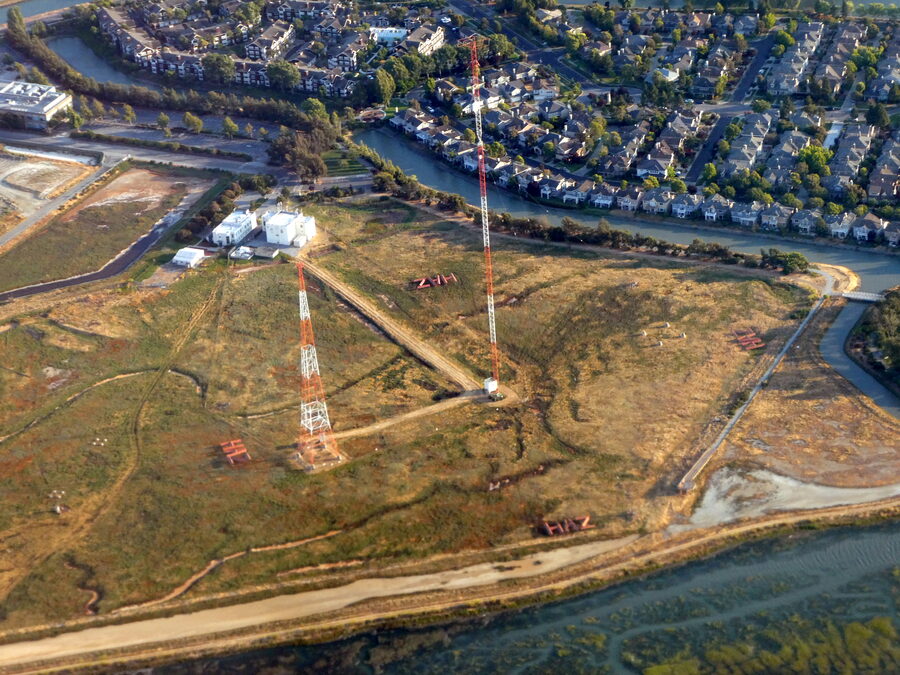
KNBR 680's transmitter site on the bay marsh, 2024 — the hatted, modified-Franklin main tower and its auxiliary (the surviving 1933 KPO tower), on the same ground that carried KPO's flat-top wire antenna. Salt marsh below, capacity hat above: the two best signal multipliers a 50 kW station can own. (Photo: Pi.1415926535, CC BY-SA 4.0, via Wikimedia Commons.)
Spotting them. Once you know the silhouette, hats are everywhere: the spoked crown on a short suburban stick squeezed onto a small lot, the subtle umbrella of insulated upper guys on a daytimer, WHO's 745-foot top-loaded giant in Des Moines, WDRU's four-tower top-loaded array in North Carolina (both in the 50 kW records table). Every one of them is the same dodge: when you can't buy height, buy capacitance.
Why the hat works. A bare short tower wastes its height on a current taper forced to zero at the tip. Add the hat and the current has somewhere to go — the same steel carries nearly full current top to bottom.
Sources: NAB Engineering Handbook (medium-wave antennas, top loading); ARRL Antenna Book (MF/LF verticals and top loading); Stuart Ballantine, "On the Optimum Transmitting Wave Length for a Vertical Antenna over Perfect Earth" (Proc. IRE, 1924); FCC AM database (top-loaded entries); John F. Schneider / The Radio Historian & Bay Area Radio Museum ("KNBC Radio, Belmont — New Franklin Antenna, 1949"; Belmont photo archive); KNBR Belmont engineering tour accounts.
The FAA's dividing line for making a structure conspicuous to aircraft is 200 feet above ground level. Anything taller has to wear the candy-striped aviation orange-and-white paint, or carry red obstruction beacons or white strobes, laid out according to FAA Advisory Circular 70/7460-1M. (For how those two systems work — paint versus white strobes — see Marking the Towers.) At 200 feet or under, none of that is required — no paint, no lights, and no FCC Antenna Structure Registration either.
The catch is location. A tower shorter than 200 feet still has to be marked, lit, and registered if it reaches into the protected airspace around an airport or heliport — the Part 77 glide-slope surfaces — and the FAA can call for marking on a short structure anywhere it judges a genuine hazard. Away from airports, though, the 200-foot line holds, which is why the typical small-town AM tower stands bare gray steel.
For AM the rule has a twist, because the tower is the antenna and its height is dictated by frequency. A full-size quarter-wave radiator is roughly 234 feet divided by the frequency in MHz, so it only shrinks below 200 feet once you're past the middle of the dial. That's why the AM towers you'll see standing unpainted and unlit cluster at the high end — the graveyard and upper-dial stations from about 1230 kHz on up. A 50,000-watt clear-channel down at 700 or 880 kHz, by contrast, needs a tower hundreds of feet tall, which means orange-and-white bands and a row of red lights up the side. (At the far extreme, see The Shortest Tower in America.)
| Frequency | Full-size quarter-wave tower (approx.) | Paint & lights? |
|---|---|---|
| 540 kHz | ~435 ft | Required |
| 700 kHz | ~335 ft | Required |
| 880 kHz | ~265 ft | Required |
| 1000 kHz | ~235 ft | Required |
| 1170 kHz | ~200 ft | Borderline |
| 1340 kHz | ~175 ft | Exempt* |
| 1490 kHz | ~155 ft | Exempt* |
| 1700 kHz | ~140 ft | Exempt* |
* Exempt only away from airport glide-slope surfaces. And these are full-size 90° figures: real AM towers run shorter (electrically loaded) or taller (120°–195° for efficiency), so a given station can land on either side of the line. But frequency is the first thing that decides whether an AM tower has to wear the paint — the higher on the dial, the better the odds it gets to stay bare.
Sources: FAA Advisory Circular 70/7460-1M (Obstruction Marking and Lighting) · FAA obstruction-lighting guidance · Society of Broadcast Engineers.
Once a tower has to be made visible to aircraft — because it tops 200 feet, or reaches into the protected airspace around an airport (see The 200-Foot Rule) — the FAA's Advisory Circular 70/7460-1M spells out how. There are two basic ways to make a structure conspicuous, and a given tower uses one system or the other: paint it, or light it with white strobes.
The traditional method is the candy-striped look: alternating bands of aviation orange and white, an odd number of them so that both the top and bottom band are orange. The bands are equal in width — roughly one-seventh of the tower's height — but never more than 100 feet nor less than 1½ feet each. Paint covers daytime visibility; after dark the same tower switches to red obstruction lights — a flashing red beacon at the top and steady red lights at the intermediate levels. This is the classic orange-and-white tower with the red light on top.
The modern alternative is high-output white strobe lights, bright enough to mark the tower by day without any paint at all. They come in two intensities: medium-intensity white strobes for towers roughly 200–500 feet, and high-intensity white strobes for towers above about 700 feet. A medium strobe flashes about 40 times a minute at 20,000 candelas in daylight, dimming to 2,000 at night; a high-intensity unit can reach 270,000 candelas by day. Choosing a white-strobe system — or a dual system, white by day and red by night — eliminates the painting requirement entirely. The appeal is maintenance: no bands to repaint as they fade, and no string of red side-lights to service. That's why many owners pick strobes, especially on harsh sites where paint weathers fast.
| System | Daytime | Nighttime | Painted? | Typical height |
|---|---|---|---|---|
| Paint + red lights | Orange/white bands | Red beacon + side lights | Yes | Any required height |
| Medium-intensity white strobe | White flashes | White (dimmer) or red | No | ~200–500 ft |
| High-intensity white strobe | White flashes | White (dimmer) | No | ~700 ft and up |
| Dual (white/red) | White flashes | Red lights | No | Common in urban areas |
A local example sits in the bayland flats of Hayward: the five-tower array of KTCT 1050 (the Bay Area's "KNBR 1050"). Each tower stands about 62 meters — roughly 203 feet — just over the 200-foot line, and the array sits less than two miles west of Hayward Executive Airport's runways (with Oakland International about five miles north), so the FAA evaluated the towers as aviation obstructions. Yet not one of the five is painted. Instead they carry white strobe lights — the no-paint option above — a choice stations often make to cut maintenance, doubly attractive on a salt-air site where paint weathers fast.
Sources: FAA Advisory Circular 70/7460-1M (Obstruction Marking and Lighting) · FCC Part 17 / Antenna Structure Registration · FCC facility ID 51188 (KTCT) ASR tower data · FAA airport data.
The tower you can see is only half of an AM antenna. The other half is underground.
The Standard. A properly engineered AM ground system consists of 120 copper radials, each a quarter wavelength long, buried just below the surface and radiating outward from the tower base like spokes of a wheel. At 540 kHz (the bottom of the AM band), a quarter wavelength is about 456 feet — each radial wire stretches nearly the length of one and a half football fields. At 1600 kHz (the top of the band), it's about 154 feet. A full ground system for a low-frequency station can cover many acres of land.
How It Works. The buried radials act as an RF mirror, creating an electrical image of the tower below ground that effectively doubles the antenna's electrical length. A quarter-wave tower over a perfect ground plane behaves like a half-wave dipole — the most efficient basic antenna. Without the ground system, much of the transmitter's power is wasted heating the soil instead of radiating as signal. Poor ground means poor signal, regardless of how tall the tower is or how much power the transmitter puts out.
Why It Matters. This is why mountaintop AM stations perform so poorly (you can't bury copper in granite), why stations near salt water perform so well (salt water conductivity is nearly perfect), and why AM transmitter sites need so much flat land. It's not just the tower footprint — it's the acres of buried copper surrounding it. When a tower site is sold to a developer, ripping out the ground radials is part of the demolition. Once they're gone, they're gone.
Half the antenna is underground. A vertical monopole only works against a return path: for every ampere flowing up the tower, an ampere flows home through the ground beneath the coverage area, converging on the base. Plain dirt is a terrible conductor, and current fighting through it turns transmitter power into warm soil. The cure has been settled since Brown, Lewis & Epstein's landmark 1937 measurements: bury 120 copper radials, each a quarter-wave long, one every 3 degrees, and the returning currents ride low-loss copper for their final journey instead of lossy earth. At 1000 kHz that's roughly 5.6 miles of wire plowed in a few inches deep, plus a ground screen or mesh under the tower where current density is fiercest, all brazed to a perimeter of straps that tie to the ATU's ground side. It's the least photogenic part of an AM station and one of the most expensive to do right — and because several miles of buried copper has scrap value, it's also what the thieves come for (see the building-grounding and WJLX sections).
An AM transmitter site is an unusually rich target: acres of buried copper, more copper coiled inside the tuning houses and the phasor, and all of it sitting at the end of a dirt road behind a chain-link fence, unattended, in the dark. As scrap-copper prices have climbed past $4 a pound, thieves have worked their way through the country's AM sites one by one — and because the copper is half the antenna, stealing it doesn't just cost money, it knocks the station off the air, sometimes for months, sometimes for good.
The buried radials are the least of it. They're thin, dirty, oxidized wire spread over a quarter-wave in every direction; digging up 120 of them is a lot of work for scrap that pays poorly. The real prizes are clustered at and around the tower base and inside the buildings:
The ground screen, ring, and strap at the base — solid copper mesh and heavy bar where all the radials tie together — are the densest copper in the field and the easiest to find. Better still, from a thief's point of view, are the antenna tuning units in the doghouse at each tower base and the phasor cabinet in the transmitter building: big coils wound from copper tubing and strap, bus bars, and the copper-jacketed feed line. That's clean, heavy, high-grade copper, above ground, behind nothing more than a padlock. When thieves gutted WGSF in Memphis in 2025, they didn't stop at the ground system — about 85% of the station's phasor was gone, all three tuning-unit doghouses were roughly half destroyed, and the coax was sliced from the transmitter. The radials are the appetizer; the ATUs and phasor are the meal.
Pull the copper and the tower stops being an efficient antenna. The return current is forced through raw soil instead of a low-loss copper plane, so most of the transmitter's power ends up heating dirt rather than radiating. Coverage collapses. The antenna's base impedance shifts as the ground resistance climbs, the tuning no longer matches, reflected power spikes, and the transmitter often faults itself off to protect its final amplifier. For a directional station it's worse: the licensed pattern depends on a precise current-and-phase balance referenced to an intact ground system under every tower, so uneven damage bends the pattern out of tolerance — and the station is legally barred from radiating it until the whole system is rebuilt and re-measured.
Not really. The antenna monitor is a measurement instrument — it reads the towers' current ratios and phases and can raise an alarm, but it is not a kill switch. Under 47 CFR §73.62 a directional station that drifts out of tolerance isn't required to drop instantly: minor deviations allow 24 hours to correct (logged), and only when a limit is exceeded must the licensee “terminate operation within three hours or reduce power.” That's a compliance clock, not a security system. The alarm goes to a remote operator or a contract engineer's phone at 2 a.m.; by the time anyone drives out, the copper is long gone. And there's a cruel twist: if the damage shifts the impedance enough to trip the transmitter off, the site goes dead and silent — which removes the RF hazard and lets the thieves work in peace.
These raids happen at night, which for many of these stations is exactly when they're running — often a directional pattern at full licensed power. A series-fed tower base sits at hundreds to thousands of RF volts, and every radial and strap is carrying RF current. Cutting or lifting energized copper next to a live tower means deep RF burns — penetrating, slow-healing, nothing like an ordinary shock — along with RF shock and violent arcing the instant a blade parts a current-carrying conductor. A directional site has several hot towers, not one, and simply standing in that near field exceeds RF-exposure limits. It is a genuinely hazardous place to be swinging a shovel in the dark.
A full ground system is hundreds of pounds of copper, but buried, dirty wire is discounted hard at the scrap yard, and a crew only lifts a fraction of it in a night. So the payoff is startlingly small against the wreckage left behind: reporting on these thefts found thieves walking away with “a few hundred dollars” of metal while inflicting tens of thousands in damage and taking small stations off the air for months.
| Station | Where | When | What happened |
|---|---|---|---|
| WGSF 1030 | Memphis, TN | May 2025 | Phasor ~85% stripped, all three tuning-unit doghouses ~50% destroyed, coax cut. ~$170,000 damage; off air, ran an FM translator. |
| WGVM 1260 | Greenville, MS | Nov 2025 | A vehicle yanked the transmission lines out of the building; AM tuning unit, iso-coupler and transmitters destroyed — “massive and total damage.” Took an AM and two FM signals down. |
| KFTI 1070 | Wichita, KS | Jan 2026 | Tower-array ground system stripped and the transmitter damaged; knocked off the air, left streaming only. |
| WJLX 1240 | Jasper, AL | Feb 2024 | The entire 200-foot tower and the transmitter were hauled away — guy wires cut, the whole structure taken. The owner called it “a professional hit.” |
| WZRK | Lake Geneva, WI | 2012 | Ground radials dug up from outside the fence line — the site's second theft; the owner asked the FCC for months of silence to rebuild and add security. |
| WPPA / WAVT | Pottsville, PA | 2024 | Ground-system copper taken; thieves netted “a few hundred dollars” against tens of thousands in repairs — a case in the reporting on small stations going silent. |
Sources: individual incidents linked in the table above (Radio World, Inside Radio, RadioInsight, Columbia Journalism Review). Ground-system role and the copper screen: Radio World, AM Ground Systems and Ground Systems. Out-of-tolerance rules: FCC 47 CFR §73.62. The Hugo, Oklahoma tower case: Radio Ink / Wireless Estimator (Jan 2024).
Ground conductivity is everything in AM radio. Salt water is the best conductor on earth for groundwave propagation — 5,000 millimhos per meter versus 15 for good farmland versus 2–4 for dry rock. Stations built near salt water get a massive, free performance boost.
| Call | kHz | City | Power | Water Feature |
|---|---|---|---|---|
| KKSF | 910 | Oakland / San Francisco, CA | 20 kW / 5 kW | Twin-tower directional array built on Point Isabel, a narrow peninsula in San Francisco Bay, Richmond. Towers essentially built on piers in the water. Salt water ground conductivity is nearly perfect. KDIA 1640 diplexes onto one of KKSF's towers during the day. |
| KNBR | 680 | San Francisco, CA | 50 kW | Ground radials extend into San Francisco Bay — copper wires dangling in salt water. |
| KSL | 1160 | Salt Lake City, UT | 50 kW | Transmitter site in the salty marshes near the Great Salt Lake. The brine-saturated soil provides excellent ground conductivity. |
| KSCO | 1080 | Santa Cruz, CA | 10 kW / 28 W | Tower site located over water near the Santa Cruz Small Craft Harbor. The station has a dedicated KSCO section on this page for its colorful FCC history. |
| KNEW | 960 | Oakland, CA | 5 kW | Three-tower directional array at the eastern end of the Bay Bridge, directly on the Oakland shoreline of San Francisco Bay. |
| KIQI | 1010 | San Francisco, CA | 10 kW | Towers near the Bay Bridge toll plaza on a spit of land historically known as "Krow Island" (named for former call letters KROW, now KNEW). Surrounded by Bay water on three sides. |
| KDOW | 1220 | Palo Alto, CA | 5 kW / 145 W | Transmitter site in East Palo Alto near the Bay marshlands. Low-lying wetland terrain adjacent to San Francisco Bay. |
| KZDG | 1550 | San Francisco, CA | 10 kW | Transmitter site in the Belmont wetlands along Highway 101, adjacent to San Francisco Bay. Marshy, salt-saturated ground. |
| KMBY | 1240 | Monterey, CA | 1 kW | Transmitter site near Monterey Bay. Coastal location benefits from proximity to salt water. |
The Salt Water Effect. DXers have long known that coastal AM stations reach much farther than inland stations of equal power. A 50 kW station on the coast with salt water in its ground path can be heard hundreds of miles out to sea and far up the coastline. The same station on dry rocky ground inland would cover a fraction of that area. This is why KFBK in Sacramento — sitting in irrigated Central Valley farmland with 15 millimhos/m conductivity — puts out such a dominant signal: it's not salt water, but it's among the best ground on the continent. And it's why mountaintop stations on dry granite (2–4 millimhos/m) struggle to cover their own city.
WVOA 1540 (formerly WSIV) in East Syracuse operates a nighttime antenna that is almost certainly the shortest AM tower in the United States: a 33-foot (10-meter) Valcom whip on a downtown rooftop. At 18 electrical degrees on 1540 kHz, it radiates 57 watts — barely enough to cover a few blocks.
The Contrast. WVOA is co-owned with WOLF 1490, which operates from a 412-foot tower and is a 400 Club member on this page. Same owner, two stations: one with a tower taller than many buildings, the other with a whip antenna shorter than a school bus. The height ratio between the two is 12.5 to 1. During the day, WVOA runs 1 kW from a conventional tower near the Thruway. At sunset it switches to the 33-foot rooftop whip downtown — making it a split-site station as well (see Split-Site Stations above).
Before cheap land on the outskirts of town became the standard, many AM stations put their towers on top of buildings — hotels, office buildings, even nightclubs. A few still do.
| Call | kHz | City | Notes |
|---|---|---|---|
| WMBM | 1490 | Miami Beach, FL | Tower sits above bars and nightclubs on Washington Avenue in South Beach. A bar directly underneath was called "Radio Bar." The tower is a neighborhood landmark — visible from the beach, lit up at night, surrounded by nightlife. |
| WPNA | 1490 | Oak Park, IL | Tower atop the Oak Park Arms Hotel, now a retirement community. Residents live directly beneath an active AM antenna. |
| WVOA | 1540 | East Syracuse, NY | Nighttime 33-ft Valcom whip on downtown rooftop. Shortest AM tower in the US. See above. |
| KYPA | 1230 | Los Angeles, CA | Operated from an 80+ year-old rooftop L-antenna. Only US Class C station with DA-1. Now on KBLA's array. Already on main trivia page. |
| WNTD | 950 | Chicago, IL | Rooftop near the Loop (day site, 1 kW ND). Switches to a different site at night (5 kW DA). Split-site station. |
When the ground plane can't touch the ground. A rooftop AM tower has the same physics problem as any monopole — the return currents must get home to the base — but there's no soil to bury radials in, only tar paper and a building full of tenants. The classic answer, used since stations first colonized hotel roofs in the 1920s, is the elevated counterpoise: a fan of copper wires stretched on insulated standoffs a few feet above the roof, bent and folded to fit the building's outline, often tied together with a perimeter bus. That wire plane — not the earth ten stories down — is the antenna's "ground," collecting the return currents in clean air and coupling capacitively to the real earth below; the building's structural steel is bonded in for lightning and safety, making the whole skyscraper an electrical participant. The happy surprise of the physics is that radials in air are far more efficient per wire than radials in lossy dirt, so a rooftop counterpoise with a modest number of wires can perform respectably against a full 120-radial field. The unhappy part is everything else: a hot tower and a live wire ceiling on an occupied roof means fences, signage, and careful RF-exposure math (see the rooftop and MPE sections).
Some AM stations run so little power at night that the signal barely leaves the transmitter site. These nighttime authorizations exist mostly as placeholders — just enough to maintain "full time" status and keep the license alive.
| Call | kHz | City | Day Power | Night Power | Ratio | Notes |
|---|---|---|---|---|---|---|
| WCKB | 780 | Dunn, NC | 7,000 W | 1 W | 7,000:1 | One watt at night. A single watt. Already on main trivia page. |
| WSQR | 1180 | Sycamore, IL | 900 W | 1 W | 900:1 | Also 1 watt at night. |
| WMQM | 1200 | Lakeland, TN | 50 kW | 35 W | 1,429:1 | 50,000 watts to 35 watts. Already on main trivia page. |
| WVOA | 1540 | East Syracuse, NY | 1 kW | 57 W | 17.5:1 | 57 watts through a 33-foot whip antenna. See Shortest Tower above. |
| KSCO | 1080 | Santa Cruz, CA | 10 kW | 28 W | 357:1 | Reduced from 5,000 W night after 30 years of unauthorized operation. See KSCO story above. |
| WILY | 1210 | Centralia, IL | 10 kW | 3 W | 3,333:1 | 3 watts at night from a single tower. Split-site station — day site has 2-tower DA. Class D. |
| WGNZ | 1110 | Fairborn, OH | 5 kW | 2 W | 2,500:1 | 2 watts at night through a DA-3 directional array. Three Phasor Club member. Must protect WBT Charlotte on 1110 kHz. |
None of these stations actually generates one or two watts — nothing in a transmitter rack makes a clean, fully-modulated signal that small on its own. The watt is produced in two steps.
1. Run the transmitter at its lowest stable preset. Solid-state rigs have a floor below which they can't regulate or modulate cleanly. A Nautel J1000 — a 1,000-watt AM transmitter — runs cleanly all the way down to 10 watts, but no lower.
2. Pad the rest of the way down. A resistive attenuator (a “pad”) goes in the line between the transmitter and the antenna tuner. Ten watts down to one watt is a factor of ten — a 10 dB pad — passing one watt to the tower and dumping the other nine into load resistors. The pad is passive and linear, so it carries the modulation through untouched. Two rules: build it at the 50-ohm line impedance, and rate the resistors for the modulation peaks (a 1-watt carrier swings to about 4 watts on 100% peaks). Starting from a 10-watt preset rather than full power means the pad dissipates only a few watts — a small, cool network, not a big load bank.
The old way: a bank of light bulbs. Before purpose-built low-power transmitters, engineers ran a bigger rig at its lowest setting and threw most of the output away — into a dummy load, or famously into a bank of incandescent light bulbs, switched on one at a time as more power needed dumping. It worked, but a bulb's resistance changes as it heats, drifting the impedance match, so engineers prefer fixed resistors. Same principle as the modern pad: make a stable, well-modulated signal, waste almost all of it, radiate a sliver.
You can't just dial it down. Below its floor a transmitter loses regulation and modulation tracking and can't hold its spectral mask. A real FCC case makes the point: station WGRP (940 kHz) was licensed for 2.2 watts at night and tried to make it on a J1000. Nautel told the Commission the transmitter is only certified down to 10 watts and can't produce 2 watts without distortion. The station let the rig run where it physically landed — about 27 watts — and programmed it to switch to that unauthorized level automatically; the FCC ruled the violation willful. If the licensed power is below the transmitter's floor, you reach it with a pad, not by abusing the transmitter.
One modern footnote: the watt is often almost ceremonial. Most of these stations now simulcast on an FM translator, so the nighttime audience is really on FM and the AM's one or two watts mainly keep the license alive.
The whole hundred-year arc of AM station values can be told on a single New York frequency. In 1926, AT&T decided to get out of broadcasting and sold its flagship WEAF — 660 in New York — and its chain operations to RCA for $1 million, the deal that created NBC and announced to the world that a radio station was property. Sixty-six years later, in 1992, Emmis sold the same 660 facility — by then reborn as all-sports WFAN — to Infinity Broadcasting for $70 million, the record price ever paid for an AM station. And in 2024, WFAN's parent company Audacy went through Chapter 11 bankruptcy, its shareholders wiped out. One frequency: the first million, the record, and the reckoning.
Why prices stayed sane for 70 years. From the 1930s until 1996, the FCC kept a lid on the market by capping ownership — ultimately at 40 stations nationwide and no more than two AMs and two FMs in any single market. With every buyer limited in how much they could own, demand was artificially suppressed and stations traded as profitable local businesses, valued on their cash flow.
The 1996 gold rush. The Telecommunications Act of 1996 removed the national ownership cap entirely, and the result was the greatest buying frenzy in broadcast history: 2,045 stations changed hands in the first year alone — $13.6 billion worth — and the annual volume of station transactions exploded roughly seven-fold. The radio stock index jumped 107 percent in 1997, more than triple the Dow's gain. Consolidators like Jacor went from 25 stations to 240 in three years; small-town AMs sold for nearly double what their cash flow justified, because the buyers were assembling empires and the sellers knew it. If you owned an AM station, roughly 1996–2000 was the moment to sell — and many lifelong broadcasters did exactly that.
The slide. What followed was two decades of unwinding. The empires assembled with debt met the internet, the smartphone, and the slow erosion of AM listening; iHeartMedia (the former Clear Channel) went through bankruptcy in 2018 owing roughly $20 billion, and Audacy (the former CBS Radio/Entercom) followed in 2024. The case study is WQEW 1560 New York: Disney bought the 50 kW station outright from the New York Times in 2007 for $40 million, then sold it to Family Radio in 2014 for $12.95 million — a full-power New York signal shedding two-thirds of its value in seven years. In 2024 the slide claimed an institution: WCBS 880 ended nearly six decades of all-news, its format judged not worth the electric bill on one of the great 50 kW facilities in America.
Today's floor. At the bottom of the market, the numbers turn surreal. Small AMs now change hands for five figures, get donated to religious broadcasters for the tax write-off, or are simply surrendered to the FCC because no buyer exists at any price. And the recurring modern punchline is that the most valuable thing about many AM stations is the real estate: a tower site needs acres of open ground near a city, which is exactly what developers pay millions for — the land outvalues the license, and the station goes dark so the towers can come down (see Tower Sites Lost to Development).
Landmark sales. A definitive "top ten AM sales" list doesn't really exist — many prices were never disclosed, and the biggest dollars moved in group deals where no single station's value was broken out — but these documented landmarks trace the arc:
| Year | Station | Price | In today's $ | The story |
|---|---|---|---|---|
| 1926 | WEAF 660, New York | $1,000,000 | ≈ $18M | AT&T sells its flagship (and chain) to RCA — the deal that founded NBC. The first million-dollar station. |
| 1992 | WFAN 660, New York | $70,000,000 | ≈ $160M | Emmis sells the first all-sports station to Infinity — the record price for an AM station, on the very same frequency as the 1926 sale. |
| 2007 | WQEW 1560, New York | $40,000,000 | ≈ $60M | Disney buys the 50 kW signal outright from the New York Times, near the top of the market. |
| 2014 | WQEW 1560, New York | $12,950,000 | ≈ $17M | Disney sells the same station to Family Radio — down 68% in seven years. |
From a million dollars that shocked the country, to seventy million for a sports station, to full-power signals worth less than the dirt they stand on — the price tags tell AM's whole story in four digits or fewer... per kilowatt.
Sources: Wikipedia (Broadcasting Company of America; 1926 in American television; Radio homogenization); CBS New York / WFAN 25th anniversary (Smulyan on the $70M Infinity sale); RadioInsight (WQEW sales); Washington Monthly, "The Death of Local Radio"; FCC commissioner remarks, NAB Radio Show 1998.
More than a century after the first AM signals crackled to life, a handful of heritage stations are still genuine money-makers — and the lesson in which ones is unmistakable. It isn’t music. It’s news. When BIA Advisory Services broke out the ten highest-billing AM stations in the country for the first time, the top of the chart read like a roll call of all-news and news/talk institutions, and the numbers were anything but nostalgic. BIA stands for Broadcast Investment Analysts — the Virginia media-research and station-valuation firm, in business since 1983, whose annual revenue estimates the radio industry treats as its standard scorecard.
BIA ranks by over-the-air advertising revenue — the real dollars a signal earns selling airtime, not ratings or reputation. Every station in the top five programs news or news/talk. News formats swept the top seven spots outright; the first sports station, Dallas institution KTCK “The Ticket”, doesn’t appear until number eight. Together the ten stations booked more than $225 million in a single year — proof that a well-run heritage AM brand is still a serious business, not a charity case, and a direct counterpoint to this page’s account of collapsing AM station values.
| # | Station | Market | Owner — Format | 2023 Revenue |
|---|---|---|---|---|
| 1 | WBBM 780 | Chicago | Audacy — all-news | $30.0M |
| 2 | WCBS 880 † | New York | Audacy — all-news | $29.7M |
| 3 | KTRH 740 | Houston | iHeartMedia — news/talk | $24.6M |
| 4 | KFI 640 | Los Angeles | iHeartMedia — news/talk | $23.8M |
| 5 | WSB 750 | Atlanta | Cox — news/talk | $23.8M |
| 6 | KOA 850 | Denver | iHeartMedia — news/talk/sports | $21.6M |
| 7 | KNX 1070 | Los Angeles | Audacy — all-news | $20.8M |
| 8 | KTCK 1310 | Dallas | Cumulus — sports (“The Ticket”) | $18.1M |
| 9 | KYW 1060 | Philadelphia | Audacy — all-news | $16.6M |
| 10 | KCBS 740 | San Francisco | Audacy — all-news | $16.4M |
† WCBS 880 was shut down in 2024; Audacy kept the frequency and leased the bare signal to another operator, now ESPN New York / WHSQ-AM — see below.
The two purists. One detail on the chart is quietly remarkable: of the ten, only KTRH 740 Houston and KFI 640 Los Angeles earn their place on pure AM, with no FM simulcast running alongside — and they rank third and fourth on the whole list. Both are 50,000-watt clear-channel giants, the kind of booming signal that once defined the band, and both are iHeartMedia news/talk stations. Every other station here leans on an FM simulcast to help carry its audience; these two still do it the old way, on the AM dial alone.
News is the whole story. Look down the list and the pattern is total: news, news/talk, all-news, over and over, with a single sports outlier near the bottom. The music that once made AM the soundtrack of America migrated to FM decades ago and then to streaming, and it never came back. What kept these signals commercially alive is the one thing a listener still reaches for live and in the moment — traffic on the drive home, weather when the sky turns, a familiar voice reading the headlines at the top of the hour. That is a product you cannot playlist in advance, and on the biggest heritage signals it still sells.
Even the giants aren’t safe — the WCBS shutdown. The loudest warning on the whole chart is sitting at number two. WCBS 880 New York — a top-two AM biller pulling nearly $30 million a year — was shut down completely on August 26, 2024, ending the all-news operation it had run since 1967, disbanding its newsroom, and retiring the historic WCBS call sign after nearly six decades. This was not a station changing formats or rebranding — it was the end of WCBS. Here is the part that stops people cold: the station was making money. So why kill it? Because revenue is not profit — and all-news is the most expensive format in commercial radio to produce. That $29.7 million is a top-line figure; underneath it sat a full newsroom running around the clock: reporters, anchors, editors, traffic and weather. When it went dark, the Writers Guild of America East reported 23 of its members laid off, and that was only part of the payroll that vanished with it. A music or sports-talk station bills less but keeps far more of every dollar.
The decisive factor wasn’t WCBS standing alone — it was that Audacy owned both of New York’s all-news stations: WCBS 880 and WINS (1010, simulcast on 92.3 FM). The company was funding two competing newsrooms chasing the same audience in a single market — and of the two, WINS was the clear winner. For years WINS had run well ahead of WCBS in the Nielsen ratings, a lead that widened sharply after WINS added its 92.3 FM simulcast in October 2022; by its final months WCBS was tying its all-time record-low share while WINS kept climbing to new highs. Folding everything into WINS let Audacy keep the stronger, higher-rated signal while running one newsroom instead of two. As its New York market president put it, the city had long been unusual in supporting two all-news brands, but the economics of local journalism no longer justified paying for both.
The bigger signal is the one that went dark. There’s an irony in the engineering, too. WINS 1010, the station Audacy kept, is a directional signal — it shares its frequency with 50,000-watt Toronto powerhouse CFRB and must aim its pattern away from Canada, so it fades fast outside the metro. WCBS 880, the station Audacy gave up for news, is the opposite: a 50,000-watt non-directional clear channel heard across the eastern seaboard at night, one of the great heritage AM blowtorches. The catch is that WINS’ directional pattern is aimed straight into Manhattan and the boroughs — where the audience and the ratings actually are — and since October 2022 it has been simulcast on 92.3 FM as well. So Audacy walked its news franchise away from the far bigger signal and onto the smaller one, because on today’s AM dial the reach that pays is reach into the five boroughs, not reach across the map. The clear-channel giant now carries someone else’s sports.
And here is the distinction that matters — the one “flipped to sports” gets wrong. The 880 signal didn’t go silent, but WCBS did not become a sports station either. Audacy kept ownership of the frequency and leased it out, under a Local Marketing Agreement, to Good Karma Brands — the operator that runs ESPN’s New York programming and holds the Mets radio rights. Good Karma had been about to lose its FM home when a lease expired, and a 50,000-watt AM signal was exactly what it needed. So a different company now programs ESPN New York on 880 under new call letters, WHSQ-AM. WCBS wasn’t converted — WCBS was shut down, and its old transmitter was rented to someone else who put sports on it. That is the real warning buried in this chart: on today’s AM dial, even a station earning real money can be switched off outright if its format costs too much and its owner finds a cheaper way to cash in the signal — here, by handing the transmitter to a competitor.
Revenue isn’t profit — and the owners prove it. Look one level up from the call signs and the picture turns sobering. These are the highest-billing AM stations in America, yet the companies that own them have spent recent years in and out of bankruptcy court. Audacy — owner of five of the top ten (WBBM, WCBS, KNX, KYW, and KCBS) — filed for Chapter 11 in January 2024 carrying roughly $1.9 billion in debt, most of it inherited from its 2017 purchase of CBS Radio, and emerged that September only after shedding about 80 percent of it. iHeartMedia, which owns three more (KTRH, KFI, and KOA), went through its own Chapter 11 in 2019 and has carried heavy debt ever since. Cumulus, owner of KTCK, emerged from bankruptcy in 2018. Of the ten, only Cox Media Group’s WSB answers to an owner that has stayed clear of Chapter 11. Nine of the ten highest-billing AM stations in the country, in other words, are cash registers bolted to balance sheets that couldn’t carry their own weight.
That is the real backdrop to the WCBS shutdown, and the answer to the obvious question: how does a top-two station in the number-one market get switched off? It was not a sign that New York had stopped supporting news radio — WINS, the survivor, is still on the air. It was a company in the middle of a bankruptcy restructuring deciding it could no longer justify paying for two expensive newsrooms while its creditors converted nearly two billion dollars of debt into equity. The signal that went dark was healthy; the balance sheet above it was not. On today’s AM dial, a station’s fate is often decided less by its own ledger than by how much debt its distant owner is trying to survive.
A hometown coda. Fittingly, the station that closes out the top ten is the one closest to home. KCBS 740 San Francisco traces its lineage directly to Charles “Doc” Herrold’s pioneering voice-and-music broadcasts from downtown San Jose beginning in 1909 — arguably the oldest continuously operating broadcasting enterprise in the world. From a jury-rigged arc transmitter above a San Jose engineering school to a 50,000-watt all-news institution still booking $16 million-plus a year, it is a straight line of more than a century. The band that keeps getting written off as obsolete put its very first voice on the air a few miles from where this page is being written — and that voice is still a top-ten earner.
Source: BIA Advisory Services, Investing in Radio 2024 — top-billing AM stations by 2023 over-the-air revenue (the first year BIA broke out an AM-only ranking). Shutdown, FM-simulcast, and ownership-bankruptcy details verified via Inside Radio, RadioInsight, RBR, Radio World, Variety, and CBS New York. See also What’s an AM Station Worth?
A children’s network built on the cheapest signals on the band — and one of the clearest case studies in the collapse of AM station values.
Few things on the AM band were stranger than Radio Disney. When Disney bought Capital Cities/ABC in 1996, it inherited a stack of historic stations almost by accident — that deal was about television and ESPN. But for its new children’s network, launched November 18, 1996, Disney went out and deliberately assembled its own fleet of cheap AM signals to pump Top-40 pop and call-in contests to kids riding in cars. At its peak the network owned around 23 stations, blanketing nearly every major U.S. market.
The dial tells the story. Look at where these stations sat and the first oddity jumps out — 1560, 1580, 1590, 1640, 1690: the far right end of the AM band, the weak, hard-to-hear signals nobody else wanted. That was the point. The audience was children in the back seat during daylight hours; it didn’t need a powerhouse. The call signs were their own whimsy, branded into little Disney monograms — WDWD (Walt Disney World) in Atlanta, the “Mickey” cluster of KMKI, KMKY, WMKI, and a parade of -DZ and KDIS variants scattered coast to coast.
| Freq | Call | Market |
|---|---|---|
| 1110 | KDIS | Los Angeles (flagship, last to go) |
| 1560 | WQEW | New York |
| 1300 | WRDZ | Chicago |
| 620 | KMKI | Dallas |
| 640 | WWJZ | Philadelphia |
| 1310 | KMKY | San Francisco |
| 1260 | WMKI | Boston |
| 590 | WDWD | Atlanta |
| 910 | WFDF | Detroit |
| 1590 | KMIC | Houston |
| 1580 | KMIK | Phoenix |
| 1260 | WSDZ | St. Louis (last one sold, Dec 2015) |
Plus Seattle (1250 KKDZ), Miami (990 WMYM), Denver (1690 KDDZ), Cleveland (1260 WWMK), Pittsburgh (1250 WDDZ), Portland (1640 KDZR), Sacramento (1470 KIID), Minneapolis (1440 KDIZ), Charlotte (1480 WGFY), Orlando (990 WDYZ) and more — nearly all on AM.
The overnight riddle. Here’s the part that makes no sense until you understand AM. These stations ran the same kids’ programming overnight — identical pop songs and contests playing at 3 a.m., when every child in the audience was asleep. Why? Because by the 2000s the whole network was a single automated national feed. Nobody was programming the overnight hours; the feed simply kept running, because stopping it cost effort and gained nothing. There were no overnight DJs to pay, no separate content — just the machine playing on.
AM made it stranger still. After dark, AM signals skip for hundreds of miles off the ionosphere, so the FCC forces most stations to slash power, switch to directional antennas, or sign off entirely at night to protect one another. So overnight, these already-marginal far-right-dial signals shrank to a fraction of their daytime reach — broadcasting children’s music, at a whisper, to almost no one. The one odd upside: on a quiet night a distant DXer might catch Radio Disney skipping in from three states away, logged by someone who was assuredly not the target demographic. The autopilot had a purpose beyond thrift, too — an FCC license generally requires the station to actually operate, so running the feed around the clock was the simplest way to keep the transmitter legally lit. By 2014, Disney’s own figures told the real story: only 18% of the audience still listened over the air at all.
The value collapse. Nowhere was the fall in AM station values starker than at the fleet’s crown jewel, WQEW 1560 New York — a 50,000-watt signal, the biggest prize in the group. Disney leased it from The New York Times in 1998, then bought it outright in 2007, and paid dearly.
| WQEW 1560, New York | Amount |
|---|---|
| Bought from The New York Times (2007) | $40 million |
| Sold to Family Radio (2014) | $12.95 million |
| Value lost in seven years | −68% (~$27M) |
And per radio historian Scott Fybush, even that $12.95 million was really a bet on the land under the towers in a built-up corner of Queens — the broadcast license itself had cratered even further than the price suggests. The rest went for scraps: when Disney announced in 2014 it would sell everything and go digital, the last five stations combined fetched just $2.225 million from Salem Media in 2015. The lone holdout, LA flagship KDIS/KRDC 1110, lingered as the network’s origination point and then an ESPN simulcast before Disney sold it in 2023 for $5 million; today it’s Christian broadcaster KWVE. A big-market national AM network, unwound for a rounding error.
Radio Disney went fully dark on April 14, 2021 — its final song, automated to the end, fading into an ESPN Radio simulcast most listeners never noticed. A children’s network broadcasting to sleeping children on dying signals, run by a machine because live radio had become too expensive: the whole story of AM’s twilight, compressed into one very strange 25-year experiment. (For the flip side — the valuable stations Disney sold high — see ABC Radio: The Heritage Giants Disney Sold High.)
Sources: FCC assignment filings · Radio & Records (Nov. 22, 1996) · NERW / Fybush.com · RadioInsight · The Hollywood Reporter · station records.
The mirror image of the Radio Disney story: a portfolio of century-old, blowtorch-signal powerhouses that Disney cashed out of at the peak — and that mostly outlived the network Disney kept.
If Radio Disney was the marginal experiment Disney ran into the ground, ABC Radio was the opposite — a set of storied, high-value stations Disney couldn’t wait to sell. When Disney bought Capital Cities/ABC in 1996 it inherited some of the most famous call signs in American broadcasting: WABC 770 New York and WLS 890 Chicago chief among them, 50,000-watt clear-channel stations heard across half the continent at night. WABC alone dates to 1921.
Not failing — just unwanted. WABC and WLS were profitable talk-radio institutions. The problem was purely strategic: in 2005, CEO Bob Iger declared the whole radio division a “non-core asset” — a slow-growth business dragging on a stock investors wanted to see as high-growth media. So Disney sold. On February 6, 2006, it announced it would offload 22 large-market stations plus the ABC Radio Networks to Citadel Broadcasting, keeping only ESPN Radio and Radio Disney.
| The Citadel deal — closed June 12, 2007 | Figure |
|---|---|
| Total transaction value | ~$2.7 billion |
| Stations transferred | 22 (plus ABC Radio Networks) |
| Cash retained by Disney | $1.35 billion |
| Structure | Tax-free “reverse Morris Trust” |
Where the money went — and where it didn’t. Because of the reverse-Morris-Trust structure, the value flowed to Disney’s shareholders as Citadel stock, not into Disney’s treasury. The $1.35 billion Disney kept came from debt ABC Radio took on before the spin-off, not a sale price. Crucially, none of it funded Radio Disney: Disney was exiting general radio and keeping its kids’ network as a separate, subsidized brand play. Disney cashed out of the valuable stations and clung to the marginal one.
The roster read like a hall of fame of American radio: WABC and WPLJ (New York), KABC and KLOS (Los Angeles), WLS (Chicago), KGO and KSFO (San Francisco), WMAL (Washington), WJR (Detroit), WBAP (Dallas), and more.
What became of them. Here the story turns. Citadel, loaded with debt from the deal, filed for bankruptcy in 2009 and was swallowed by Cumulus Media in 2011. Most of the heritage stations remain under Cumulus today — WLS Chicago, KABC Los Angeles, WMAL Washington — largely running syndicated talk, shadows of their former local glory. WABC took the most colorful path: in 2019 a debt-strapped Cumulus sold the 50,000-watt flagship — one of the most famous call signs in radio — to billionaire grocer John Catsimatidis for just $12.5 million. He grew up on the station, called it “iconic,” and runs it independently today as “Talkradio 77.” A signal that once defined Top-40 America, sold for the price of a Manhattan apartment.
The through-line with its sister story is almost too neat. Disney sold the valuable heritage stations to please Wall Street and kept the gimmick for its brand — and the gimmick, Radio Disney, is the one that ended up silent. WABC and WLS, the century-old AM giants Disney was so eager to unload, are still on the air. The Mouse cashed out of the good stuff and ran its own creation into the ground — a fitting coda to this page’s long account of rising, peaking, and falling AM station values.
Sources: SEC filings (Disney/Citadel Form 8-K & 425, 2006–2007) · The Walt Disney Company press releases · ABC News · Wikipedia station histories (WABC, WLS, KABC) · station records.
As commercial operators walked away from AM, two kinds of buyer kept the old signals lit — and turned some of the most legendary call letters in American radio into faith and language stations.
When the bottom fell out of AM station values, the heritage signals didn’t simply go dark. Someone bought them — just not the kind of owner who once fought to program Top 40 on them. Two buyers-of-last-resort emerged, and between them they now own a startling share of the AM dial’s former royalty: religious broadcasters (Catholic networks like Relevant Radio and Immaculate Heart, and Christian operators like Family Radio) and multicultural broadcasters serving Spanish- and Asian-language communities.
Why they’re the buyers. The logic is the same for both, and it’s the key to the whole phenomenon. A commercial music station lives or dies on ratings and ad revenue, and by the 2000s a big AM signal couldn’t deliver either. But a religious network or an ethnic broadcaster values something a ratings book doesn’t measure: coverage. A faith community or a language community is spread thin across a metro, and a 5,000- or 50,000-watt AM signal reaches all of it at once, cheaply. They’re not buying an audience the advertisers want; they’re buying a footprint that reaches their people. So they’ll pay for a big stick that a commercial operator has given up on — which is exactly why the grand old Top 40 giants kept ending up in their hands.
KHJ 930, Los Angeles — the two-step fall. No station tells it better than KHJ. This was the West Coast’s “Boss Radio” flagship, the station where programmer Bill Drake perfected the tight, high-energy Top 40 format in 1965 and made stars of The Real Don Steele, Robert W. Morgan, and Charlie Tuna — a sound copied across North America. Its format changed twice after that. First it went Spanish-language: around 1991, under Liberman Broadcasting, 930 became Spanish-language “La Ranchera” (briefly as KKHJ, then reclaiming the historic KHJ calls in 2000). Then it went religious: in 2014 Immaculate Heart Radio bought it, and today it is the West Coast flagship of Relevant Radio, airing Catholic programming. The station that defined Top 40 on the West Coast passed through both aftermarkets in turn.
KYA 1260, San Francisco — and its rival. Up the coast, KYA was the Bay Area’s Top 40 leader — the station where Bill Drake first made his name before Los Angeles, broadcasting from an Art Deco transmitter building atop Candlestick Hill designed by Julia Morgan, the architect of Hearst Castle. It sold for real money at the peak (Bartell paid $1 million in 1958; AVCO paid $4 million in 1966). Its end was quieter: after stints as KOIT and KXLR, Bonneville sold 1260 to Immaculate Heart Radio, and on December 10, 2007 it became KSFB, a Catholic station — now Relevant Radio. The irony writes itself: KYA’s great 1960s Top 40 rival, the mighty KFRC 610, also ended up religious, as Family Radio’s KEAR. The two stations that once fought for every teenager in the Bay Area now both preach.
| Station | In its heyday | What it is now | Buyer type |
|---|---|---|---|
| KHJ 930, Los Angeles | “Boss Radio” Top 40 flagship (Drake, The Real Don Steele) | Relevant Radio (Catholic) — after going Spanish first | Both |
| KYA → KSFB 1260, San Francisco | Bay Area Top 40 leader; Julia Morgan transmitter | Relevant Radio (Catholic) | Religious |
| KFRC → KEAR 610, San Francisco | KYA’s great Top 40 rival, “The Big 610” | Family Radio (Christian) | Religious |
| KTNQ 1020, Los Angeles | “Ten-Q,” ex-KGBS, one of LA’s last AM Top 40s | Spanish-language (Heftel → Univision) | Multicultural |
These are illustrative, not exhaustive — the pattern repeats in nearly every large market. Relevant Radio and Immaculate Heart alone assembled a coast-to-coast chain of former commercial AM signals this way.
The result is a quiet transformation of the AM band’s character. The 50,000-watt sticks that once carried Chuck Berry and the Beatles to teenagers on hilltop parking lots now carry the rosary, or ranchera, or a pastor’s call-in show. It isn’t decline exactly — the signals live on, serving real communities that value them — but it is a profound change of purpose, and a direct consequence of the collapse in what a commercial AM station is worth. When the ratings money left, the mission money stayed. It’s the same force that produced Radio Disney’s fire-sale ending and drove the deletions elsewhere on the dial — only here the stations found a second life instead of silence.
Sources: Wikipedia station histories (KHJ, KSFB, KOIT, KTNQ) · Bay Area Radio Museum & Hall of Fame · SoCalRadioHistory.com · RadioInsight · station records.
The legendary AM stations that once ruled popular music — the 50,000-watt clear-channel “blowtorches” whose skywave reached teenagers hundreds of miles away, and the modest-power programming powerhouses that out-rated them anyway.
For roughly twenty years — from the late 1950s until FM took the music away in the early 1980s — the AM dial was pop music in America. Nearly every city had at least one dominant Top 40 station; the big markets had several battling head to head. Two things made a station a giant, and they didn’t always come together: signal and programming.
The blowtorches. The signal giants were the 50,000-watt clear-channel stations — the maximum power the FCC allows any U.S. AM station. On a clear channel at night, when AM signals skip hundreds of miles off the ionosphere, a single station could blanket half the continent. Teenagers from the Dakotas to the Gulf fell asleep to WLS Chicago, KOMA Oklahoma City, KAAY Little Rock, and WABC New York booming in from far away — the only rock and roll for hundreds of miles of open country. These were the blowtorches.
The engineering twist: not all blowtorches were equal. Most 50 kW clear-channel stations are non-directional by day but must go directional at night — steering their signal with multi-tower arrays to protect other stations on the same frequency. A rare few ran non-directional around the clock, radiating equally in every direction at full power. WABC 770 was the king of these: a single half-wave tower in Lodi, New Jersey (engineers consider a half-wave the ideal height), giving it a signal so strong it was reported in Hawaii, Australia, and Europe. WLS, KFI, WNBC, and KNBR were the other true non-directional 50 kW giants. The famous CKLW “Big 8,” WKBW, and KOMA — every bit as legendary — achieved their reach with directional arrays.
The programming twist: some of the biggest legends weren’t blowtorches at all. Here’s the surprise. The two men who invented Top 40 — Todd Storz and Gordon McLendon — built their empires on modest signals and brilliant programming, not raw power. WMCA 570 New York ran just 5,000 watts yet beat 50 kW WABC in the mid-1960s on the strength of its “Good Guys.” Miami’s WQAM (5 kW) was ranked the #7 Top 40 station of all time; McLendon’s legendary KLIF Dallas ran 5 kW on 1190. Great programming, it turned out, could beat a big stick.
| Station | Freq | Market | Music heyday | Signal | Today |
|---|---|---|---|---|---|
| WABC | 770 | New York | “Musicradio 77” Top 40, 1960–82 | 50 kW, non-directional (half-wave) | Talk |
| WLS | 890 | Chicago | “Big 89” Top 40, 1960–80s | 50 kW, non-directional | Talk |
| KFI | 640 | Los Angeles | #1 Top 40 nationally, mid-late 1970s | 50 kW, non-directional | Talk |
| WNBC | 660 | New York | Music & personality (later Imus, Stern) | 50 kW, non-directional | Sports (WFAN) |
| KNBR | 680 | San Francisco | Full-service / MOR music | 50 kW, non-directional | Sports |
| CKLW | 800 | Windsor / Detroit | “The Big 8,” hugely influential Top 40 | 50 kW, directional | Talk |
| WKBW | 1520 | Buffalo | East Coast Top 40 powerhouse | 50 kW, directional | Talk (WWKB) |
| KOMA | 1520 | Oklahoma City | Top 40 for the entire western plains | 50 kW, directional at night | Sports |
| WCFL | 1000 | Chicago | Top 40, WLS’s great rival | 50 kW, directional | Sports (WMVP) |
| WLAC | 1510 | Nashville | Legendary Southern R&B / blues | 50 kW, directional | Talk |
| KAAY | 1090 | Little Rock | Top 40 across the South & central U.S. | 50 kW, directional | Religious |
| WNOE | 1060 | New Orleans | Gulf-South Top 40 | 50 kW, directional | Country |
| KYW | 1060 | Philadelphia | Top 40 (chiefly its Cleveland era) | 50 kW, directional | All-news |
| WKY | 930 | Oklahoma City | Daytime Top 40 companion to KOMA | 50 kW, directional | Sports |
| Station | Freq | Market | Music heyday | Signal |
|---|---|---|---|---|
| WMCA | 570 | New York | The “Good Guys” — beat 50 kW WABC in the mid-1960s | 5 kW |
| WQAM | 560 | Miami | Storz station; ranked #7 Top 40 of all time | 5 kW (1 kW night), non-directional |
| KLIF | 1190 | Dallas | Gordon McLendon’s flagship, a Top 40 pioneer | 5 kW |
| WHB | 710 | Kansas City | Storz station, Top 40 leader | 10 kW |
| WINS | 1010 | New York | Alan Freed’s station; Top 40 until 1965 | 50 kW, directional |
| WDGY | 1130 | Minneapolis | Storz “Wee-Gee,” Twin Cities Top 40 | 50 kW, directional |
Almost none of them play music today. The blowtorches that once carried the Beatles and the Supremes to hilltop parking lots now carry sports, talk, all-news, or religion — the same drift that produced the religious and multicultural conversions elsewhere on this page, and the broader collapse in what an AM station is worth. But for two decades, these were the giants: the 50,000-watt sticks and the 5,000-watt programming geniuses alike, the sound of a generation growing up with a transistor radio under the pillow.
Sources: Wikipedia (WABC, WLS, KFI, KYW, KLIF); musicradio77.com; Bay Area Radio Museum; 560.com WQAM tribute; List of 50 kW AM stations; Radio Ink “Greatest Top 40 Stations”; station records.
Radio has always been an unusually family-run business. At one end sits a broadcasting dynasty four generations deep; at the other, the small-town station where the owner reads the obituaries himself. Both are increasingly rare in the age of the thousand-station chain.
Few American industries have stayed as family-held as radio. As the business consolidated — iHeartMedia (the former Clear Channel) alone once owned some 850 stations, all capable of running from one automated playlist — a stubborn minority of stations stayed in the hands of the families that built them. They come in two very different sizes, and the contrast between them tells the whole story of American radio ownership.
The dynasty — Hubbard Broadcasting. The definitive family broadcaster started in 1923, when Minnesota native Stanley E. Hubbard put an early station on the air — soon WAMD, “Where All Minneapolis Dances,” which broadcast part-time because Hubbard had to keep leaving the microphone to go sell the advertising that paid for it. It was one of the first stations anywhere supported entirely by ad revenue. In 1928 WAMD merged with St. Paul’s KFOY to become KSTP, and on March 29 of that year President Calvin Coolidge pressed a gold telegraph key in the White House to formally activate the station. KSTP has been on the air ever since.
What makes Hubbard remarkable is the unbroken bloodline. Stanley S. Hubbard, the founder’s son, started as a prop boy at seventeen in 1951 and eventually ran the company; his children — the third generation — took the key management roles, with Ginny Hubbard Morris heading the radio operations; and a fourth generation is now on the job. The company grew into television (KSTP-TV was the first station between Chicago and the West Coast in 1948), helped pioneer satellite broadcasting, and today owns around 30 radio stations and a string of TV stations. Yet it remains family-controlled — and the family argues that’s exactly its advantage. As one KSTP news director put it, there’s no distant board of directors and no stock price to please, so the newsroom is never beaten on a story for lack of resources. Where corporate broadcasters answer to shareholders, the Hubbards answer to the next generation of Hubbards.
The mom-and-pops — radio with the family on the air. At the opposite end of the scale is the small-town AM station, owned and operated by one family for decades, where the people who sign the checks are also the voices on the air. These stations survive not on ratings or national ad buys but on a kind of intimacy the chains can’t replicate: local news read from the police blotter, high-school football, the daily obituaries, and the enduring “Swap Shop” — a buy-sell-trade call-in show that’s the signature format of family radio, running in some towns in the same time slot for seventy years.
WMNC in Morganton, North Carolina has been in the Cooper family for more than 77 years — Nathan Cooper, a World War II veteran, won the license in 1946 (beating the local newspaper publisher in a rivalry), and his son Joe runs it now; Joe’s wife Elizabeth started there in 1976 as the reporter who checked the arrest blotters before her 6 a.m. broadcast. WKSR in Pulaski, Tennessee was founded in 1946 after a scout drove into town and counted the storefronts around the courthouse square to see whether there was enough business to support a station; its “Swap ’n Shop” has aired in the same 7:45 a.m. slot since day one. And KJAY in Sacramento — 500 watts, in the Powell family since 1964, one part-time paid employee — broadcasts from 43 acres where peacocks and chickens wander the transmitter field, selling airtime to Hmong, Russian, Brazilian, and religious programmers nobody else will carry. It is, as one profile put it, a throwback in a world of corporate radio.
| Station | Location | Family / since | What makes it notable |
|---|---|---|---|
| KSTP 1500 | St. Paul, MN | Hubbard — 1928 | Four-generation dynasty; activated by President Coolidge’s gold key |
| WMNC 1430 | Morganton, NC | Cooper — 1946 | 77+ years one family; thrice-daily Swap Shop |
| WKSR 1420 | Pulaski, TN | founded 1946 | “Swap ’n Shop” in its original 7:45 a.m. slot since day one |
| KJAY 1430 | Sacramento, CA | Powell — 1964 | 500 watts, peacocks on 43 acres; airtime for immigrant communities |
Illustrative, not exhaustive — hundreds of family-run small-market AMs still operate. What they share is local ownership and locally-produced programming, the thing hardest for a national chain to copy.
The two ends of the scale are really the same impulse at different sizes: radio held as a family calling rather than a financial asset. The Hubbards kept an empire in the bloodline; the Coopers and Powells kept a single beloved signal alive against every pressure to sell to a chain. Both are swimming against the tide that produced the collapse in station values and the fire-sale endings elsewhere on this page — and both are getting rarer every year. When one of these families finally sells, a station that answered to a town for seventy years starts answering to a spreadsheet instead.
Sources: Wikipedia and Hubbard Broadcasting company history (KSTP / Hubbard); The Paper, Morganton (WMNC); WKSR station history (worldradiohistory.com); Comstock’s magazine (KJAY); station records.
Plenty of well-known people didn’t just appear on the radio — they owned the stations. A First Lady, a border-blaster governor, a singing cowboy, two crooners, a Hall-of-Fame lineman, and three pioneers of Black-owned radio all held broadcast licenses, and several of these investments quietly out-earned the fame that made the names.
For much of the twentieth century, an AM station was a smart place for a famous person to put money: a local monopoly on a scarce license, steady advertising revenue, and a business their celebrity could help promote. The owners below came from politics, Hollywood, Nashville, the NFL, and the record business — and in more than one case the station made its owner far richer, or more powerful, than the career that made them a household name.
Lady Bird Johnson — KTBC, Austin. Wife of a young Texas congressman and future First Lady of the United States. In December 1942 she paid $17,500 of a family inheritance for KTBC, a failing 250-watt daytimer, in her name alone to sidestep her husband’s conflict of interest. With Lyndon Johnson’s influence felt at the FCC, it was quickly granted 590 kHz, 5,000 watts, 24-hour operation, and a CBS affiliation. KTBC was the flagship; the Johnson company grew to include a 29% stake in Waco’s KWTX, the KRGV stations in the Rio Grande Valley (sold 1961), and eventually six Austin stations. It became KLBJ in 1973.
W. Lee “Pappy” O’Daniel — XEAW, the border blaster. A Fort Worth flour salesman who turned a wildly popular noon radio show — the Light Crust Doughboys, and the catchphrase “Pass the Biscuits, Pappy!” — into the Texas governorship in 1938, then a 1941 U.S. Senate win over a young Lyndon Johnson. (He is the model for the governor in O Brother, Where Art Thou?) His one confirmed station ownership is the wild part: while sitting as governor, he was part-owner of XEAW, a high-powered Mexican “border blaster” bought from the notorious goat-gland quack Dr. John R. Brinkley by his partner, Crazy Crystals laxative magnate Carr P. Collins. Border stations beamed enormous signals across the Rio Grande to sidestep U.S. power limits — so the Governor of Texas quietly co-owned an outlaw station aimed back at his own state.
Gene Autry — KMPC, Los Angeles. The original Singing Cowboy of movies and records, and later founding owner of baseball’s Los Angeles Angels. He bought KPHO Phoenix near the end of World War II, then paid an estimated $800,000 for LA powerhouse KMPC 710 in 1952, building the Golden West Broadcasters chain. His broadcast holdings out-earned his movies — and bankrolled the ballclub.
Frank Sinatra and Danny Kaye — KJR, Seattle. Ol’ Blue Eyes and the beloved film comedian (star of White Christmas) jointly bought KJR 950 in a deal that closed in 1958. It became a legendary Northwest Top 40 station under DJ Pat O’Day. Sinatra sold his share to Kaye in 1964, leading to Kaye-Smith Enterprises.
Cathy Hughes — WOL, Washington D.C. A radio executive turned entrepreneur. Turned down by 32 banks, she and her then-husband bought WOL-AM in 1980, and when she lost her home she moved into the station. She hosted its morning show for 11 years and built it into Radio One (now Urban One) — the largest Black-owned broadcasting company in the country, and the first Black-woman-led firm on a U.S. stock exchange.
Percy Sutton — WLIB, New York. A Tuskegee Airman, Malcolm X’s attorney, and Manhattan Borough President. His Inner City Broadcasting bought WLIB in the early 1970s, making it New York City’s first Black-owned station — “your total Black news and information station.”
James Brown — WJBE, WRDW, WEBB. The Godfather of Soul, and one of the first Black radio-station owners in America. He bought WJBE Knoxville in 1967 (call letters = his initials, “Raw Soul” format), then WRDW in his native Augusta — the very station outside which he had shined shoes as a boy — and WEBB Baltimore. In 1970 he went on WRDW’s air to help calm the Augusta riots.
Buck Owens — KUZZ, Bakersfield. The architect of the “Bakersfield sound” and later co-host of Hee Haw. He bought his hometown country station KUZZ in 1966 and added a second Bakersfield AM in 1984. It is still owned by his family’s Buck Owens Production Company today.
Willie Davis — KCKC, Riverside. Pro Football Hall of Fame defensive end for Vince Lombardi’s champion Green Bay Packers. After football he became a successful businessman, and his All-Pro Broadcasting owned KCKC 1350 (among other stations) until selling to Jacor in 1998.
| Owner | Known as | Station(s) | Note |
|---|---|---|---|
| Lady Bird Johnson | Future First Lady | KTBC 590 (later KLBJ) | Bought 1942 for $17,500; grew to six Austin stations |
| Pappy O’Daniel | TX governor & senator | XEAW (Mexican border blaster) | Co-owner with Carr Collins while governor; beat LBJ for Senate |
| Gene Autry | Singing Cowboy; Angels owner | KMPC 710; KPHO | Golden West Broadcasters; out-earned his movies |
| Frank Sinatra | Singer / actor | KJR 950 | Co-owned with Danny Kaye, closed 1958 |
| Danny Kaye | Film comedian | KJR 950 | Co-owner; later Kaye-Smith Enterprises |
| Cathy Hughes | Founder, Radio One / Urban One | WOL 1450 | Built the largest Black-owned broadcaster from one AM |
| Percy Sutton | Politician; Inner City Broadcasting | WLIB | NYC’s first Black-owned station |
| James Brown | Godfather of Soul | WJBE; WRDW; WEBB | Owned the Augusta station he once shined shoes outside |
| Buck Owens | Bakersfield-sound legend | KUZZ 550 | Still family-owned today |
| Willie Davis | NFL Hall of Famer (Packers) | KCKC 1350 | All-Pro Broadcasting; sold 1998 |
Verified station ownership — not to be confused with the many stars who merely performed on radio. O’Daniel’s XEAW was a Mexican-licensed border station, not a U.S. AM. Illustrative, not a complete list.
What ties them together is a truth the industry understood early: a broadcast license was a genuine asset, not just a stage. These people already had fame; a station gave them ownership of the airwaves themselves — and, often enough, a fortune or a platform that outlasted the applause. It’s the same underlying value that ran through the great station-value era, seen here from the owner’s side of the microphone.
Sources: Wikipedia, Texas Monthly, and the LBJ Library (Lady Bird Johnson / KTBC); Texas State Historical Association border-radio entry and Bill Crawford, Please Pass the Biscuits, Pappy (O’Daniel / XEAW); 710kmpc.com and station histories (Gene Autry); HistoryLink.org (Sinatra & Danny Kaye / KJR); Washington Post and Radio One records (Cathy Hughes / WOL); Museum of Broadcast history and Inner City Broadcasting records (Percy Sutton / WLIB); Radio Hall of Fame and station histories (James Brown); Wikipedia and Radio World (Buck Owens / KUZZ); Los Angeles Radio People and trade records (Willie Davis / KCKC).
The paradox. The AM band itself has never shrunk — it has only ever grown, most recently when the expanded band added 1610–1700 kHz. What is shrinking is the roster of voices on it. The count of licensed US AM stations peaked at 4,987 in 1991 — almost the exact moment the FCC was preparing to hand the band ten brand-new channels. The band got bigger and emptier at the same time, and the emptying has never stopped.
The count. The FCC publishes licensed-station totals every quarter, and the AM line has pointed one direction for three decades. From the 1991 peak of nearly five thousand, the total slid to 4,684 by 2015, 4,342 by the end of 2025, and 4,310 as of March 31, 2026 — 32 stations gone in a single quarter, more than 70 across the past five quarters. In all, roughly 677 licenses have vanished since the peak, about one station in seven. At the current pace, an AM station leaves the air for good about every three days.
How a license dies. Since the 1996 Telecommunications Act, deletion is automatic: under Section 312(g) of the Communications Act, a station silent for twelve consecutive months forfeits its license by operation of law — no hearing, no discretion, the authorization simply expires. So the path from struggling station to deleted call sign is short: revenues thin, the transmitter fails or the rent comes due, the station goes silent “temporarily,” and the twelve-month clock runs out. The FCC’s silent-station list is the band’s waiting room.
Why they go. The forces are the ones this page keeps meeting: transmitter land worth more than the license sitting on it (see Tower Sites Lost to Development), station values in long retreat, and operating economics tight enough that stations petition to cut their own night power. The most telling cases are the ones where a station couldn’t be given away — owners have literally offered AM licenses as donations and found no serious takers.
| Date | Licensed US AM Stations | Change |
|---|---|---|
| 1991 | 4,987 | The peak |
| 2015 | 4,684 | −303 from peak |
| Dec 31, 2025 | 4,342 | −342 in a decade |
| Mar 31, 2026 | 4,310 | −32 in one quarter |
The Trivia. The decline is entirely a story of exits, not evictions — the FCC has never reclaimed AM spectrum, and the channels stay right where they are, waiting for licensees who no longer come. Deletion outpaces creation so thoroughly that a genuinely new AM station is now among the rarest events in American broadcasting. And the arithmetic of the last three decades has a grim elegance: the band gained ten channels and lost nearly seven hundred stations.
Sources: FCC Media Bureau Broadcast Station Totals (quarterly) · Radio World · Radio Ink.
Before the vertical tower revolution of the late 1920s and early 1930s, every AM station used horizontal wire antennas. These took several forms — flattops, cage antennas, T-antennas, and L-antennas — all suspended between masts or between a mast and a building.
The existing antenna history section on this page covers the Wire Era (1920–1930) in detail. Here are specific examples that didn't make it into that narrative:
| Station / Location | Description |
|---|---|
| WHK, Cleveland, OH | Built an elaborate flattop antenna with non-metallic support towers to avoid re-radiation from the supports. One of the most sophisticated wire antenna installations of the 1920s. |
| Portofino, Italy | A 50 kW wire antenna strung 590 meters (nearly 2,000 feet) across a valley. One of the largest wire AM antennas ever built, demonstrating the massive scale these installations could reach before towers replaced them. |
The Key Insight. What engineers didn't realize at first was that in most wire antenna installations, the vertical feed wire running up from the transmitter to the horizontal wire did most of the actual radiating. The horizontal wires on top were essentially just capacitive loading. Once Stuart Ballantine proved this mathematically in 1924, the move to purpose-built vertical towers was inevitable — why build an elaborate two-mast wire system when a single vertical tower did the job better?
A flat-top (T-type) antenna: a horizontal wire "top hat" slung between two masts on insulators, feeding a vertical down-lead to the transmitter. The horizontal section mostly adds capacitance — the vertical wire does most of the radiating, the realization that doomed the design once Ballantine proved it in 1924. (Feed the down-lead from one end instead of the center and the same antenna becomes an "inverted-L," below.)
An inverted-L antenna: the end-fed cousin of the flat-top. The horizontal arm provides capacitive top-loading (with a little radiation of its own) while the vertical down-lead does most of the radiating. The single right-angle bend — up, then across — is what gives the "inverted-L" its name. Feed the horizontal section at its center instead of one end and you get the T-antenna (above).
How much horizontal wire did a wire-era station actually need? Slide the frequency and the vertical down-lead height and watch the flat-top grow or shrink — in this first-order model the vertical and the top hat always add up to one quarter-wave. Companion to the Wire Antennas section above.
When a maintenance crew disconnects a jumper or transmission line on an energized AM tower, an arc forms across the gap. The ball of ionized air — plasma — vibrates at audio frequencies modulated onto the carrier, and it acts as a speaker. You can hear the station's programming coming directly from the arc. The sound is distorted and buzzy, but intelligible — music, voices, commercials, all emanating from a glowing ball of plasma at the base of the tower.
This happens because the arc's impedance varies with the instantaneous RF voltage, which is amplitude-modulated with the audio signal. The changing impedance causes the plasma to expand and contract at audio rates, pushing air just like a conventional speaker cone. Videos of the phenomenon exist online and are mesmerizing — a miniature sun hanging in the air, playing talk radio.
Safety Note. This is emphatically not something anyone should try on purpose. The RF voltages at the base of an energized AM tower can be lethal. Maintenance crews de-energize towers before working on them. The plasma speaker effect is an accidental byproduct of a dangerous situation — but it's one of the most vivid demonstrations of how AM modulation works.
More than half of all AM stations in the United States use directional antennas — multiple towers fed with carefully controlled currents and phases to shape the radiation pattern. The US has more directional AM arrays than all other countries combined.
Lobes and Nulls. When two or more towers are fed with signals that differ in phase and amplitude, their radiated fields add constructively in some directions (creating lobes of strong signal) and cancel in others (creating nulls of little or no signal). By adjusting the current ratio and phase angle between towers, engineers can sculpt the radiation pattern into almost any shape — cardioids, figure-eights, clovers, butterflies, or surgical beams aimed at specific cities.
The Gain Is Real. Directional antennas don't just suppress signal in unwanted directions — they concentrate it in the wanted directions. The power that would have gone into the nulls adds to the lobes. A two-tower array can produce 3–4 dB of gain, effectively doubling or tripling the power in the favored direction. KFBK's Franklin array turns 50 kW into an estimated 100–400 kW effective in its main lobe. WBZ's cardioid turns 50 kW into roughly 350 kW equivalent toward Boston. Same transmitter, same electric bill, dramatically more signal where it matters.
The Phasor Room. The heart of any directional array is the phasor — a room full of coils, capacitors, and transmission lines that divides the transmitter's output among the towers and precisely controls the current amplitude and phase angle fed to each one. Change a single capacitor value and the entire pattern shifts. The phasor for a two-tower array is manageable; for a twelve-tower array like KFXR in Dallas, it's an engineering nightmare. Every component must hold its value under tens of thousands of watts of RF power, in a room that gets hot enough to require dedicated cooling.
Pattern Shapes. The simplest useful pattern is a cardioid (heart-shaped) from two towers — strong in one direction, null in the opposite. Add more towers and you get more control: three towers can produce a sharper cardioid or a figure-eight. Four towers can carve deep nulls to protect specific stations in specific directions. KFXR's twelve towers produce a nighttime pattern so tight that engineers sitting 50 feet from the reference tower could clearly receive WOAI on 1200 kHz from San Antonio, 200 miles away, hearing only faint sideband splatter from 1190.
A hands-on companion to the section above. Pick the number of towers, then drag the spacing and relative phase to watch the horizontal radiation pattern change in real time — from the broadside figure-eight to the steerable cardioid null that stations use to protect distant co-channel neighbors after dark. (This is an idealized array-factor model for equal-power point sources; a real licensed pattern is lumpier and more irregular.)
The rarest and most complex AM antenna operations in the United States. DA-3 stations run three different directional patterns every day — one for daytime, one for nighttime, and a third for critical hours (the two hours after sunrise and two hours before sunset). Four pattern switches per day, three complete sets of phasor settings, three proofs of performance to maintain. Out of approximately 4,300 AM stations in the US, only 15 are DA-3 — 0.3% of all stations.
| Call | kHz | City, State | Class | Day Power | Night Power | Critical Hours | Notes |
|---|---|---|---|---|---|---|---|
| KNFL | 740 | Fargo, ND | B | 50 kW | 940 W | 7.5 kW | Biggest DA-3. Same 6 towers, three different patterns: day (4 augmentations, 2236.8 mV/m), critical hours (4 augmentations, 866.3 mV/m), night (1 augmentation, 288.7 mV/m). 50 kW to 940 W — 98% power reduction at sunset. FM translator K297BW. |
| KYES | 1180 | Rockville, MN | B | 50 kW | 5 kW | 8 kW | Different tower counts per mode: 2 towers day, 6 towers night, 2 towers critical hours. Uses different subsets of the same array. FM translator K228FV. |
| WIXC | 1060 | Titusville, FL | B | 50 kW | 5 kW | 17 kW | Different tower counts per mode: 3 towers day, 5 towers night, 3 towers critical hours. 16 augmentations at night. On 1060 kHz — must protect Class A KYW Philadelphia. FM translator W288DZ. |
| WYSL | 1040 | Avon, NY | B | 27 kW | 500 W | 10 kW | On 1040 kHz — must protect Class A WHO Des Moines. |
| KXXT | 1010 | Tolleson, AZ | B | 23 kW | 300 W | 9.8 kW | On 1010 kHz — must protect Class A WINS New York. |
| WCHR | 1040 | Flemington, NJ | B | 15 kW | 1.5 kW | 7.5 kW | — |
| WNVR | 1030 | Vernon Hills, IL | D | 10 kW | 120 W | 3.2 kW | On 1030 kHz — must protect Class A WBZ Boston. |
| KZNX | 1530 | Creedmoor, TX | D | 10 kW | 220 W | 1 kW | On 1530 kHz — must protect Class A KFBK Sacramento and WCKY Cincinnati. |
| KENT | 1540 | Enterprise, NV | B | 10 kW | 270 W | 3.7 kW | Near Las Vegas. |
| WGNZ | 1110 | Fairborn, OH | D | 5 kW | 2 W | 1.7 kW | 2 watts at night! On 1110 kHz — must protect Class A WBT Charlotte. Flea power champion. |
| WGUE | 1180 | Turrell, AR | D | 5 kW | 26 W | 3.5 kW | — |
| KRHW | 1520 | Sikeston, MO | B | 5 kW | 1.6 kW | 5 kW | Same power day and critical hours. |
| KGBC | 1540 | Galveston, TX | B | 3.6 kW | 185 W | 2.6 kW | — |
| WRYT | 1080 | Edwardsville, IL | D | 500 W | 20 W | 380 W | Smallest DA-3. Three different directional patterns for 500 watts. On 1080 kHz — must protect Class A KRLD Dallas. |
| KFXZ | 1520 | Lafayette, LA | B | 10 kW | 500 W | 10 kW | Day: 10 kW non-directional, 1 tower. Night: 500 W directional, 6 towers, 16 augmentations. Critical hours: 10 kW directional, 6 towers, 10 augmentations. Same power day and critical hours but different patterns. FM translator K253CO. Call sign history: KXKW → KINF → KACY → KDYS → KFXZ. |
Why So Rare? Every step up the antenna complexity ladder adds equipment, maintenance cost, and potential for failure. A DA-3 station needs three complete sets of phasor adjustments and must switch between them four times per day: at sunrise (night → critical hours), two hours after sunrise (critical hours → day), two hours before sunset (day → critical hours), and at sunset (critical hours → night). Each switch means changing the current amplitude and phase angle to every tower in the array. If the switch is done wrong, the station could interfere with other stations — an FCC violation. Most stations avoid DA-3 because the engineering complexity and maintenance cost aren't worth it. The 14 stations that run DA-3 do so because their frequency, location, and protection requirements leave them no other choice.
The Extremes. KNFL 740 in Fargo runs 50 kW by day, drops to 940 watts at night (98% reduction), and runs 7.5 kW during critical hours — all through different directional patterns, all from the same tower array. At the other end, WRYT 1080 in Edwardsville runs three different directional patterns to manage just 500 watts by day, 20 watts at night, and 380 watts during critical hours. And WGNZ 1110 in Fairborn drops to 2 watts at night — two watts through a directional array, which may be the most elaborate engineering solution to the smallest power level in American broadcasting.
Build your own AM directional array: pick a 2/3/4-tower configuration, drag towers to change the geometry, slide each tower’s phase and amplitude, and watch the radiation pattern reshape live. The phasor strip shows each tower as a vector in the complex plane — engineering’s eye view of what the equipment is doing.
A directional AM station leads a double life. By day its towers throw one pattern; at sunset, to keep its nighttime skywave from smashing into distant co-channel stations, it must change to a different pattern — usually a tighter one, often at lower power — and then change back at sunrise (see The Daytime-Only Era and Pre-Sunrise & Post-Sunset Authority for why the clock matters). Today that swap happens by itself: a timer or the remote control fires a bank of heavy RF relays that go ka-chunk while the transmitter blinks off and back on. But for the first few decades of directional broadcasting, the pattern didn't change by itself. A human changed it — by hand, twice a day, every day.
The machine in the middle. The heart of a directional array is the phasor — a cabinet full of capacitors and variable inductors that does two jobs: it divides the transmitter's power among the towers, and it delays the current to each tower by a precise amount. Those amplitude-and-phase relationships are what bend the signal into the licensed shape. A second pattern means a second set of values — different power division, different phase angles, and often different settings in the antenna tuning units (ATUs) out at the base of each tower. Changing patterns meant physically moving the array from one set of values to the other.
By hand, with a logbook and a crank. In the manual era the phasor was a wall of knife switches and hand-cranked controls — roller inductors and variometers (variable coils) and big air-spaced variable capacitors, each with a dial. The engineer kept a logged set of positions: one column for day, one for night. Twice a day the ritual ran — at the FCC-defined local sunset, and again in reverse at sunrise. At sunset: drop the transmitter's power, throw the changeover switches to bring the night network into the circuit, crank each variometer and capacitor to its logged night position, bring the power back up, then walk to the antenna monitor and confirm the phase and current-ratio readings for every tower fell inside the license. If a reading was off, you cranked until it came in. At sunrise you did the whole thing again, the other way.
The danger. This was not flipping a light switch. The phasor and the tuning units carry the entire output of the transmitter — on a 5 to 50 kW station that means high RF current and several thousand volts of RF sitting on the coils, the capacitor plates, and the switch jaws. Three ways it could hurt you:
And all of this got done twice a day — including at a bleary local sunrise — often by one person, alone, in a small building out in a field. The procedure (power down, switch cold, ground it, then touch it) wasn't bureaucratic caution. It was the difference between a routine changeover and a very bad morning.
| The changeover, by hand — at sunset, and again in reverse at sunrise |
|---|
| 1. Reduce transmitter power (or switch off) — never switch RF under full power |
| 2. Throw the knife switches / changeover bars to the night network (day network at sunrise) |
| 3. Crank each variometer and variable capacitor to its logged "night" position ("day" at sunrise) |
| 4. Bring power back up to the licensed level for that part of the day |
| 5. Read the antenna monitor — verify phase and current ratio for every tower |
| 6. Adjust until every reading is within the licensed tolerance, then log it |
Enter the motor. The hand-crank era ended not with a rule change but with hardware. Motor-driven variometers, preset taps, and banks of RF contactors — relays heavy enough to carry the array's current — let the whole day/night swap be triggered by a single control instead of a sweating engineer with a logbook. Once the change was a switch closure, it could be thrown from the studio over the remote control (authorized for directional stations in 1957), and eventually fired automatically on a clock. The modern descendant is exactly what you hear on a tour of a working directional site: a dozen or more massive relays slamming over in sequence with that signature ka-chunk ka-chunk, the transmitter ducking for a half-second, and the pattern reshaping itself with nobody in the building.
The trivia. A 1960s phasor and a 2020s phasor do the same physics with the same kinds of parts — coils, capacitors, and a common-point match. The difference isn't the network; it's who turns the knobs, and at what risk. For the array's first decades that was a person, on site at sunrise and sunset, reaching into a cabinet full of high-voltage RF and reading dials by the glow of the meters. Now the relays do it on a timer, and the only thing that remembers the old ritual is the ka-chunk.
Sources: Radio World (Mark Persons, "Best Practices for AM Directional Systems"; "Digital Phasor for AM Directionals") · Jeff Geerling / Hackaday (WSDZ phasor site tour) · Wikipedia (Phasor (radio broadcasting); Knife switch; RF burn).
Walk into any AM transmitter building and look just inside the rear door of the transmitter cabinet. Hanging there, almost always, is a fiberglass rod with a metal hook on the end and a heavy braided cable running from it to the station ground. Broadcast engineers call it the Jesus stick — because it's the thing standing between you and meeting Him. Its polite name is a grounding stick or shorting stick; its job is to drain the lethal charge out of a transmitter before you put your hand inside.
Why the charge is still there after you flip the switch. An AM transmitter runs its final amplifier on a high-voltage DC supply — thousands of volts, and on a big 50 kW rig well into the tens of kilovolts. To smooth that DC, the supply uses large filter capacitors, and a charged capacitor doesn't care that you've switched the transmitter off. It can sit there holding a killing charge for minutes or longer after the power is gone. Most supplies have bleeder resistors meant to drain the caps automatically when the high voltage drops — but bleeders fail, quietly, and you have no way to know one has failed by looking. So the iron rule of every transmitter shop is the same: never trust the bleeder. The capacitor is assumed live until you have personally shorted it to ground.
How it's used. One end of the stick is bonded permanently to the station ground — the same copper that ties the whole site to earth. The other end, the hook, rides on the insulated handle. After shutting the transmitter down and opening the cabinet, the engineer reaches in with the stick and touches the hook to every high-voltage node in turn — each capacitor terminal, the plate cap, the supply output — draining each one to ground. Better sticks have a current-limiting resistor for the first touch (to soften the discharge) and then a hard, dead-short ground for the second. If a bleeder had failed and a cap was still charged, you find out the safe way: a loud, startling SNAP and a blue flash at the hook — the sound of the shock you didn't take. And even after all that, the discipline holds: you never assume the stick did its job. You verify with a meter before a finger goes near anything.
The other names. The Jesus stick goes by several shop names, each telling you something about the people who coined it:
| Name | Where it comes from |
|---|---|
| Jesus stick | It's what's between you and meeting Jesus — skip it and you may make the introduction |
| Chicken stick | You'd be a fool not to be "chicken" around a charged HV supply |
| Shorting / grounding stick | The plain-English name — what it literally does |
| Brinkley stick | The British radar term, from RAF tradition; named after Charles Brinkley, an amputee ferryman who carried radar crews across the River Deben (no relation to the goat-gland Dr. Brinkley of the border blasters) |
The trivia. The Jesus stick is the most low-tech object in a building full of precision RF gear — a stick, a hook, and a wire — and it is arguably the most important. It exists because the same site that once had a lone operator on duty around the clock, hand-cranking a phasor full of high-voltage RF, was a place where one careless reach into a cabinet could be the last thing you ever did. The transmitters got safer and the staffing went away, but the stick still hangs inside the door of every transmitter on the dial — because a filter capacitor in 2026 holds its charge exactly as hard as one in 1946.
Sources: Wikipedia (Brinkley stick) · WorldwideDX / broadcast-engineering forums (capacitor discharge / "Jesus stick" practice) · U.S. Patent 7,834,487 (shorting stick for safing high-voltage equipment).
Why the dramatic name is earned. Killing a transmitter doesn't make it safe: the high-voltage filter capacitors can hold a charge of thousands of volts after shutdown, and the bleeder resistors that are supposed to drain them are exactly the kind of part that fails silently — you find out the moment your hand finds the terminal. The grounding stick is the zero-trust answer. The engineer's hand never leaves the insulating fiberglass; the metal hook visits every capacitor, bus bar, and tube anode; and the heavy braid dumps whatever charge is hiding straight into the station ground — sometimes with a rifle-crack and a flash that is the sound of an accident not happening. The discipline is in the sequence shown above, and in the placement: the stick hangs inside the rear door, where reaching past it without using it requires a deliberate act of foolishness. The nickname survives because the lesson does — it's the thing standing between a routine repair and meeting its namesake.
An AM transmitter site uses more copper than almost any other small building in the country. Some of it is famous — the buried radial field that the antenna works against (see Ground Radial Systems), often 120 wires a quarter-wavelength long fanning out from each tower, adding up to tens of miles of copper in the dirt. But there's a second, less-visible copper system inside and around the transmitter building itself, and it's doing three different jobs at once.
Three grounds, one reference. What looks like a single "ground" is really three:
| Job | What it does |
|---|---|
| RF bonding | Ties every piece of equipment, rack, and cabinet to one common potential so the building doesn't become part of the antenna — and so stray RF doesn't get into the audio and control gear |
| Lightning | Carries a tower strike — potentially 20,000 amps from a million volts — safely to earth around the equipment instead of through it |
| AC safety | The ordinary code-required fault ground that keeps the chassis of everything at earth potential so a fault can't electrocute someone |
The cardinal rule is that all three must be bonded together to a single-point (reference) ground — a star, not a daisy-chain — so there's never a dangerous voltage difference between two grounded things during a strike.
Strap, not wire. Walk the building and you'll see wide, flat copper strap — three or four inches across — rather than round wire. The reason is impedance: at RF, and against the microsecond rise-time of a lightning surge, a flat strap has far lower inductance than a round conductor of the same copper. A main strap runs from the radial-field junction at the tower base into the building, bonds to the AC ground, continues to a designated point inside the transmitter cabinet, and then branches out to every rack and every box. Skip that bonding at a real AM station and, as the old hands put it, you turn every semiconductor junction in the building into a tiny crystal radio — the station's own signal rectifying into the audio chain.
Built to send lightning the other way. The art of a good AM ground is steering the strike. The transmitter and electronics sit on a "stub" off the reference ground, so lightning arriving down the tower finds its easy path to earth at the reference point and never bothers to detour through the gear. A ground ring with driven rods often circles the building, tied to the reference ground at exactly one point. Every coax and control line enters through a single copper entrance panel (the "ground window"), where surge protectors bolt directly to the strap before anything crosses the wall — and a classic trick is to coil five or six turns of the incoming line right there, because lightning travels in a straight line and won't follow the curve. Connections are exothermically welded (Cadweld) or clamped with anti-corrosion compound, and bends are kept gentle — a sharp 90° bend adds just enough inductance to spoil the whole scheme.
The copper-theft problem. All that exposed copper has made AM sites a target. Thieves strip ground straps and radial wire for scrap, which is both dangerous (it can leave equipment ungrounded and detune the array) and expensive to repair — a modern cousin of the outright tower theft that took down WJLX 1240.
The trivia. The signal an AM station radiates is only as good as the copper it can't transmit through. The radial field is the invisible other half of the antenna; the building strap is the invisible thing keeping the building out of the antenna and the lightning out of the racks. It's the least glamorous part of the plant — buried wire and flat bar bolted to a wall — and pulling any of it out degrades the signal, invites interference, and removes the path that keeps a strike from finding the Jesus stick's job the hard way.
Sources: Radio World ("Field Service Tips: Grounding," Mark Persons) · Mike Holt Enterprises electrical forums (AM tower strap/bonding practice) · ICO Optics (grounding and lightning protection for radio installations) · Nautel grounding guidance.
Diplexing is the art of feeding two or more AM stations into the same tower or tower array on different frequencies. It saves land, towers, and money — but the engineering is demanding and the consequences of failure are expensive.
How It Works. A diplexer is a set of filters — typically networks of inductors and capacitors — that allows each station's transmitter to feed the shared antenna while blocking the other station's signal from flowing backward into the wrong transmitter. Each filter must pass the station's 20 kHz bandwidth cleanly while presenting a near-infinite impedance to the other station's frequency. If the filters drift or fail, one station's RF energy can flow into the other's transmitter output stage — expensive damage.
| Trivia Category | Call | Dir | City, State | kHz | Day Power | Day Towers | Night Power | Night Towers |
|---|---|---|---|---|---|---|---|---|
| Two Non-Directional 50 KW stations diplexing on a single tower Both Class A clear-channel stations sharing one tower on High Island, Bronx. 100 KW total. 880 was WCBS all-news for 57 years (1967–2024), now WHSQ "ESPN New York 880." See detail writeup above. | WHSQ WFAN | ND1 ND1 | New York, NY New York, NY | 880 660 | 50 KW 50 KW | 1 1 | 50 KW 50 KW | 1 1 |
| Two directional stations diplexing | KFAX KTRB | DA1 DAN | San Francisco, CA | 1100 860 | 50 KW 50 KW | 4 1 | 50 KW 6 KW | 4 4 |
| Sharing 4-tower array | KVVN KLIV | DA2 DA2 | Santa Clara, CA San Jose, CA | 1430 1590 | 4 4 | 4 4 |
Triple Diplexing. A handful of sites push the engineering even further with three stations sharing towers:
| Stations | Frequencies | City | Notes |
|---|---|---|---|
| KBLA + KHJ + KYPA | 1580 + 930 + 1230 | Los Angeles, CA | Three stations sharing a 6-tower array at 34-05-08 N 118-15-27 W. KBLA runs 50 kW DA day (4 towers) / 50 kW DA night (6 towers). KHJ runs 5 kW ND day (1 tower) / 5 kW DA night (3 towers). KYPA runs 1 kW DA-1 day and night (2 towers) — the only Class C DA-1 in the US. |
| KLOK + KSJX + KZSF | 1170 + 1500 + 1370 | San Jose, CA | Three stations diplexed on a shared array. Already on main trivia page. |
| KRXA + KYAA + KTGE | 540 + 1200 + 1570 | Carmel Valley, CA | Triple diplex on a shared ground array in the Salinas Valley. |
| KSSK + KHVH + KIKI | 590 + 830 + 990 | Honolulu, HI | Three iHeartMedia stations sharing one 450-ft top-loaded tower at Dillingham Blvd & Kokea St. All ND1. Total AM power 24.5 kW. Hawaii DOT proposed relocating the tower in 2017 because it obstructs the emergency flight path into Honolulu Airport. KSSK 590 is Hawaii's primary EAS station. |
The Risk. Every diplexed installation is a compromise. The shared antenna can't be optimized for both frequencies simultaneously — one station always gets slightly better performance than the other. The diplexer filters add insertion loss, reducing the effective power reaching the antenna. And if a filter component fails under power, the result can be thousands of watts of RF energy flowing into the wrong transmitter, destroying output transistors or tubes in seconds. Stations that diplex accept these tradeoffs because the alternative — buying and maintaining a separate tower site — is even more expensive.
Two tenants, one piece of steel. Diplexing puts two complete stations on one tower, and the entire art is in the yellow boxes: each station's feed passes through a reject trap — a parallel coil-and-capacitor circuit tuned to the other station's frequency. At resonance a parallel LC looks like an open circuit, so Station B's 1510 kHz hits a brick wall on its way into Station A's transmitter, and vice versa; each PA happily drives the tower while remaining deaf to its neighbor's kilowatts, which would otherwise cook its output stage and spray intermodulation across the dial. Past the traps, both signals share the common point and the same radiator — which each station experiences differently, because electrical height is measured in wavelengths: the example's 332-foot stick is a textbook quarter-wave at 740 and nearly a half-wave at 1510, so each matching network solves a completely different impedance problem. Wide frequency spacing is what makes the traps sharp and the marriage stable. The same trick stacks: triplexing adds a third tenant and another layer of traps, and diplexing a directional array puts a trap at every tower (see Reject Networks above).
The Diplexing section explains the basic bargain: feed two or more stations into one antenna and save a tower site. This is the engineering that actually makes that survivable — the part that keeps each station's signal from corrupting the other's.
The problem with sharing steel. Diplexing a single non-directional tower is hard enough, but diplexing a directional array is where it gets genuinely fierce. Each tower's base network in the doghouse is tuned to set that tower's current amplitude and phase at its station's frequency — the values that carve the licensed pattern. But both stations' RF is present on every tower at once. Left alone, station B's energy would flow through the network so carefully tuned for station A, dragging A's current distribution off its licensed values and wrecking the pattern.
The reject network. The fix is a band-reject network — a parallel-resonant inductor-capacitor trap tuned to the other station's frequency and placed in series in the feed. At its own station's frequency the trap is nearly invisible; at the foreign frequency it presents a very high impedance, isolating each station's tuning network from the other. Every tower in a diplexed directional array therefore carries not just its ATU but a set of reject traps — one for each co-located station — so that two independent, fully licensed patterns can ride the same steel at the same time without touching each other.
Triplexing raises the stakes. The three-station sites listed under Diplexing push this further still: each tower must now reject two foreign frequencies, traps stacked on traps. It's why diplexed and triplexed directional arrays are among the most painstaking installations in all of AM to tune and to prove — the engineer is holding two or three separate antenna-monitor readings inside spec at once, on the same towers, where a change made for one station nudges the others.
Sources: NAB Engineering Handbook · Kintronic Labs (diplexer / reject-network design) · Radio World.
The story of AM transmitter manufacturers mirrors the story of AM radio itself: dozens of names in the golden age, decades of mergers and shakeouts, and today essentially two companies still building new AM transmitters for the North American market. Here is the roster, past and present.
| The Pioneers (tube era, pre-WWII) | |
|---|---|
| Western Electric | AT&T / Bell Labs; built many of the first high-power AM transmitters in the 1920s–40s. Its AM transmitter line passed to Continental Electronics after the FTC broke up AT&T's broadcast group in 1953, along with the Doherty amplifier work. |
| Westinghouse | Owner of KDKA; built early broadcast transmitters (see KDKA — The Station of Firsts). |
| General Electric | Major supplier through the tube era. |
| RCA | The giant — built everything from 250 W to 50 kW; the legendary BTA series (BTA-50G, BTA-5T). |
| Lee de Forest | The "father of radio"; built early transmitters. |
| Federal Telegraph | Early West Coast pioneer. |
| The Golden Age (1930s–1970s) | |
| Gates Radio Co. | Founded 1922 in Quincy, IL (Henry, Cora & Parker Gates); first AM transmitter in 1936; a principal U.S. supplier by the 1950s. |
| Collins Radio | Founded 1932 by Arthur Collins, Cedar Rapids, IA; legendary build quality; broadcast line sold to Continental in 1980. |
| Continental Electronics | Founded 1946 by James O. Weldon, Dallas; built XERA's 500 kW border-blaster unit; the 317-series 50 kW AM was a workhorse (200+ sold). |
| Raytheon | Made broadcast transmitters before turning to defense. |
| ITA | Industrial Transmitters & Antennas. |
| Standard Electronics | Took Western Electric's FM transmitter line in the 1953 AT&T breakup. |
| CSI | Communications Systems Inc. |
| The Consolidation Era (1970s–1990s) | |
| Harris Corporation | Bought Gates (1957, as Harris Intertype; renamed Harris in 1975) and became the dominant U.S. AM brand. Lineage: Gates → Harris → Harris Broadcast → GatesAir. |
| McMartin | Smaller but well-regarded. |
| Sintronic / Singer | Broadcast transmitter line of the Singer company. |
| Wilkinson Electronics | Independent transmitter builder. |
| Energy-Onix | Known for affordable, rugged transmitters. |
| CCA | Communications & Cable; Juan Chibrando's grounded-grid triode designs. |
| Vector / CSP | Later independent entrants. |
| Still Making AM Today | |
| Nautel | Hackett's Cove, Nova Scotia; founded 1969 by Dennis Covill. Pioneered solid-state AM — the first 10 kW (1982) and 50 kW (1985) units when rivals still ran tubes; later built the world's largest medium-wave transmitter (2 MW, 2017). The last full-line AM maker standing. |
| GatesAir | Mason, OH / Quincy, IL. The direct descendant of Gates Radio; still builds AM, FM, and TV transmitters — more broadcast transmitters are made in Quincy than any other city on earth. |
| Continental Electronics | Dallas. Has largely exited AM broadcast; now focused on shortwave, military, and high-power longwave. |
By the early 1990s, after Harris and others proved that all-solid-state 50 kW AM transmitters worked — and ran far more efficiently than tubes — the industry abandoned vacuum-tube AM almost overnight. The shakeout left just two companies building new AM broadcast transmitters for North America today, Nautel and GatesAir: the last of a line that once ran dozens deep.
Sources: Radio World · The Broadcast Archive (oldradio.com) · Wikipedia (GatesAir; Continental Electronics; Nautel; Collins Radio) · Nautel · company histories.
For a high-power AM station, the monthly electric bill is one of the largest fixed costs of staying on the air — and as listenership and ad revenue have eroded, that bill has become one of the line items that can push a marginal station from "barely hanging on" to "not worth keeping on." Two waves of transmitter technology have gone after that cost directly, and for some stations they've been the difference between going dark and staying lit.
From hot tubes to cool silicon. The classic AM transmitter was a tube rig — a plate-modulated (later Doherty or pulse-step) design built around big vacuum tubes that ran hot, demanded constant filament power and forced-air cooling, and turned only somewhere around 50–70% of the power they drew into actual signal, shedding the rest as heat. Beginning in 1969, the Canadian firm Nautel pioneered the all-solid-state broadcast transmitter, and delivered the first solid-state 10 kW (1982) and 50 kW (1985) AM transmitters to the industry. Modern solid-state designs from Nautel (NX series) and GatesAir (Flexiva 3DX) build the signal from dozens of identical hot-swappable power modules switched in step with the audio — "direct digital modulation" — and reach typical overall efficiency around 88%. Less waste heat also means less air conditioning, compounding the savings.
The carrier trick: MDCL. The bigger lever is a deceptively simple idea. In a standard AM signal the carrier represents about two-thirds of the transmitted energy — yet the carrier itself carries no information; all the program audio rides in the sidebands. Modulation-Dependent Carrier Level (MDCL) exploits that: it continuously senses the audio and quietly lowers the carrier power during soft passages — by as much as 6 dB, depending on the algorithm — restoring it when the audio gets loud, with no audible difference to listeners. International broadcasters had used the technique for decades under names like Dynamic Carrier Control. The FCC first allowed it experimentally on non-commercial Alaska stations in 2011, where electricity is especially expensive, and those stations reported power reductions of 30 to 35 percent with no deterioration in sound and no listener complaints. On the strength of that trial, the FCC opened MDCL to all U.S. AM stations in a September 2011 Public Notice (DA 11-1535); that October, New York's WOR 710 became the first 50 kW U.S. AM station to test MDCL on the air, on a GatesAir 3DX-50 feeding its three-tower array. Today it's built into transmitters like the Nautel NX as a standard software feature.
What it adds up to. Stack the two — an efficient solid-state rig plus MDCL — and the savings are real money. Here's a worked example for a 5,000-watt station running day and night (8,760 hours a year), figured on carrier power at the U.S. average commercial electricity rate of about 14¢/kWh:
| Transmitter | Efficiency | Annual kWh | Annual cost | Saved vs. tube |
|---|---|---|---|---|
| Old tube rig | ~60% | ~73,000 | ~$10,200 | — |
| New solid-state | ~88% | ~49,800 | ~$7,000 | ~$3,200/yr (~32%) |
| New solid-state + MDCL | ~88% + MDCL | ~34,800 | ~$4,900 | ~$5,300/yr (~52%) |
At average rates, trading an old tube rig for modern solid-state cuts the bill by about a third; switching on MDCL roughly halves it. In a high-cost state like California (~30¢/kWh) those savings more than double — on the order of $7,000–$11,000 a year — which is how a new transmitter can pay for itself in just a few years on the electric bill alone, before even counting lower maintenance and cooling costs.
None of this reverses the larger forces working against AM — the loss of listeners and advertisers, rising electrical noise from modern electronics, and automakers dropping AM from the dashboard. But it eases one very real pressure, and for a station living close to the margin, a power bill cut in half can be exactly what keeps the lights on for a few more years — long enough, perhaps, to see whether the all-digital future pays off. (For the rigs and the companies that built them, see Who Built the Transmitters; for the decline this fights against, see The Golden Age & Decline of AM Radio.)
Sources: GatesAir (Flexiva 3DX) · Nautel (NX Series; Power-Saving MDCL; company history) · FCC Public Notice DA 11-1535 (Sept. 2011) · Radio World ("International Broadcasters Know DCC") · Engineering Radio (MDCL) · GatesAir MDCL field-test paper (WOR) · U.S. Energy Information Administration (commercial electricity rates).
Before high-voltage rectifiers existed, an AM station that needed thousands of volts of clean direct current to drive its transmitting tubes did the only thing it could: it spun a machine. A motor-generator set — an AC motor bolted on a common shaft to a DC generator — was the beating heart of the power plant in the early transmitter hall.
What the tubes demanded. A vacuum-tube AM transmitter needs high-voltage DC on the plates of its tubes — thousands of volts, and for a powerful station, tens of kilowatts of it. Just as important, that DC has to be clean. Any ripple riding on the plate supply modulates the carrier and comes back out of every receiver in the coverage area as hum. In the 1920s there was simply no practical, efficient way to rectify utility AC into that much clean high-voltage DC.
Why a spinning machine. The cleanest high-voltage DC available came from rotating machinery. An AC motor turned a DC generator whose commutator produced smooth, low-ripple DC at whatever voltage the generator was wound for. Because that output was inherently smooth, only modest filtering was needed — a decisive advantage in an era when filtering many kilovolts was bulky and expensive, and when hum was the constant enemy of a clean signal.
When they ruled the transmitter hall. Through the 1920s and into the 1930s, the motor-generator set was the de facto standard for transmitter DC. The first machines pressed into broadcast service rarely exceeded about 1,500 volts; but as station power climbed, builders demanded far more, and by the mid-to-late 1920s motor-generators wound for upwards of 18,000 volts were being built specifically for radio service. These were held to a tighter standard than ordinary industrial generators: even a slight voltage perturbation could not be tolerated, because it would ride straight out onto the air.
What a 50,000-watt plant required. A 50 kW transmitter was a serious industrial installation, and the motor-generator set sat at the center of it. The plate supply alone had to deliver well over the station’s carrier power as clean DC; the big water-cooled final tubes drew low-voltage filament current measured in the hundreds of amperes; and distilled water was circulated through the tubes to carry away the heat. The diagram below shows the shape of the whole plant.
What replaced them. Two changes retired the spinning plate supply. First, the hot-cathode mercury-vapor rectifier tube matured through the late 1920s and 1930s and could make high-voltage DC directly from AC — smaller, cheaper, and far more efficient than a room-sized machine, though the tubes had to be carefully “conditioned” before service. Then, from the 1960s, solid-state silicon rectifier stacks replaced the rectifier tubes in turn.
The motor-generator’s one lasting virtue — inherently clean, hum-free DC — was the very problem that better rectifiers and better filtering eventually solved by other means.
Sources: Radio World, "How Transmitter Power Supplies Evolved" and "They Put the Juice in Powerful Radio" (James O’Neal); general AM broadcast-engineering history. Values shown are representative of the era rather than of any one transmitter.
A technical companion to Who Built the Transmitters and The Transmitters That Pay for Themselves: how engineers in the 1930s wrung efficiency out of giant tube AM rigs — and why one of their tricks quietly runs your cell phone today.
An early high-power AM transmitter was, electrically, a space heater that happened to make radio. The problem is built into old-fashioned amplitude modulation: to be ready for the loudest peaks, the final tubes have to idle near full tilt all the time, even during silence. The numbers were brutal. RCA's 1 kW "1B" drew about 13,000 watts from the wall to put 1,000 watts into the antenna — roughly 7.5% efficient. Western Electric's 7A, one of the first commercial 50 kW rigs, swallowed some 230,000 watts for a 21% return. The rest went up the stack as heat. As the Depression deepened and stations clamored for ever-higher power, the electric bill became the enemy.
Plate efficiency, conventional 1930s rigs vs. the Doherty amplifier.
Doherty's insight (1936). William H. Doherty, an engineer at Bell Telephone Laboratories, found a way to keep the tubes efficient across the whole modulation cycle. His amplifier splits the work between two tubes: a carrier tube that does the steady job of the unmodulated signal, and a peak tube that wakes up only on the loud peaks. A clever quarter-wave coupling network, with the two tubes driven 90° out of phase, makes the carrier tube "see" a changing load as the peak tube kicks in — so both run near their efficient sweet spot instead of idling hot. The payoff: plate efficiency of roughly 60–65%, independent of modulation — triple the old designs — and as a bonus it eliminated the enormous, room-filling modulation transformer that conventional high-level rigs needed.
The Doherty idea: split steady vs. peak duty between two tubes so neither wastes power idling.
Ampliphase, the rival approach. RCA needed an answer that dodged Western Electric's patent, and found one in an older idea: outphasing, proposed by Henri Chireix in 1935. The trick is almost magical — take two carriers of constant amplitude, and vary the phase angle between them. When they're nearly aligned they add up; when you swing them apart they partially cancel. Modulate the phase difference and the sum comes out as an ordinary AM signal — all while the tubes themselves never change power, so they stay efficient. RCA bought the patent (by way of McClatchy Broadcasting) and marketed it as Ampliphase, first at 50 kW and later in 10 kW and 5 kW models. It was clever, compact, and notoriously fussy to keep in tune.
And a third: the Sainton amplifier. The story didn't end there. Continental Electronics (the firm with deep roots in this page's transmitter history) refined the Doherty idea with a screen-modulated variation patented by Joseph Sainton in 1967, building an entire 50,000-watt transmitter with just nine tubes. Continental's CE 317C became the runaway favorite — nearly 300 installed in North America alone, more than all competitors combined.
| Technique | Origin | How it saves power | Marketed by |
|---|---|---|---|
| Doherty | W. H. Doherty, Bell Labs, 1936 | Carrier + peak tubes; load shifts so both stay efficient | Western Electric |
| Ampliphase (outphasing) | Chireix, 1935 → RCA | Two constant-power carriers; vary the phase angle between them | RCA |
| Sainton (Doherty variant) | J. Sainton, Continental, 1967 | Screen-modulated Doherty; far fewer tubes | Continental Electronics |
The twist: the old idea is everywhere again. Tube-era AM is mostly history, and the last Ampliphase rigs are museum pieces — KFBK in Sacramento reportedly kept an RCA BTA-50H as a standby, the "last gasp" of the concept. But Doherty's 1936 circuit had an astonishing second life. The same carrier-plus-peak principle, rebuilt in solid state, is now the workhorse of modern radio: it's how cellular base stations and digital TV transmitters stay efficient while handling signals with big peaks. A circuit invented to trim a Depression-era radio station's light bill is, right now, helping power the phone in your pocket. For the companies and rigs behind these transmitters, see Who Built the Transmitters; for the modern efficiency fight, see The Transmitters That Pay for Themselves.
Sources: Radio World ("Reinventing Bill Doherty and His High-Efficiency Amplifier") · Wikipedia (Doherty amplifier; William H. Doherty; Ampliphase) · ScienceDirect (Doherty power amplifier overview) · Continental Electronics history.
For as long as there had been records to sell, there had been money changing hands to get them played. The practice picked up the name payola — "pay" plus the "-ola" of Victrola and Pianola — and by the 1950s it was the quiet engine of the hit parade: a record's success on the air had less to do with how good it was than with how generous its label had been to the disc jockey spinning it.
What dragged it into daylight was a different scandal. The television quiz shows of the late 1950s — most famously Twenty-One — turned out to be rigged, and when Congress went looking into broadcasting's honesty, radio's open secret was the next thing it found. The House Special Subcommittee on Legislative Oversight, chaired by Representative Oren Harris of Arkansas, opened the investigation in 1959 and ran it into 1960. There was a music-industry war underneath it, too: the old-line publishers of ASCAP, who had largely missed the rock 'n' roll boom, were happy to see the probe widened to payola — because the music getting all the paid airplay was licensed by their upstart rival, BMI (see The Year a Million Songs Vanished). For many in the business, the payola hearings were really an attempt to kill rock 'n' roll.
The numbers were startling for the era. One Chicago DJ admitted taking $22,000 to play a single record; a Cleveland disc jockey copped to $12,000 in "listening fees" for "evaluating" records he then happened to play; Boston's DJs alone had pocketed better than $40,000 in three years from four local distributors. The money was always dressed up as a consulting fee.
Two men became the faces of it, and their stories ran opposite directions. Alan Freed — the Cleveland-then-New-York DJ who had done more than anyone to popularize the very phrase "rock 'n' roll" — refused to testify even with immunity offered, was fired from WABC, and was ultimately convicted on two counts of commercial bribery. His career never recovered. Dick Clark, host of American Bandstand, played it the other way: ABC required him to divest his tangle of record-label and publishing holdings, he testified as a model citizen, and he walked away essentially unscathed.
The lasting mark wasn't the firings — it was the law. On September 13, 1960, Public Law 86-752 amended the Communications Act: Section 317 was tightened so a station must announce, on the air, whenever something is broadcast in exchange for payment, and a new provision (codified at 47 U.S.C. § 508) required anyone paying or accepting money for airplay to disclose it to the station beforehand. Undisclosed pay-for-play became a federal crime carrying up to a $10,000 fine and a year in prison per offense. Payola didn't die — it just learned to hide, resurfacing as "drugola" in the 1970s and drawing record-label settlements in the 2000s — but every paid-promotion disclosure you hear on the air today traces back to those 1960 hearings.
Sources: HISTORY ("The Payola Scandal Heats Up") · FCC ("Payola and Sponsorship Identification"; 47 U.S.C. §§ 317, 508) · Public Law 86-752 (Pillsbury broadcast advisory) · Wikipedia (House Subcommittee on Legislative Oversight) · EBSCO Research Starters.
A dozen years after Congress made pay-for-play a crime (see Payola), it came roaring back with a darker twist. The thread began in February 1973, when a federal grand jury in Newark indicted a New Jersey talent agent named Pasquale Falcone — who handled Columbia artists like Sly Stone and Lynn Anderson — on heroin-smuggling charges. Digging through Falcone's affairs, investigators found a fictitious trucking company billing Columbia Records for work never done, and in his papers the name of David Wynshaw, Columbia's director of artist relations.
That thread, pulled, unraveled the top of the industry. In May 1973 CBS fired Clive Davis — president of the CBS Records Group and the most powerful record executive in the country — and sued him for spending roughly $90,000 of company money on personal luxuries. Then the real allegation surfaced. The New York Times coined the term "drugola": the claim that airplay was now being bought not just with cash but with drugs. Wynshaw reportedly told the Newark organized-crime Strike Force that Columbia had spent $250,000 on payola to Black-oriented stations alone, including a $7,000-a-week payoff to an influential tip-sheet publisher. The FCC, IRS, Justice Department, and postal authorities all piled in.
It landed on the front pages right alongside Watergate, and the whole record business broke out in a cold sweat. But the lurid drugs-for-airplay picture never resolved into the sweeping criminal case the headlines promised; what actually stuck was far narrower than the rumors. Clive Davis weathered it and went on to build one of the most successful careers in the history of the industry. The episode's real lesson was the one payola keeps teaching: outlawing it in 1960 didn't end it — it just drove it underground, where it resurfaced as drugola in the '70s and again in the record-label settlements of the 2000s.
Sources: Rolling Stone (1973 Columbia "drugola" coverage) · Newsweek / Maureen Orth ("The Specter of Payola '73") · Time ("Show Business: Payola Rock") · New York Times archive (July 22, 1973).
John R. Brinkley held a medical degree, but he'd bought it from a diploma mill, and the procedure that made him rich and famous was implanting goat testicles into men as a cure for impotence. Beginning in 1917 he performed thousands of these "rejuvenation" operations, and to feed the pipeline of patients he turned to the newest marketing tool in America: radio. In 1923 he put KFKB — "Kansas First, Kansas Best" — on the air from the tiny town of Milford, Kansas. By 1930 Radio Digest had named it the most popular station in the country.
The heart of the operation was a program called the Medical Question Box. Brinkley would read aloud letters from listeners describing their symptoms, diagnose ailments for patients he had never seen, and prescribe remedies — conveniently sold by a network of druggists who kicked back a cut. That was the part the government couldn't stomach. In June 1930 the Federal Radio Commission voted 3–2 not to renew KFKB's license, finding it served Brinkley's interest rather than the public's, and ruling that diagnosing patients by mail was a menace to public health. Brinkley fought back, arguing that pulling his license amounted to government censorship of his speech.
He lost, and the way he lost is why the case matters. KFKB Broadcasting Association v. Federal Radio Commission became a landmark of broadcast law: the courts held that the Commission could look at a station's past programming when deciding whether to renew — that judging a broadcaster's track record was not forbidden censorship but the heart of the "public interest" standard. Nearly a century of license-renewal practice rests on that idea.
Brinkley wasn't finished. The Kansas medical board pulled his medical license the same year, and three days later he announced a write-in campaign for governor — and very nearly won. When that failed, he did what the era's disgraced broadcasters did: he went to the border. From Del Rio, Texas, he beamed his pitch back into the United States over a Mexican border blaster running power no U.S. station could legally touch, staying on the air for years before lawsuits finally ruined him. (His Iowa counterpart took the same road — see Norman Baker and KTNT.)
Sources: Brewminate ("The Goat-Gland Doctor") · Wikipedia (KFTI / KFKB) · HistoryNet · Legends of America · Time archive ("Brinkley's Trial") · Kansas Reflector.
Brinkley had a cousin in spirit one state over. Norman Baker — a former vaudeville mentalist with no medical training who nonetheless called himself "Dr." — put KTNT, "Know The Naked Truth," on the air in Muscatine, Iowa, in 1925. He opened a hospital and began advertising a cure for cancer, which laboratory analysis later revealed to be a worthless brew of clover, corn silk, watermelon seed, and water. Desperate patients came from across the country; many paid Baker and then died for want of real treatment.
Like Brinkley, Baker used his microphone to wage war on the American Medical Association, and like Brinkley, it cost him the station. In May 1931 the Federal Radio Commission refused to renew KTNT's license, citing his quack cancer cures and "venomous, obscene broadcasts against the public interest." His response was identical to Brinkley's, too: he crossed into Mexico and built XENT, a 100,000-watt border blaster in Nuevo Laredo, and kept selling the cure. The law caught up in the end — Baker was convicted of federal mail fraud in 1940 and served a four-year prison sentence, the cancer guarantees he'd mailed across state lines finally being the thing that stuck.
Sources: FSU Special Collections ("Norman Baker and The Naked Truth") · History Collection · Social Networks and Archival Context (SNAC) · Find a Grave · Wikipedia (Norman G. Baker) · Antique Radio Forums.
Robert P. Shuler was the pugnacious pastor of Trinity Methodist Church in downtown Los Angeles, and from 1926 he ran his own station — KGEF, which he said stood for "Keep God Ever First." He used it to thunder weekly against gamblers, bootleggers, grafters, and above all corrupt politicians and police — genuine muckraking tangled up with anti-Catholic bigotry and reckless personal attacks. He helped discredit a district attorney, a city prosecutor, and two police chiefs; he was sued for libel and twice found guilty of contempt of court, doing a stint in jail and throwing himself a celebration when he got out.
In November 1931 the Federal Radio Commission refused to renew KGEF's license — only the second station the FRC ever pulled — and the story goes that the suspension order arrived as a collect telegram Shuler had to pay $4.77 to receive. He appealed on free-speech grounds, and lost in a way that shaped the medium. In Trinity Methodist Church, South v. Federal Radio Commission (1932), the D.C. Circuit held that the public interest in suitable broadcast content can override a broadcaster's First Amendment claims, warning that otherwise "radio will become a scourge and the nation a theater for the display of individual passions." The Supreme Court declined to hear it, and the revocation became final in 1933. Together with Brinkley's case the year before, it settled the principle that what you'd already put on the air could cost you the air.
Sources: Wikipedia (Trinity Methodist Church, South v. FRC, 62 F.2d 850; Robert P. Shuler) · Time archive ("Religion: Radio Rights") · Los Angeles Times archive (via WikiMili).
If Shuler tested the limits in one city, Father Charles Coughlin tested them for the whole country. From the Shrine of the Little Flower in Royal Oak, Michigan, he began broadcasting in 1926 over Detroit's WJR, went national on CBS in 1930, and built one of the first true mass audiences in radio history. At his peak tens of millions tuned in — some estimates near thirty million — and he received more mail than the President. He started as an FDR supporter and a scourge of bankers and communists.
Then it curdled. By the late 1930s Coughlin was openly promoting fascism and authoritarian rule, and his broadcasts turned explicitly antisemitic — most notoriously when he defended the Nazi violence of Kristallnacht in November 1938 as justified retaliation. Anti-Nazi groups begged the FCC to act, but the government was wary of muzzling so popular a priest directly. What finally pushed him off the air was the broadcast industry policing itself: in October 1939 the National Association of Broadcasters adopted a code restricting the sale of airtime to "spokesmen of controversial public issues" and requiring scripts in advance — a clause written specifically to stop Coughlin. When his contracts lapsed, most stations simply declined to renew, and by 1940 he announced he'd been forced off. In 1942, with a sedition prosecution looming and his Social Justice magazine barred from the mails, the Bishop of Detroit ordered him to give up broadcasting and politics entirely.
The contrast is the lesson: Shuler the regulators could silence with a license denial, but a national figure with thirty million listeners was stopped instead by the industry's own code — the moment broadcasters decided self-policing was safer than waiting for the government to do it. That same NAB code on editorializing leads straight into the long fight over what a station may advocate (see The Broadcaster Cannot Be an Advocate).
Sources: Radio World ("The Rabble-Rousers of Early Radio Broadcasting") · U.S. Holocaust Memorial Museum (Charles E. Coughlin) · Britannica · Slate ("The Late '30s Deplatforming of Father Coughlin") · Jewish Virtual Library.
The broadcast itself is covered among radio's great dramas elsewhere on this page (see The Top Five — Radio's Theater of the Air); what belongs here is the scandal that grew out of it. When Orson Welles's fake-newscast Martian invasion aired on October 30, 1938, a portion of listeners were briefly fooled — but the nationwide hysteria splashed across the next morning's front pages was something closer to a fabrication. Hardly anyone had even been listening; the show ran opposite the most popular program on the air, Edgar Bergen and Charlie McCarthy's Chase & Sanborn Hour (the same show that had banned Mae West a year earlier).
The motive behind the headlines is the real story. Through the 1930s, radio had been steadily draining newspapers' advertising and beating them to breaking news, and the print press resented the upstart. A story about radio terrorizing the country was too useful to check carefully — it cast the new medium as reckless and unfit to be trusted with the news. It worked well enough that a senator called for a censorship board and the FCC opened an investigation, and broadcasters spent years afterward wary of any format that simulated a real news bulletin.
That the manufactured panic outlived the truth by eighty years is its own kind of lesson. The one place a War of the Worlds broadcast genuinely caused deadly chaos was Quito, Ecuador, in 1949: when listeners realized the local version had been a hoax, they burned the radio station to the ground and several people died.
Sources: Newspapers.com blog ("War of the Worlds Radio Scare") · New Jersey Monitor · Smithsonian Magazine · A. Brad Schwartz, Broadcast Hysteria (via NPR) · Michael J. Socolow, University of Maine.
RKO General was the broadcasting arm of the General Tire and Rubber Company, and through the mid-century it held a roster of major-market stations — including legendary AM signals like WOR in New York and KHJ in Los Angeles — alongside its television outlets. The trouble began with a routine renewal: when RKO filed to renew the license for WNAC-TV, Channel 7 in Boston, at the end of 1968, rival applicants challenged it, and the FCC put RKO's very character as a licensee on the table.
What the inquiry turned up was a pattern of corporate misconduct. In June 1980 the FCC's decision rested on four findings: reciprocal trade practices in which RKO pressured advertisers to buy General Tire products as a condition of airtime; General Tire's misdeeds in non-broadcast fields; inaccurate financial reports filed with the Commission; and RKO's general lack of candor throughout the Boston proceeding. Behind it sat General Tire's own reckoning with the SEC over illegal political contributions and foreign bribery — evidence RKO had withheld from the FCC.
Here is the part worth underlining. When RKO appealed, the D.C. Circuit upheld the loss of WNAC-TV's license narrowly — solely on the basis of RKO's "egregious lack of candor." Not the bribery, not the trade practices: the concealment itself. The court found RKO had intentionally failed to tell the FCC about the investigation into its parent company, and in 1982 the Supreme Court declined to disturb the ruling. The cover-up was worse than the crime. The case dragged on for some 22 years, and by the end RKO was effectively disqualified from broadcasting altogether — forced to shed its entire group, the storied AM stations included.
Sources: Washington Post archive (1987) · UPI archive (1982) · RKO General, Inc. v. FCC, 670 F.2d 215 (D.C. Cir. 1981) · Wikipedia (WNAC-TV (Boston)) · Boston College Law Review ("The Struggle to Define Character in FCC License Renewal Decisions").
For most of radio's history there was a federal answer to the question Coughlin and Shuler had raised — how far a station may go in pushing its own views — and it swung from one extreme to the other. It started with the Mayflower decision of January 1941. A company called Mayflower Broadcasting had tried to grab the license of Boston's WAAB; the FCC turned Mayflower down, but in renewing WAAB it scolded the station for editorializing and laid down a flat principle: "the broadcaster cannot be an advocate." Stations were to stay neutral on news and politics — the strongest content restriction ever placed on American broadcasting.
The industry hated it, and in 1949 the FCC reversed course. Its Report on Editorializing by Broadcast Licensees scrapped the Mayflower ban and replaced it with what became the Fairness Doctrine: broadcasters could now editorialize, but they had to cover controversial issues of public importance and give airtime to contrasting viewpoints — though never equal time, and never balance within a single program. The Supreme Court upheld it in Red Lion Broadcasting v. FCC in 1969, leaning on the scarcity of broadcast frequencies as the justification for regulating them.
Then it vanished, and that's the part that reshaped the AM dial. A deregulatory FCC abolished the Fairness Doctrine in 1987. Combined with the flight of music listeners to FM and the rise of syndication, the repeal is exactly what turned AM radio into the home of the opinionated talk host — the format that now dominates the band. The line runs straight from Coughlin's microphone, through forty-six years of the broadcaster-as-neutral rule, to the syndicated commentators you'll find anywhere on AM today.
Sources: EBSCO Research Starters (Fairness Doctrine) · Encyclopedia.com · Cato Institute ("The Sordid History of the Fairness Doctrine") · Wikipedia (Mayflower doctrine; Fairness doctrine; Red Lion Broadcasting Co. v. FCC) · Journal of Radio & Audio Media ("Broadcast Editorializing and the Mayflower Experiment").
By 1940, ASCAP — the society that licensed songwriters' work to anyone who played it — had radio over a barrel. It controlled more than 1.25 million compositions, something like 80% of what a typical station played, and since 1932 broadcasters had paid it 5% of their advertising revenue for a blanket license. Then ASCAP announced it would roughly triple the fee. The broadcasters decided to fight. They had quietly founded their own licensing house, Broadcast Music Inc. (BMI), in 1939, and at their 1940 convention they resolved on a drastic answer: starting January 1, 1941, the networks and most stations would simply stop playing ASCAP music.
Overnight, a million songs went silent. For ten months — January 1 to October 29, 1941 — no ASCAP-licensed music aired on NBC or CBS. The disruption reached everywhere: even program theme songs were ASCAP-controlled, so Jack Benny had to stop playing "Love in Bloom" on his violin, and Burns and Allen lost their theme. Stations filled the air with public-domain pieces, regional music, and the rhythm-and-blues and country styles ASCAP had long looked down on — Stephen Foster's 1854 "Jeanie with the Light Brown Hair" became an unlikely hit simply because it was free to play.
ASCAP blinked. The boycott ended in October 1941 with ASCAP accepting 2.75% — far less than it had been getting before, let alone the tripled rate it demanded. But the deeper consequence wasn't the money. BMI had built itself around blues, country, and folk — the local music ASCAP ignored — and those ten months gave a national, white audience its first real exposure to rhythm and blues. BMI survived as a permanent rival, the home for exactly the music that would become rock 'n' roll a decade later — which is also why ASCAP's old grudge against BMI was simmering underneath the payola hearings of 1959.
Sources: Wikipedia (ASCAP boycott) · Radio World ("This Boycott Changed American Music") · Pay for Play (University of Oregon OpenText) · Priceonomics · OneTubeRadio.com.
James C. Petrillo ran the American Federation of Musicians, and he had a conviction that hardened into a war: recorded music was killing the live musician. Radio had once been one of a player's most reliable paychecks — stations employed live orchestras — but as broadcasters and jukeboxes increasingly spun records instead, that work evaporated. Petrillo's remedy was blunt. At midnight on July 31, 1942, he ordered every union musician to stop making commercial recordings — they could still play live radio and concerts, just not cut records — demanding that labels pay royalties into a union fund for out-of-work players.
Few took it seriously at first; he'd threatened before. Instead it became the longest strike in entertainment history, running more than 27 months. Record companies survived at first by reissuing pre-strike material from their vaults — and by leaning on a loophole, since singers belonged to a different union and could still record, which pushed vocalists to the front of popular music while the bands sat silent (the strike years are also when bebop quietly took shape, largely undocumented on record). Decca cracked first; RCA Victor and Columbia held out until November 1944, finally agreeing to pay into Petrillo's Recording and Transcription Fund.
Then he did it again. On January 1, 1948, Petrillo called a second, year-long ban — this time provoked partly by the 1947 Taft-Hartley Act, which had rendered his royalty fund illegal. The resolution replaced it with the Music Performance Trust Fund, a structure that survives in some form today. Petrillo made himself one of the most reviled men in American entertainment — but he had forced an industry that profited from recorded music to put something back, and he'd done it by proving that the people who actually made the sound could, for a while, simply withhold it. (His was the second great music-industry war of the era; the first is the ASCAP boycott.)
Sources: Wikipedia (1942–1944 musicians' strike) · Local 802 AFM ("Another Take on James Petrillo") · Mainspring Press · HubPages ("The Recording Bans of 1942–1944 and 1948") · Slate ("One Year") · thebluemoment.com.
On December 12, 1937, Mae West guested on NBC's top-rated Chase & Sanborn Hour — Edgar Bergen and Charlie McCarthy's show — to plug her latest film. She appeared in a Garden of Eden sketch written by Arch Oboler, playing Eve opposite Don Ameche's Adam, followed by a flirtatious turn with the dummy Charlie McCarthy. On paper it was harmless. In rehearsal West had read the lines flatly; on the air she delivered them in her famous come-up-and-see-me-sometime manner, and the suggestion she poured into them was the whole problem. NBC executives huddled mid-broadcast but decided that yanking the show off the air would cause an even bigger scene than letting it finish.
The protest was instant and national. Telegrams, letters, and phone calls flooded NBC; women's clubs passed angry resolutions, and much of the fury came from Catholic reformers who wanted the Legion of Decency's reach extended from the movies to radio. The sponsor and network apologized, and the FCC issued a formal letter of reprimand to NBC and its affiliates.
What makes it more than a celebrity flap is what came next. The reprimand triggered a backlash of its own — critics accused the FCC of censorship — making the incident a genuine landmark in the prewar fight over how far the government could police broadcast content. NBC, for its part, took the simplest route: it banned Mae West from its airwaves, and she didn't return to network radio for more than a decade. A handful of suggestive inflections had cost one of America's biggest stars an entire medium. (One year later, the very same Chase & Sanborn Hour would unwittingly star in another scandal — see The War of the Worlds Panic.)
Sources: Journal of Radio Studies ("Out of Eden: The Legion of Decency, the FCC, and Mae West's 1937 Appearance") · The Ultimate History Project · USA Radio Museum · Internet Archive (audio of the December 12, 1937 broadcast) · contemporary newspaper coverage.
Elsewhere this page tells the full stories of San Jose's Herrold (see KQW / KCBS 740) and Pittsburgh's KDKA (see KDKA — The Station of Firsts); what belongs here is the fight between them and a half-dozen others, because "the first radio station" is less a fact than a definition you choose. The dispute has run for a century, and the root of it is that no one agrees on the criteria — first to transmit voice, first on a regular schedule, first to a public audience, first licensed — or even on the difference between "oldest" and "first." Pick a definition and you pick a winner.
The claimants are many. The Detroit News put 8MK on the air in late August 1920 — roughly three months before KDKA — broadcasting concerts and news to a general Detroit audience on a regular schedule; it survives today as WWJ and still calls itself a pioneer. 8MK even carried the 1920 presidential returns, the same stunt KDKA is famous for. Herrold's San Jose voice-and-music broadcasts go back to 1912 (and his tests to 1909), and Lee de Forest's 2XG in New York and the 1XE/AMRAD station near Boston were airing voice and music in the same pre-war years — all of them silenced by the wartime ban on civilian radio. KDKA's defensible claim is narrower and accurate: first commercially licensed station to broadcast, on November 2, 1920. The irony is that on that very night the station was still operating under the temporary amateur call 8ZZ, because the KDKA authorization hadn't yet arrived.
So why does everyone "know" KDKA was first? Not because the question was settled — because Westinghouse settled it with money. KDKA holds the popular title due principally to the tireless efforts of the Westinghouse promotions department. Its rivals simply couldn't compete at publicity: the Detroit News never promoted 8MK beyond its own city, AMRAD's owner couldn't afford to, while Westinghouse was a wealthy manufacturer with a large publicity operation — and a powerful reason to crown its own station, since trumpeting "the first broadcast station" also sold Westinghouse radio receivers. The history got written by the company with the biggest advertising budget. That's the real scandal of "first": not who got there, but who got remembered — which is exactly why Doc Herrold died forgotten, three miles from where this page was assembled.
Sources: Radio World ("What, Exactly, Was First About KDKA?"; "Roots of Radio") · The Broadcasters' Desktop Reference ("When Broadcasting Really Began — Refuting the KDKA Myth") · Revisiting Radio History (WWJ) · oldradio.com (KDKA FAQ / 8ZZ) · Pennsylvania Center for the Book.
Radio's life as America's news medium had begun seven years earlier, on election night 1920, when KDKA read the Harding–Cox returns into the dark (the page tells that story under KDKA — The Station of Firsts). But it was a lone aviator who first proved the new medium could rivet the entire country to a single unfolding event. On May 20, 1927, Charles Lindbergh lifted the Spirit of St. Louis off a Long Island runway, alone, bound for Paris.
The flight itself carried no radio — Lindbergh had stripped the plane of everything inessential, down to leaving out the radio, the gas gauge, and a parachute. For thirty-three and a half hours America could only wait, catching word as he was sighted over Ireland, then England. When he touched down at Le Bourget at 10:22 p.m. Paris time on May 21 before a crowd of a hundred thousand, the news moved faster than it ever had: three minutes after he landed, the cable announcing it was in New York, and within another minute it had reached San Francisco. The bulletins hit the air that Saturday night, ahead of the Sunday papers — anyone near a set learned Lindbergh had made it before they could read it.
The real radio spectacle came with the homecoming. When Lindbergh returned, NBC — barely six months old — sent announcer Graham McNamee to narrate the Washington welcome over a chain of stations, installing microphones along the parade route and declaring June 11, 1927 "Lindbergh Radio Day." Millions listened to a parade they couldn't see. It was the moment radio glimpsed what it was for — not just music and headlines, but gathering the whole country around one event at the same instant.
Sources: UPI Archives (1927, "Fast work by United Press gives world news of Lindbergh landing") · Library of Congress ("Charles Lindbergh's Arrival in Washington," NBC / Graham McNamee) · "Lindbergh Flies the Atlantic, 1927" (EyeWitness to History) · HISTORY · Minnesota Historical Society.
Five years later the same fame curdled into horror. On March 1, 1932, the Lindberghs' twenty-month-old son was taken from the family's New Jersey home; the baby was found dead that spring, and the saga became the "crime of the century." After a manhunt of more than two years, police arrested an unemployed carpenter and German immigrant named Bruno Richard Hauptmann, and on January 2, 1935, in Flemington, New Jersey, the Crime of the Century gave way to the Trial of the Century — six weeks of testimony the nation followed by radio.
Every network had its voice. Walter Winchell pronounced Hauptmann guilty on NBC's Blue Network before the trial even opened — potential jurors were disqualified if they admitted listening to him; Boake Carter held forth nightly on CBS; and Gabriel Heatter's daily reports on WOR and Mutual drew audiences so large that sponsors paid to weave their ads into his commentary. When the jury was ready, the technology got brazen: reporters smuggled portable radio transmitters into the courthouse to signal the verdict the instant it came. On the night of February 13, 1935, that is exactly what happened — Hauptmann guilty, condemned to the electric chair — and Charles Lindbergh himself heard the verdict, and the roar of the ten-thousand-strong mob outside, over the radio.
The circus had a lasting cost. So appalled was the legal establishment by the flashbulbs and the smuggled transmitters that media behavior at the trial prompted the American Bar Association's 1937 rule discouraging photography and broadcasting in courtrooms — Canon 35, which kept cameras out of even the most headline-grabbing trials until the ABA finally repealed it in 1982. The most-covered trial of the radio age became the reason the next several generations of trials couldn't be covered at all.
Sources: A&E ("How the Lindbergh Baby Kidnapping Became a 'Media Circus'") · Slate ("Charles Lindbergh, the Trial of the Century") · The Paley Center for Media (radio coverage; Winchell, Carter, Heatter) · Law Library — American Law and Legal Information ("Media: The Crime of the Century").
In December 1936, the British king did something no British monarch ever had: he quit. Edward VIII had reigned less than a year when he chose to abdicate rather than give up Wallis Simpson, a twice-divorced American socialite from Baltimore whom the government, the Church of England, and the public would not accept as queen. For Americans the story had an irresistible hook — the woman at its center was one of their own.
On the evening of December 11, 1936, after Parliament had endorsed the abdication, the former king spoke over the BBC from Windsor Castle, explaining that he could not carry on "without the help and support of the woman I love." American radio stations carried the speech, and millions of listeners on this side of the Atlantic heard a king renounce his throne in his own voice, in real time. It was among the first occasions Americans experienced a world-historic moment not by reading about it the next morning but by hearing the principal say it himself, live, as it happened.
That same night he left for the Continent, and his brother became George VI. The medium had shrunk the Atlantic to nothing: a constitutional crisis in London had played out in American living rooms at the speed of sound, and the most intimate sentence a monarch ever spoke went straight into the ears of a foreign public that had a personal stake in how it ended.
Sources: HISTORY ("Edward VIII announces his abdication") · Britannica ("Edward VIII") · Poynter ("Today in Media History: Radio stations broadcast the 1936 abdication speech") · Maryland Center for History and Culture ("Wallis Warfield Simpson: Baltimore's Would-Be Queen").
This one belongs on the list precisely because of a myth. On May 6, 1937, the German airship Hindenburg burst into flames as it approached its mooring at Lakehurst, New Jersey, killing thirty-six people. A young WLS Chicago reporter named Herbert Morrison was on the field with engineer Charlie Nehlsen — not to broadcast, but to experiment with new recording equipment, since WLS couldn't air live from Lakehurst that day. As the ship ignited, Morrison's cheerful landing commentary collapsed into grief, and he cried the words that outlived him: "Oh, the humanity."
Here is the correction almost everyone gets wrong: no radio listener heard Morrison describe the crash as it happened — his report was not broadcast live. Nehlsen had cut the narration onto an acetate disc, which a courier ran to NBC in New York for playback. It aired the next day, May 7, on WLS, with excerpts on the NBC Red and Blue networks — and that is the real milestone. NBC had a standing policy against airing recordings of any kind; Morrison's account was the first recording it ever broke that rule for. (The famously high, rushed voice is an artifact too — the recorder ran slow.)
So the most legendary disaster report in radio history is the one radio didn't actually carry as it happened. Its fame is the fame of a recording — and in being judged too important to leave on the shelf, it pried open a door the networks had kept firmly shut, the door to recorded news. In 2002 the recording was entered into the Library of Congress's National Recording Registry; the newsreel film everyone now pictures alongside it was shot separately and married to Morrison's audio only decades later.
Sources: Airships.net ("Oh the Humanity! Herbert Morrison and the Hindenburg") · Wikipedia ("Herbert Morrison (journalist)"; "Hindenburg disaster newsreel footage") · The Conversation ("Broadcast turns 100") · Illinois House Republicans / The Caucus Blog ("Oh the humanity!").
Some shared radio moments weren't news bulletins at all, and the biggest was a prizefight. On June 22, 1938, at Yankee Stadium, Joe Louis met Max Schmeling in a rematch of the 1936 bout in which the German had handed Louis the only loss of his career. After that upset the Nazis had trumpeted Schmeling as proof of Aryan superiority, and the press cast the rematch as democracy against fascism — though the truth was messier: Schmeling was no Nazi, and during Kristallnacht that November he sheltered two Jewish boys. Louis got a pre-fight pep talk from President Roosevelt, who squeezed his arm and said these were the muscles needed to beat Germany.
What makes it belong here is the listening. Roughly 60 to 70 million Americans — almost half the population — tuned in on the radio, part of a worldwide audience near 100 million, with the fight called in English, German, Spanish, and Portuguese. NBC's Clem McCarthy did the blow-by-blow over a din that nearly drowned him out, and in American cities the streets all but emptied as families clustered around their sets. It is believed to be the largest audience in history for a single radio broadcast — and the broadcast was almost nothing. Louis attacked from the opening bell and it was over in two minutes and four seconds.
Half the country experienced those 124 seconds at the same instant, through the same little speaker — a single national heartbeat that radio, and only radio, could deliver. The Library of Congress added the recording to the National Recording Registry in 2005.
Sources: Library of Congress, National Recording Preservation Board ("Joe Louis–Max Schmeling Fight," Clem McCarthy) · NPR / North Country Public Radio ("The Fight of the Century: Louis vs. Schmeling") · Sports Illustrated (Jerry Izenberg) · Round By Round Boxing · Wikipedia ("Joe Louis vs. Max Schmeling II").
If the prizefight was radio's biggest shared night, the Munich Crisis was the season radio news came of age. In September 1938 the world held its breath as Hitler pressed his demand for the Sudetenland of Czechoslovakia, a confrontation that ended in the Munich Agreement and the brief illusion of "peace for our time." For the first time, Americans followed a European war scare not in the next morning's papers but live, hour by hour, from the capitals themselves.
The machinery had been improvised that spring. The CBS World News Roundup debuted March 13, 1938, during Germany's annexation of Austria — Robert Trout in New York linking shortwave correspondents in Paris, Berlin, Rome, London, and Vienna, the first time on-the-scene European field reporters were tied to a central anchor for a national broadcast, and the first news report Edward R. Murrow ever delivered. When the Sudetenland crisis broke that fall, CBS made the Roundup a daily fixture; over about three weeks NBC and CBS went live from Europe 147 and 151 times.
The enduring image is one exhausted man. H. V. Kaltenborn, CBS's chief commentator, was fluent in German and translated Hitler's speeches live off the shortwave as they arrived, and during the crisis he simply stayed in the CBS studio for eighteen days, sleeping on a cot between reports. The correspondent model born in those weeks — Murrow reporting from London, Shirer from Berlin — would carry America through the entire war. And the country had grown so accustomed to programs breaking for urgent bulletins from abroad that, just one month later, a twenty-three-year-old could exploit the exact format for a fake Martian invasion (see The War of the Worlds Panic).
Sources: Radio Hall of Fame ("CBS World News Roundup") · Wikipedia ("CBS World News Roundup") · Tufts University, "The Life and Work of Edward R. Murrow" · New World Encyclopedia ("Edward R. Murrow") · Revisiting Radio History ("Historic National Radio Networks — CBS"; Kaltenborn) · History in the Margins.
On September 1, 1939, Germany invaded Poland and the Second World War began; two days later Britain and France declared war. An ocean away, Americans learned that the world had tipped into catastrophe not from the next morning's papers but from radio bulletins, as it happened — radio was the most immediate medium through which Americans received news of a continent going to war.
The correspondent network improvised during Munich now delivered the real thing, and it nearly didn't. In the tense final days, CBS ordered its European reporters to put together a light change-of-pace program, "Europe Dances," from continental cabarets; Murrow flatly refused, risking his job. A week later Germany invaded Poland, and the question of dancing was moot. When NBC and Mutual hastily suspended their European broadcasts, Murrow's CBS team had the field to itself, hiring staff to report from capital after capital.
On September 3, Americans heard Prime Minister Chamberlain announce over the BBC that Britain was now at war with Germany, and that same day President Roosevelt went on the air to speak to the country about the war beginning in Europe. A nation four thousand miles from the fighting was living the outbreak of history's largest war in real time, through a box in the living room — and the voice that came to define it, Murrow's "This is London," was about to become the most trusted sound in America.
Sources: The National WWII Museum ("The Words of War") · Warfare History Network ("'This is London': Edward R. Murrow in WWII") · History Hit (Neville Chamberlain's broadcast, 3 September 1939) · PBS Masterpiece · Internet Archive, "1939 Radio News."
It was a quiet Sunday afternoon. Back East, families were tuned to football games, dance bands, and a New York Philharmonic concert when, shortly after the noon hour on the West Coast and mid-afternoon in the East, CBS newsman John Daly broke into the Philharmonic broadcast with a special bulletin: the Japanese had attacked Pearl Harbor. Across the dial the same flash shattered whatever was playing. For an entire generation, the attack and the radio fused into a single memory — the original "where were you when you heard," and nearly everyone heard it the same way, a bulletin cutting into an ordinary program.
The voices came through the rest of the day and into the night. That evening, in her regular Sunday slot on NBC, Eleanor Roosevelt became the first of the Roosevelts to address the nation about the attack, telling Americans she was sure they could accomplish whatever was asked of them. The President's own words waited for the next day.
On December 8, in a speech of barely six and a half minutes carried live, Franklin Roosevelt stood before Congress and called December 7 "a date which will live in infamy." It gathered the largest radio audience the country had ever assembled, and within little more than half an hour Congress had declared war. Then attention turned to the dial itself — for in the days that followed, the discovery that an AM signal could guide enemy bombers would silence and reshape the band, the story told under Radio Silence, December 1941.
Sources: CBS News ("Almanac: Pearl Harbor"; John Daly bulletin) · National Archives ("Day of Infamy" speech; Joint Address to Congress) · CBS News ("Pearl Harbor: How FDR responded to the 'day of infamy'") · FDR Library / U.S. National Archives & Google Arts & Culture (Eleanor Roosevelt's December 7 broadcast).
In the early afternoon of April 12, 1945, at his cottage in Warm Springs, Georgia, Franklin Roosevelt complained of a headache while sitting for a portrait, slumped forward, and at 3:35 p.m. was pronounced dead of a cerebral hemorrhage at sixty-three. Within fifteen minutes of the press office's notification, every major network had broken into its programming, halted regular shows, and given the air over to bulletins, solemn music, and interviews with stunned citizens. The shock was total: FDR had been president for more than twelve years, and young Americans had no memory of any other.
The procession two days later gave radio one of its most human moments. Arthur Godfrey, CBS's morning man in Washington, took the microphone for a live, firsthand account of the funeral procession, carried by the entire network — describing the caisson bearing the President's body and the crowds along the route, the kind of "color" a sportscaster gives those who cannot see.
But the strain showed. As President Truman's car came into view near the end, Godfrey's composure failed; in a choked voice he said, "God bless him, President Truman," broke down on the air, and quickly cued listeners back to the studio. A nation listening broke with him. It was the thing print could never do — carry not just the fact of grief but the sound of it — and the country was so moved that CBS handed Godfrey his own national morning show two weeks later.
Sources: National Constitution Center ("Looking back at the day FDR died") · National Archives / Prologue ("The Death of a President") · Library of Congress, National Recording Preservation Board ("Radio Coverage of President Franklin D. Roosevelt's Funeral") · Radio Hall of Fame & Wikipedia (Arthur Godfrey).
The war ended twice, and both times Americans heard it on the radio. The first came on May 8, 1945 — V-E Day — when Germany's unconditional surrender brought Truman, on his sixty-first birthday, and Churchill across the Atlantic to the microphones to declare the war in Europe over. It was half a victory; the Pacific still burned.
The bigger one came in August. All through August 14 the country hovered by its sets, and crowds gathered in Lafayette Park across from the White House to wait and listen for the President; at 7 p.m. Eastern, Truman stepped before reporters and announced Japan's unconditional surrender. Three years and eight months after Pearl Harbor, it was finally over.
The country came apart with joy. In Times Square the news sign scrolled "OFFICIAL — TRUMAN ANNOUNCES JAPANESE SURRENDER" at 7:03, and a crowd that would swell past two million by ten o'clock erupted in a single cry of relief. The formal surrender lay weeks ahead, aboard the USS Missouri on September 2 — the date Truman chose as the official V-J Day — but for the people in the streets, the war ended the night the radio said it had.
Sources: National Archives / The Unwritten Record ("Celebration of V-J Day, 08/14/1945") · The National WWII Museum ("V-J Day"; "What (and When) Is V-J Day?") · history101.nyc (Times Square, V-J Day, 1945) · FDR Library ("The Atom Bomb and V-J Day").
On August 6, 1945, an American plane dropped a single bomb on Hiroshima, and President Truman — at sea aboard the cruiser Augusta, sailing home from the Potsdam conference — received the secret message that it had worked. At 11 a.m. Eastern the acting White House press secretary handed out a prepared statement, and radio stations began airing it, informing Americans that the country had used a strange new weapon.
The announcement told the public — for most people, the first time they had ever heard of such a thing — exactly what had been built in secret: "It is an atomic bomb. It is a harnessing of the basic power of the universe." One bomb with more force than twenty thousand tons of TNT, more were already in production, and an ultimatum hung over what came next.
It was the rarest sort of news — not merely an event but the opening of an age — and an entire generation learned the world had changed not from a newspaper the next morning but from a voice coming out of the radio that hour. Three days later a second bomb fell on Nagasaki, and within the week both the war and the era that preceded it were gone.
Sources: Harry S. Truman Library ("Statement by the President Announcing the Use of the A-Bomb at Hiroshima") · Miller Center, University of Virginia (Truman, August 6, 1945) · Air & Space Forces Magazine ("Truman Reports, 'It is an Atomic Bomb'") · H. W. Brands ("So, we dropped an atom bomb. But what is an atom bomb?").
A plain-language reference to the technical terms used throughout this page — antenna, signal, regulatory, and emergency-broadcast vocabulary, in alphabetical order.
Amplitude Modulation (AM) — The carrier’s strength (amplitude) is varied in step with the audio, while its frequency stays fixed. Contrast with FM, which varies frequency instead.
Antenna monitor — The instrument that displays each tower’s current amplitude and phase against a reference, proving a directional array is holding the licensed pattern minute to minute.
Antenna Tuning Unit (ATU) — The matching-and-phasing network at a tower’s base, housed in the trackside “doghouse,” that transforms the tower’s impedance to the feedline and, in an array, sets that tower’s phase and amplitude.
Augmentation — A localized adjustment added to a directional array’s theoretical pattern to account for real-world re-radiation, written into the station’s licensed standard pattern.
Austin transformer — An air-gapped ring transformer that carries 60 Hz lighting power across a tower’s base insulator to feed the obstruction lights, while blocking the AM RF from escaping to ground.
Ball gap — Two metal spheres set a precise distance apart across the base insulator; a lightning surge arcs the gap to ground instead of puncturing the porcelain, while the station’s own RF never jumps it.
Base insulator — The porcelain or steatite block a series-fed tower stands on, carrying the structure’s full weight in compression while isolating the electrically “hot” tower from ground.
Blaw-Knox tower — The distinctive diamond- or lozenge-shaped tower (widest in the middle), mostly built in the 1930s; the tower itself is the radiating element.
Carrier — The steady RF signal a station transmits; audio rides on it. With no audio, it’s “just the carrier.”
Carrier current — Low-power AM injected into a building’s electrical wiring, which acts as the antenna; historically used by campus stations under Part 15, not a normal licensed over-the-air signal.
Clear channel — A frequency where one or more Class A stations are protected so their nighttime skywave can reach hundreds or thousands of miles. (The protection scheme — not the radio company of the same name.)
Co-channel — Sharing the same frequency. Co-channel stations must protect one another, which is the reason behind most directional patterns and nighttime power reductions.
CONELRAD — Control of Electromagnetic Radiation; the 1951–1963 Cold War alert plan in which stations shifted to 640 or 1240 kHz so enemy aircraft couldn’t navigate by their signals.
C-QUAM — Motorola’s Compatible Quadrature Amplitude Modulation, the AM-stereo system the FCC settled on as the U.S. standard in 1993.
Critical hours — The two hours after sunrise and the two before sunset, when some stations must reduce power or go directional to protect clear-channel stations.
DA-1 / DA-2 / DA-3 / DA-N — Directional antenna codes. DA-1 uses one pattern day and night; DA-2 uses two (for example non-directional by day, directional at night); DA-3 uses three (day / critical hours / night); DA-N generalizes to N distinct patterns.
Daytimer (daytime-only) — A station licensed to operate only from sunrise to sunset, with no nighttime authority, to protect other stations’ skywave after dark.
Detuning — Making a nearby structure you don’t own — another tower, a cell monopole — electrically “invisible” at the AM frequency with a skirt and tuning network, so it can’t re-radiate and bend the licensed pattern.
Diplexing — Feeding two stations on different frequencies into one shared tower through filter networks (triplexing for three), each keeping its own pattern.
Directional antenna (DA) — A multi-tower array phased to shape the signal, concentrating it in some directions and creating nulls in others to protect other stations.
Doherty amplifier — A high-efficiency transmitter design (W. H. Doherty, 1936) that pairs a carrier amplifier with a peak amplifier to cut power consumption.
EAS (Emergency Alert System) — The 1997-to-present digital alerting system that uses SAME data bursts; it replaced the EBS.
EBS (Emergency Broadcast System) — The 1963–1997 alert system with the familiar two-tone “this is a test” signal; it replaced CONELRAD and was itself replaced by the EAS.
Electrical degrees / electrical height — A tower’s height expressed as a fraction of the wavelength, in degrees (360° = one full wavelength). A 90° tower is a quarter-wave. Radiation behavior depends on electrical height, not physical height.
Expanded band — 1610–1700 kHz, added to the AM band in the late 1990s; about 88 stations received expanded-band licenses.
Field strength — Signal strength at a given distance, measured in millivolts per meter (mV/m); the usual reference is at 1 km for 1 kW.
Flea power — Hobbyist slang for extremely low transmitter power — a few watts, sometimes under one watt (often a nighttime authorization).
Folded unipole — A grounded tower fed by a skirt of wires run down its outside and connected partway up, a shunt-feed method that avoids a base insulator and eases impedance matching.
Franklin antenna — A tower that stacks two half-wave radiators end to end, fed in phase, concentrating energy at a low angle for exceptional groundwave; KFBK’s is the only FCC-certified true Franklin in the US.
Graveyard channel — The local channels (1230, 1240, 1340, 1400, 1450, 1490 kHz) packed with many low-power Class C stations, whose signals fade out within a small radius.
Ground conductivity — How well the soil carries RF. High conductivity (moist soil, salt water) extends ground-wave range; measured in millisiemens (millimhos) per meter.
Ground radials — Buried copper wires fanning out from the tower base (typically 120, each a quarter-wave long) that form the ground plane — the invisible half of the antenna.
Ground wave — The part of the signal that follows the earth’s surface for tens of miles up to roughly 200, day and night; it provides the reliable daytime coverage.
Half-wave — A radiator 180 electrical degrees tall (half the wavelength). Taller than the common quarter-wave, it drives more energy along the ground.
HD Radio (IBOC) — In-Band On-Channel digital sidebands sent alongside the analog AM signal — or, in all-digital MA3 mode, instead of it.
Ionosphere (D / E / F layers) — The charged upper atmosphere that governs AM at night. The daytime D layer absorbs skyward medium-wave signals; after sunset it fades and the higher E and F layers reflect them back as skywave.
Isocoupler — A coupling device across a tower’s base insulator that lets a tenant’s VHF/UHF signal ride the “hot” AM tower while blocking the AM RF.
kHz (kilohertz) — Thousands of cycles per second. AM channels sit every 10 kHz from 530 to 1700 kHz.
Local channel — Frequencies reserved for many low-power Class C stations serving a single town (see graveyard channel).
M3 map — The FCC’s national contour map of ground conductivity, laid under a proposed coverage area to predict how far a station’s groundwave will reach over a given soil.
Method of Moments (MoM) — A computer-modeling technique now accepted by the FCC to certify a directional array’s pattern, replacing the old drive-around field proof.
Modulation — Impressing audio onto the carrier; “percent modulation” describes how deeply.
Monopole — A single vertical radiator working against a ground plane — the standard AM tower-as-antenna, effectively half a dipole with the ground forming the mirror image.
NARBA — North American Regional Broadcasting Agreement (1941); it set the original class system (Roman numerals I–IV) and triggered the 1941 “Moving Day” frequency shuffle.
Non-directional (ND) — A single-tower station radiating roughly equally in all directions; ND1 and ND2 codes distinguish day and night variants.
Null — A direction in a directional pattern where radiation is deliberately minimized to protect another station.
Pattern (radiation pattern) — The map of how much signal a directional array sends in each compass direction.
PEP (Primary Entry Point) — A small set of hardened, high-power stations that receive national alerts directly from FEMA and feed the EAS chain.
Phasor — The cabinet of phasing and matching networks that splits transmitter power among an array’s towers at the right phase and amplitude to form the pattern.
Proof of performance — The measurements that demonstrate a station meets its licensed pattern and parameters — historically a field proof driven radial by radial, now often a Method of Moments model.
PSRA / PSSA — Pre-Sunrise Service Authority and Post-Sunset Service Authority; limited low-power permissions that let daytimers operate during the twilight hours.
Quarter-wave — A radiator 90 electrical degrees tall (one quarter of the wavelength); the classic efficient AM monopole height.
Regional channel — Frequencies shared by medium-power Class B stations covering a region.
RF (radio frequency) — The high-frequency electrical energy that becomes radio waves when fed to an antenna.
Rio Agreement — The agreement (adopted in the 1990s) that replaced NARBA’s numeral classes with today’s letter classes (A/B/C/D).
RMS (field strength) — Root-mean-square; the single averaged field-strength figure (mV/m) that summarizes a directional array’s whole pattern and serves as its size for comparison and protection.
Sectionalized tower — A tower split by an insulator partway up so the upper section is fed separately, used to build Franklin-type or center-fed designs that reshape the vertical radiation.
Series-fed / shunt-fed — How a tower is connected. A series-fed tower sits on a base insulator; a shunt-fed tower is grounded and fed by a wire partway up.
Skirt / skirted antenna — A set of wires hung around a grounded tower and fed at the base, turning a structure that was never insulated for AM (often a shared FM/TV tower) into an AM radiator.
Skywave — The signal that refracts off the ionosphere at night to travel hundreds or thousands of miles; the reason for nighttime DXing and clear channels.
Station classes (A / B / C / D) — A = clear-channel, high power; B = regional, medium power; C = local, low power (graveyard); D = daytime or limited.
Three-letter call sign — A broadcast call sign of only three letters (WGN, KFI, WOW), issued in radio’s earliest years. The FCC granted the last new one in 1930 and now assigns only four-letter calls; a three-letter call can be added today only by “conforming” it to a commonly owned station that already holds one, so once a three-letter call lapses with no sister station using it, it normally returns only by special FCC waiver.
TIS / HAR — Travelers’ Information Stations / Highway Advisory Radio; low-power government information stations, often on 530 or 1610 kHz.
Top-loading (capacitance hat) — Horizontal wires or a structure at a tower’s top that make it electrically taller than its physical height.
Translator (FM translator) — A low-power FM repeater that rebroadcasts an AM station on the FM dial.
EKKO Verified Reception Stamp Album. Before QSL cards, there were EKKO stamps. In 1924, the EKKO Company of Chicago created a system where listeners could prove they'd heard a distant AM station by mailing a "Proof of Reception" card (with a dime) to the station. The station checked its logs, and if the report matched, mailed back a colorful engraved stamp bearing the station's call letters — printed by the American Bank Note Company, the same firm that printed U.S. postage stamps. EKKO sold albums ($1.75) with pre-printed outlines for each stamp, organized by state. Over 800 stations in the US, Canada, Cuba, and Mexico participated between 1924 and the early 1930s. The hobby was wildly popular — Radio News magazine featured it on the cover in February 1925 — before fading during the Great Depression. Canadian stamps featured a beaver instead of the American eagle. Today, EKKO stamps and albums are rare collector's items. N6JET has an original 1924 (first edition) EKKO Broadcasting Station Stamp Album listing 138 stations, with 103 verified reception stamps and 118 log entries collected. The inside cover is inscribed in pencil "12/1/24 HELENA" — likely Helena, Montana, suggesting the album's original owner was a DXer in the remote mountain west, where dark quiet skies and few local stations made for ideal long-distance AM reception. (Photos and full table of all 138 listed stations coming soon — to be built from photos of the album pages.)
Sources: FCC AM Query, FCCinfo.com, Radio-Locator.com, Wikipedia, RadioDiscussions.com, The BDR, Fybush.com, Jim Hawkins Blaw-Knox page, Radio-Timetraveller, Bay Area Radio Museum & Hall of Fame, Radio World, Barry Mishkind — The Eclectic Engineer (oldradio.com) & The Broadcasters' Desktop Resource (theBDR.net). Page compiled by N6JET. Questions or corrections? Email chris@n6jet.com.
Ask “what's the oldest radio station in America?” and you'll start a fight — because “first” has at least four honest meanings, and a different station wins each. Here are the four perennial contenders side by side; we're not crowning a winner. Below them, the survivors ranked by the one date you can actually pull from the FCC: the first broadcast license.
| Station | Anchored to | The claim — and its catch |
|---|---|---|
| KCBS (Herrold) | 1909 / July 1912 | Earliest experimental scheduled voice broadcasts (Charles Herrold, San Jose). Catch: purely experimental, and silent during WWI — continuity is broken. |
| WWJ (as 8MK) | Aug 20, 1920 | Earliest regular daily broadcasts by a still-operating station. Catch: began under an amateur license, not a commercial one. |
| KDKA | Nov 2, 1920 | First pre-announced, licensed, scheduled broadcast (Harding–Cox returns). The most widely endorsed “birth of broadcasting.” Catch: others were on air earlier. |
| WBZ | Sep 15, 1921 | Arguably the first license issued under the government's new dedicated “broadcasting” category. Catch: a narrower, paperwork “first.” |
date verified against FCC.gov AM Query license date pending FCC pull (best-known value shown). “Signed on as” is the call it first went out under — often an experimental call. Note how several 1920/1921 “pioneers” carry a later license date: their early fame is experimental/amateur operation.
| Station | City (of license) | Signed on as | First license (FCC) | Earliest on-air (folklore) | Note |
|---|---|---|---|---|---|
| KDKA | Pittsburgh, PA | 8XK | Oct 27, 1920 | Harding–Cox election broadcast Nov 2, 1920 | Mainstream “first commercially licensed scheduled broadcast” |
| WBZ | Springfield, MA → Boston | WBZ | Sep 15, 1921 | First broadcast Sep 19, 1921 | Arguably first license under the new “broadcasting” category |
| WABC | Newark, NJ → New York | WJZ | Sep 30, 1921 | WJZ tests ~Oct 1, 1921 | Renamed WABC in 1953 |
| WWJ | Detroit, MI | 8MK | Oct 13, 1921 ✓ FCC | Nightly trial broadcasts as 8MK from Aug 20, 1920 | Licensed as WBL; “1920” fame is the amateur 8MK station |
| KYW | Chicago → Philadelphia | KYW | Nov 15, 1921 ✓ FCC | “Nov 11” first-broadcast claim | FCC settles it: license = Nov 15, 1921 |
| KWG | Stockton, CA | 6FI | Dec 7, 1921 ✓ FCC | Amateur 6FI debut Nov 22, 1921 (Schumann-Heink) | Still on air (Relevant Radio); one of the oldest West Coast survivors |
| KNX | Los Angeles, CA | 6ADZ | Dec 8, 1921 | Amateur 6ADZ on air Sep 10, 1920 | Licensed as KGC |
| KCBS | San Jose → San Francisco, CA | Herrold / KQW | Dec 9, 1921 ✓ FCC | Herrold experimental voice from 1909/1912 | Licensed as KQW; “world's oldest” claim rests on pre-WWI experiments |
| WHA | Madison, WI | 9XM | Jan 13, 1922 ✓ FCC | 9XM experimental 1915; first spoken-word Jan 3, 1921 | Campus plaque's “oldest in nation / 1919” claim disputed by scholars |
| WGY | Schenectady, NY | WGY | Feb 4, 1922 | First broadcast Feb 20, 1922 | Oldest to run continuously in New York State |
| WOC | Davenport, IA | 9BC | Feb 18, 1922 | Amateur concerts Dec 1919 | Oldest surviving in the middle Mississippi Valley |
| WLW | Cincinnati, OH | 8XAA | Mar 2, 1922 | First broadcast Mar 23, 1922 | Later the only U.S. station licensed for 500 kW (1934–39) |
| WGR | Buffalo, NY | WGR | Mar 14, 1922 | First broadcast May 21, 1922 | First commercial station in Western New York |
| WSB | Atlanta, GA | WSB | Mar 15, 1922 | First broadcast Mar 15, 1922 | One of the first stations in the South |
| WKY | Oklahoma City, OK | 5XT | Mar 16, 1922 | Daily broadcasts from Mar 5, 1922 | Oldest station in Oklahoma |
| KMJ | Fresno, CA | KMJ | Mar 23, 1922 | On air 1922 | Kept its original three-letter call |
| KFI | Los Angeles, CA | KFI | Mar 31, 1922 | First broadcast Apr 16, 1922 | |
| WWL | New Orleans, LA | WWL | Mar 31, 1922 | First broadcast Mar 31, 1922 | First station on the air in Louisiana |
| WHB | Kansas City, MO | WHB | Apr 1922 † | First broadcast Apr 10, 1922 | † license date pending FCC pull |
| KSL | Salt Lake City, UT | KZN | Apr 21, 1922 | First broadcast May 6, 1922 | First station licensed in Utah |
| WBAP | Fort Worth, TX | WBAP | May 1922 † | First broadcast May 2, 1922 | † license date pending FCC pull |
| KTAR | Phoenix, AZ | KFAD | Jun 21, 1922 | Signed on June 21, 1922 | Oldest surviving station in Arizona (see KOY note) |
| WHAS | Louisville, KY | WHAS | Jul 13, 1922 | First broadcast Jul 18, 1922 | Kentucky's first station |
| WCCO | Minneapolis, MN | WLAG | Sep 5, 1922 ✓ FCC | Signed on Sep 4, 1922 | FCC license lineage traces to 1922 — supports the WLAG continuity |
| WOAI | San Antonio, TX | WOAI | Sep 14, 1922 | First broadcast Sep 25, 1922 |
Not on this list, and why: KQV Pittsburgh (traces to 1919) went dark Dec 31, 2017 — no longer really on the air. WFAA and WRR Dallas are often called “oldest,” but neither survives as an AM station today (WRR is FM-only; WFAA's AM lineage became other calls). KOY Phoenix is the same trap in reverse: its 1922 heritage (as KFCB) is still broadcasting — but as KFYI on 550, because the KOY call and format jumped to 1230 in 1999, and today's “KOY 1230” is physically a 1950 signal. This is an oldest-AM-still-broadcasting list, so those are left off.
Sources: FCC AM Query (fcc.gov) for the ✓-marked license dates; individual station histories via Wikipedia (footnoted to Dept. of Commerce / FCC records and early-radio historians), Thomas White's earlyradiohistory.us, and jeff560.tripod.com. Competing “first” claims drawn from the KDKA, WWJ, KCBS and WBZ histories.
.jpg)
