Chapter 14, Section 5
Part of AM Radio Facts and Trivia: The AM Broadcast Band in the USA. Updated November 15, 2026.
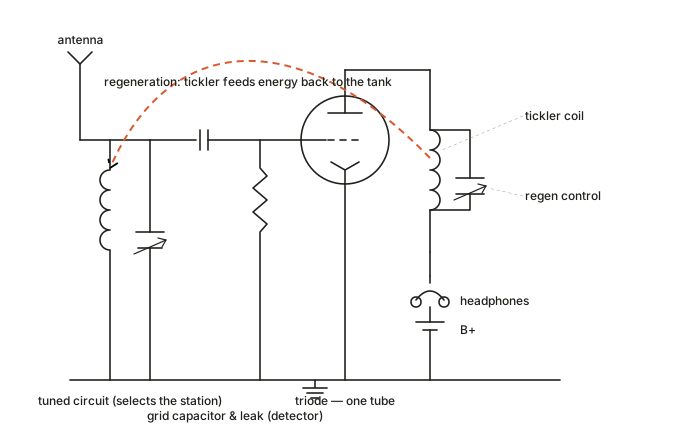
It sounds like a tall tale: a radio with a single tube, a coil of wire, and a pair of headphones, pulling in stations from clear across the country, and on a good night, from across the ocean. But the one-tube receiver was real, it was popular for decades, and it worked thanks to one of the most ingenious tricks in all of radio: regeneration.
Ordinarily a tube detects a signal once and passes it along. Edwin Armstrong's insight, made while he was still an undergraduate at Columbia (invented in 1912, patented in 1914) was that radio-frequency energy still lived in the tube's output circuit after detection, and that a controlled trickle of it could be fed back to the input through a small "tickler" coil. Round and round the signal went, amplifying itself on every pass, until a single tube delivered as much as seventeen hundred times the gain it had alone. That one tube now did three jobs at once: amplifying the radio signal, detecting it, and amplifying the audio, which is exactly why it could stand in for a whole receiver. In an era when vacuum tubes were expensive, wringing everything from one tube wasn't a stunt; it was the whole point.
It took a feel in the fingertips. The set had a regeneration control, and the trick was to advance it right up to the brink of oscillation, where sensitivity peaked, without tipping over, because one notch too far and the tube broke into a squeal that not only drowned the station but leaked back out the antenna to annoy the neighbors. Riding that knife-edge was the skill of the regenerative operator, and half the fun. There is a nice irony in the origin, too: Lee de Forest, who built the first tube, had stumbled onto this very feedback back in 1912 and spent his energy trying to get rid of the howl. Armstrong saw what it was worth.
The one-tube regen became the staple of the homebrew magazines: Short Wave Craft, Radio News, QST, whose readers built them on cigar boxes and breadboards from published plans. The most famous scheme came from a radio fan named Walter Doerle of Oakland, California, whose simple regen receiver, first published in December 1931, caught on like wildfire and was soon popularized by the radio shops along New York's fabled "Radio Row." For about four dollars, a couple of days' wages, a builder could put together a set like the Twinplex and have a working shortwave-and-broadcast receiver. These little sets earned an affectionate nickname: the "thrill box," for the thrill of sitting up late, nudging the regeneration, and suddenly hearing a foreign voice swim up out of the static from across the ocean.
The regenerative receiver eventually gave way to the superheterodyne, which was more stable and didn't squeal at the neighbors, but the one-tube wonder never really died. It lived on as the classic first project of anyone learning the craft, from the Knight-Kit Ocean Hopper to the kits builders still solder up today. It remains the purest demonstration of a beautiful idea: that with Armstrong's feedback trick, a single tube, a coil, and a long wire to the sky, you can reach out and touch the whole world.
Picture 14.5-1
Sources: Wikipedia (Regenerative circuit; Edwin Armstrong); OneTubeRadio.com & W1UJR (Doerle sets); Short Wave Craft (one-tube type 30; Twinplex).
© 2026 Chris, N6JET. Free to read and share for non-commercial use with credit (Creative Commons BY-NC 4.0). Not for sale.
All AM radio stories by subject · AM radio interactive tools and simulators · AM Trivia Challenge quiz