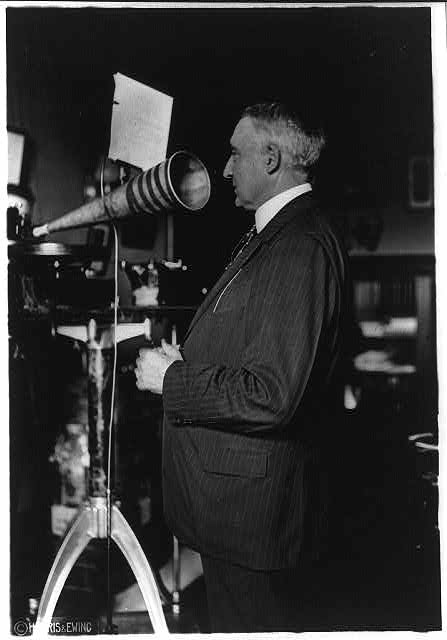
Ask who first put the presidency on the radio and most people will say Franklin Roosevelt, but FDR's famous Fireside Chats didn't start until 1933, more than a decade after a president's voice first went out over the air. That distinction belongs to Warren G. Harding, the 29th president, who embraced the brand-new medium from almost the moment it existed.
The first voice. Harding's voice was first transmitted live by radio on May 30, 1922, at the dedication of the Lincoln Memorial in Washington, a speech reportedly heard by as many as two million listeners, an audience no orator in history had ever reached at once. He was also the first president to own a radio set and the first to have one installed in the White House, in 1922, where the Navy wired a receiver into the second-floor library; by all accounts he became a near-daily listener, pulling in stations from across the continent.
The first State of the Union on the air. On December 8, 1922, Harding's Annual Message to Congress (what we now call the State of the Union) became the first to be broadcast, carried by the Navy's experimental station NOF near Washington. It corrects a stubborn bit of folklore: commentators have for decades credited Calvin Coolidge with the first broadcast State of the Union in 1923, but Harding beat him to it by a year. The difference was reach: Harding's went only to a few thousand sets around Washington, while Coolidge's the next year rode a nationwide hookup.
The KDKA connection. Harding's link to radio runs right back to the medium's birth. The very first broadcast by a commercially licensed station, Pittsburgh's KDKA, on November 2, 1920, was the returns of the Harding-Cox presidential election (see KDKA: The Station of Firsts), and KDKA is also credited with carrying the first broadcast of a presidential inauguration, Harding's, on March 4, 1921. He was, in effect, on the air before, during, and after taking office.
Cut short. Harding kept experimenting with radio on his 1923 cross-country "Voyage of Understanding," with broadcasts from St. Louis, Kansas City, Denver, Salt Lake City and other western stops. A "spectacular radio demonstration" was planned for San Francisco, but he fell gravely ill and died there on August 2, 1923, before he could deliver it. He never lived to take full advantage of the medium he had pioneered.
Who really mastered it. That fell to his successors. Coolidge didn't get there first, but he worked at it, taking coaching on his "radio manners," softening his delivery, and using the nationwide networks to speak past Congress and the newspapers directly to the public, earning the nickname "Our First Radio President." Then Roosevelt turned the whole thing into an art form, and the image of the president by the microphone became permanent.
Date
Presidential radio milestone
Nov 2, 1920
KDKA's debut broadcast carries the Harding-Cox election returns, radio's first licensed commercial broadcast
Mar 4, 1921
Harding's inauguration broadcast (credited to KDKA)
May 30, 1922
Harding's voice first transmitted live: Lincoln Memorial dedication
1922
First radio set installed in the White House (for Harding)
Dec 8, 1922
First presidential Annual Message (State of the Union) broadcast: Harding, via NOF
Summer 1923
Harding broadcasts from western cities on his "Voyage of Understanding"; dies Aug 2 in San Francisco
Dec 6, 1923
Coolidge's State of the Union goes out on the first nationwide radio hookup
Mar 12, 1933
FDR's first Fireside Chat
Table 11.9-1
Sources: HISTORY (history.com) · Harding Presidential Sites · Ohio History Connection · Calvin Coolidge Presidential Foundation · CBS Pittsburgh (KDKA Firsts).
The voice America finally got to hear. Harding speaking into a funnel-shaped recording horn, capturing his voice for phonograph records, the acoustic-era cousin of the microphone he would make history with. Harding was the first president to deliver an amplified inaugural address, the first to have a radio set in the White House, and, at Fort McHenry on June 14, 1922, the first heard live on broadcast radio. A president's voice, once something almost no citizen would ever hear, was suddenly everywhere. Photo: Library of Congress, Prints & Photographs Division, LC-USZ62-47664 (no known restrictions on publication).